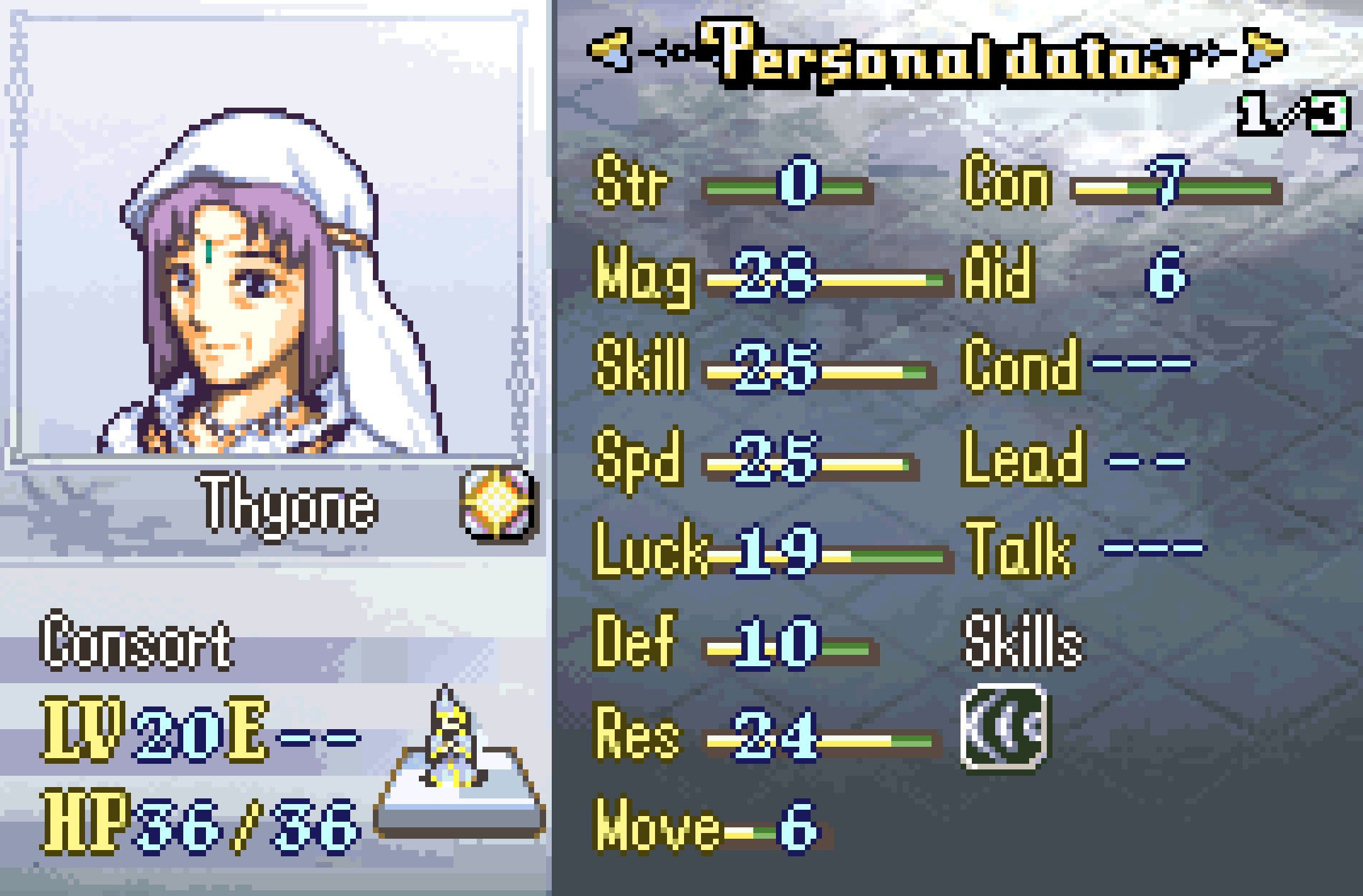
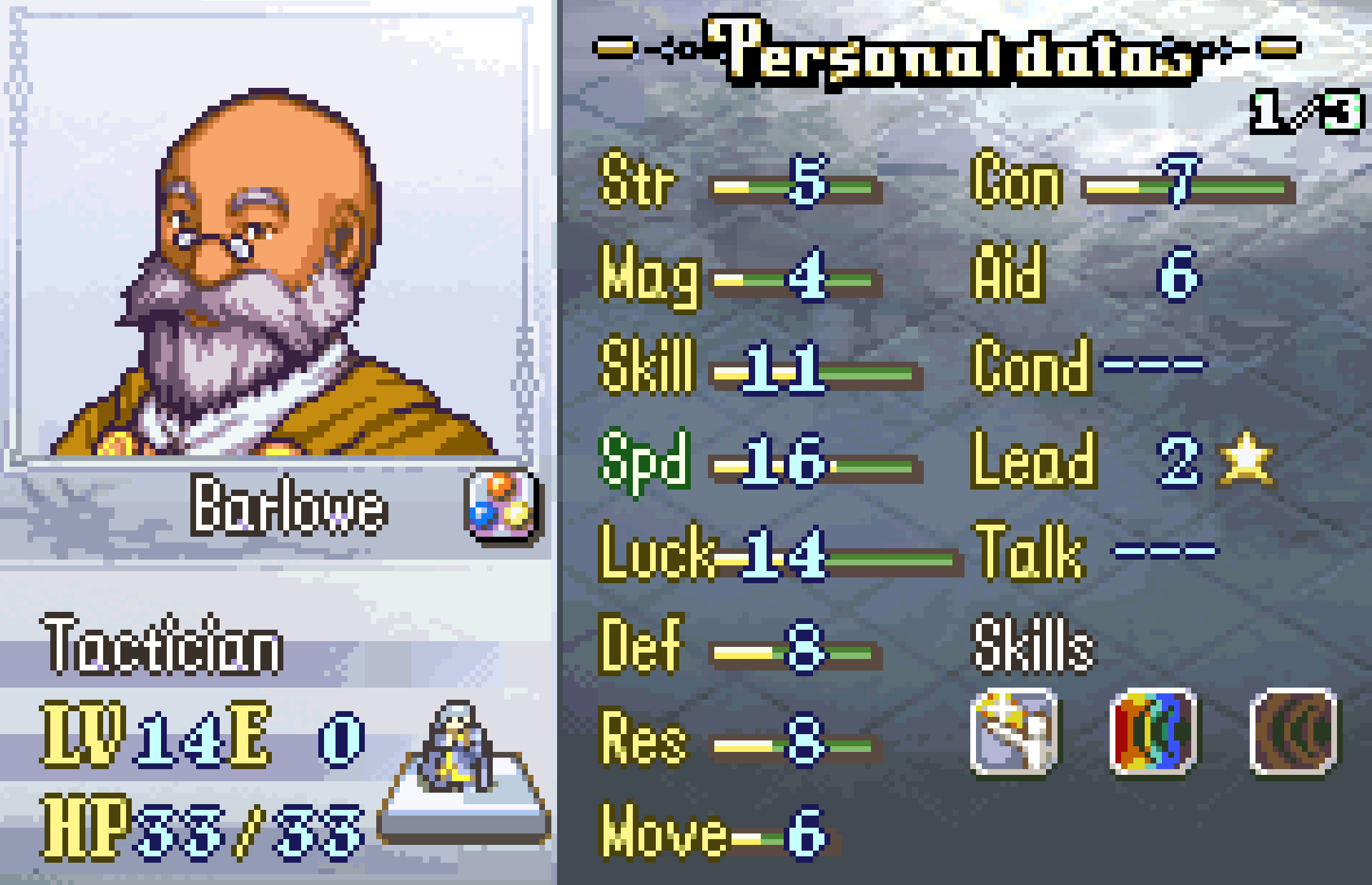
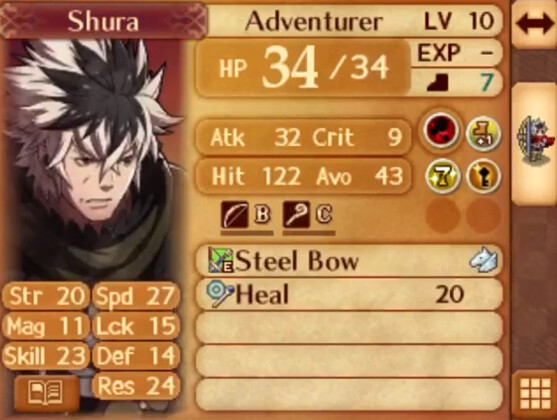
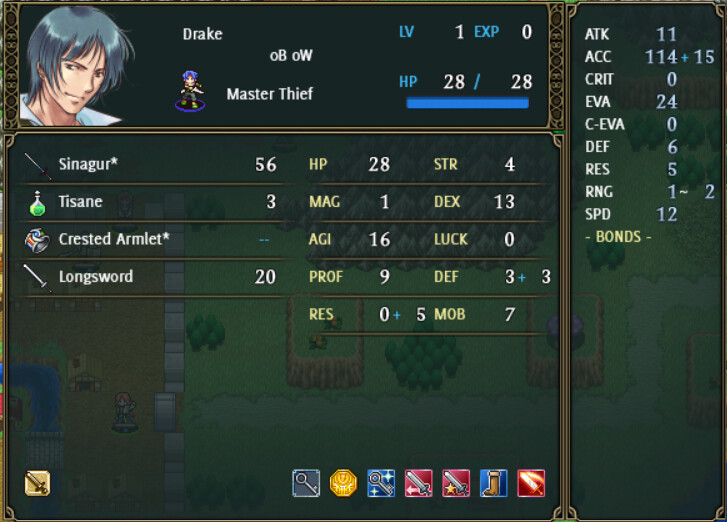
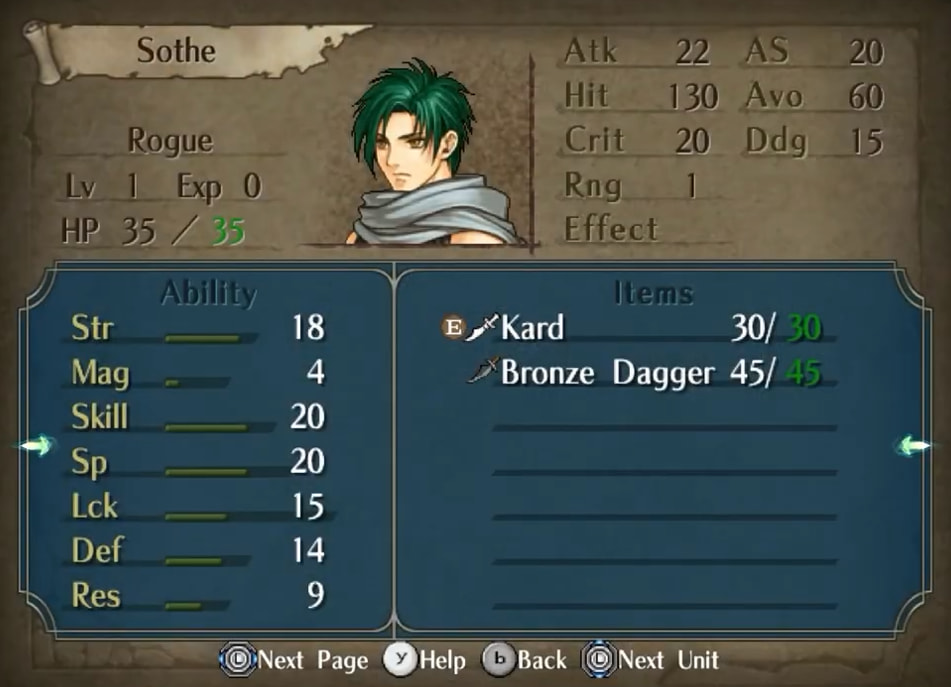
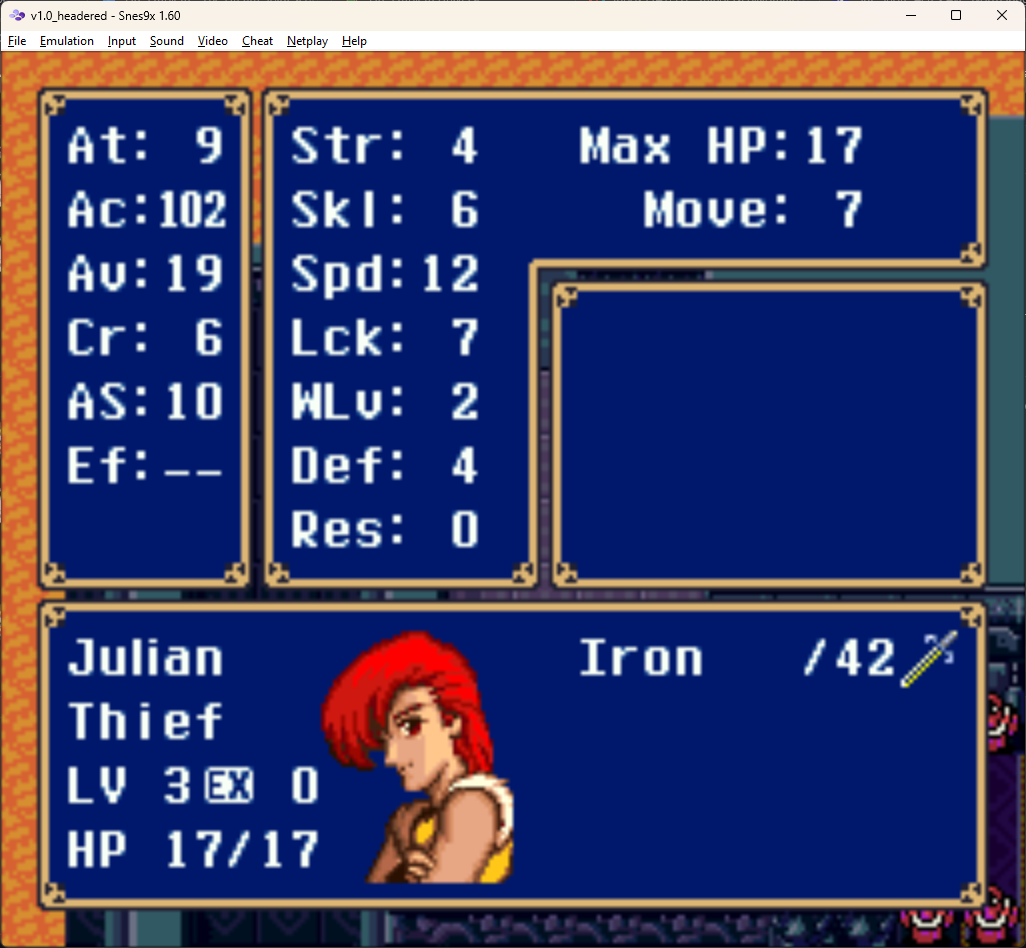
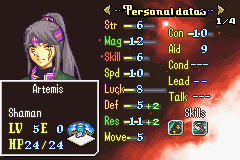
SHAMAN
1 – Misfit Toys
There is a certain thrill to using the weapons of the enemy, telegraphed as such. There’s little else that feels so much like turning the tables, particularly if they’ve spent the prior campaign as a thorn in your side. From the alien, spherical Neotanks of Advance Wars, the serpentine Naga in Warcraft 3, the deeply ahistorical Xolotl cavalry in Age of Empires’ Aztec campaign, the hulking, arrogant Trow of Myth II, and the fifth example I remembered when I started writing this sentence but then forgot, this is an itch that a lot of campaigns are eager to scratch. No unit is as alluring as the one that feels like it got lost on the way to the enemy roster.
That is the fantasy that the Shaman taps into. Or at least… it did back in GBAFE. But it all makes sense, right? Dark robes, heavy cowls, powerful magic… how many fourteen year olds tapping away on their semi-transparent plum-purple GameBoy Advances in 2004 actually thought they’d get one of those for themselves? Dark doesn’t have to mean evil, says Canas, and then we walk into Nergal and find it absolutely can, and then meet Bramimond, and find that it can get even worse.
Of course, now we all know these units existed in vanilla, and probably know their growth rates, too, and have strong opinions on snowstorms. Shamans aren’t enough, now, so we scratch that itch with playable monsters, brigands and, worst of all, soldiers. But we all remember when shamans were special, and we all want to hearken back to some kind of feeling, and that, I think, is what the class’ appeal comes back to, the reason so many custom campaigns keep a place by the fire for a class that, come the GameCube, had already vanished without trace.
2 – Vanilla
Before there were shamans, there were dark magi; this is still the flavouring a lot of custom campaigns go for, and the flavouring that FE itself ultimately plumped for in a post-10 world. But between FE1 and its remake, 11, dark mage’s image had been rehabilitated, going from the Bad Guy Class For Bad Men to something you could casually turn Cord into, for the memes, no more or less real a class than cavalier.
The turning point happened mid-Jugdral. In FE4, Dark Magic was, well… Dark Magic. Over the course of the game, Man in Robes Face Half Shadowed would hound your steps; one in Chapter 1 was the first sign of the greater conspiracy (and lesser subplot), and then Manfroy was throwing them at you by the end. They were the pawns – in the sense of a basic playing piece – of the greater evil, the Problem Dragon. But then, a game later, someone called Salem shows up. While Salem is a very capable staff user – indeed, he’s introduced as an enemy hitting you with a Sleep staff – his dark magic use is still key to his character, and you get to unleash it as the player for the first time… sort of.
In FE5, you’re still acutely aware that Salem is a convert from a traditional enemy class. Take the spell Poison, which simply converts into a direct damage spell upon capture. But GBAFE wants to complete the shift, in large part because they have a trinity to fill out, and they have a trinity to fill out because they’ve pulled another – the anima triangle – apart. No longer will dark and light magic simply be stronger than elemental spells, the ‘default’. Now, shaman (itself a more palatable name) is a class like any other, wielding just another one of the four magical types.
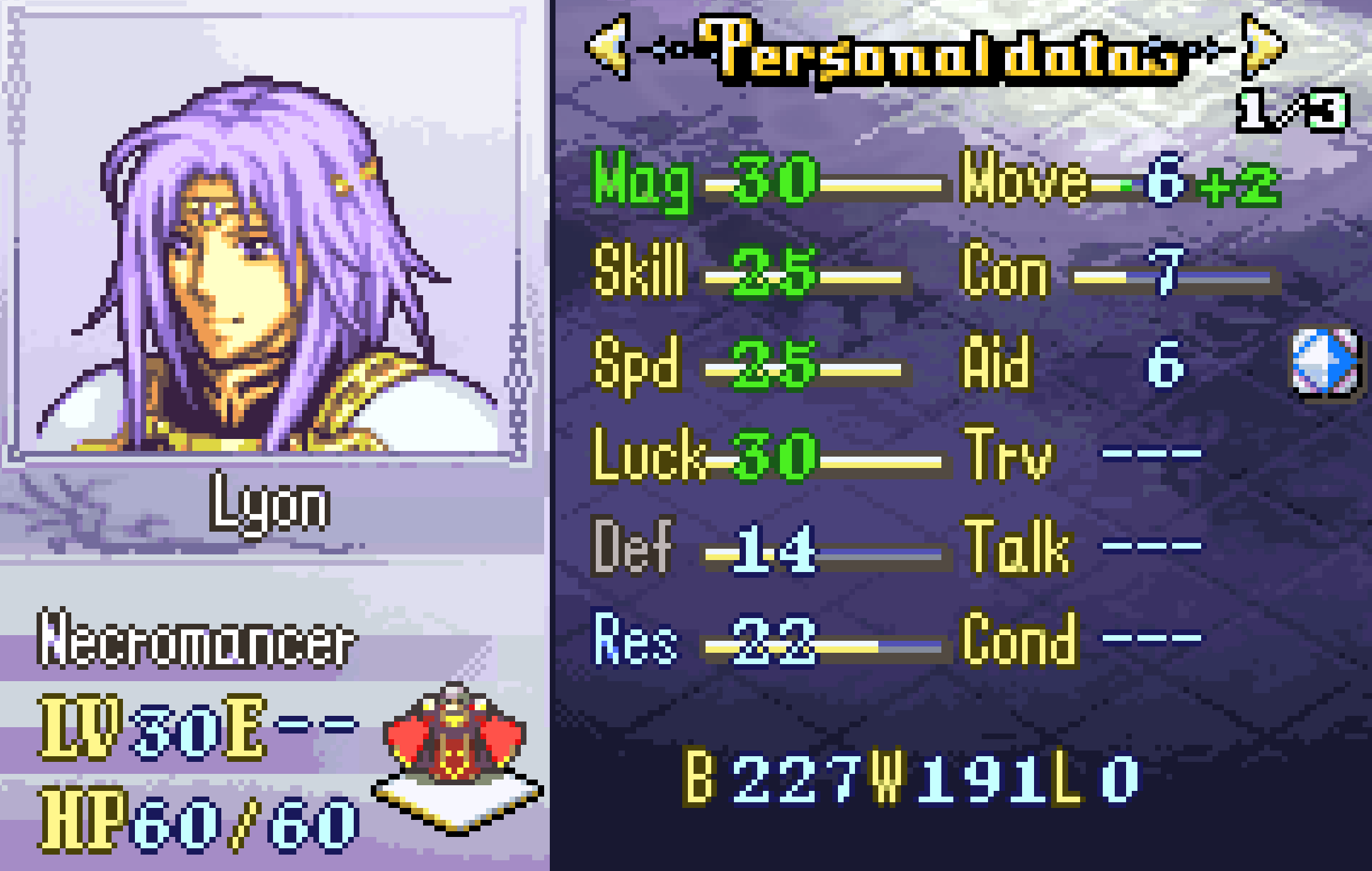
The vanilla GBAFE campaigns give you five shamans / druids. Each of them took the class a different path. Raigh was just a kid mage but one who took a darker path; his stats were well-balanced. This was in stark contrast to Sophia, whose mystical, enigmatic vibes were interesting, but not enough to justify a statline that made her one of the worst units in the series. Niime is the obvious star of the show, and the one that really best hits the class fantasy; wildly powerful, extremely fragile. Granted, that power largely manifests through staves, mechanically.
It is largely between Niime and her son, Canas, that Elibe discusses the role of Dark magic. Canas, an amiable, helpful scholar, is adamant that it’s value-neutral… and yet, his brothers are vegetables, and he himself is doomed not to make it to FE6. And FE7’s final showdown sees the ultimate antagonist (if not literal final enemy) Nergal, a Dark Druid, using a dark spell… but he’s ultimately struck down by Athos, a virtuous Archsage, using the supreme dark magic in turn, FE7 Luna. Then there’s Knoll, kind of splitting the difference between Canas and Niime; he’s a pleasant man and a scholar, but he’s also implicated in the Big Plot, one in which darkness is very much the tool of evil, even as it’s sporadically taken up by the forces of good; even the monsters have dark affinity. Knoll’s statline is iconic, which is to say that he’ll die to a stiff breeze, and probably get critted by it. Most of HIS utility comes from being promoted in preps and working on Summoning… but that’s someone else’s write-up to make.
Neutral or not, the class still looks sinister. Their hoods cover their faces, they’re almost formless beneath their robes, and even their basic attack spell is a malignant ooze that seeps through the ground to strike the opponent from beneath. Given FE’s Relationship With Gender™, it doesn’t feel like a coincidence that these elements are significantly softened for Sophia’s animation. She gets a face, her robes don’t loom as much. Actually, I said five earlier… it’s actually six, but I only remembered Ewan existed thinking about his garish bright cyan and red robes.
Dark won’t last as a core weapon type. It gets sidelined in FE9 (along with light, for the most part, which takes Resire back), sort of returns in FE10 but very much the least prominent of the three, doesn’t really exist in 11/12 (though dark mage itself does), and then settles into a role as a subtype of magic only wieldable by specialists. Shaman, really, was a flash in the pan. But that flash coincides with the era of the series we’re all hacking, and the thought of Shaman being squeezed out is unthinkable.
There’s just one problem with this. Was Dark Magic a mistake?
3 – … is a Crowd
GBAFE wanted its two trios within two sets of four, and that’s neat. It’s tidy. But while the melee triangle just about does enough to justify its existence – though I would argue blend together more than they ought – the magic triangle, more rare and with fewer avenues for differentiation, doesn’t wind up so effective in practice. So what place does Dark take in it, and what went wrong?
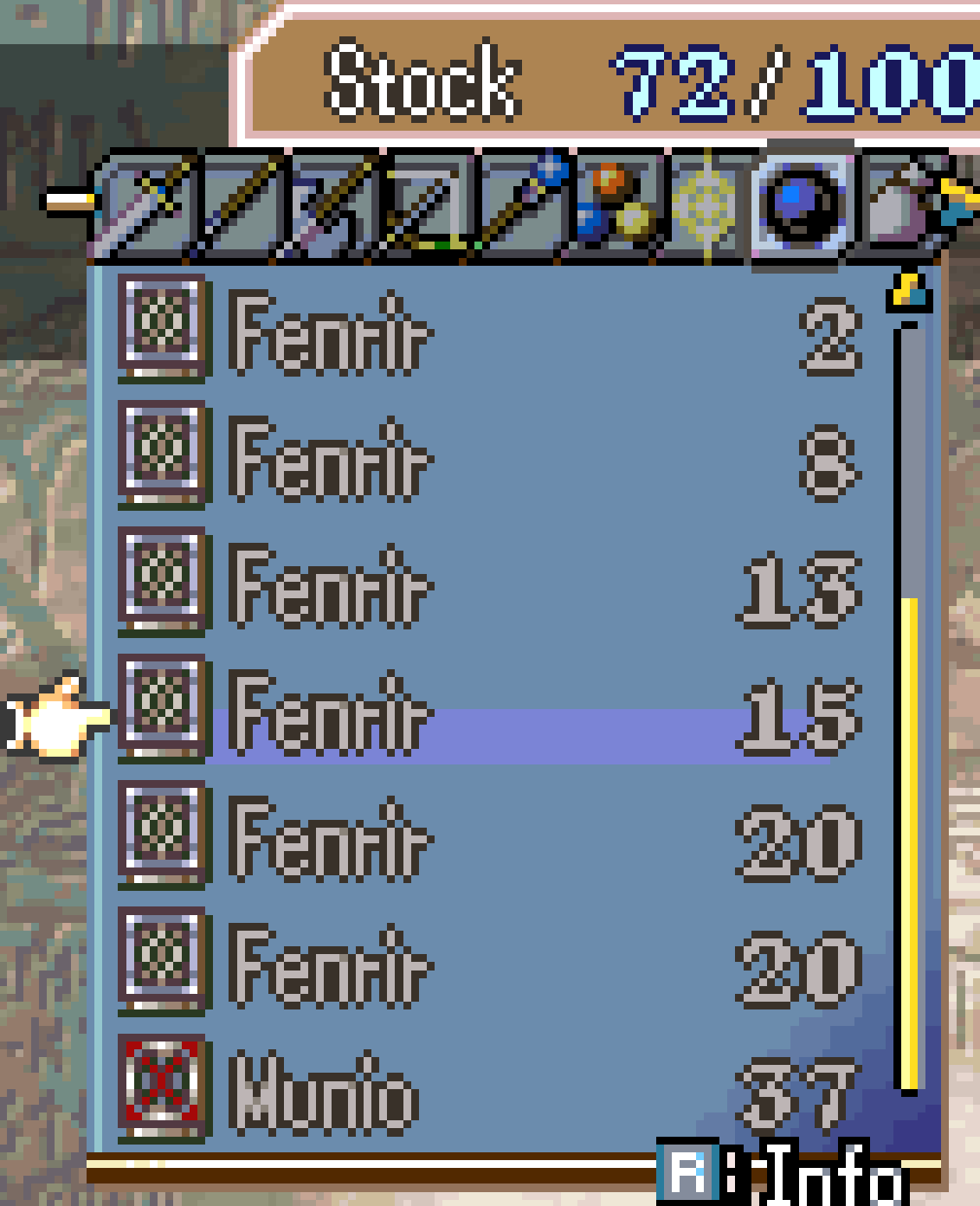
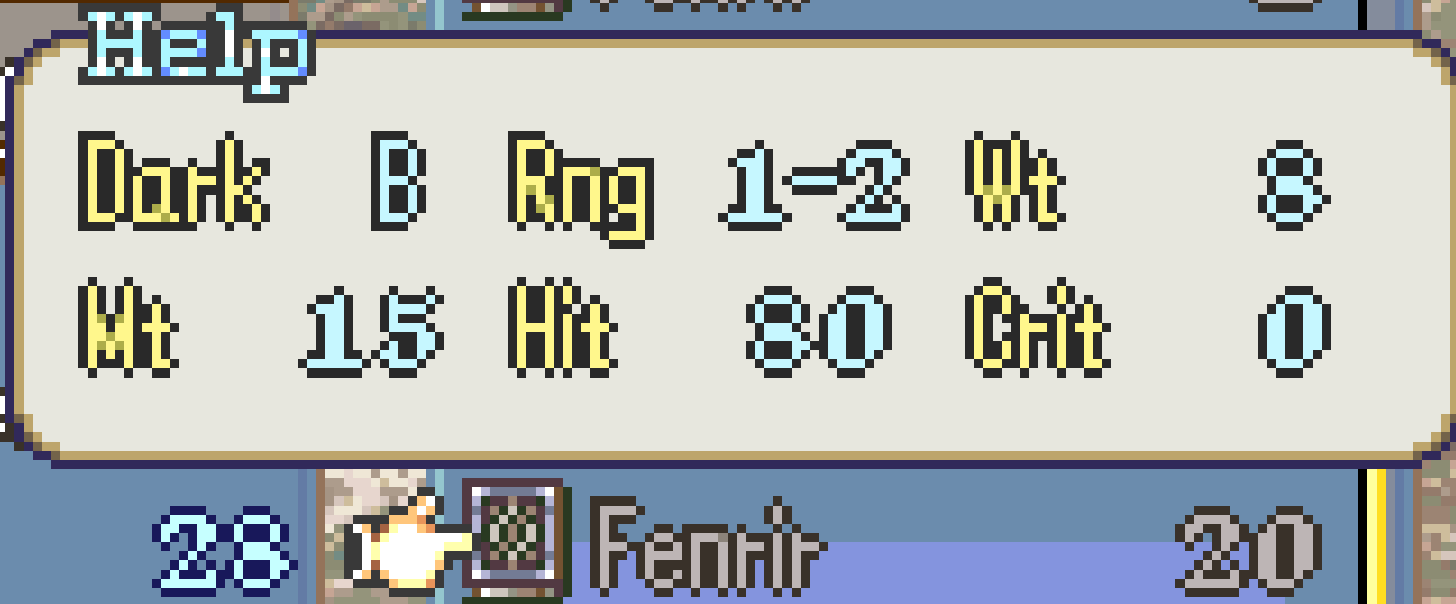
Ultimately, Dark finds its identity through weirdness. While Anima magic is all about fairly straightforward, functional and efficient attack spells – which makes it feel somewhat flat – Dark magic is gimmicky. It has a strong basic attack tome, Flux, with a good balance of traits, such that it doesn’t really need a midway point to Fenrir, the big daddy of the class that nobody actually uses.
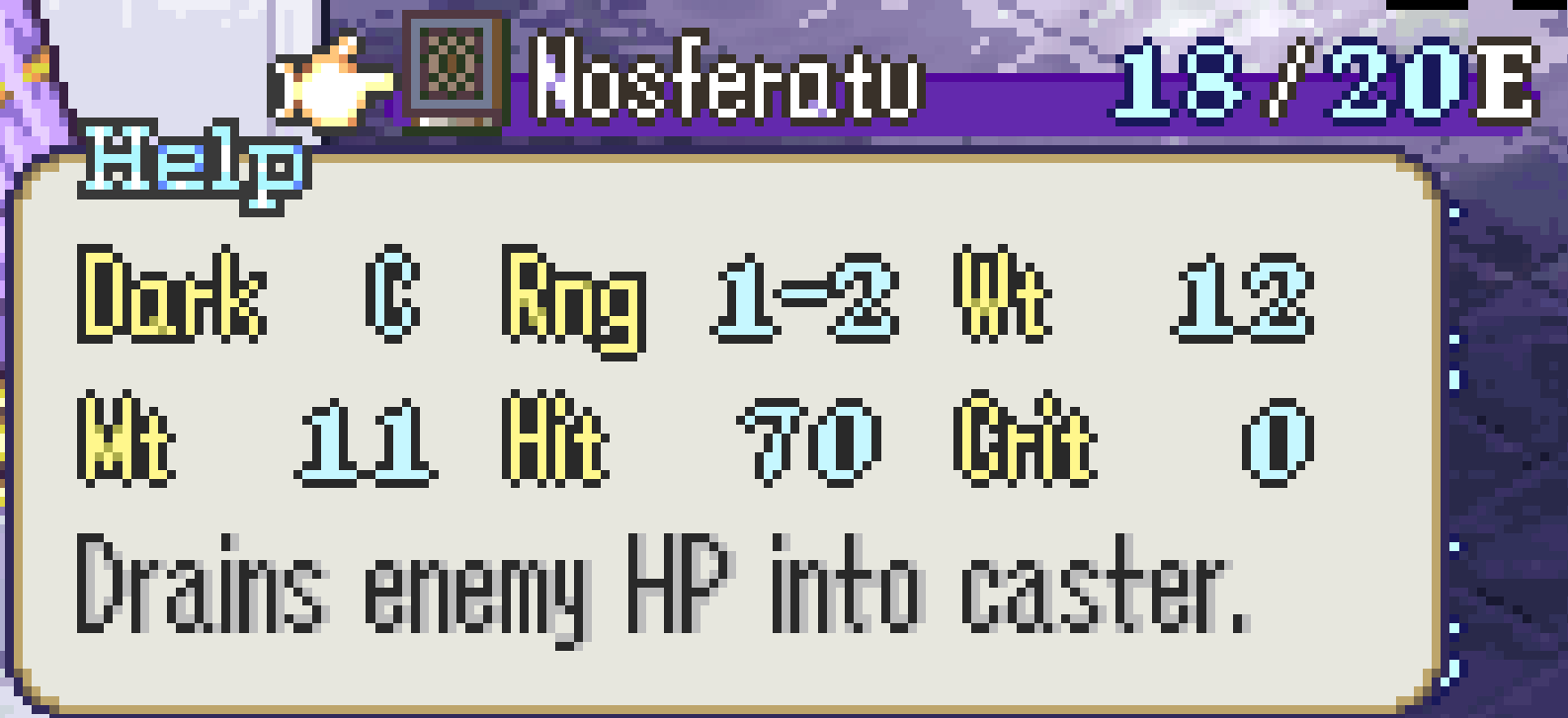
So it uses those points instead to explore other avenues. Conveniently, much ink has been spilled by ArcherBias about the virtues of Luna and Eclipse, and I’m just going to link to those instead of adding to them directly. But there’s also Nosferatu. And it’s Nosferatu, I think, which is particularly central to the identity of the Hackrom Shaman.
The Custom Campaign Consensus, such as it is, tends to arrive at light being the ugly duckling of the three. I’m minded to agree. In vanilla, light gets the distinction of being the weakest of the three magic types, but it makes up for this by also being the heaviest. While it isn’t versatile, it also isn’t inexpensive. But, hey, you get larger and larger amounts of floating crit that aren’t enough to work with. In FE6 (and 9), it’s deliberately the red-headed stepchild, and no space was really left for it to advance. So in FE7 and 8, the heavy lifting is done by its practitioners, instead; the glass cannon Lucius, and the Slayer bishops of Magvel.
4 – Warlocks and Sorcerers
So, I could then boil this down into what the class means to me, but I’ve already sort of done that, over the course of three-and-a-third campaigns. Because there are two axes – tank vs. specialist, scholar vs. cultist – and I’ve strayed up and down them in order to find where I sit.
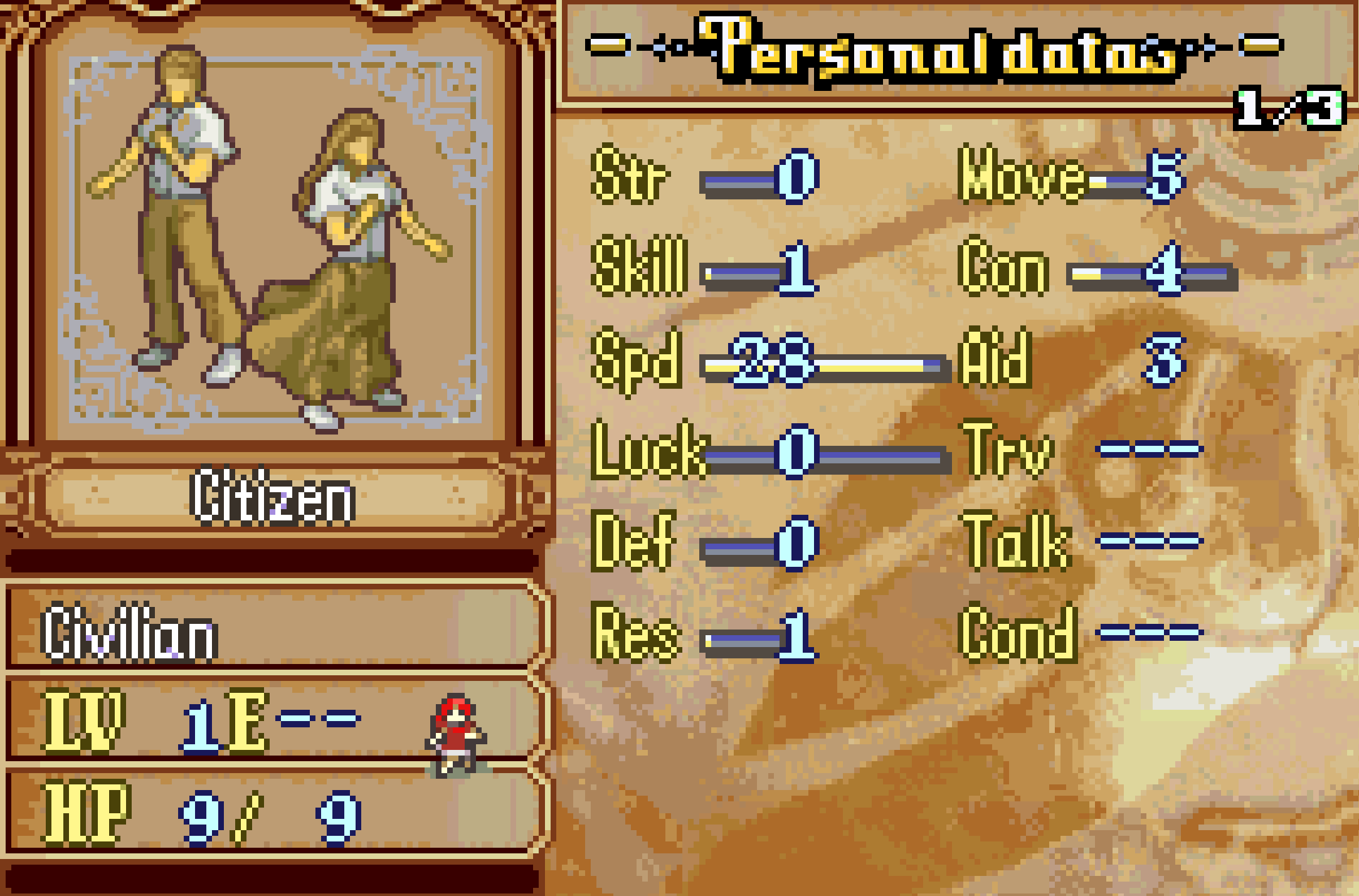
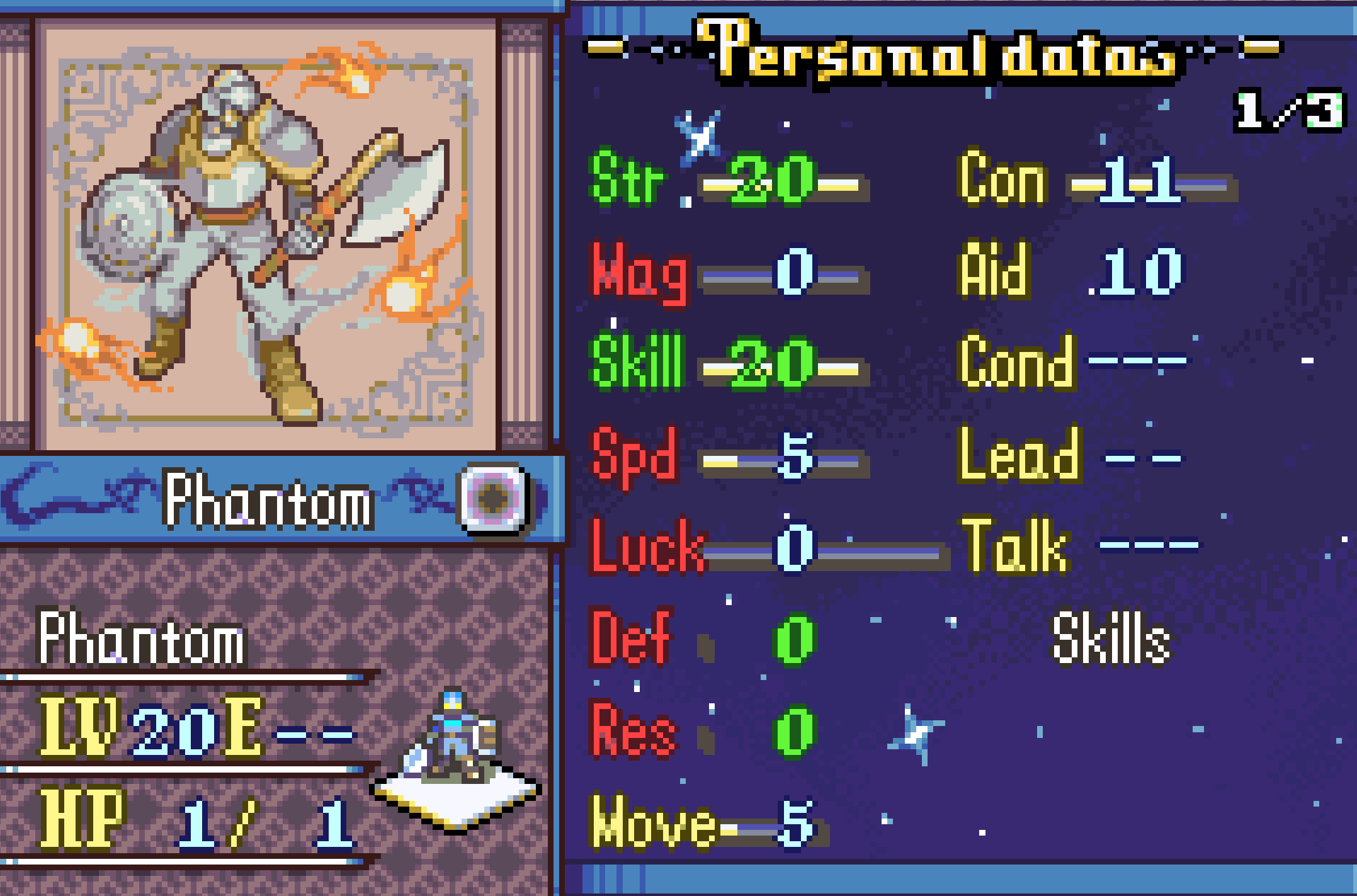
Let’s talk about the class features and stats proper. In vanilla GBAFE, shaman stats are fucking putrid. But there’s some sense of a slant towards power and away from speed. Honestly, part of this is just communicated through the sprite and the magic animations. Shamans attack slowly and deliberately, devoting almost no attention to the enemy and requiring all their energy just to channel their spells, which take fucking forever to resolve to the point where there’s literally a patch to speed Flux up. Try attributing a skill/speed slant to that.
For these reasons, from the very outset in Drums of War and continuing on into Dream of Five (which iterated on DoW’s class stats), the shaman identity was The Slow, Powerful one. The stat slants hinted at by vanilla GBAFE were exaggerated, which aligns with my approach to class design in general. As I progressed through Homecoming and into Day of Reckoning, I leaned in further to a particular facet of their identity, one with a contradiction in vanilla I was able to remove.
HC and DoR both killed Light as a common weapon type, but preserved Occult/Dark’s advantage over Arcana/Anima. So leaning into the idea of them as an anti-magic mage just fits. They have strong resistance, they have a favourable weapon type, they even have Luna. They have the means to punch through any other mage while pretty much stonewalling them. Their weak points: very poor speed and physical bulk. In DoR, they have the highest resistance of any generic class, and the lowest HP. From Do5 on, the classes were renamed to Warlock, promoting to Sorcerer, and their identity was established.
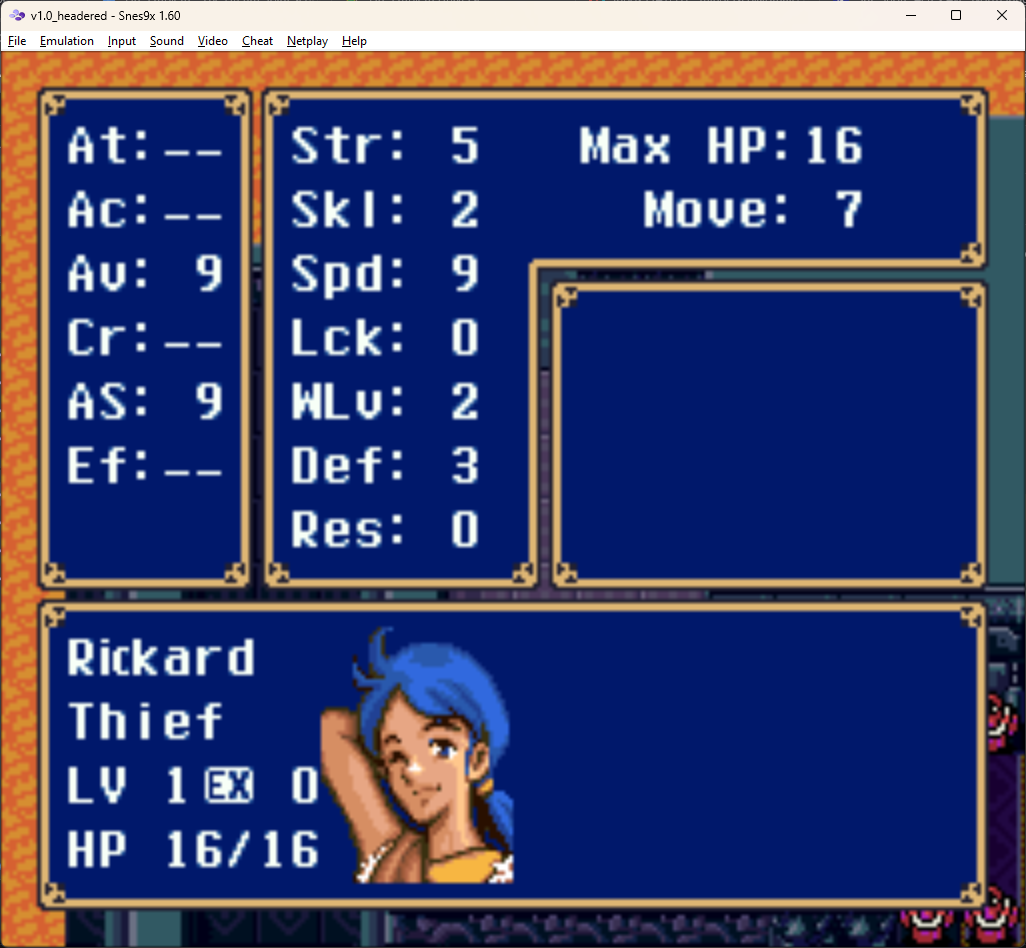
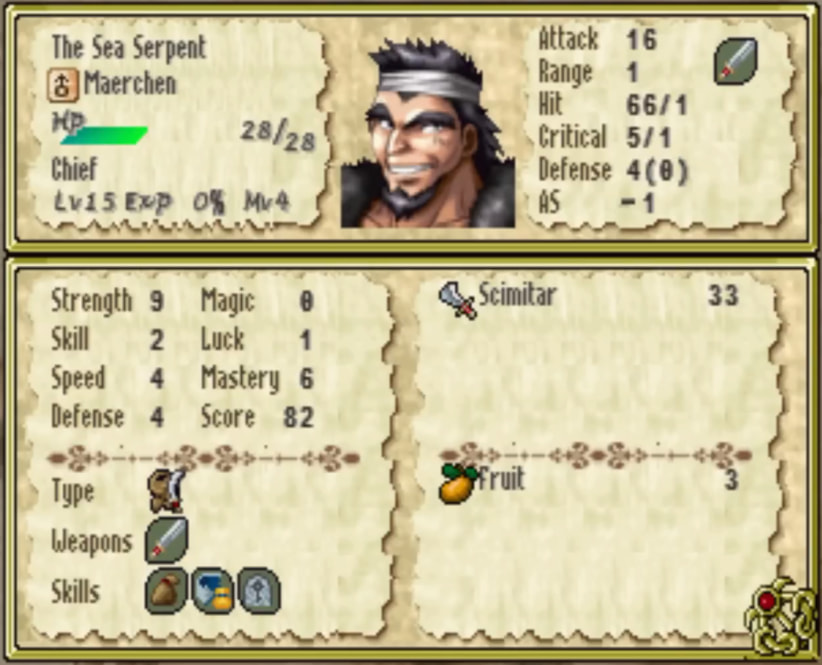
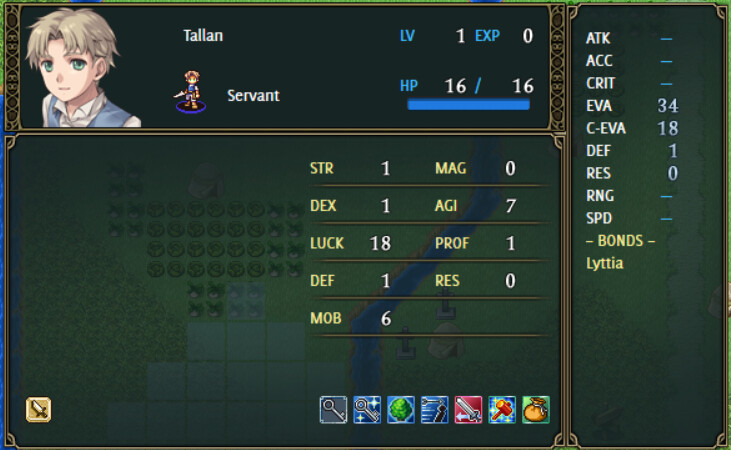
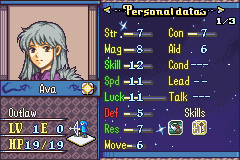
So to the Drums of War warlock, fanfic favourite Vivica, who arrives late in the prologue. She was originally envisioned as that anti-mage role, though not quite with as stratified a statspread as enemies, but playtesting forced me to add further strings to her bow. See, there just… weren’t all that many mages to kill? And also, she wore them down without one-rounding, so while an impeccable defensive wall against them, she needed more strings to her bow.
Vivica’s biggest buff was not actually to her statline, but to enemies. Because of how I’d sorted out the statlines, armour knights had 2 speed instead of 0. Well, why not give them 0? I gave them 0. Suddenly, Vivica went from one solid hit to doubling and one-rounding, and armours ARE a very common enemy type in DoW, particularly earlygame. And she was now your best answer. The second buff was serendipity; a friend had a very highly-blessed one with like 8 defence, and said how good she felt with high defence. I decided to make that the core experience instead.
So having started out on the specialist end, Vivica became a fairly serviceable tank, though her defence was middling in the greater scheme of things. It’s actually quite common for custom campaign shamans to have genuinely good defence, and we’ll be meeting them later, as well as talking about how this became core to one vision of their identity. For Vivica’s part, she’s a fairly mediocre unit, probably, though one some people swear by. Happily, she winds up finding late OHKO thresholds on powerful enemies with her tomes.
An early midgame boss recruit, Elisenda, is a more straightforward case. While Vivica started a little more well-rounded and ended significantly moreso (as was her arguably more direct competition, the bishop Chasimir from two chapters earlier), Elisenda was from the very beginning designed to be, for want of a better term, ‘early Niime’. In a game with accessible Physic but not many opportunities for status staves, Elisenda winds up being a common fixture of the midgame but relatively rarely goes all the way to the end, a mediocre combatant who will ultimately be fairly easily ORKOed by enemies. I’m pleased with where she ended up.
So into Dream of Five. Gabriel, earlygame warlock – building off a unit present in the 2012 vintage – essentially has a statspread like Vivica, but he’s in a different, bulkier game. Gabriel’s not one-shotting anyone because almost nobody is. Like Vivica, he can eat armours (and has plenty of armours to eat) and absorbs enemy mages pretty trivially, but that isn’t his long-term niche.
No, Gabriel really wants to be your long-term staffer. He has the overkill power for it, and it’s a game that will, in fact, last long enough to let him reach those ranks, to the point where it’s a grind the 0%-growth LTC puts him through (albeit begrudgingly). A trained Gabriel boasts the same ‘skate ramp’ statspread as Vivica, but his role will end up quite different, thanks in large part to the campaign just lasting a whole twelve maps longer.
And – to get into the real sickos shit – the fact that his long-term viability revolves around a Power stat he’s bound to cap ram and that staff-spamming is his major grind creates an incentive to early promote in a campaign otherwise fairly hostile to it, meaning he can serve as a powerspike combatant in Act 2. Did I have all this in mind when designing him? No. He’s actually pretty similar to his 2012 incarnation… on paper, at least. But this is just how he found a niche in this environment. High power magi never really go out of fashion.
Rozelle underwent more of a journey. It started, actually, with her visuals; ‘River’ in 2012 was more or less explicitly ‘Mist but a Shaman’, and even after a recolour her mug could still instantly be clocked. So, she got a facelift, and I had to find a statspread that gave Gabriel room to breathe while still feeling like a shaman. The answer? Ease off a little on magic, nerf her speed and defence into the earth and boost everything else by comparison.
If you look at pure stat total at 20/20, Rozelle actually has the highest in the game (yes, including over Jauger, the actual Est). But this isn’t GameFAQs, and actually, tanking speed and defence does have consequences; physical enemies carve Rozelle up with ease. Further, unlike Gabriel, Rozelle doesn’t have the availability or the overkill magic to be an especially appealing staff-spammer; it’s her magic-tanking (and ONLY magic) and her combat which must carry her.
So, relatively late in development, I decided: fuck it, it’s Christmas somewhere. And I gave her a 1–3 range tome, the Innocuous Book, which would allow her to chip at enemies from a safe distance and marshal her combination of still-quite-good Magic and extremely strong native accuracy. Between that and the Constitution – well, and not caring about speed one iota anyway – she becomes a natural bearer of the heaviest and most unwieldy dark tomes, ones nobody else could really bring to bear. Rozelle’s quite a mediocre unit, in the greater scheme of things. But she found her niche, and she finds her way in plenty of endgame rosters.
Onto Homecoming, where the class line is by a distance the strongest of the completed trio. With Trefor, the idea was to basically min-max, leaning into… well, as it happened, basically Vivica’s original statspread, before her floor was lifted. But this is a different environment, and Trefor thrives. He also gets a Prf tome, as does every magic-user in Homecoming; riffing off vanilla Luna, he gets a 2-3 range Luna with 40-odd crit and +5 Res boon with which he can deal heavy, consistent damage, fish for crits and stonewall enemy mages.
Trefor’s weak points are fairly obvious. He will simply be instagibbed in melee combat. He is not your man to Nosferatank. But ultimately, the difference between truly wretched physical bulk and merely bad bulk is not all that substantial; after all, even if Trefor had +3 defence, you would probably highly prioritise not letting physical foes attack him, right? Trefor also benefits from getting C staves on promotion, so with an early promotion he’ll have a pretty clear run to Physic, Fortify and Sleep, and more than enough magic to be effective with them.
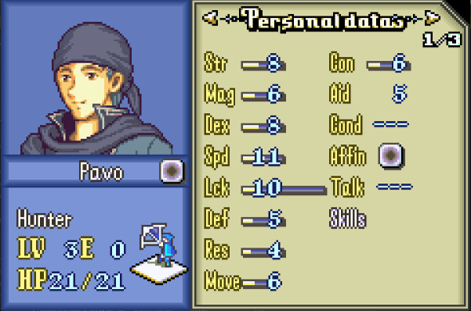
Trefor and Elisenda are the only two of these warlocks to tie into the necromantic aspect of the class, too. Elisenda had a familiar, the mogall Ochulo, who was basically a joke unit (joining terribly underlevelled and with abysmal bulk, benefiting from flight, 6 move and infinite use monster weapons); she could also support the later-acquired skeleton, Deadeye. Trefor, meanwhile, joins with the skeletons Shaker (melee) and Rattler (ranged). They have no luck, and they rely on their mutual B supports to escape the thresholds and to give each other +2 attack bonuses. Trefor can act alone; the skeletons, though, are significantly degraded by it.
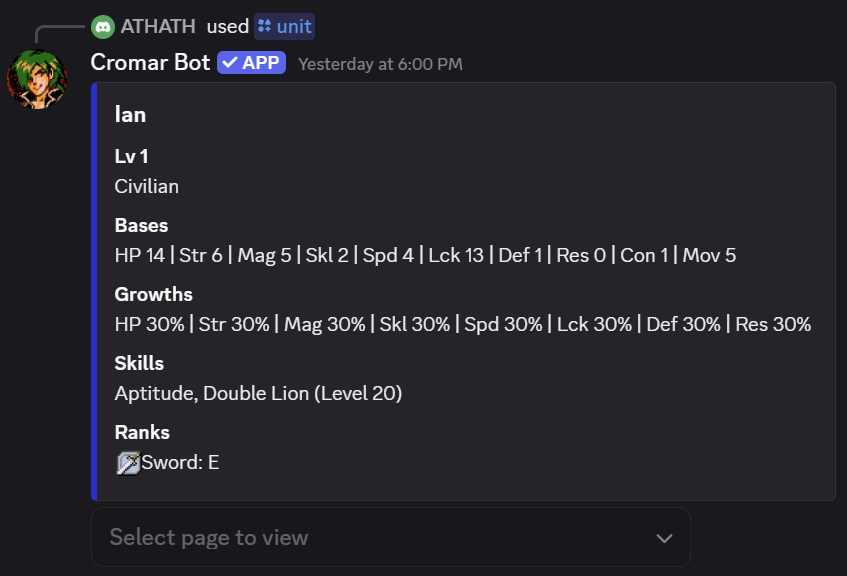
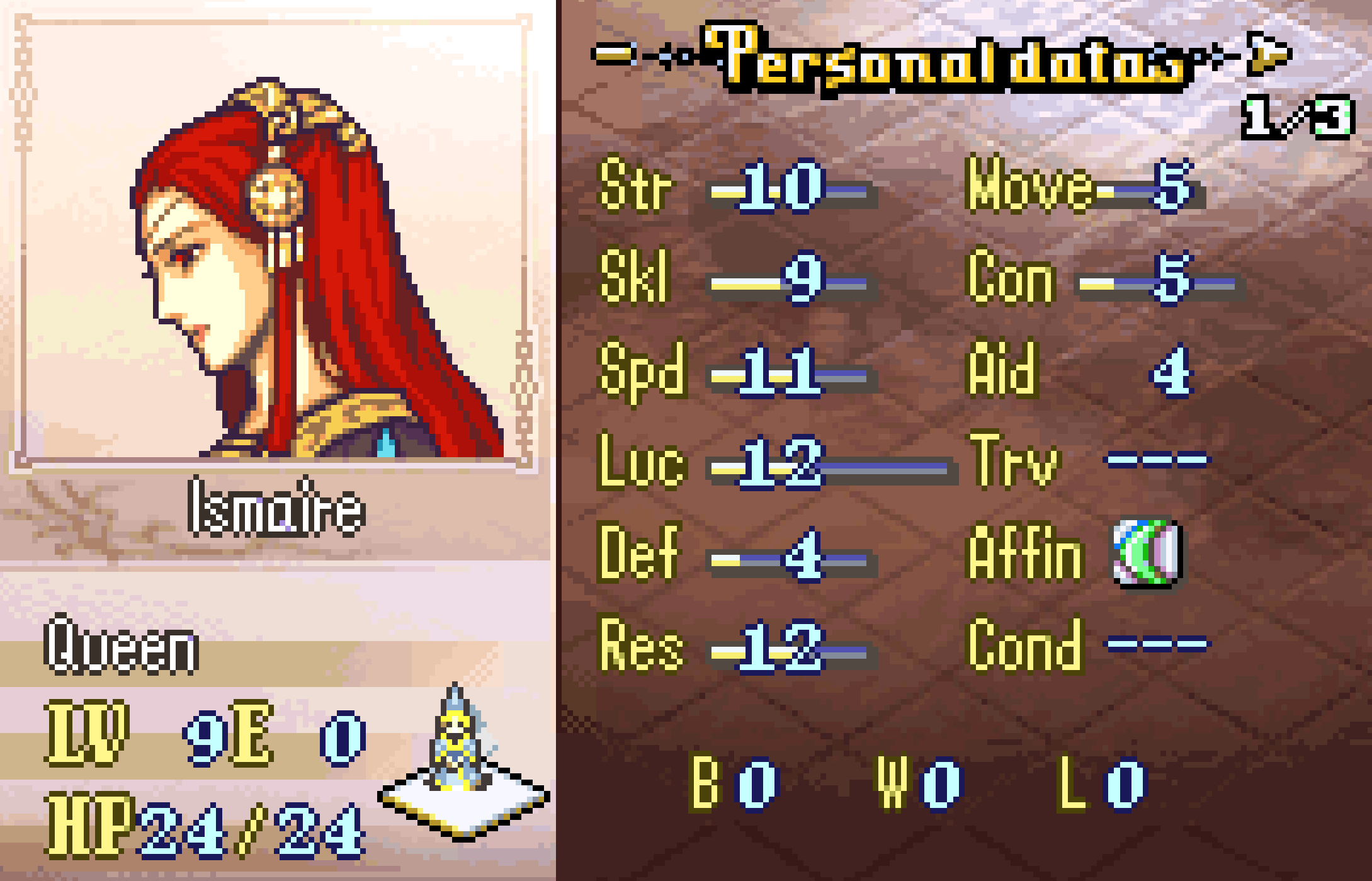
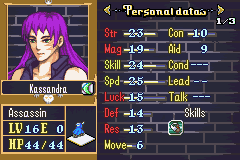
Islwyn’s statspread, while still looking basically like a warlock, is far more balanced. Lower ceiling, higher floor. Notably, she only has one Pwr and zero Res on Trefor, arriving significantly later (mid-C11 instead of mid-C5) and at a higher level. Her defence starts okay but won’t grow much; her speed is, at least, enough to double slow classes, and probably . What she doesn’t look like is ‘arguably the best unit in the campaign’. Islwyn is arguably the best unit in the campaign.
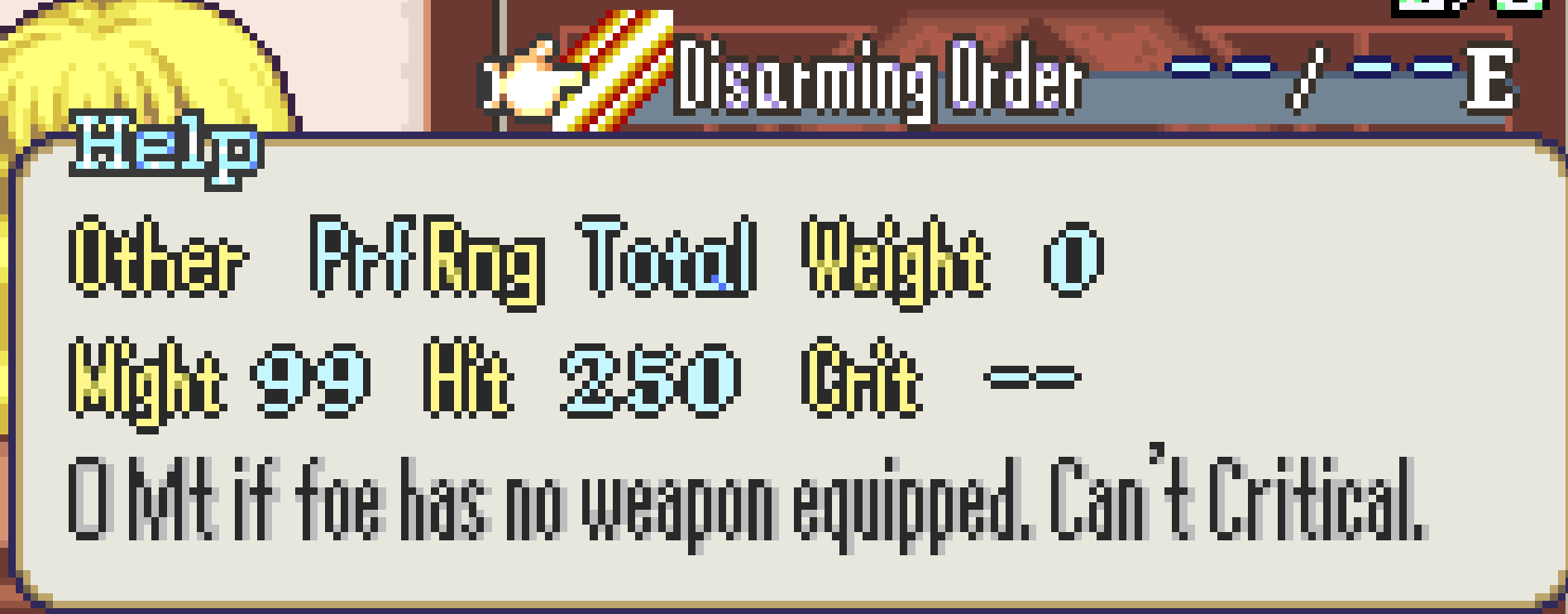
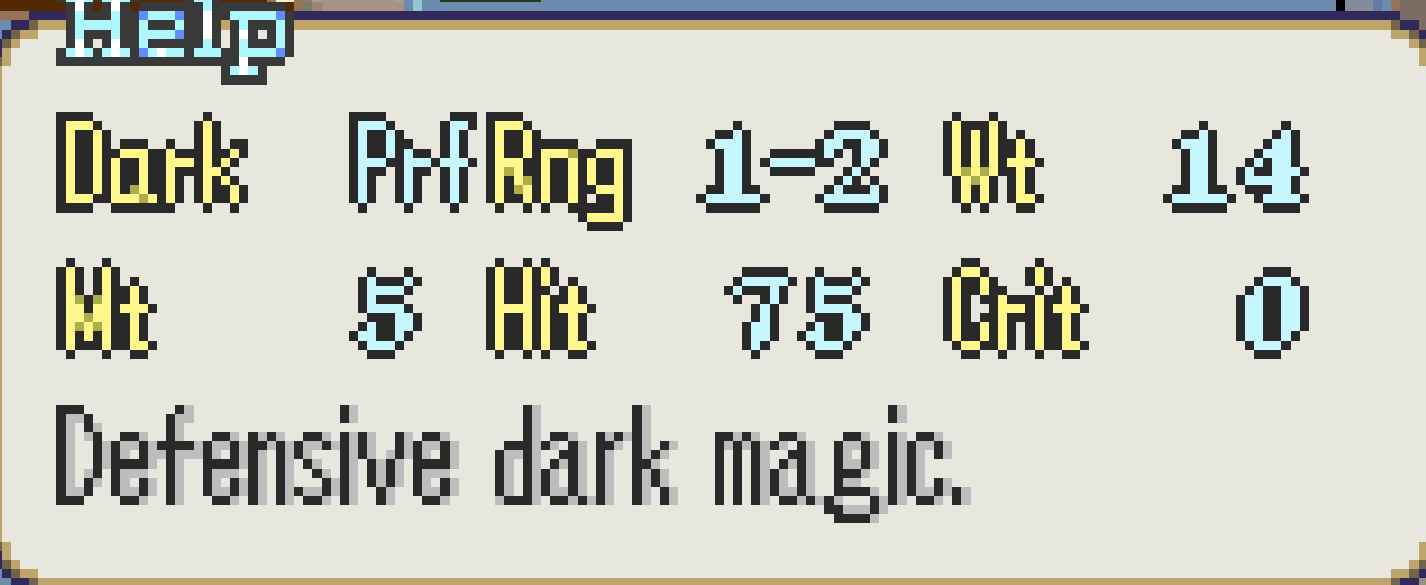
If you discount the Est, whose Prf is designed to compensate for her arrival at level 1 about five chapters from the end, Islwyn’s Prf is the best one in Homecoming. Actually, even if you do count the Est, Islwyn’s Prf might still be the best in the game. Certainly it’s the most character-defining. Islwyn’s Bloodmoon Rise comes with 30 uses and has the Hel effect, dropping any unit to 1 HP (or knocking off the final HP). It has full 3-10 siege range. Critically, it only hits (but, if so, always hits) if Islwyn’s current HP is higher than her target’s.
So while Islwyn is a pretty mediocre sorceress in her own right – not an outright bad one, a decent combatant, a good staff unit on promotion – she has the unique utility of blasting people with fucking sky lasers. Being deceptively strong through a gimmick… how Dark Mage can you get? Now, originally, she had notably low HP, I think 24… you will note she now has 36. It turns out Prfs are only really fun if you can actually use them, and fun is more important than balance.
Clarian, meanwhile, leans into the staff sorcerer archetype. And he taught me a similar lesson. Originally, he was far heavier slanted towards Skill and away from Pwer, and also only had a D-rank in staves. That unit sounds terrible. Well, his Prf is a 1-3 range one with 0 attack but +10 Pwr. The idea was that you saw that, pogged, and grinded towards Physic, while also feeling emboldened by how versatile the Prf was and able to put three or even four staves on him… well, the reality was he didn’t really get that far. He joined quite late (mid-C17; the game ends on, effectively, C25). So after a few smaller buffs, I just decided, fuck it… he can be the ultimate staff user. And now he is, slotting into many lategame teams. Maybe don’t always get cute.
Final honourable mention goes to Matzi, in Day of Reckoning. He is, as you’ve no doubt noticed, absurdly min-maxed. But occult magic is extremely powerful in DoR, and has a lot of utility tomes; there’s also a lot of comically slow units, and Matzi will annihilate any of them with ease using basic tomes. He’s the most distilled shaman experience I’ve yet created. Will it be enough? Early signs point towards: maybe.
So… what’s everyone else been up to?
5 – To All the Shamans I’ve Loved Before
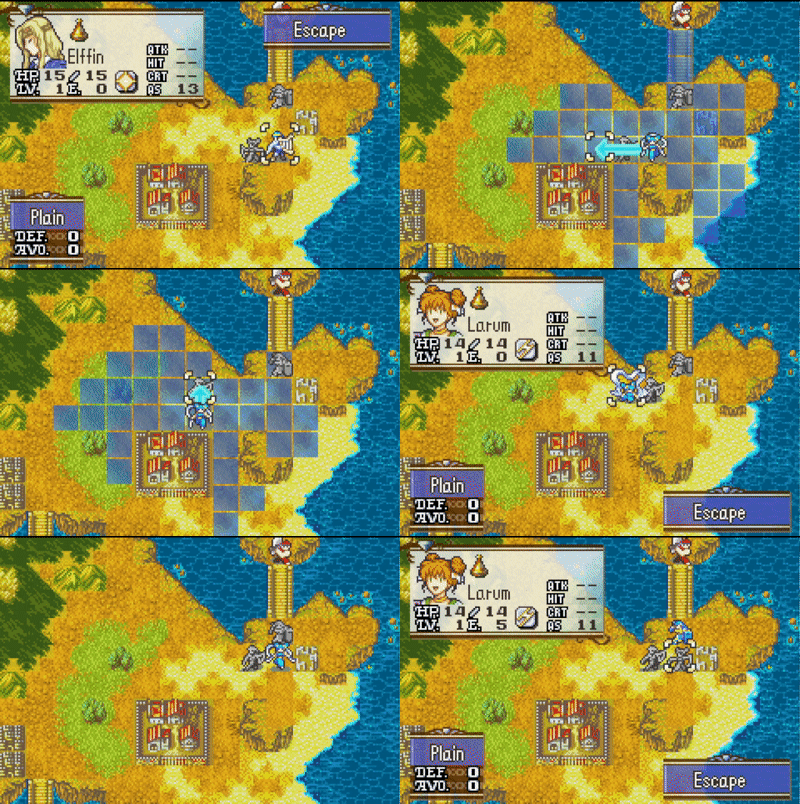
Shackled Power had its own take on fulfilling the class fantasy of the shaman, and did so exceptionally well. The first one you find is Demi. Suffice to say her first impression was not the best, and falls somewhat into one of the problems I mentioned earlier…
But she did fit the class fantasy, and, actually, I got a lot of pushback when I said I didn’t care for Demi as a unit. She has a nice, unique design with visuals that play well in SP’s sense of style, and apparently she gets some great battle quotes down the line, too. Those who did click with her got plenty of mileage from her mixed bulk (in a game where resilience is extraordinarily hard to find!) and her ability to strike hard at range (more than you might expect – more on that later).
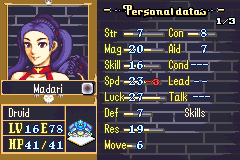
There’s a later Druid, though, Madari, who I did use through to the end – a very fun character, too, and a nice design. And while Madari doesn’t have the traditional statspread, she still very much feels like she fits the class. A lot of that is down to flavour, bluntly; her story role, her personality, her appearance, her Vibe. But her esoteric magic act is helped a lot by having some esoteric, non-vanilla magic to sling, supplementing the dark spell list.
The main edge Shackled Power gives to its dark mages is dark magic itself, which is expanded on with two spells I can remember. First, Stygia, which is a powerful and accessible 3-range tome; second, Cthylla, a tome which damaged the user but was Brave and gave all-around stat boosts. Do I think shaman generally lends itself to being a slow, powerful class? Yes. Would I trade my quadding princess Madari for the world? No.
Like most units in Vision Quest, Bulan has a relatively balanced statspread, a largely insignificant skill list (I (metaphorically) don’t remember what Demoiselle does; I (literally) don’t remember what Hex does) but her class, slant and availability still give her a very definite role. You can see that her flagrant long-term weakness, her Skill, actually has a decent base, allowing her to reliably inflict damage. And that’s important because she arrives in Act 3, when you have a new team foisted on you; that team is quite heavy on cavalry, and almost entirely inflict physical damage, so she becomes your immediate answer to a lot of problems and has unique utility for a time. Further, that long-term skill issue just means she becomes a natural endpoint for the many, many secret books you can purloin in VQ, The Crime Simulator, while being a staff unit becomes extremely valuable in Act 4, and she rolls in with a C from the get-go. Bulan isn’t flashy, but her strengths and weaknesses create a satisfying, cohesive unit.
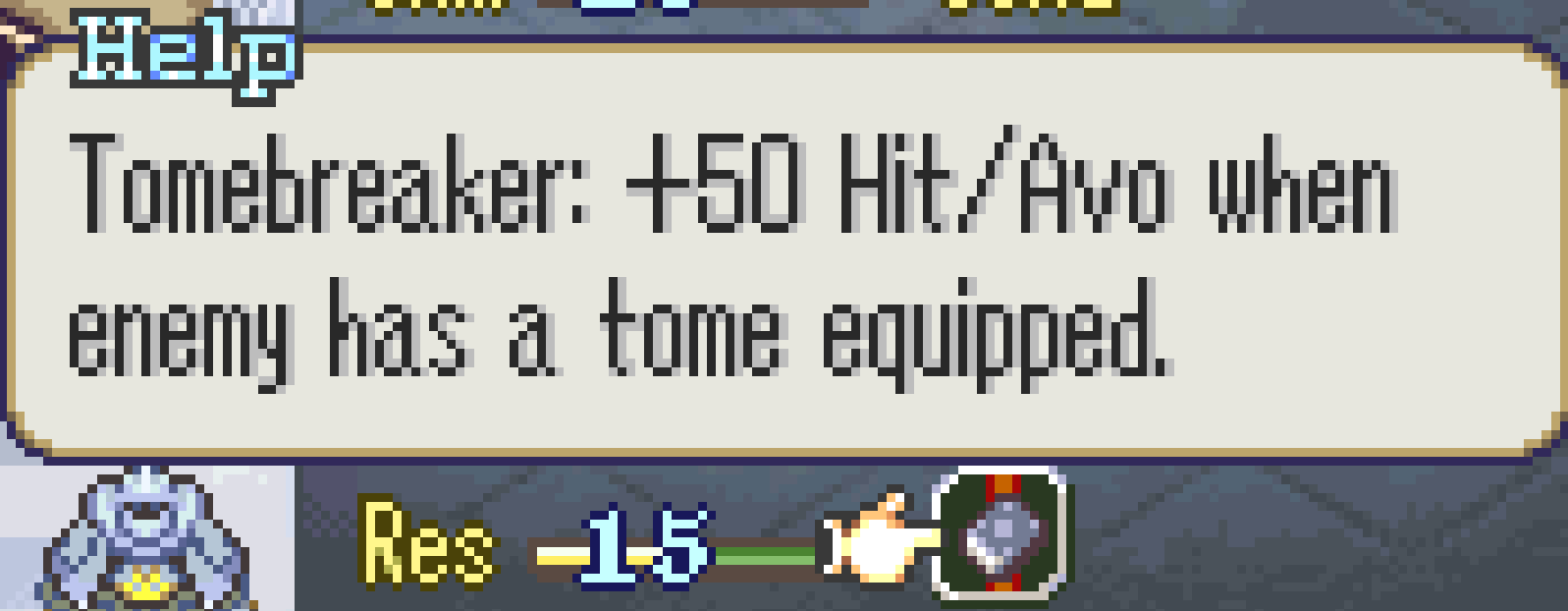
Statistically, Hecate is pretty similar to a lot of other shamans, but she doesn’t have the option of pivoting to utility like many of her kindred. Instead, she doubles down on the combat role she already possesses, because Druid has the innate skill of Tomebreaker – massively boosting her hit and dodge against all tomes – solidifying her role as a mage-killer. That’s handy, because Hag is festooned with enemy mages (almost always anima and dark) on most maps, thoughtfully providing a target-rich environment. Oh, well, she can also technically promote to rogue-with-dark. But she won’t.
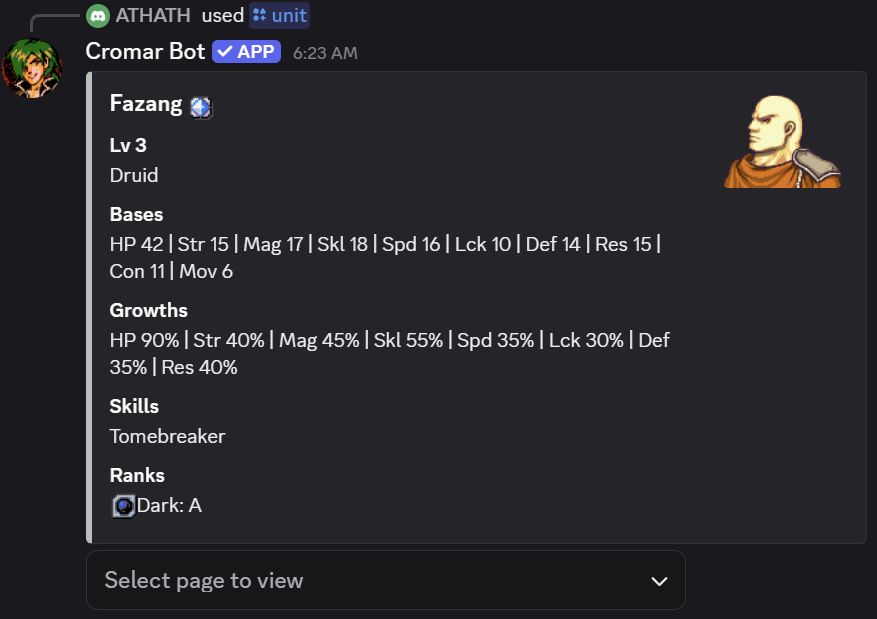
Now, I was ironmanning, and due to a string of bad bets and worse rolls, the Inquisition dropped a train on her. Not to worry: I had picked up Fazang a few chapters ago, and while he was now underlevelled, and his stats weren’t nearly a match for Hecate’s, he had a niche to slot in, and so my team had a hard-counter for enemy wizards again, that being a vital role to have. Hag is a rarity in that Shaman Combat really is enough to keep up on its own.
My favourite of the titular Seven Siblings, Kristia works on strong, but not overpowering defences, and she’ll need them because she’s going to be doubled by everything, particularly as her almost-not-putrid base speed gives way to absolutely zero growth. The fact she’s getting doubled means that Nosferatu negates one hit, but not the second, so damage will add up on her. And that honestly follows a usual pattern for Shamans, but in a different way; her combat becomes less relevant over time in favour of her support, but instead of it being her attack falling off, it’s her defences, and instead of picking up staves, she transitions to summoning.
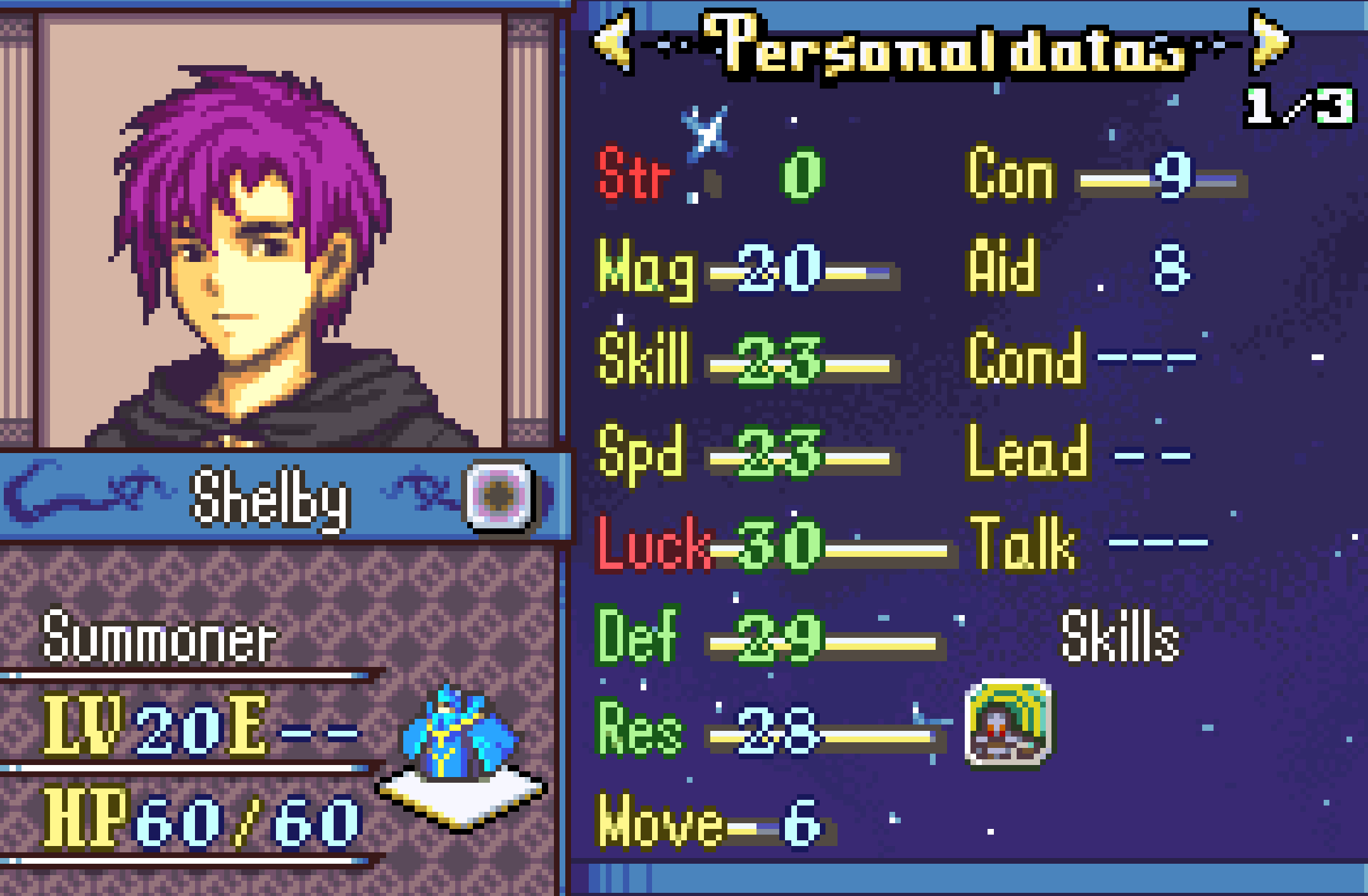
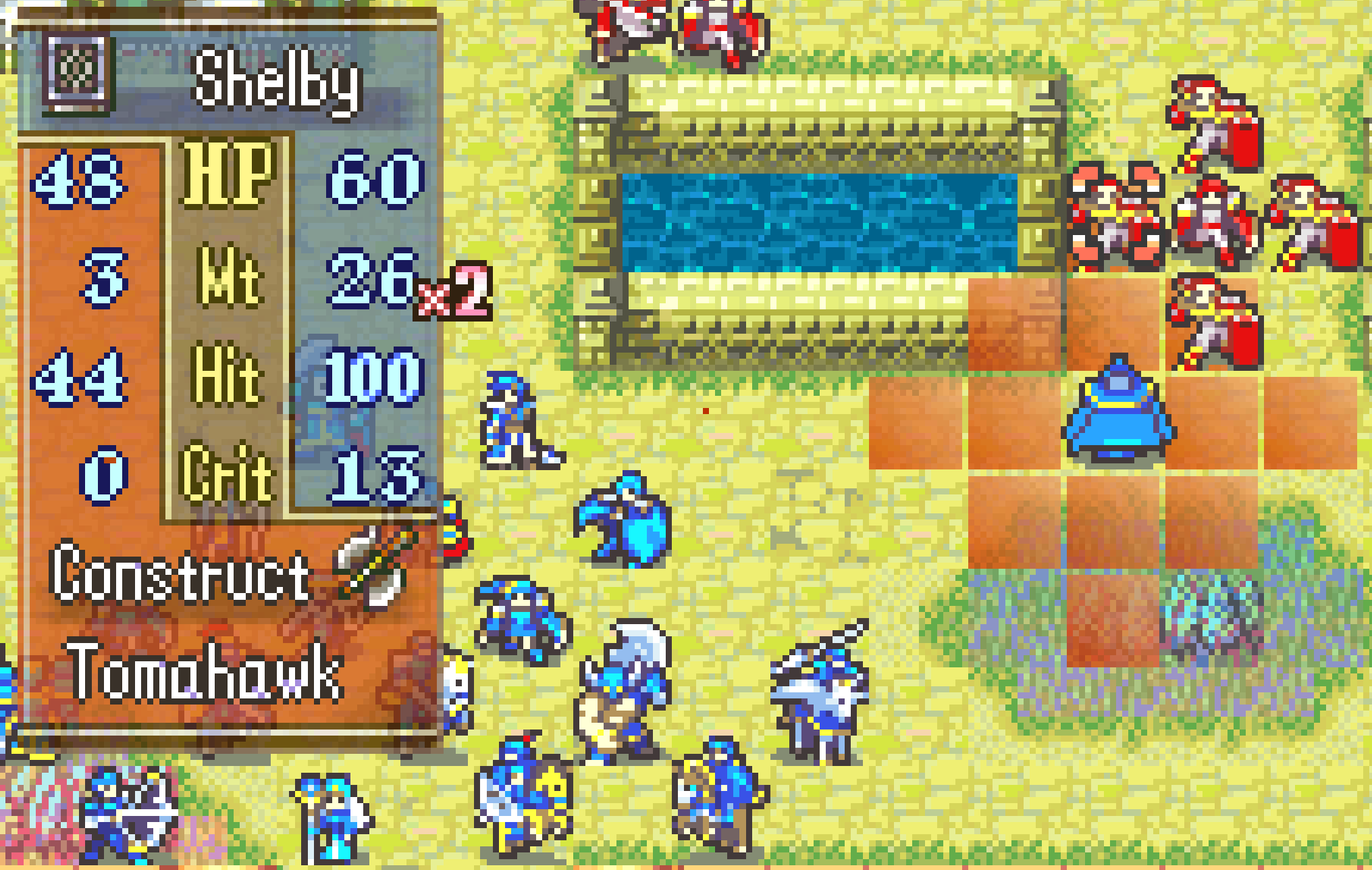
Probably the elephant in the room is Four Kings’ Shelby. Now, Shelby’s stats look, at a glance, 1) deeply mediocre and 2) like Krash only knows or acknowledges the numbers that appear in the TRS RN seed, so obviously there’s a catch. And it’s not just Summoning – again, look somewhere else for that. Indeed, my experience of Shelby dragged him through most of the game at level 9 before, finally, being able to drop him like a hot stone, because I didn’t like him much.
Which is why it’s deeply irritating that he’s the best unit in the game, and that this was apparent with minimal training to begin with. Every 4K unit has a Prf that is meant to define them unless they’re Chase, who is defined instead by being Temu Silph (and thus still the best character, ignore that I just said that was Shelby). Shelby’s is pretty straightforward. Munio gives him +10 def / res. That’s enough to stonewall just about everything in the earlygame, and still makes him a very competitive off-tank all the way through to the end of the route split (and thus, no bench), even if you dislike him and sandbag him from kills to the point where he’s level 9 at chapter 20. That’s as a mixed tank, in an environment where tanking even one of the two damage types is rare. For those who continue to use Shelby, his advantage is further cemented by lategame, where physical enemies largely swap to brave weapons… that mean their attack stats will not clear Shelby’s defence. Shelby’s a one-trick pony, but it’s a hell of a trick… and, hey, sometimes he can even use dark magic to attack safely at range with Flux or whatever, which isn’t nothing.
6 – To All the Druids I’ve Left Behind
Now it’s time to talk about custom campaigns I haven’t played. So the following insights are gathered through osmosis. If you disagree with anything, blame someone else.
Shackled Power isn’t the only campaign to allow dark mages to express themselves largely through an expanded spell list. Thoril does have the advantage of being, relatively speaking, fairly close to the fastest party member in his campaign; this is, unfortunately, because his campaign is Doubled or Nothing. His durability is such that he’s easily 2HKOed, and thus, pattern-recognising brain havers will intuit, one-rounded. Except, critically, he has access to the Omen spell, which does nothing for his durability… directly. What Omen does offer is that it’s a powerful brave spell, and trivially capable of destroying most enemies. If an enemy is too dead to administer the critical second attack, your ‘ORKO-able’ unit instead cleanly wins the matchup, and as a result becomes one of the player’s most reliable EP units. Depending on the campaign environment, it may not even require a brave tome to see this effect in play, if a direct one-shot is situationally within reach.
Looking now to Cerulean Crescent, Basil cheats through having two Power stats, at least in melee; there, Strength contributes as well as Magic to damage through his skill, which he pairs up with a solid ability to physical tank. As a result, while he can chip from distance (there is a 1-5 range tome he can prod with, when he can’t keep up with the fight), he’s incentivised to get up close and personal with his enemies, a pivot around which your more dynamic and finicky glass cannons can safely operate. Promotion helps this by giving him a horse, and overall making him an unfussy, reliable unit in a sea of mercurial gimmick pieces while still having a very strong and distinctive core concept.
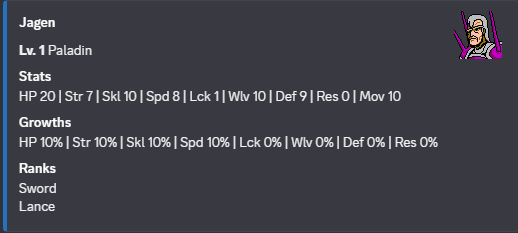
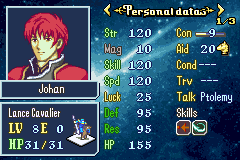
One must now give the appropriate flowers to the most archetype-defining Druid in the hackrom scene. That is original character Teodor Anunexpectedcaller. To massively simplify, he’s what you get if you put Niime in the prologue, and also make him the devs’ collective favourite unit. In the words of my anonymous source, A. Bias, ‘teodor def used to be a huge telephone devs dont give the jagen fucking everything challenge’ (emphasis mine). For more specifics, refer to Further Reading and Retina’s effortpost.
Courtesy of Krash.
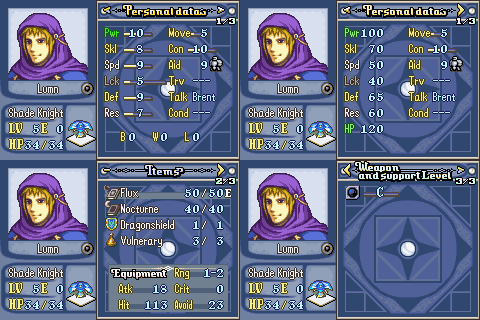
As soon as someone mentioned Lumn Soulsoftheforest, people in the chat immediately started bickering. This is the secret to unit design: you want to foster discourse. Anyway, so the story goes, Lumn was at one stage in SotF’s development cycle by far its strongest unit, a legitimate tank in a hyperoffensive game who could actually stand up to opponents (so… Shelby). In the current build, he’s largely been reined in, and other units have caught up to him. But his reputation remains.
Along similar lines is Kenneth of TMGC. In raw stats, he doesn’t quite resemble a Lumn or a Shelby, sure, but TMGC’s environment is one where a bulky unit who can take on all-comers is valuable. But where TMGC is unique in the scene is as a unit-builder. You get a ton of scope to boost units. And who rewards investment more than your magic-wielding omnitank? With appropriate TLC, Kenneth can become an immovable object.
7 – Final Takeaways
You’ve seen shamans and dark mages. Some of them are scholars, others cultists. While some find their utility in pure power and esoteric offensive magic, others find a new identity as mixed tank units, and in both cases often find niches that other classes don’t neatly fit. In summary, Shaman is a land of contrasts.
The one thing I would caution against is that Shamans are vulnerable to becoming overly balanced for their own good. Canas has a very well-balanced skillset, which means he excels at all things… against the Black Fang, anyway, and their roster of elite assassins consisting of deficient mutants mass-ordered from Wish. If you have stronger enemies, that sort of statspread quickly stops being ‘jack of all trades’ and looks a lot more like ‘master of none’. On the other hand, if they’re overly min-maxed in a way that seems intuitive (at least to me), it might not leave them with room to excel, or else the situations in which they excel might be too niche.
Either way, it leads here. Even more than most classes, you have to pay attention to what units they’re going to counter and in what ways they’re going to counter them. For enemies, being a clean problem that delivers one strong hit is solved by archers (with range) or fighters (with one-shotting) is enough, but if ORKOing is a fair expectation in combat, then the player shamans are going to either have to hit damage numbers high enough to reach that, or they’ll have to be fast enough to double at least something.
Also, depending on your environment, they might wind up more valuable long-term for their staff usage (and / or their summoning, if applicable) than their combat. And that isn’t necessarily a bad thing, either. You can do a lot worse than leaning into that. Niime’s iconic for a reason!
Also, Shamans / Druids don’t have to be the lone standard bearers of dark magic! Sibyls in Do5 and Hexes in HC and DoR both promote from light / anima respectively into dark magic, gain a point of movement to compensate for no staves, and particularly when it comes to Sibyls, have more favourable statlines for Nosferatu tanking in particular and dealing with mixed opponents generally.
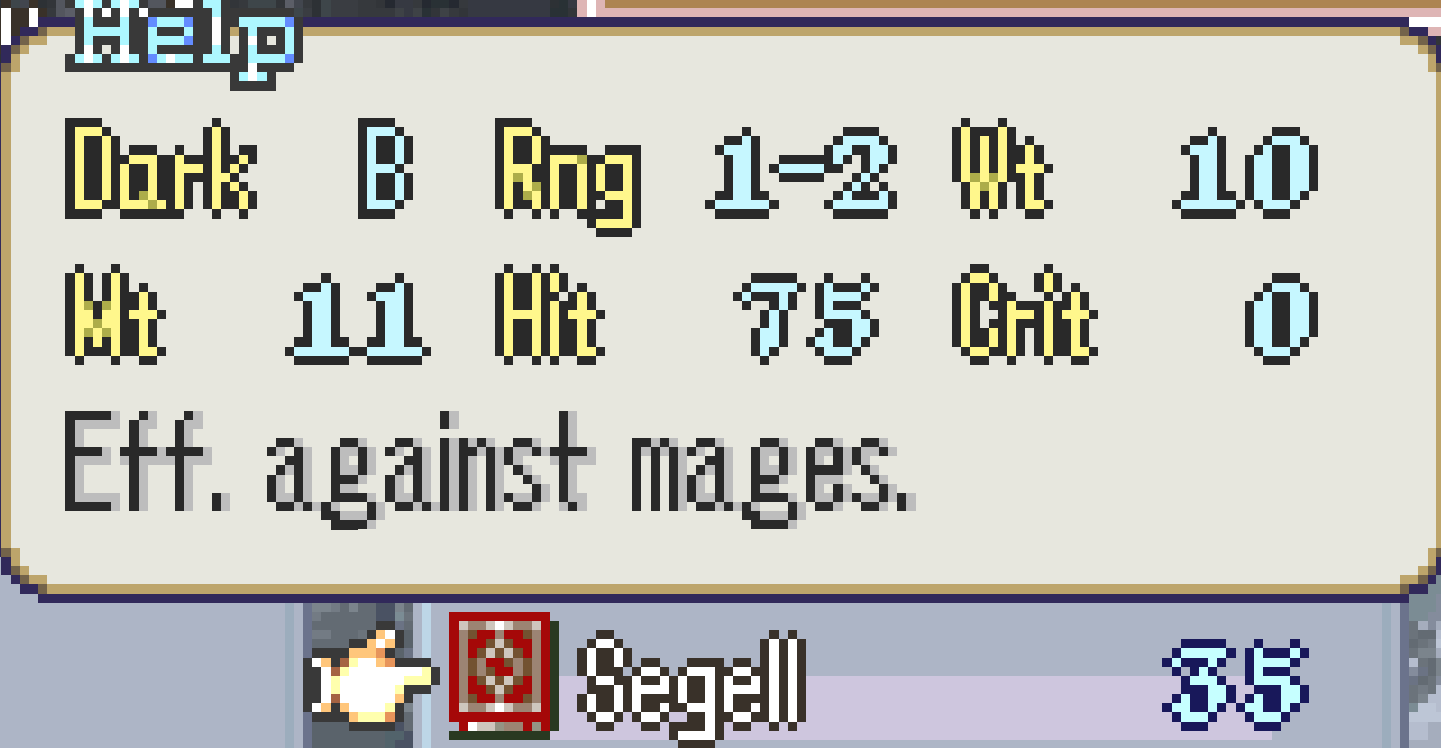
As far as enemies go, it is enough to lean hard into that anti-magic mage experience. If you’ve bolstered the Dark roster, they also offer an opportunity to really flex that in the player’s direction, and perhaps foreshadow tomes they’ll get a few chapters early. Eclipse can be a softer alternative to hard siege (though be mindful of the unpredictability of attack order; you can rig this with the Commander number). Just be mindful that there are answers to whatever questions they pose, ideally multiple. If enemies have crit Luna, do you have crit-immune units, or longbows? If they have Nosferatu, are they one-shottable, or largely stonewalled by your own shaman or pegasus knight? Get cute and fancy, but make sure that the solution doesn’t require the player to have read your mind and positioned their resources just so. One other factor with Luna is that, crit or not, you probably don’t want to go crazy with it; while it fits the niche of anti-mage mage, it also means another attack that doesn’t hit resistance, when you most likely need more opportunities for that stat to be relevant, not fewer.
At the end of the day, if you want my opinion – and, this far in, I should hope you do – Shamans feel best when the developer resists the urge to normalise and smooth down their rough edges, and instead leans into their oddball identity. They are the most enigmatic and imposing magic class, both visually and in terms of their weaponry. Dark magic should feel different and special. Help this unit feel like one that the player, really, probably shouldn’t get to have.
8 - Further Reading
Teodor has been further expanded on by Retina for an Effortpost. There’s also an effortpost on DLATMOL’s Chandra, by Bobby Asaka. This is more focused on her story role than her class design, but it would feel incomplete not to mention.
Finally, ArcherBias’ discussion of Luna, most prominently a defence of crit Luna (and FE7’s implementation more broadly). Worth engaging with. He’s also an advocate for Eclipse, which comes up in the comments in that thread.