I’m Not Good At Class Design Discussion
I will preface this by stating that unlike ATHATH I am not a part of this project, and I am a little grateful I wasn’t asked to be a part in this project because I don’t know whether I would’ve been able to say anything of substance about a particular class and how it functions like everyone else has. I kinda just don’t think often about class design because it’s not that important to my vision as a creator.
I honestly agree with Leche that class really doesn’t really have much sway on actual function and gameplay. I have generally perceived class as more impactful on the overall vibes and aesthetic of a player unit rather than a true measure on how they function mechanically.
But while I don’t really think that “how do you make [X] class good” is a very interesting discussion inherently without proper scaffolding and context, I can see these essays being helpful as a reference point for someone who got stuck figuring out how to make a specific player unit or enemy type unique.
All that is to say, I am not the target demographic of this thread, because I think what makes class design most interesting is not at the fundamental level itself (as others have already discussed)… but rather as a backdrop to draw out certain attributes and elements of specific units that don’t fit in with the quilt you’ve already sewn.
So, let’s talk about that as one additional pebble on this tower of stones.
The Tale Of Ji Gong: When Someone Who Doesn’t Care About Class Design Contributes To A Class Design Thread
Buddhism is a religion centered around releasing all that is ephemeral for the sake of that which is truly eternal—discarding the fleeting things that cannot give you true peace in lieu of what actually can. Buddhist ethics are built around the teachings of the Buddha himself. No eating meat, no drinking wine, etc etc. There were monastic codes that traditional Buddhist monks strove to follow to a letter in their pursuit to do good deeds and achieve enlightenment.
The Buddhist monk known as Ji Gong certainly did not care about any of those. His robes were always torn and stained with dirt. He would drink wine and eat meat and repeatedly ignored all the rules that his peers followed. He’d walk the streets when he should have been chanting sutras with the other monks. He’d sing and sway and laugh and people would wonder whether he was intoxicated or not, eventually seeing him as the local nutcase.
And yet people loved him so much that he eventually became a folk tale, because he lived life his way and did good deeds to the beat of his own drum. All of the stories around him are about him doing his own thing trying to help ordinary people around him, with bystanders often staring in confusion until it turns out his actions led to a better outcome for all. There’s one particular story where he kidnaps a newlywed wife in the middle of her wedding, and everyone in the village chases him out of the temple and outside the village… only for a mountain to fall on top of the village, crushing it. But because everyone was outside the village trying to chase Ji Gong, no lives were lost.
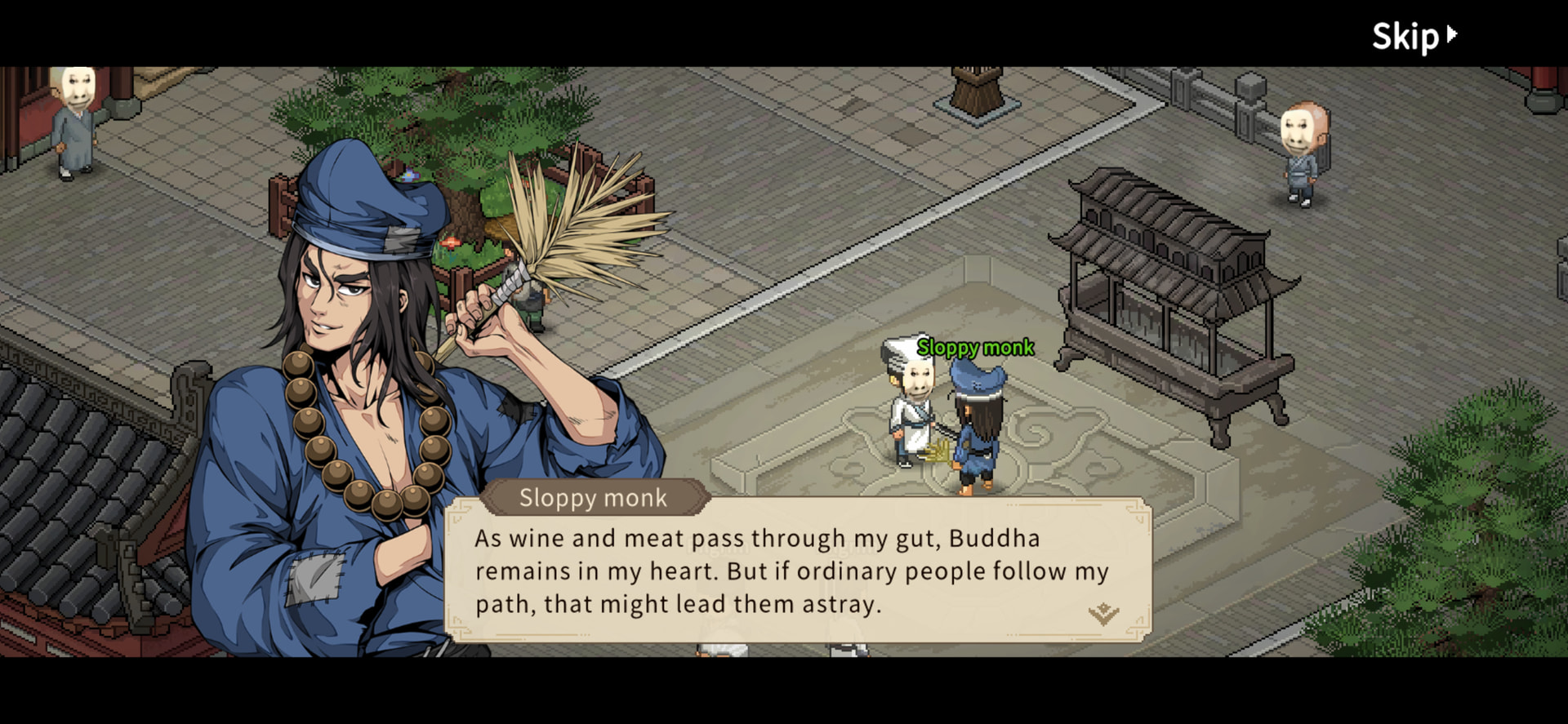
My favorite character from the coolest SRPG ever is explicitly inspired by him. If you’re looking for more romhack inspiration, hop on Hero’s Adventure: Road to Passion
What makes Ji Gong’s tale gripping, in my opinion, is not his behavior in of itself. Rather, it is his behavior when placed adjacent to the rigid rules and expectations of being a Buddhist temple monk. When we see this man who tries to do good in his own way, following his own compass instead of adhering strictly to the rules expected from Buddhism, it invokes a feeling of what I’d almost call purity—a feeling like this man cares more about serving those in need than keeping up appearances.
Ji Gong shines because of the stage that he stands upon, and because of how different his colors are from the environment that surrounds him. His story is made more compelling because he is a monk, despite not being anything like what one might think a monk should be like.
And I bring this all up because understanding the “why” behind what makes Ji Gong’s story compelling is critical to analyzing where class design matters most in romhacks—for reasons that might already be apparent to you.
Sloppy Buddhists In Romhacks
When going into a romhack, it is very likely (almost guaranteed) that people will have some kind of presupposition or expectation about what classes are like, unless they are among the likely-single-digit demographic of “first-time hack trier who has never tried a mainline game before”. These are all natural shortcuts developed through pattern recognition; it’s cognitively efficient to see a myrmidon and immediately know to expect a speedy but frail enemy who wields swords and gets owned by your lance units, or expect a slow but physically bulky opponent who dies to mages from an enemy with an armored sprite. These are shortcuts that we naturally develop as we complete hacks, because they make our time with the game easier and more streamlined.
It also means that, once there is an expectation in our head associated with a given class, any deviations from that pattern stick out a lot, just like Ji Gong does to the rest of the Buddhist monks. This can be used to the developer’s advantage… and this is how some of the units I find most memorable among romhacks came into being.
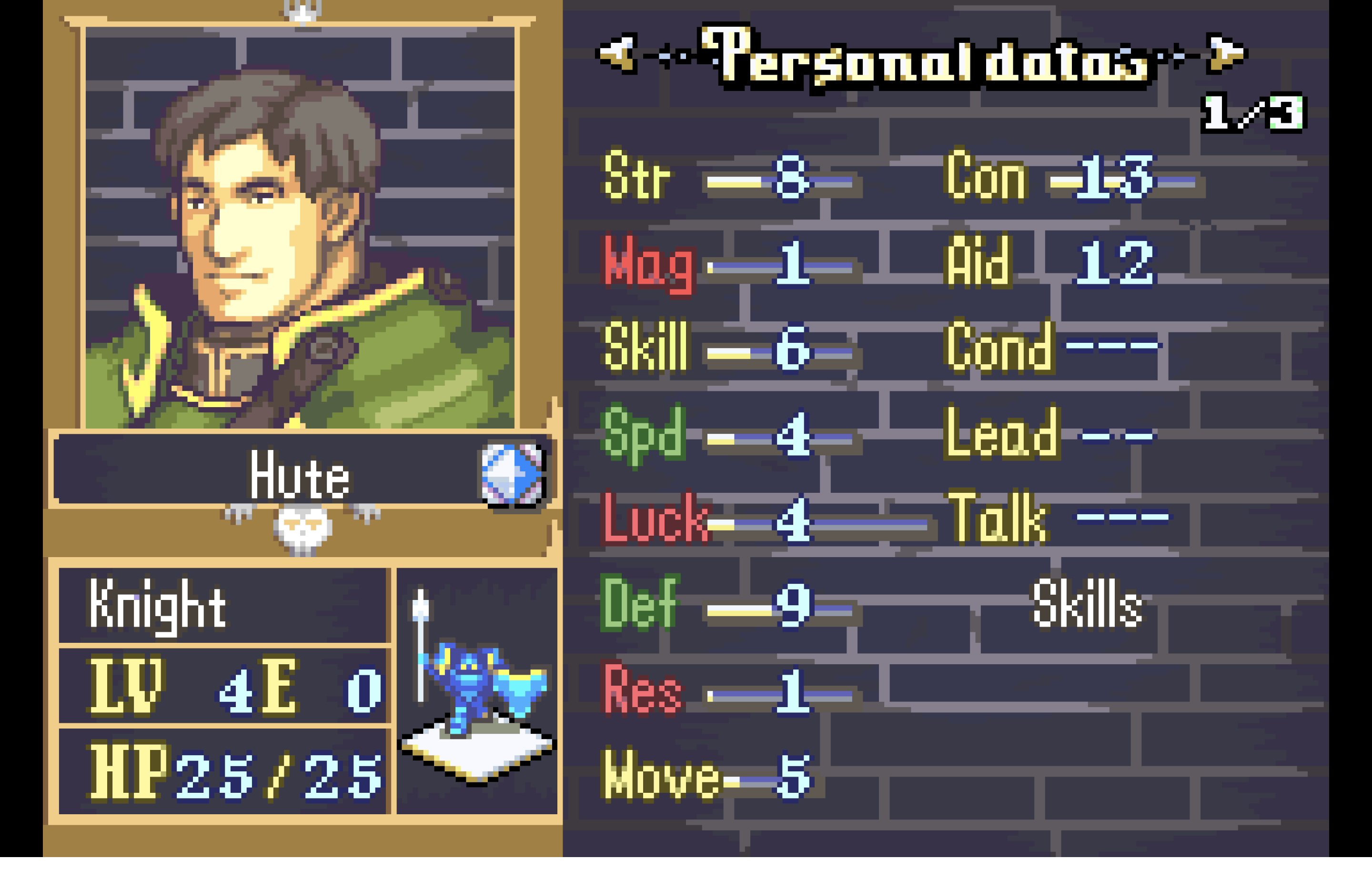
It is highly likely that vanilla has given you a certain schema of Armor Knights that might vary from person to person, but probably includes high defense and low speed. So when you take your first look at Hute from Shackled Power, his numbers immediately pop out as abnormal.
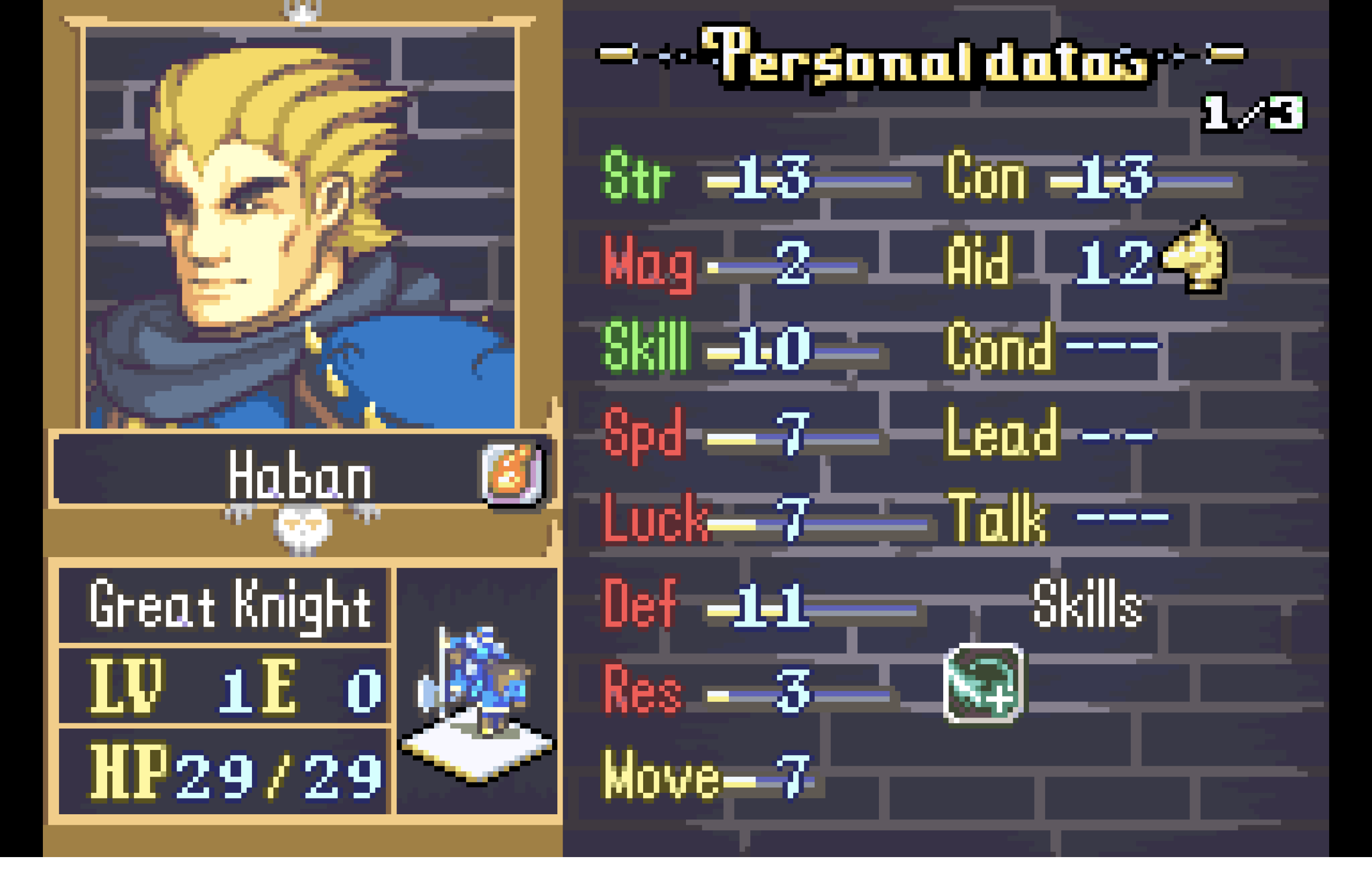
There are two big deviations here: Hute’s speed growth is actually pretty solid, and his base Defense isn’t actually that good. I mean, Haban from Shackled Powers just a few tiles away has a whole 2 Def more than him!
These are attributes that will immediately pop out about Hute, because he doesn’t fit the Armor Knight mold that you’ve been trained to expect from most knights. But… why? An astute reader might take a look at his portrait, see the awkward straps keeping the set of armor together, and come to the conclusion that it’s because his set of armor is crap.
But the story doesn’t end with observations and headcanon alone. Those who stick with Hute and get his supports will actually see these traits addressed by the script:
Nello (in Hute/Nello C support): You do already seem like you’ve got the walk and mannerisms down to be a good royal guard.
Hute: That may come with having to move around in armor like this. Even better, when this armor comes off… Well, let’s say you wouldn’t want to have to race me.
Nello: Is that a challenge?
It’s easy to infer from this dialogue that Hute is actually a pretty limber and quick guy who’s just encumbered by using armor that’s bulky and poorly fitted for him. So it makes sense that his speed would grow quickly for an armor knight—he’s just getting more accustomed to fighting with his plates.
This isn’t the only place where Hute’s armor comes up in discussion, either.
Hute (in Hute/Barbara B): [My armor is] not one of those standard armor designs though. It’s a bunch of plates I bought at a bazaar and sewed together into something solid.
Barbara: That’s a horrible way to do it. You would have been better off buying the full set. At least the maker would have more experience.
Hute: I didn’t have the money to have it custom-made. Besides… I needed to share the plates too.
Barbara: With who?
Hute: My sister. My village started getting attention from bandits, and we needed someone to watch out for them. My sister insisted that she should do it.
And this brings it all together just the same. Given his background as a poor country boy, of course it makes sense that Hute would have to split his gear with Annie and work with what he had available to him, even if most knights from the capital would dismiss it as insufficient for the job. It’s no wonder his defense isn’t numerically impressive at the start of the game!
These scenes are a big part of what makes Hute memorable and fun to play: he works as a back-and-forth dialogue between the audience and the game. The game provides these distinct points of statistical identity for Hute by having him go against the grain expected of a unit of his class in small ways, and then contextualizes these traits with in-universe lore. In tandem, the curious reader notices these irregularities, and then is rewarded for noticing these things upon discovering that there is a logic behind why he plays the way he does. Understanding his backstory thus develops into an easy mental shortcut to recalling his gameplay niche, and as such he becomes all the more memorable of a unit because of it.
Flaws and Flashes: Putting the “Sloppy” in the Sloppy Buddhist
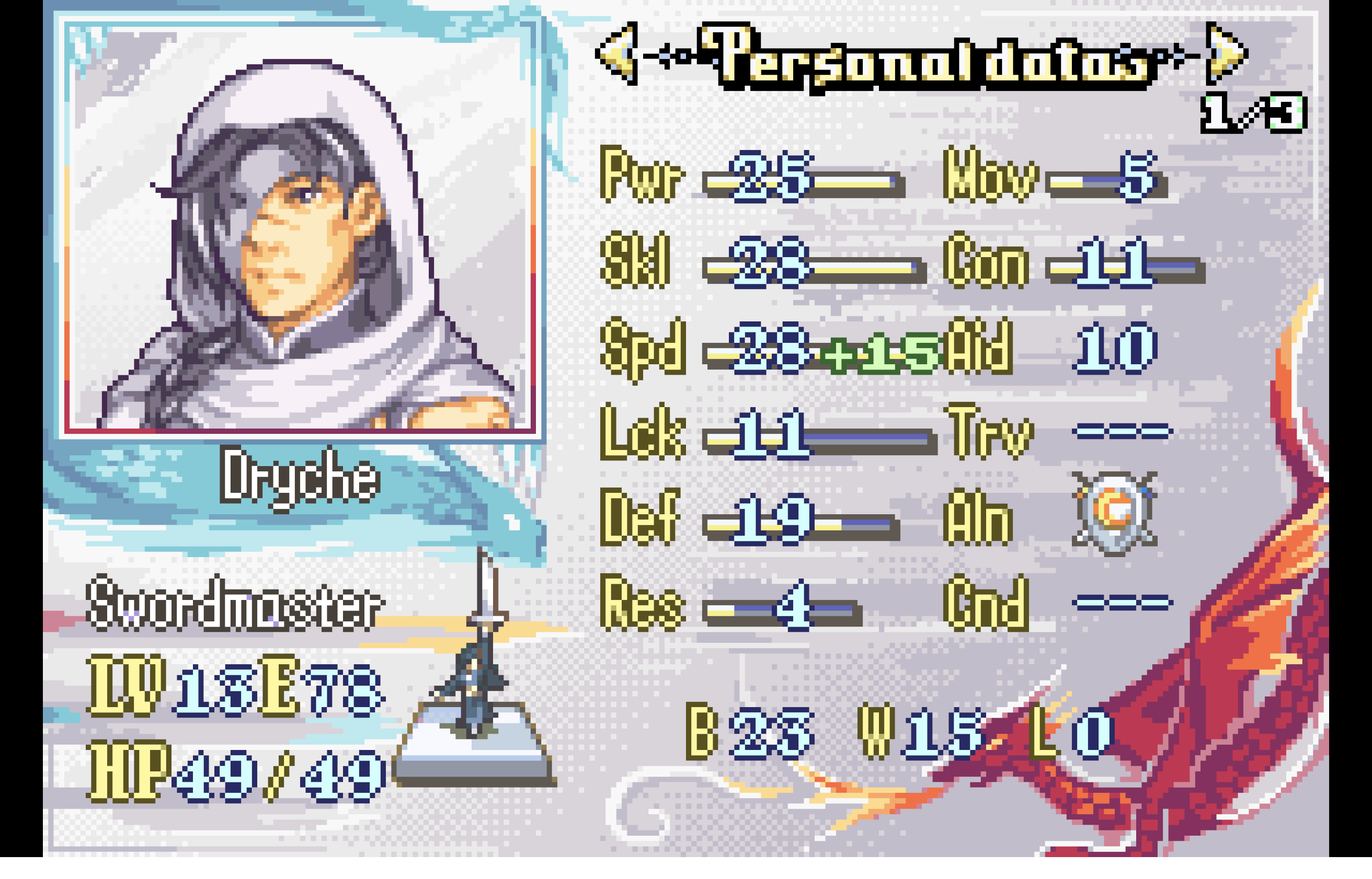
Dryche from Homecoming is a little bit different from the other swordmasters in the game for reasons that are immediately obvious when she appears.
Why does she have 1 less move than everyone else?
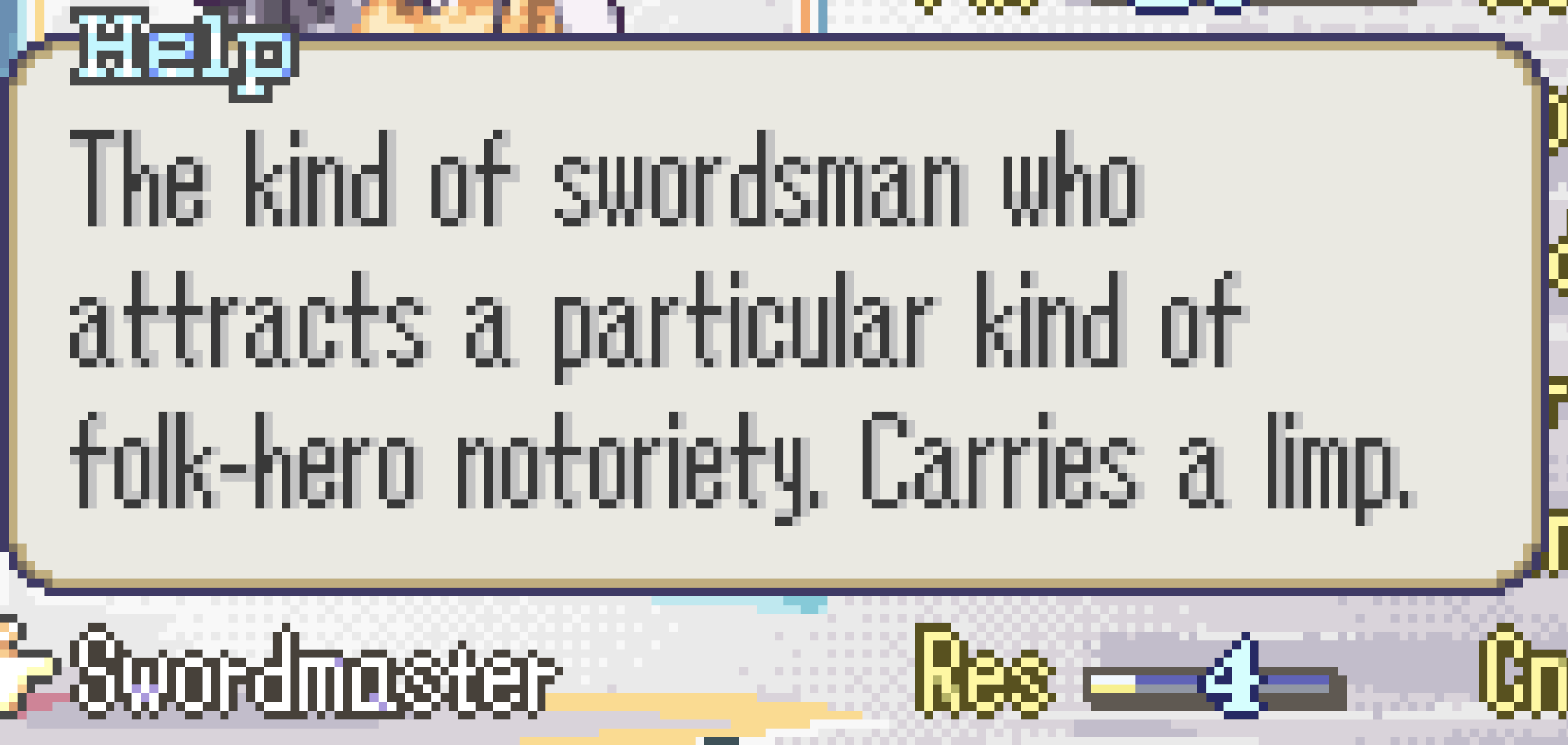
Unlike with Hute, where you get to theorize the answer until you find it in his supports, Dryche is less of a puzzle to solve and more of a LEGO set with an instruction manual included in the box.
It’s a very simple justification, but it works. And while Homecoming’s writing style means there’s little text to go off of beyond this point that addresses it… much of Dryche’s writing is centered around her being an experienced veteran warrior, and with what’s presented on her it’s easy to speculate and let your imagination run its course behind the why and how of her injury.
Dryche is a little different from Hute, because the way she varies from the expected norm comes in the form of a purely negative effect that impacts every action she makes. In my opinion this actually makes her a bit more nuanced and textured than someone like Hute, because her weaknesses are ever-present aspects of her gameplay that you always have to plan around. You simply cannot ignore that she has a crippled leg, because you will always be taking it into account when you deploy her.
This foundation of divergences arising through compelling narrative justification is a critical ingredient to the art of Ji Gong-ening effectively. Without that in-universe explanation, these statistical oddities can come off a lot more, well… jarring, in a form that draws attention away from the game in a negative way.
Hiding the Hand of The Author: Preserving Ji Gong’s Mystique
watsonian: the enchantress cursed the eleven-year-old prince from beauty and the beast and all of his servants because fairies don’t understand why humans would think that’s insane and unfair. I am using in-universe evidence to explain why the character might think or act a certain way, as if belle and the prince and the enchantress are real people.
doylist: the writers didn’t realize that the prince would have been eleven when he was cursed until it was too late to change it, and the servants are also cursed because talking furniture is funny and allows for unique character design. I am explaining this plot point based on an outside knowledge of how writing works and how writers think.
Breaking from established patterns will inevitably shine a spotlight onto the places in which the game deviates from said patterns. And when the reason behind this decision appears to be a flimsy “the dev wanted to for game balance” rather than something that’s been sewn organically into the fabric of the fiction… the developer has drawn the audience’s attention away from the interactive experience and towards the distracting existence of the man behind the curtain off the side of the stage.
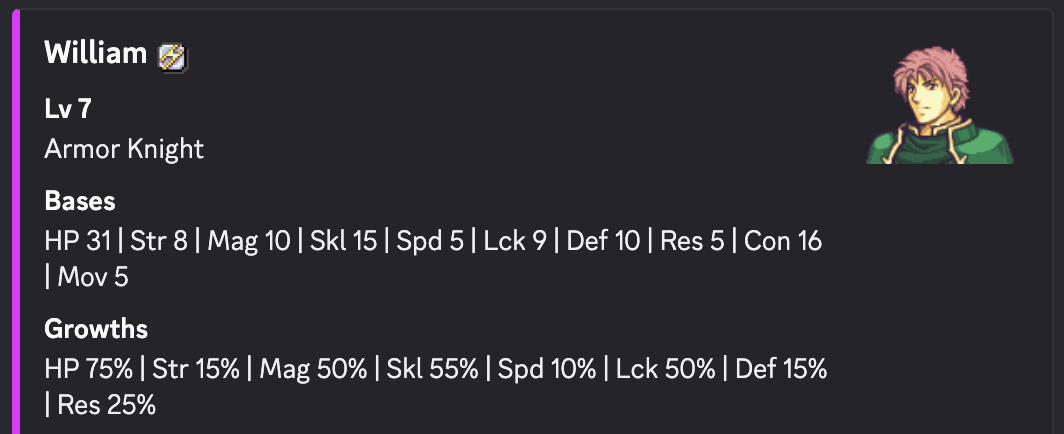
William from Lords of the Seas, much like the aforementioned Hute, sticks out as an oddity among Armor Knights at first glance. But he unfortunately stumbles into the pitfalls that Hute strides around because none of his characterization substantially ties into his statistical deviation from the armor knight median. It means these diversions from the norm come off like they were made without an in-universe reason in mind, and were fueled entirely for gameplay balance purposes. Because he is designed to be the guy with the Bolt Axe in gameplay, without a meaningful “why” beyond serving as that tool.
This effect is something that I think should be avoided if you want to convey a cohesive narrative, because it uncomfortably diverts the audience’s attention to the artificiality of the experience you’re providing. If you want to make an arcadesy experience like Westrian War where the units really are just tools and not real characters, this doesn’t matter to you because this really doesn’t matter to your target audience either. But for the hackers who want to tell a story in the video game medium, a design like this shines a light on the developer’s decision process when making the hack, and reminds the audience that they’re playing a game on their computer made by a developer rather than peering into a tale about real people. It’s immersion-breaking and damages suspension of disbelief in a form that I find really unfun, and it’s somewhat comparable to the sensation of participating in a research survey and piecing together that the survey is trying to gauge [this specific variable] based on the wording of the questions. Detecting obvious authorial intent, or even merely thinking that you perceive it even if your assumption is incorrect, will take you out of the experience and sway the way that you interact with the interface the creator has prepared for you.
Now, this is not to say that I think a developer shouldn’t design their exceptions around proper balance when need be; rather, I think it is critical to evoke these design choices in a form that doesn’t make it blatantly obvious that a decision was motivated purely by a vision for gameplay balance. For all I know, Hute’s statline could have been conceived solely because Sphealnuke wanted an armor who didn’t start that much bulkier than everyone else, but became a lot bulkier and faster with investment… and the dialogue about it was created after the concepts were. But he is more than fine in practice, because going in blind I would have never come to this conclusion about Hute (or Dryche, for that matter) with how his story and aesthetic is weaved into his distinct attributes! Conversely, William’s design very well could’ve been narratively driven for all I know—but because the script never stops to wink at or reflect on any possible narrative explanations, this is not conveyed clearly to the reader, so within the vacuum of the hack it comes off more as a choice motivated by pure game balance.
Point being, you can just as easily start with the statline divergences and work backwards to a narrative justification just as much as you can the other way—the important thing when taking that route is making the setpiece convincing and clearing your tracks so the reader doesn’t pick up on it as easily. Making a slow myrmidon? Maybe their flat feet are giving them chronic pain. A mage with a low magic growth? Perhaps he’s just not innately talented or the spirits/gods of magic just really hate him because he’s a sinner or something. A cavalier with piss poor Skill? Perhaps they’re nearsighted or missing an eye, or perhaps they have bad synergy with their mount. Low res? Consult your local lore and worldbuilding. It could be for all kinds of reasons.
Flaws and strengths that don’t align with the expected norm will give the unit a layer of extra texture. But to make them compelling, you have to ensure that they mean something beyond function alone, too—it is vital to always ask yourself “why” a unit functions the way they do, and why it’s important to know or care. Rooting these traits in the story interweaves the two and draws out the best of both aspects of the game in a form that will linger with people long after the experience is behind them.
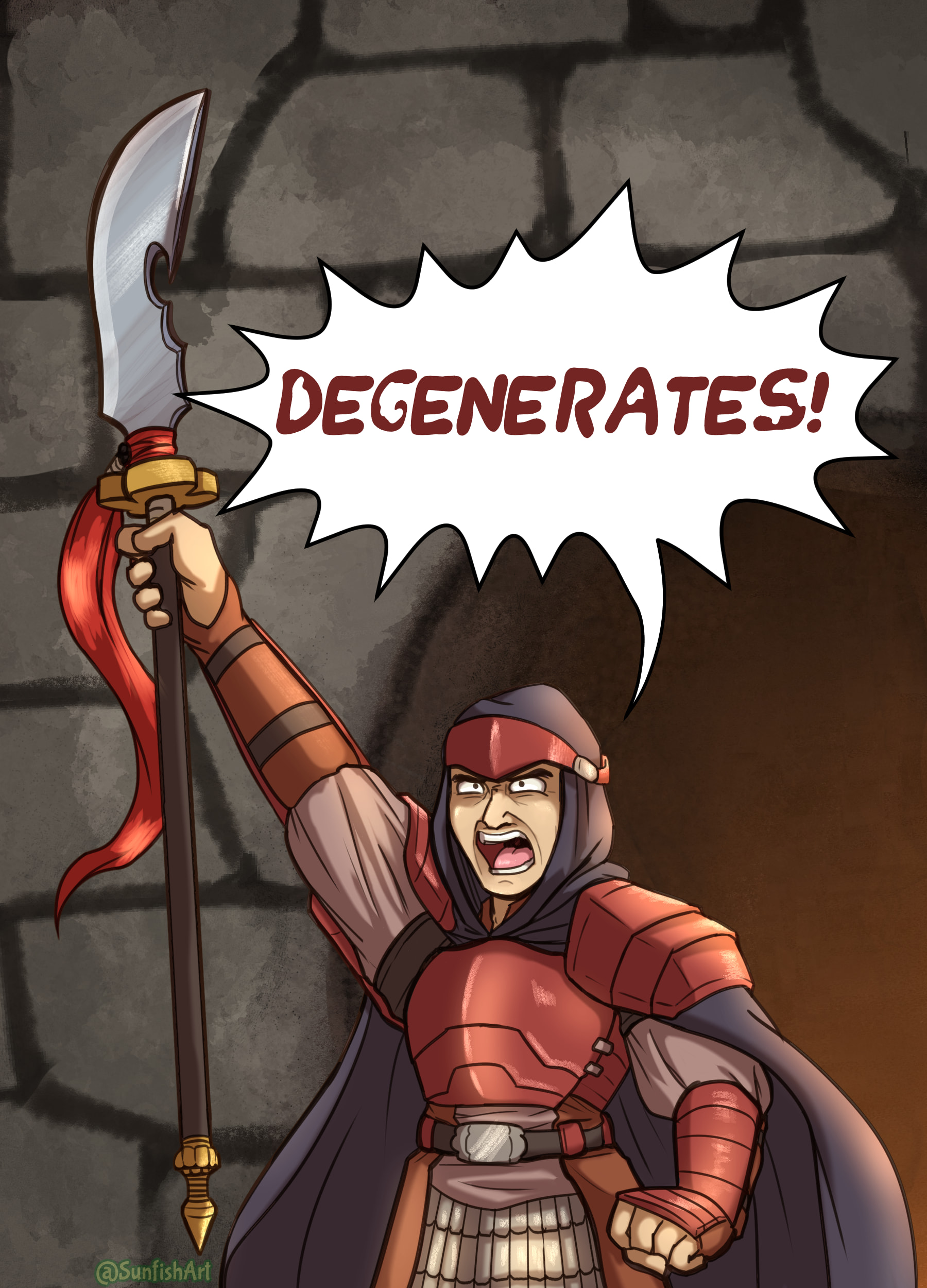
The confused and unenlightened called the Sloppy Buddhist a degenerate. Were they right?
It’s easy to do this with a class like armor knights who have a really clear and distinct identity. But how do you do this with a class that doesn’t really have an ingrained cultural norm already? Or what if you want to fundamentally approach a class in a different way than the average romhack enjoyer might expect? I mean, there’s like 10 different takes on shamans and monks and cavaliers and overclasses and so on just in this thread alone, so clearly there isn’t a universal schema of what traits are normal for a class to have.
But it would make it a lot easier if everyone’s on the same page, right? As stated in the brigand effortpost, you are always free to (and it would likely be more reliable to) set your own trends and create your own patterns for others to recognize, all within the enclosure of your own project. I highly encourage this.
That said, I think that the lack of a pattern can also draw attention to pattern-breakers in a different way. And I think this comes out super vividly in Dark Lord and the Maiden of Light, specifically with how its soldiers operate.
Let’s talk about Romhack Soldiers
Now, a lot of mainline players’ internal schema of soldiers is probably “mob fodder”. Even some people more experienced with romhacks likely feel this way; there are tons of underwhelming soldiers in hacks, with the trend going all the way back to 2010 or so when Ace first took his first steps into Tactics Universe. If there was a Romhack Soldier writeup in this thread, I probably would’ve made some direct comments about it.
And for the first ten chapters or so, soldiers in DLATMOL are exactly what you’d expect them to be from vanilla. Enemy fodder. Unremarkable, except for the one green soldier in Chapter 2 that has one of the only javelins in the entirety of Ernterre.
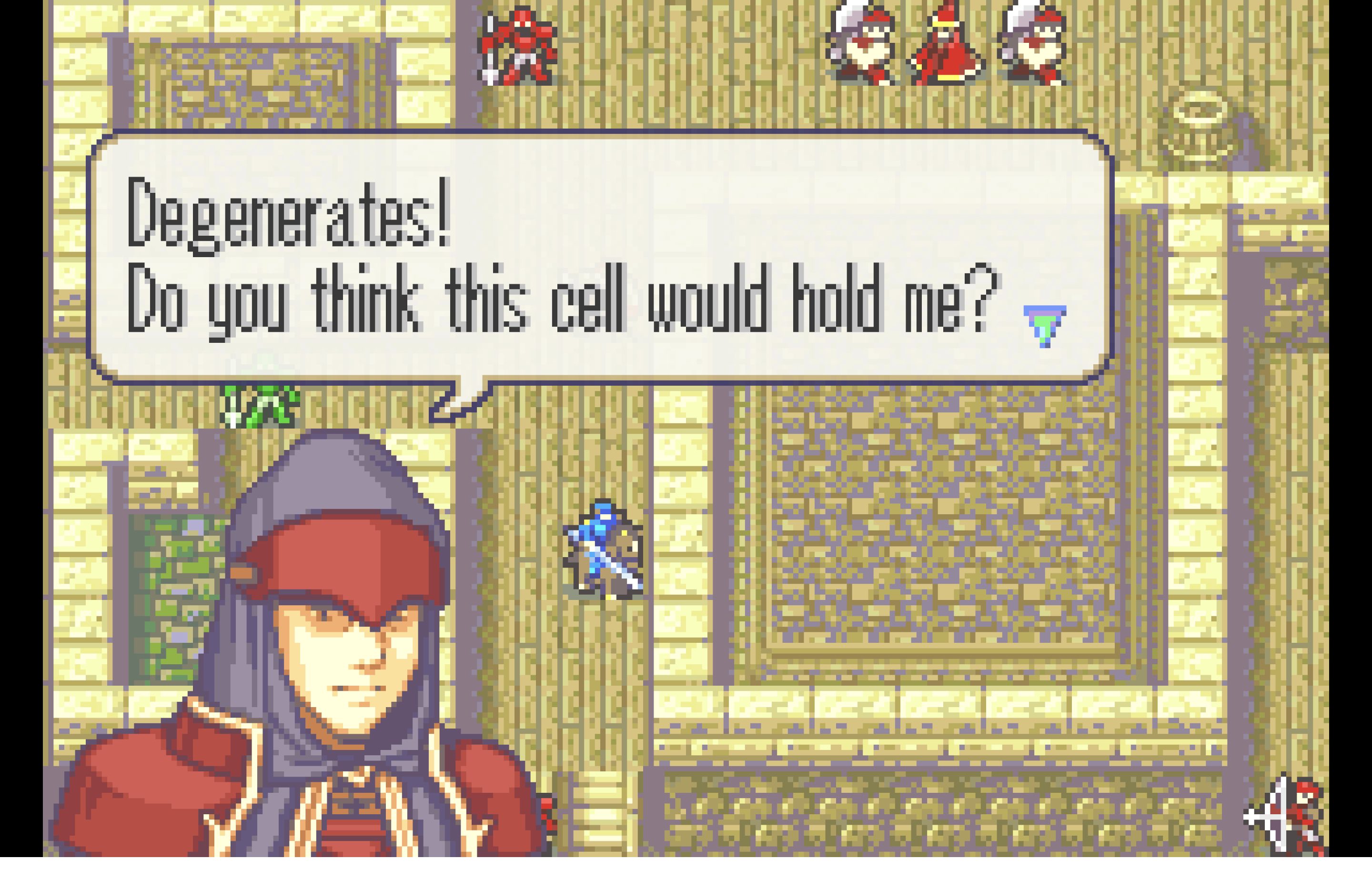
Then, after 10 chapters of soldiers being complete losers, this lunatic crushes a jail cell door with his bare hands and pops out screeching:
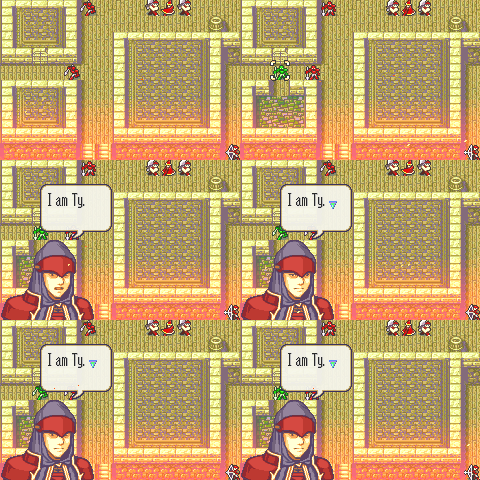
Provided by Pushwall.
Wait, he doesn’t sound like that. He actually says this after bursting through the wall.
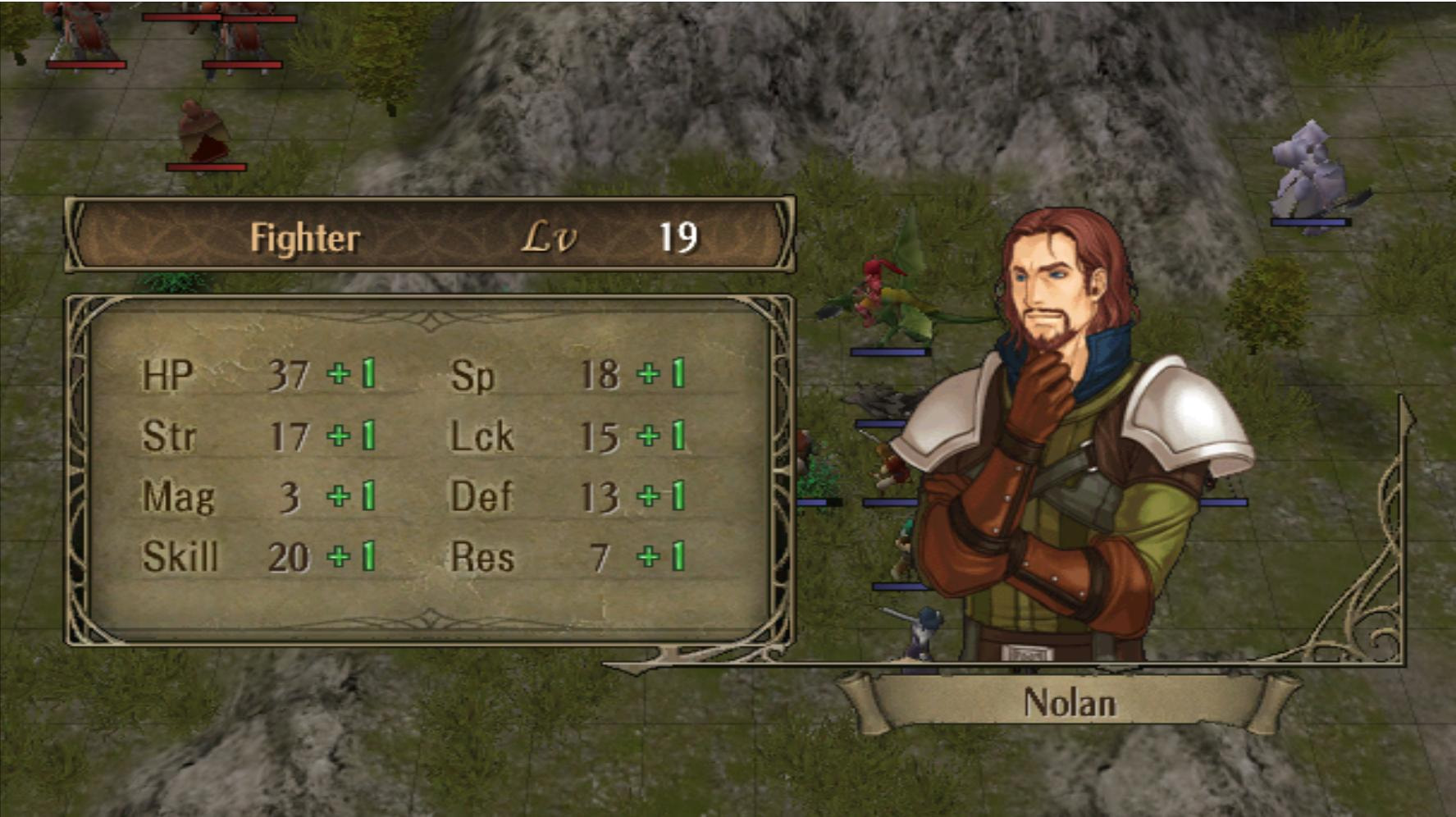
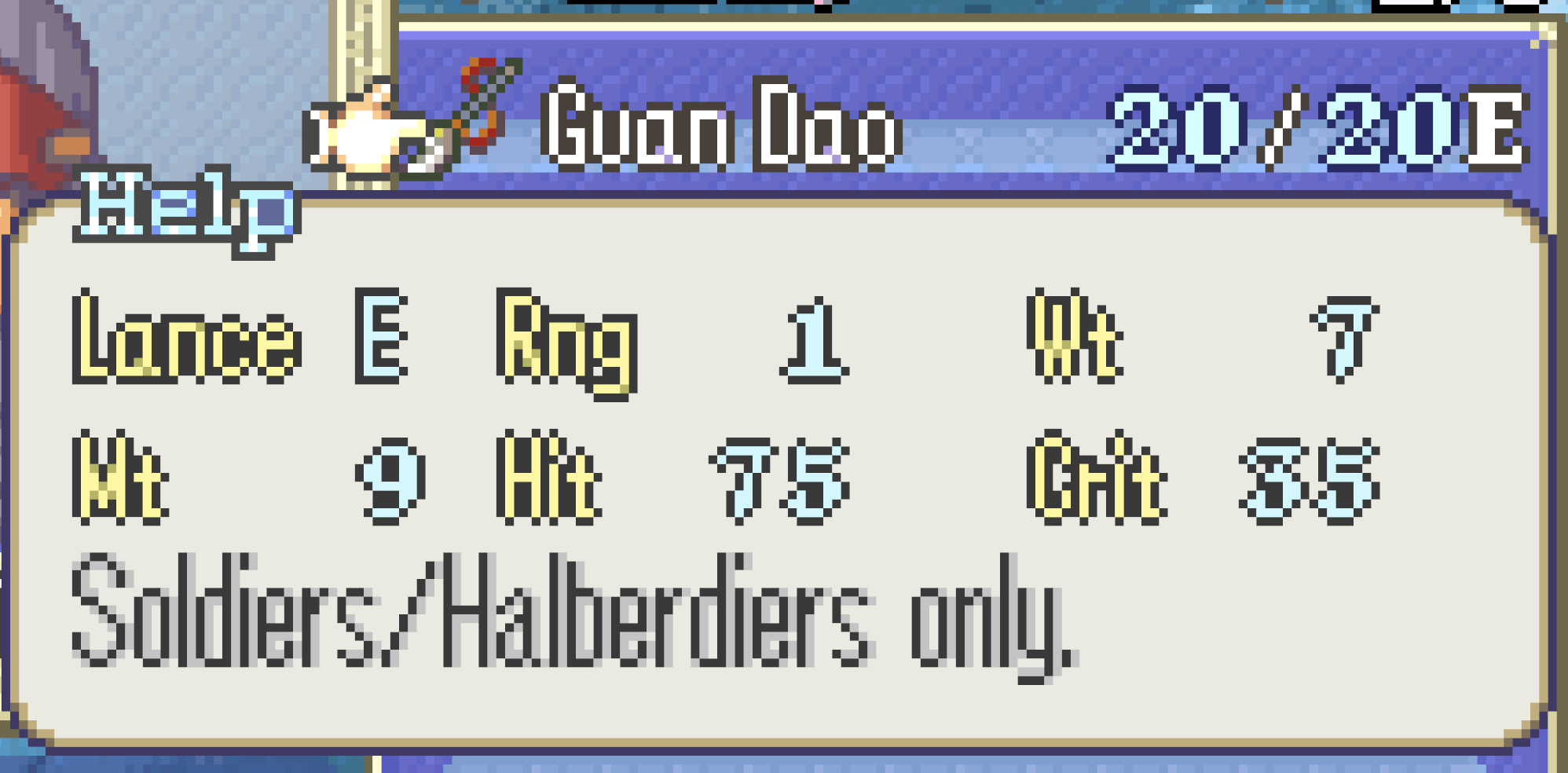
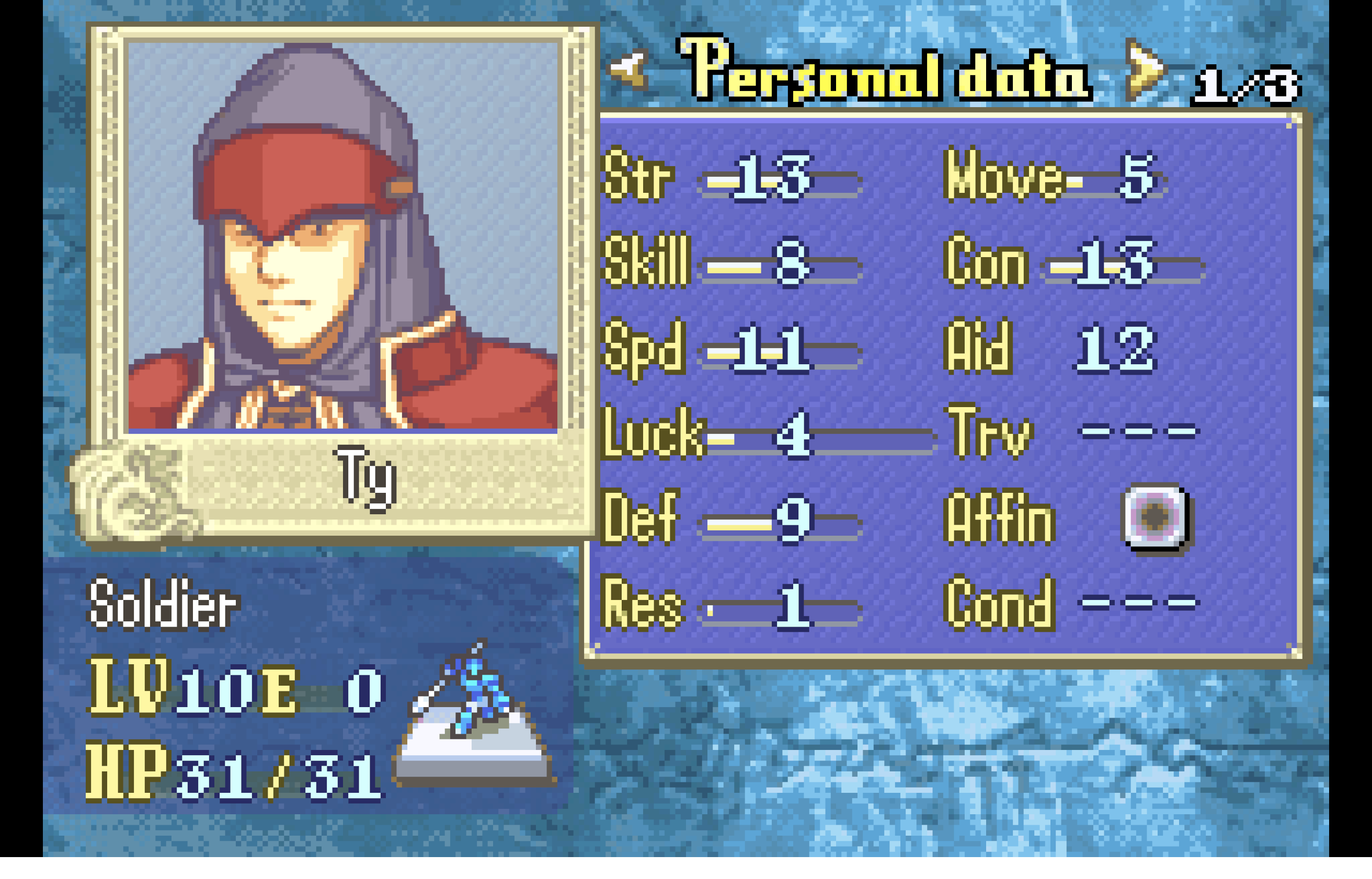
Meet Ty. Ty is honestly kind of a scrub at this point in the game; he’s probably a bit behind the curve of the rest of your guys and it hurts that he missed 10 chapters of free EXP. But he DOES show up holding a new item that draws the eye.
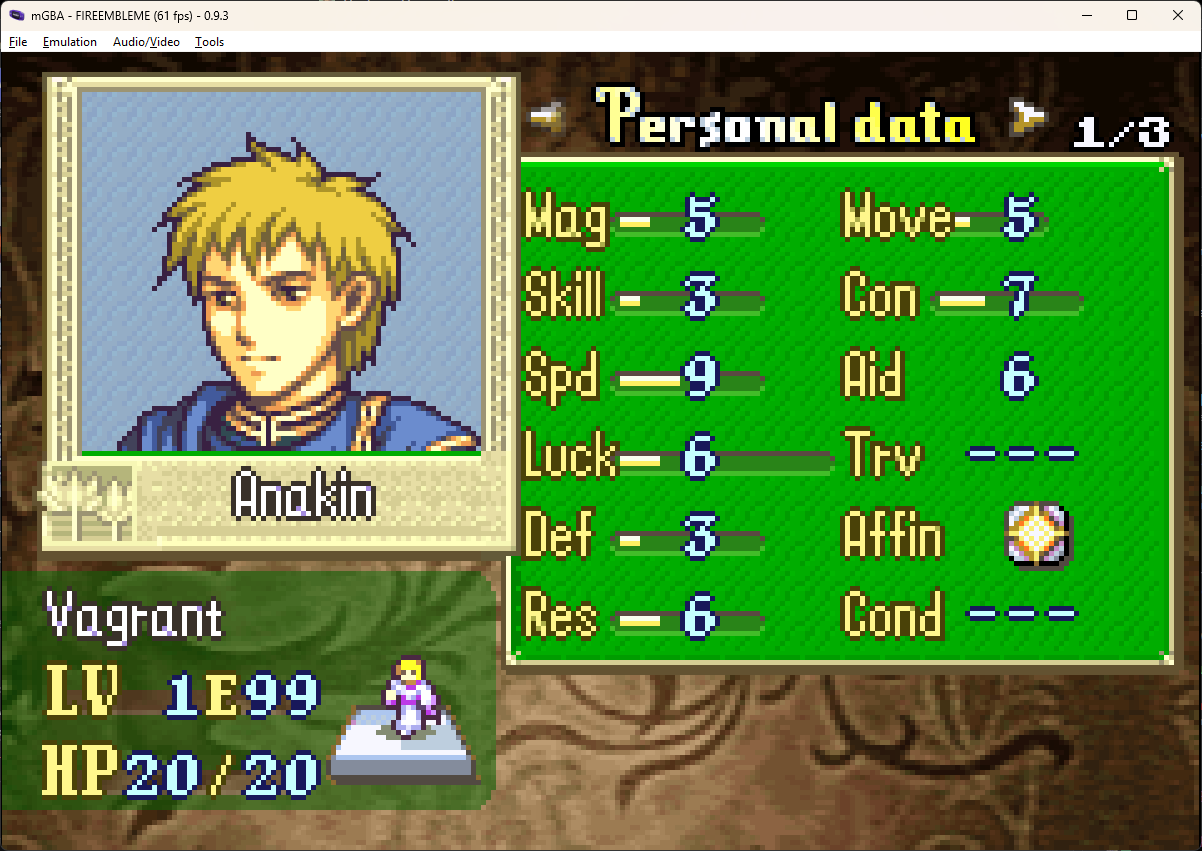
And aside from kinda sucking in the grand scheme of things, he doesn’t really fit the mold of a soldier. He has a good bit more Con, a fair bit more Strength. Speed that’s okay but not great. The differences are there, enough to draw attention to them—but most are not extreme enough to make any blanket statements yet.
Now, the statistical identity of DLATMOL’s soldiers comes into attention once more when Kathe shows up. Kathe is a prepromoted Halberdier, and at this point you’ve encountered a grand total of two (2) enemy Halberdiers—one boss and one generic who’s a total pushover—so the internal schema is probably either “scrub” or tabula rasa. But Kathe’s statistical strengths and weaknesses are pretty evident from the get-go given how specialized her stat spread is.
Right, one important thing to add: halberdiers also get crit boost in DLATMOL. And with that in mind I think Kathe’s statline speaks for itself: she is very clearly meant to be a speedy swordmaster but with lances. It also recontextualizes the Guan Dao as the halberdier equivalent of the Wo Dao and Short Bow that the other crit classes get.
But if Kathe handles like a swordmaster, is this what should be expected now from DLATMOL soldiers? Certainly not, because Ty is nothing like this. Still, Kathe fitting such a clear mold in a class that normally does not wear that mold (or a mold at all) also brings into attention another question… what IS Ty actually like?
For those who didn’t invest in Ty, this door is shut firmly until you give the game another swing. But for those who did, by the time of Kathe’s join Ty’s growths and stat spread have had ample time to develop into a clear trend, and maybe seeing Kathe jogged the pattern recognition molecules in your brain already and you came to a conclusion about him. Or maybe you saw how he was growing and already noticed the pattern… and then found a support that affirmed your guess behind what he’s meant to be.
Or maybe it happened the other way around: you found the answer already in his supports, so you already expected him to grow the way he did, and you didn’t need Kathe to prime you at all. This is a puzzle with many routes to its solution.
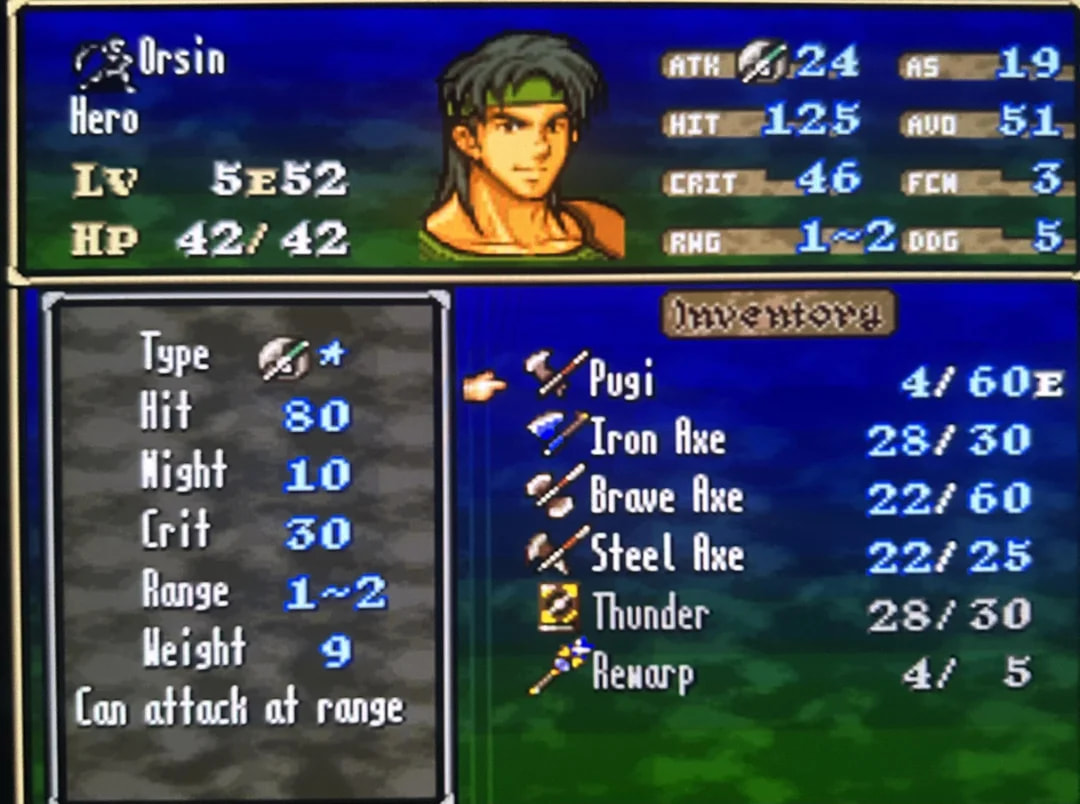
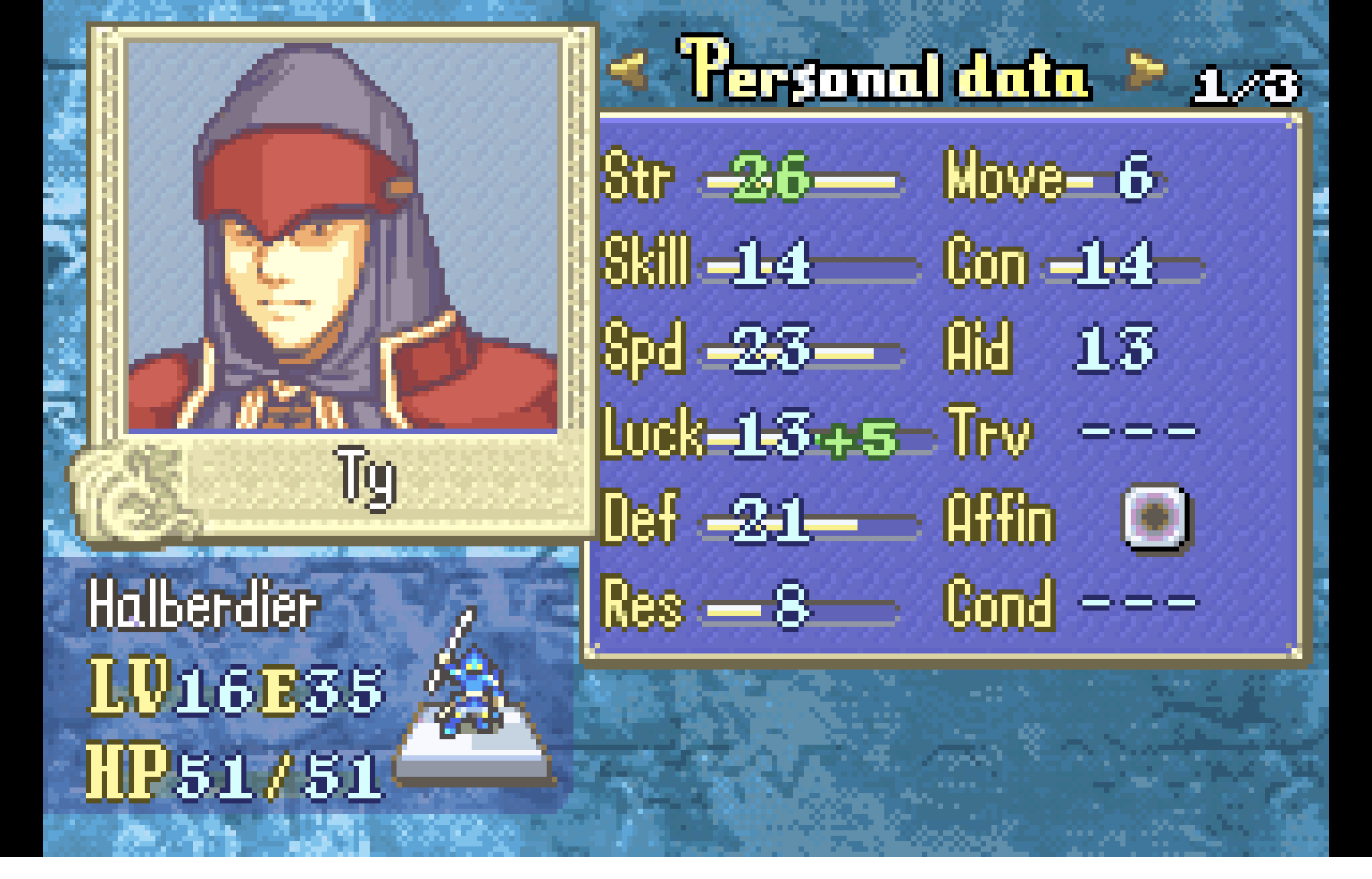
Let’s take a look again at this Ty that I grinded up in the postgame arena for reference:
And just like Kathe, I think it kinda speaks for itself. Ty is, in essence, a berserker wearing a soldier’s armor. His high HP/Str/Con, above average Speed, and low Skill all trend towards the very familiar Gonzales of FE6, and the crit boost and Guan Dao help him feel more like a berserker just like they make Kathe feel like a swordmaster. And while his fairly good bulk diverts a bit from the berserker mold, it’s within reason given his portrait and other implications about him.
Of course, Ty is like this for a reason, but this is something that you’ll never find out unless you dig into who he is. In the main story, Ty is presented as a funny and charming rando without much lore or story presence. His introduction almost makes him feel more like a joke. But his whole shtick as a character comes clearly in supports:
Ty (in Ty/Dakini A): My path began when I murdered an innocent man. And for a time after that, I was a mere brigand as well. I killed, I stole. I was a beast in human form.
Ty (in Ty/Dorothy B): I’ve taken lives I shouldn’t have. There was no reason for it. This was… after you left home. And it is the reason why I am a mercenary in the first place.
Ty (in Ty/Darius A): All men and women have twisted desires, large and small. The people we have fought and killed day after day… Do you ever wonder if they could have been allies?
Ty (in Ty/Dakini C): I just think… it doesn’t have to be this way for people, you know? Salvation is for anyone, as long as they are willing. Why would they deny a second chance…?
In short, Ty’s history aligns with his brigand/berserker statline: he used to be an outlaw who reveled in violence. But he turned a new leaf, donned a new shell, and now wanders the continent as a vigilante.
Just like with Hute, unveiling Ty is a push-pull exchange between the audience and the game that gradually nudges you to comprehend the lynchpin of his character. Almost every piece of Ty’s characterization and dialogue is recontextualized once you can see the full picture, down to previously thoughtless-looking things like why he spawned in from that random room in the random map.
With Ty, the relative subtlety of his traits in his first impression combined with the muddy cultural definition of what a soldier’s stats are “expected” to be leaves one’s expectations from him uncertain. Even if he used to be a criminal, it’s a life he’s tried to leave behind but hasn’t entirely been able to put past him yet, and his stats reflect that; the pattern-recognition footprint is something that’s quiet at first glance but is still there for the observant to catch onto, just like how Mide notices something is off about him in their support chain. Kathe’s design also indirectly feeds into this by drawing attention to the mismatch between the player halberdiers’ statlines and all the other soldiers in the game, implicitly encouraging you to think more about the reason why Ty is the way he is.
And a big part of what makes this all tick is discovering his general growth trends through watching his levels. This is something that’s really hard to replicate in any sandbox where growths are visible. If growth rates were checkable in DLATMOL this whole process would be a lot less intricate and a lot less of a conversation, because it would likely begin and end on checking the growth rates and immediately spotting the trend rather than gradually picking up on it and discovering it organically over time.
When growth rates aren’t just handed to you on a platter, the reader has to make educated guesses based on the details that they know and learn about the character, and that makes the unit more engaging to learn about. DLATMOL has many units with character quirks and details that can translate to distinct statistical oddities like this (like Arthur, who was mentioned in the cleric writeup), but it comes out especially strong with Ty. It’s a lot of fun to learn something new about Ty and compare it with his stats. It’s interesting to watch his level-ups, make an inference about him based on the patterns that you associate with various FE attributes and elements, and then have your guess confirmed or dismissed by the script. This simply wouldn’t function the same if you could just check his growths from the start with the select button.
At the end of the day, Ty is a character who works because of a number of systems that he stands upon. In many ways he is an open-ended puzzle, and there are several avenues to piece together the big picture for him—but class design pattern recognition draws attention to the initial puzzle pieces, cuing in that something’s different about this guy and inviting you to kickstart a dialogue between yourself and the game by searching for more.
He also directly calls out you, the player, and that’s pretty awesome. Art by RisingSunfish.
(Dakini, who was mentioned in the Brigands post, also functions somewhat similarly. But like Dryche she is a LEGO set with instructions included, and her required point of comparison is much easier to miss given that they’re like a bottom 5 character writingwise.)
Yeah, this entire essay was a thinly veiled request for hackers to hide growths and create an environment conducive to Pavlovian conditioning
The most interesting part of class design to me, a person who generally finds class design to be tedious busywork, is how it can be used as a foundation to create patterns in the audience’s head. Having these patterns established then allows the developer to weave something into them that leaps out from the tapestry in a way that’s eye-catching both narratively and mechanically, and it’s often this dance of foreground and background that makes memorable units emerge. Some of the coolest units in romhacks use these patterns behind them as vessels to turn understanding the unit into more of a dialogue that the player actively participates in.
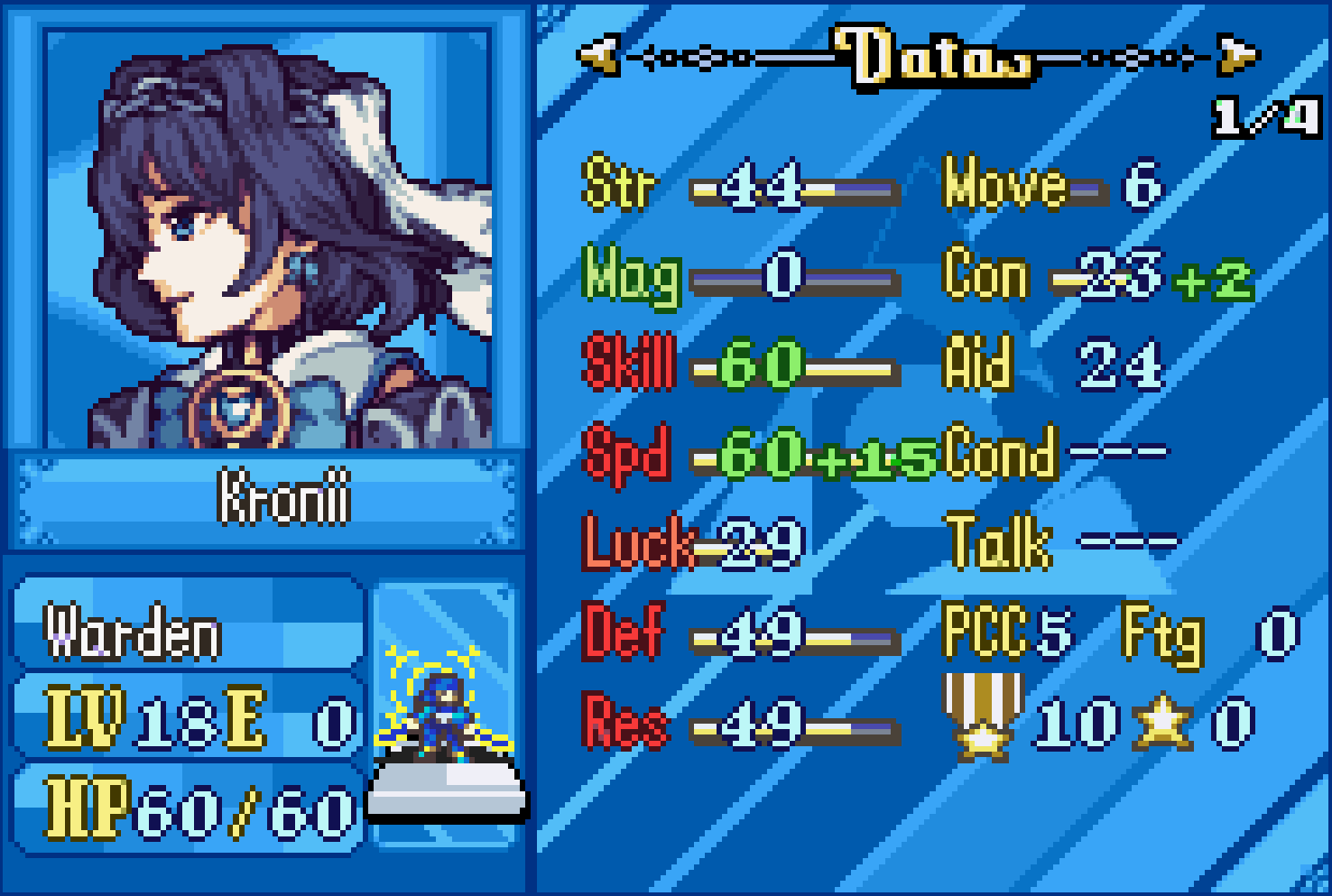
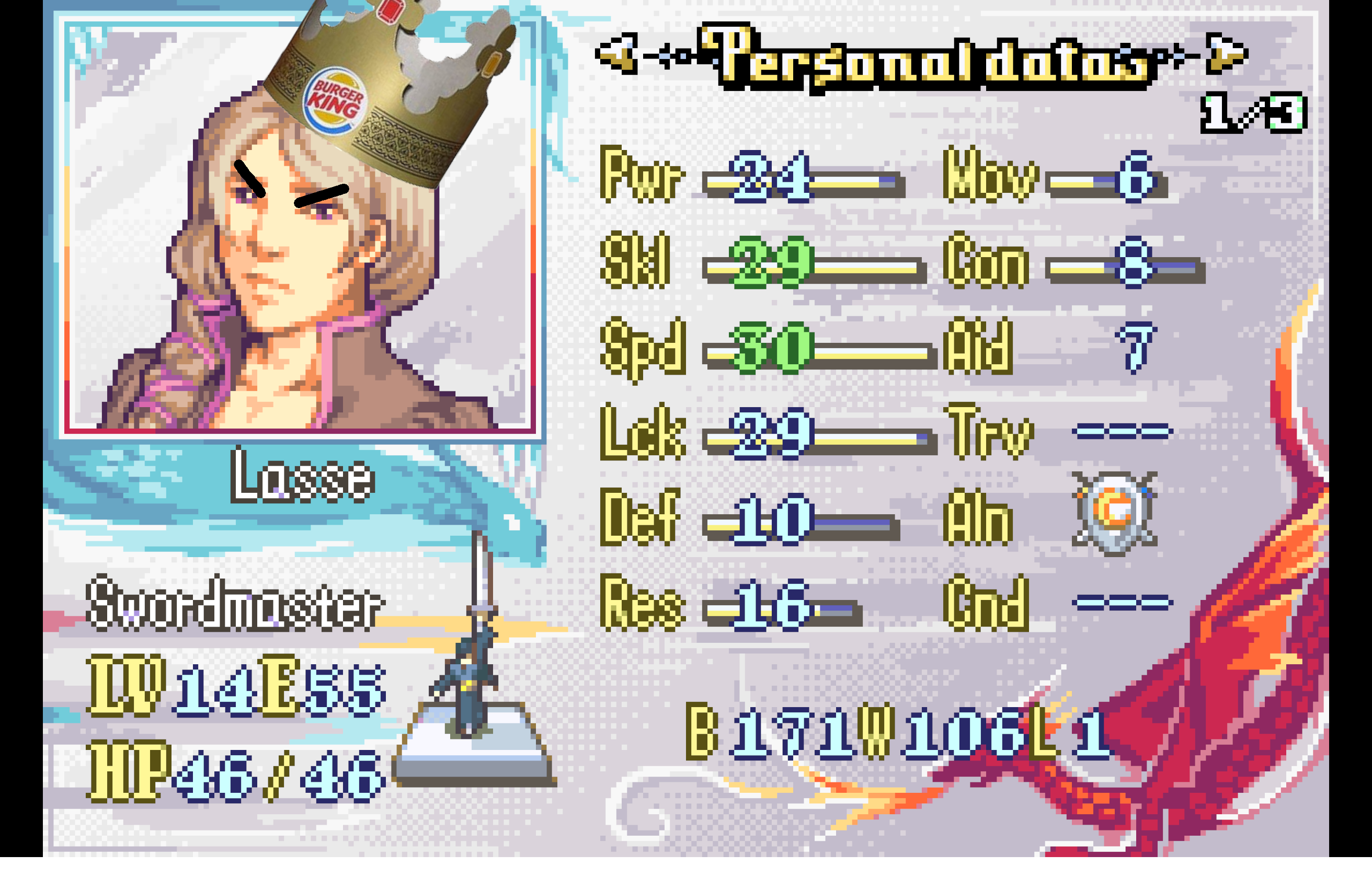
In the end, Hute wouldn’t be as interesting if we didn’t already have a prebuilt image of what an armor knight is supposed to be like. Dryche wouldn’t be interesting without Lasse and the Lord of Dance Gwyngyll standing beside her with their grand 6 move next to her measly 5. Ty works because the schema of what a “romhack soldier” is meant to be flipflops between inconsistent and nonexistent every Sunday. Only when you have built sturdy ground for the reader to comfortably stand on can you flip the script and knock them off their feet in a way that’ll make them cheer for more.



 ) | Lasara – War on Two Fronts (Griffon Rider) | Jenna – Sun God’s Wrath (Witch)
 )
)

 mbers
mbers