Mistakes I've Made in Map Design

Good morning! I’m KD. I’ve been a Fire Emblem fan for 15 years and been releasing fan games for six years. I’ve primarily, though not exclusively, worked in the LT engine, and have learned a lot across creating [Snow and Fire]( [Completed] Snow & Fire: A Tactical RPG ), [Blade and Claw]( [COMPLETE] Blade and Claw (Full Length, 23 chapters) ), [The Unbroken Thread]( Aggression Project [8/~30] ), and now the ongoing [Aggression Project]( Aggression Project [8/~30] ).

I’ve been thinking a lot about the maps I’ve made, both good and bad, and wanted to write down some advice that I wish I could give my past self. I’m not a god-tier designer, but have been doing this long enough that I think I have enough experience to at least offer some useful advice. My hope is that this thread will be yet another map design discussion where people argue about ambush spawns for a month. I also hope I can share some interesting insight with everyone here. I really hope that anyone taking the time to read these posts is willing to weigh in with their own two cents, whether or not they agree with what I’m saying. I’d love to learn from what you all have to share.

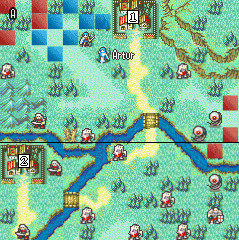
I created my first Fire Emblem map 12 years ago. It looked something like this:
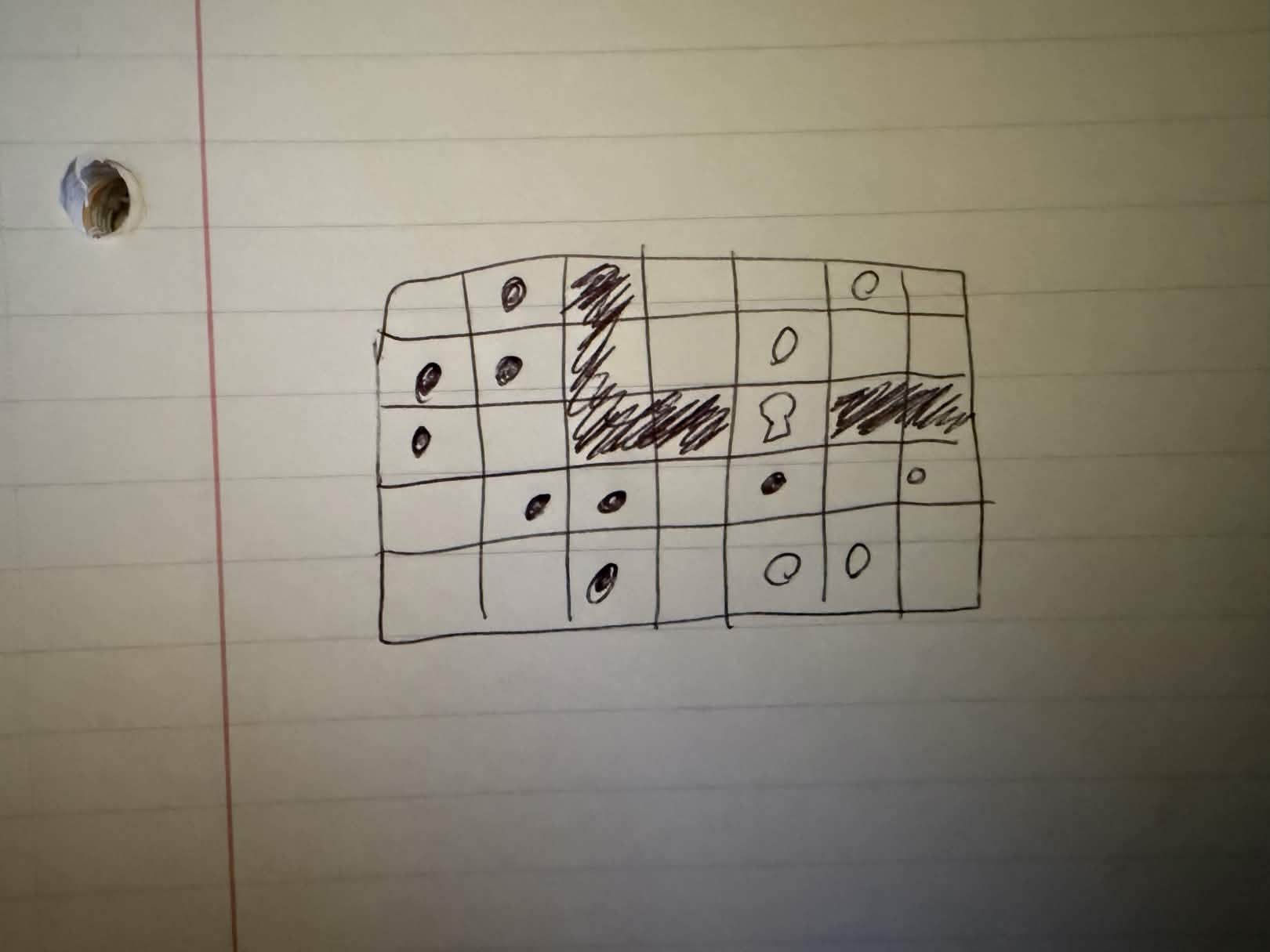
It was a prison break map, drawn on graph paper, with an enemy to tile ratio of roughly .85. My brothers and I played it out in our heads and thought we had struck gold.

Five years later I joined the Saga of Spirits team and made a few chapters that were actually playable on a computer.
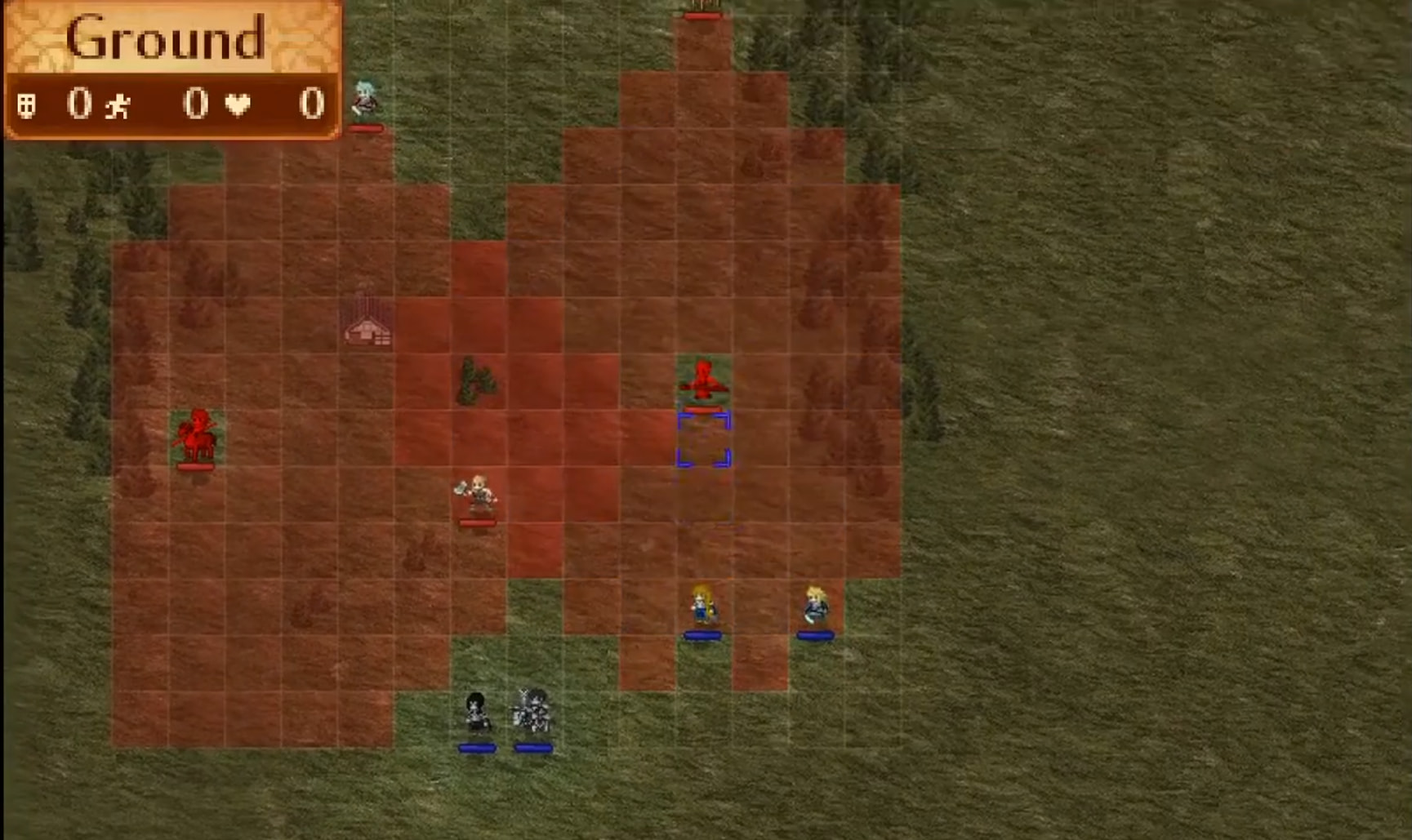
Though the files don’t exist anymore I have some old screenshots from youtube videos I made. These maps had a lot of problems but were a good first step. I could actually start playtesting and iterating on them, and got a ton of helpful feedback from other people on the team (Zech, if you’re reading this, you’re the GOAT).[1]

I eventually got bored and moved onto my first project, Snow and Fire:
Though I’ve grown to hate this game I am still proud of myself for finishing it. It was made using the old LT engine (best known for being the engine used in ZessDynamite’s far superior [Absolution]( [Lex Talionis] Absolution (32 / 32 Chapters) )) and entirely by myself. I am a huge fan of Fire Emblem 4, and wanted to recreate the way that you can paste all of FE4’s maps together to create a complete picture of its continent.
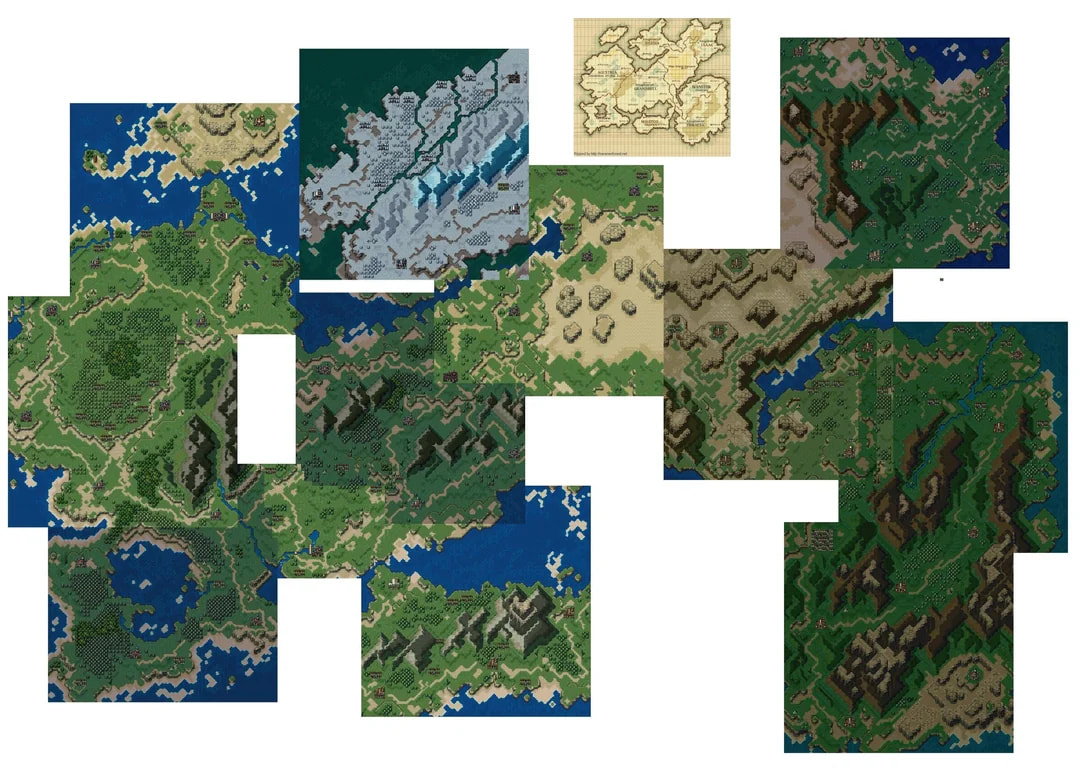
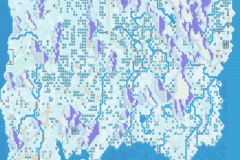
I also wanted to improve on FE4’s map design by doing more to fill in the empty space between encounters that pervades FE4’s chapters. I don’t think I succeeded in making good maps, but I was able to reduce the downtime in between enemy groups.

My map design skills magically skyrocketed when SP joined me in creating Blade and Claw.
Since then, we’ve released two completed games (the other being The Unbroken Thread), and are currently creating our third project as a team.

Every single game I just listed on has massive design flaws in at least some of its maps. I’m not writing this from the perspective of someone who has a gold star for consistently top tier map design. But at this point I feel I have enough experience to at least voice some opinions. Whether they’re at all worthwhile is up to you.

The only other thing I can think to mention is that I like to aim towards unconventional map gimmicks, more Fates Conquest style than FE7. The more outside a box of an idea I have, the more I’m drawn to it. Some of my thoughts on design, especially on how to teach map gimmicks, only really make sense with that context.

\[1\]

I want to be very clear that I am not taking credit for all of the original designs of the Saga of Spirits maps. To my memory, I designed chapter 1 solo but had significant collaboration on Prologue and 2 from other members of the team, though I’m very happy to be corrected on this. This is more referencing the slew of Gamemaker chapters I made on my own during this time.


  1. Footnotes ↩︎

12 Likes

One of the most difficult parts of game design is viewing your creation both through your intention as a designer and the player’s naive approach to it. The best games accommodate a wide berth of player experience and approaches. New game designers often take the flexibility present in their favorite games for granted and assume that it is a natural product of game design. It’s easy to believe that your intentions behind a map’s design are naturally understood by a player. They aren’t.

Most designers create maps with a particular experience they want the player to have. Oftentimes, this experience is simple, something like: “the player will battle through groups of enemies until they defeat the boss and seize the throne.” The overall strategic experience will be complimented with more tactical experience designs: “When the player reaches here, they’ll be surprised by cavalry reinforcements.” This is a natural part of design and there’s nothing wrong with it. However, it’s easy to go a step beyond and accidentally design a map with a particular solution in mind. This solution might come naturally to the designer as they create the challenge or be the result of early playtesting. There are two problems with designing this way:

1. The designer will likely make assumptions about player capabilities.

Five paladins may not be a challenge in chapter five of your game, so long as the player remembered to buy the horseslayer in chapter three. Fire Emblem is largely built around testing a player’s ability to apply tools they’re given to the challenge they’re provided. However, one of the long running design decisions of the series is to make those tools finite and unreliable. Players may lose their strongest character, miss a droppable, or simply forget to open an important chest. Mainline series games do an excellent job designing for this, but fan games sometimes forget the fallibility of their players. Though it’s unlikely that poor design will lead to your players being truly softlocked, added difficulty from a player missing an tool you assumed they would have may make the chapter so unfun that the player would rather quit than find a way through.

2. The designer will likely make assumptions about player intuition.

It’s important for a designer to remember that a player does not know at what tempo they should take the chapter. It is generally true that the best strategy in Fire Emblem is to move slowly and methodically through a map. Designers, knowing this, will often put powerful (and sometimes undefeatable) enemy reinforcements that appear if a player is judged to have taken too long. But a player, unless otherwise warned by the game, won’t be aware of these reinforcements or when they appear. I, and likely many other players, have lost chapters to punishment reinforcements spawning right behind me as I was inching my way through the chapter. Though death may be appropriate divine punishment for turtling, it’s inevitably frustrating when a player must restart the chapter because they couldn’t foresee the designer’s intention. That was a fairly egregious example, with the more likely outcome being that a player makes the chapter significantly more difficult for themselves by not approaching it how the designer intended. It’s natural and inevitable that different strategies are accompanied by different levels of challenge. However, pigeonholing valid approaches to the chapter around your intuition creates frustrating maps.

I wanted to first discuss this advice because find myself accidentally committing this error a lot. It was especially noticeable in [Blade and Claw]( [COMPLETE] Blade and Claw (Full Length, 23 chapters) ) (chapter 19 is the worst for this) and the first chapters I designed of [The Unbroken Thread]( Aggression Project [8/~30] ) (the pirate hideout map, namely). I am very prone to finding a solution to my levels as I design them and therefore assuming that solution is natural and intuitive. Because I make this mistake so often I’ve developed some strategies that have helped me reduce how often I ship a level with this problem.

1. When playtesting, never allow yourself to use the same strategy twice.

Players often desire easy and repeatable success, and the game designer isn’t excluded from that heuristic. If a solution comes to mind when designing a chapter, that’s fine. The first time you playtest the chapter, use whatever solution feels natural. However, on subsequent playtests, explicitly ban yourself from approaching the problems in the chapter in a way you have previously. If you can’t think of alternative strategies to the problems you’ve given your players, that should be a warning sign. Alternative strategies can be as simple as deploying different characters to the chapter, banning use of a strong personal weapon or skill, or ensuring that you aren’t proceeding through the chapter at the same tempo as a previous playthrough. Try completing the chapter faster and see what happens. Try taking it slower and see what happens. It isn’t a problem if some strategies are better than the others but it may be a concern if only one strategy makes the chapter feel doable. Multiple playtests with alternating your approaches to the chapter can help uncover rigidity in your design.

2. Have other playtesters.

It’s surprisingly unlikely that other playtesters will gravitate towards the solutions that you find obvious. Getting friends, fellow designers, or even randos willing to give feedback to test out your maps can give you a sense of how a chapter feels when you aren’t the one playing it. There’s been a recurring incident between SP and I that I’ve learned to understand as a sign that I fucked up. Every now and then he’ll text me and say something like “I tried your new chapter. I liked it, but it was super hard.” This, for me, is a warning sign. I rarely set out to create challenging maps, so I often hear this from SP about chapters that I thought were fairly easy. A text like that means that my knowledge of my own design intentions has drastically simplified a map that others will find very difficult. Feedback like that means I need to talk with the playtester and take another look at the design.

3. WATCH your other playtesters.

Receiving after action reports from playtesters can be extremely helpful, but watching them play often gives even more insight. Players often don’t understand why they struggled in a given level beyond surface level insight. As the map’s designer you have an naturally deeper insight into many aspects of the chapter. You can easily notice what insight the player’s missing even when the player doesn’t know that they’re missing anything. This can be difficult to schedule, and some playtesters are squeamish about being in a call with the designer, but this approach can also be immensely rewarding to your game’s quality.

An additional note on this: when watching a playtester, do not ever say anything. Give them no hints. Explain nothing. If they are frustrated and struggling do not make it easier for them. The goal of this playtesting approach is to maximize your insight on your creation through being a fly on the wall. You are not in that call to help your playtester be better at your game. You are there to be silent and learn about problems with your design that you didn’t notice before.

4. Once you’ve finished the level, take a two week break, then play the level again.

Even when attempting to be mindful and account for the your intuition as a designer, playtesting your chapter after you first create it will often give you an unnatural advantage in it. You’ve spent a long time on the map, so it’s fresh in your mind and can’t surprise you. This can greatly reduce your ability to balance and improve the chapter, as it will always seem easier than it actually is. Instead, once the map’s in a reasonable state, move on to the next chapter or focus on writing/art for a while. Then, come back once your memory of the level has faded. I most benefited from this approach while making Chapter 3 of [Aggression Project]( Aggression Project [8/~30] ). I playtested the map extensively when I first created it, and moved on extremely happy with its quality (and thought it was fairly easy). When I returned to the chapter a month later while doing final playtests before the release I could not find a way to beat it consistently. To this day, I have no idea how the hell I cleared the early versions of that map so consistently. Reviewing the map the a fresher mind I realized the both the enemy quantity and quality was far too high. I turned it down and am extremely happy with where the chapter ended up.

17 Likes

Very nice write up, thanks for posting. I agree with all that you said, and would like to explore a couple points a bit further that I feel are important, in my own opinion:

  1. FE is a game of plot, dialogue, characters, tactics & RNG, to varying degrees. I really do think maps & gameplay ought to be derivations of plot. I understand this is tricky, as many view plot as an afterthought, only to focus on gameplay - which still leads to fine games, but in the case of tempo-dependent reinforcements, while a bad idea on their own, they can be implemented well if the player expects it - and the easiest way for them to expect it is from plot cues. The tempo of a chapter, or even difficulty, whatever the designer’s intentions, can be explicitly detailed to the player through plot devices in said chapter’s intro. I see no great harm in this - only a benefit.
  2. I’m of the opinion that peaks and valleys are OK (as long as insurmountable difficulty spikes are avoided.) Big, in-depth, thought-provoking, & challenging chapters with interesting objectives are great. Simple chapters are good too. Having chapter after chapter of the former can get exhausting, and having chapter after chapter of the latter can get boring. A lot of mainline FE maps are open field route chapters, and in between everyone’s magnum opus map chapters, I do welcome simple, straightforward maps that allow me to play carefree for a chapter. The same can be said of difficulty - I do not think every chapter needs to be equally balanced. I like challenge, but there is also enjoyment in destroying weak enemy units with my own. This is another case where plot can serve to explain such a difference.
  3. Early game control. Obviously, the beginning of a game is easier for a designer to control. The player only has access to the base characters & their stats, and the few items they’ve been given. Here is where you may get away with forcing the player to find a particular solution to a chapter, and I don’t mind as a player (my opinion.) I find short, challenging, early game chapters fun - even if they’re so challenging that I end up restarting several times to pinpoint THE proper strategy. I don’t think this is so bad in a controlled environment - unless THE proper strategy is some convoluted, out-of-left-field sort of thing, or your characters get OHKO’d otherwise sort of thing. However, once the game starts rolling, and RNG, player-decisions & outcomes come in to play, the notion of boxing the player into one strategy must go out the window, as you explained. There becomes too many unknown variables to design around, and softlocking/discouraging players can become a thing. Of course, this can be avoided by making the chapter so easy that no one could fail under any circumstance, but who wants that? The reality of designing FE is that you have to playtest chapters many times off many playthroughs - different characters used, different character level ups (e.g. can’t playtest solely w/ a stat-blessed unit on a random playthrough), different inventories, etc.

I write this knowing that not everyone does everything. Many design maps with an idea in mind, but have no say in the plot or enemy placement, and vice versa. I don’t know how many times I’ve created a map, making it look good and enjoyable to play, only to write my chapter after and have it mesh horribly with said map. Or the times I’ve written a chapter, outlined my idea for it, and been unable to create a map that perfectly captured my intentions. Hell, sometimes I make nice maps only to struggle deciding where to actually deploy ally units. It’s tough, and the perfect map doesn’t exist - that’s why I think flexibility is important. In order to have special maps, you have to have some maps that aren’t that special.

7 Likes

Breather maps are one of the best design concepts that SP introduced me to. Breather maps are a simple concept that can massively improve a player’s experience in your game. The core idea is that one or more extremely difficult chapters should be followed by an easier map that allows the player to relax. This follows an extremely insightful video on Masahiro Sakurai’s YouTube channel called [Stress and Release](https://www.youtube.com/watch?v=TYh5SJb5gWk&pp=ygUjbWFzYWhpcm8gc2FrdXJhaSBzdHJlc3MgYW5kIHJlbGVhc2U%3D). The fun of video games largely comes from the experience of being put under stress by the game and then feeling a euphoric release when that stress is conquered. This should sound familiar to anyone who’s ever beaten a FromSoft boss with 1 HP remaining (or to anyone who’s cleared conquest chapter 10 blind).

Fire Emblem maps fit into this stress and release concept as well. Tough maps with strict pressure add growing tension as the player nears the finish, with the completion of the map heralding the release. This is a great feeling, and it’s amplified the more the stress is applied. Unfortunately, repeatedly applying extreme stress to a player will cause a long-term mental taxation. That release at the end of the chapter won’t be enough to compensate for the mental fatigue the player just endured. Mental breaks help refocus the player by giving them opportunities that are designed for them to succeed in. Just like in Thracia, the player needs a chapter to reset their fatigue, lest they begin to find your game permanently draining.

The mainline games already do this. Conquest 10, often considered to be one of the hardest chapters in the series, is followed by The Rainbow Sage, a slow and trivial chapter. Thracia’s Manster arc is concluded with and succeeded by the chapter 7 and 8, the first truly easy chapters since chapter 3. Blade and Claw also does this well with chapter 11, its shopping episode, following a series of pretty brutal levels.

Designing a breather map can be tricky. You don’t want the map to be outright boring, but the player should be able to recognize that they won’t need to immediately lock in. The map should also pay special attention to tools that the player may now be missing. They might’ve just lost their best character or broken their silver sword. The best breather maps often provide perfect opportunities for a player to train up benchwarmers that have now been promoted onto the main roster. A good rule of thumb is to minimize the impact of time pressure. Having a timed chest or village objective may still help the map play well without threatening a full party wipe. It’s also important to keep in mind that mental fatigue from the previous map may cause a player to make more mistakes than they normally would–if at all possible, design these maps with a little more forgiveness to compensate.

Ultimately, I’ve found that I’m best off working breather maps into my initial game plans, rather than trying to ad hoc convert chapters into breather maps. Explicitly planning for my game’s peaks and valleys of difficulty helps smoothen out the player experience. I’m curious to know if other creators have experimented with breather maps and how they’ve turned out for you. I’m really only familiar with the ones in the main series and my own games.

8 Likes

Thanks for responding!

  1. I think this is really interesting. Would you worried about players potentially skipping the plot and then finding themselves caught out unexpectedly? Or would you consider that be on them for not paying attention?
  2. 100% agreed! I actually had planned a post about that for today.
  3. Agreed here as well. I try and shy away from puzzle-like early game chapters because I don’t want to give a bad first impression, but to some extent it is unavoidable and definitely not always a bad thing. When I played Souls of the Forest I thought it was interesting how, on my first time through, I thought chapters 1 and 2 were puzzles with only one or two solutions, but on returning to the game later my opinion completely changed. I guess that suggests it’s hard even for an outside perspective to identify what is a puzzle and what isn’t.
1 Like

Your point about playtesting for later chapters reminds me of some code I wrote a month or two ago. I should probably make this its own topic on FEU but I’ll mention it here for now.

This isn’t at all a replacement for in-depth playtesting but may [help]( Discord ). Pasted as a discord link since .zip files are disallowed.

From the discord messages:

  1. One thing that I’ve struggled with for a while is figuring out what levels my units will be at a given point in a game

  2. Will they be behind the enemy level curve? If I start putting promoted units here and I gonna screw the player? Etc.

  3. So far my solution has been purely vibes based, where I do a bunch of test runs and decide based on what feels good

  4. The python code in the zip file above can provide you a way to estimate player levels with much more accuracy

It’s set up to take a list of levels, reading the level’s enemy data directly from the json. The user can specify some other details about that level to get a more accurate estimation.

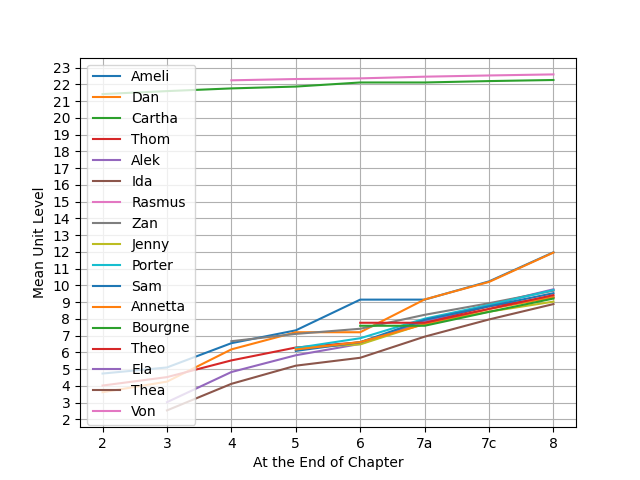
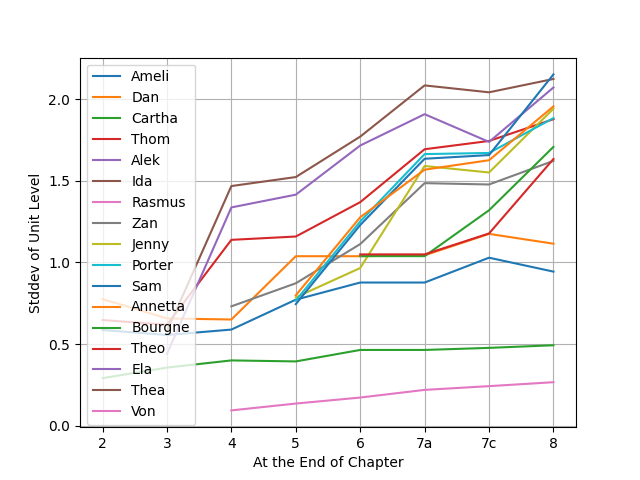
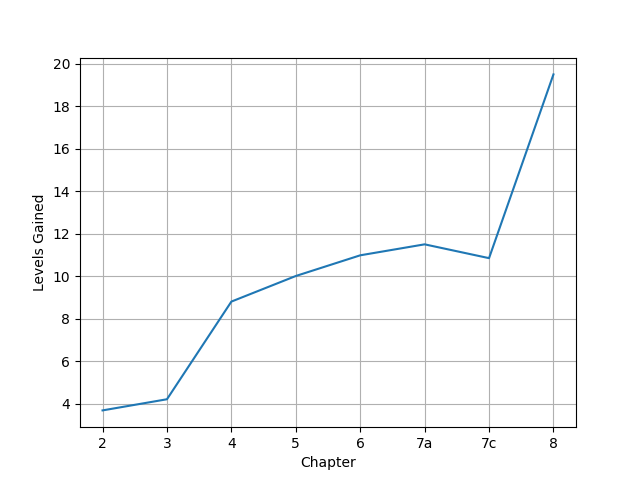
Then, it performs a user-specified number of playthrough simulations and estimates the amount of exp you have on any given level. For the Aggression Project, for instance, here’s my units’ mean exp across 100 runs, the standard deviation of those level values, and the amount of exp I’m gaining per chapter.

This is all a simple set of python scripts. Easily runnable with any LT game.

Again, this is not at all a substitute for careful playtesting. But it’s helped me make educated first guesses and spend less time turning enemy level values up and down.

5 Likes

Maps are more interesting when the enemy types on it tell a story. Enemy variety is important in Fire Emblem, especially in the context of the weapon triangle, but the visual details of that variety can add a new dimension of quality to a chapter.

Imagine if the monster chapters in FE8 had random cavalry enemies peppered around the map. It would be a little bit weird! On one hand, it may help the design as some of the maps, as the monster faction in FE8 lacks the fast moving ground reinforcements present in Grado’s roster. But any benefit to map design would be outweighed by the strangeness of seeing enemies whose presence breaks the game’s setting.

Near the end of FE9, Daein starts to deploy laguz enemies. The reason for this, in a meta sense, is that the developers wanted the player to face a wider array of enemy units. They didn’t have a plot reason for Ike to fight the laguz factions, so they instead created a story justification for the presence of laguz in Daein’s army. Explicit attention was paid to the details of enemy variety, as the developers otherwise knew that the mixing would be jarring.

All this probably seems fairly obvious: different enemy factions should be different. But I think fan game creators have the opportunity to go a step beyond where most mainline games are able to. Our access to a massive repository of fan created content allows us to create more in-depth points of difference between factions in our games. For example, the basic sword infantry of a professional army may exclusively be the mercenary sprite, while a guild of assassins use the myrmidon sprite. Even if the actual stats and functionality of these classes are the same, this added variety will make your game feel more polished. Many people won’t notice this level of effort, but those who do will really appreciate the care you’ve put into your world.

Unbroken Thread has an example of this in the mountain areas of the game. The great knights that appear there are a commonly used great knight map sprite. In terms of gameplay they are, minus a special ability, simply mounted axe units with high defense. SP was careful to only have great knights appear in relation to the fire dragon. This gives them a flair and flavor that gives their appearance weight. If they had appeared in a different chapter it would be a great “oh, shit” moment and caused players to look for a connection between the enemies in the chapter and the fire dragon.

8 Likes

That’s an interesting concept. I’ll implement it in my game whenever I’ll make it.

Great post. Do you have any specific thoughts about difficulty tuning? I want my hack to feel challenging, like Fates: Conquest and Berwick Saga, but I know that much of it has to do with creating “puzzles” within the map. I have to get good at creating gameplay puzzle scenarios, I suppose.

1 Like

It’s a really tough problem because different people always have different levels of skill. My intuition is to make things a tiny bit easier than you want, as “a tiny bit easier” will still end up as “pretty hard” for most other people.

My other advice would be to read feedback carefully and learn when to not listen to it. If you’re making something difficult there will always be people that complain about it. Some people are going to be immediately frustrated if they can’t beat a chapter flawless first try. They’ll express that frustration, and it’s up to you to determine whether what they found to be too hard actually is, or if they just made too many mistakes.

Speaking of ignoring feedback, many creators also need to learn to not let it compromise their core vision. A lot of us are people pleasers. We want to make games that people like, so if we get negative feedback we’re inclined to change things to match that feedback. This is often a bad intuition. If you’re making a game like Berwick Saga and someone tells you “I don’t like hex grids, you should change it to square tiles” it’s completely reasonable for you to say “too bad!” Not every game is for everyone. If you make a divisive choice for one of your mechanics that’s great, but just understand that it will be divisive.

Finally, playtesters are often adept at gesturing towards the existence of a problem but aren’t very good at identifying the root cause of their feeling, or the correct solution. Note the frustration and explore creative alternatives to alleviate it.

5 Likes