In just about any fantasy setting where swords and sorcery coexist, there exists the idea of the spellblade, the ultimate duelist who wields weapons and magic in tandem to take down any foe. Mastery of both forms of combat grants them the flexibility to adapt to any situation and hybrid techniques masters of only one or the other could never match. So, naturally, this concept of the hybrid mage and martial warrior has made its way into Fire Emblem. Most recently, it was called the Mortal Savant, and as any of you who’ve played Three Houses knows,
It.
F*cking.
Sucks.
Hybrid units, units with access to both a physical weapon type and a magical weapon type, are a common sticking point in FE design, both in vanilla and, of course, in hacks. Just about everyone loves the idea. But almost always, hybrid units end up underperforming compared to specialized competitors, and when they don’t, it’s usually because they forego one half of their weaponry entirely and play exactly like them. So, what gives? How did we start from “ultimate flexibility” and end up at ultimate mediocrity? Let’s take a look.
Master of None: How “Flexibility” Can Make Units Weaker
Fire Emblem is a game all about matchups. The Myrmidon beats the Fighter by hitting twice into their low defense and dodging their inaccurate counterattack. The Knight beats the Myrmidon because, even with two swings, the Myrmidon can’t dent their armor. The Fighter beats the Knight by having the power to break through their defenses, and the Knight is too slow to dodge it. Magic adds an additional dimension to the dynamic by targeting a different defensive stat, one which most units are more vulnerable to but some units are exceptionally resilient against. The value of the hybrid unit, on paper, is that they can switch damage types to target whichever opposing defensive stat is lower, and so have a positive matchup into any enemy type. In a game all about choosing the right matchups, this should make them very strong. I’m sure anyone reading this can intuitively understand why. Unfortunately, that leads to a problem, which is that the intuitive next question to ask is the following:
If the hybrid unit has a good matchup into everything, how do you make more specialized units with only one damage type worth using?
The natural response is to make those units better into their individual winning matchups. That way, the player has a choice: deploy a more specialized unit to deal with the enemy types they’re good against at the cost of being weaker against the ones they match up poorly into, or deploy the flexible hybrid to match up decently into both. This usually results in one of two scenarios. Either your hybrid unit goes the route of the easy mode cav, where enemies aren’t strong enough, or the difference isn’t large enough, for the specialist unit’s stat advantage to matter, and the more flexible hybrid unit is simply better in all scenarios – you have failed to address the prior question. Alternatively, your hybrid unit suffers the fate of the average hackrom Hero. Here’s the thing: when enemies are strong enough to make them useful, Fire Emblem gameplay greatly favors specialists.
Consider the following: you have two enemies, enemy A and enemy B. In your army, you could deploy two well-rounded, flexible units. Both units have a positive matchup into enemy A and enemy B, but neither kills either enemy in one round. Or, you could deploy two more specialized units. One kills enemy A immediately but can’t touch enemy B. The other kills enemy B but explodes on contact with enemy A. The generalists take down one enemy on the first turn. The specialists kill both, and so neither has to face their bad matchup.
The player, having multiple units at their disposal and the advantages of smarter play and going first, has immense control over which matchups they actually take with which units. When played correctly, a more specialized unit’s poor matchups can almost always be covered by another allied specialist with an opposite matchup spread, and this allows the player to make progress at the rate of the specialists’ highly-advantaged matchups rather than the generalists’ merely decent matchups. This is not a problem in itself – on the contrary, optimizing for this is at the core of what makes FE strategy interesting and engaging – but it means that our hybrid unit, whose primary advantage is being able to match up decently into everything at the cost of not being as strong on either side as a specialist, doesn’t really have any advantage at all. And that means they’re not actually flexible – sure, you can use them everywhere, but you don’t want to use them anywhere.
Master of One: Weapon Types Aren’t Created Equal (And Shouldn’t Be)
So, flexibility alone doesn’t make a unit work. If their damage output on each side is worse than that of specialized single-damage-type competitors, the hybrid unit will inevitably struggle to keep up, much like a Mercenary who has no clear weaknesses but lacks the speed to consistently double or the strength to consistently OHKO. But we can’t just give the hybrid unit stats as good as those competitors, because otherwise they just outclass them, right?
Well, first of all, I should note: you absolutely can. Fire Emblem is a single-player game. Not all units need to be created equal. “Balance” is neither necessary nor necessarily good. Some classes can simply be better than others, balanced by being rarer or only joining later in the game.
But of course, you didn’t come here just to be told hybrid units have to be overpowered or else they suck. You came here because you want to make them interesting to use, presumably on reasonably-even ground with other units in the army. So, let’s talk about what actually makes hybrid units unique: their weapon access.
Having access to both a physical weapon type and a magical weapon type is so much more than just being able to target your choice of Def or Res. Every weapon type has its own set of specialized tools – effective damage, extended range, boosted power, higher accuracy, defensive bonuses, etc. – and by having access to both a physical weapon type and a magical weapon type, you get access to a much more unique combination of these tools than a unit with two physical types or two magical types would normally get. By properly leveraging the unique specialized tools of each of your vastly-different weapon types, you can have a set of not just “decent” but truly winning matchups that no other unit can match. You can thrust a Ridersbane into a Cavalier, then turn around to blast a wyvern with Aircalibur, dunk a Myrmidon with a Swordreaver then fire a Bolting across the map, shred a Warrior with your Brave Sword then Nosferatu to survive enemy phase. This is where the strength of the hybrid unit truly lies. However, it also brings us to the other elephant in the room:
In nearly every Fire Emblem game, vanilla or hack, tomes are near-universally better than physical weapons.
It is important to note that I did not say mages or physical units. Balancing mages against physical units is well-understood: in exchange for the advantages magic provides, you almost always have fewer mages to work with, and they’re almost always much more fragile and/or less mobile than their physical counterparts. But when you have a single unit who can use both physical and magical weapons, and the physical weapons are all 1-range except for the poorly-statted Javelin or Hand Axe and the magical weapons are all 1-2 with solid accuracy while hitting the defensive stat that’s almost always lower, why on earth would you ever use the physical weapon?
I’ll take a moment to say that that question, “why would this unit want to use this weapon type”, is something you should ask yourself any time you give a unit access to multiple weapon types, regardless of what they are. But for hybrid units in particular, in any remotely-standard FE sandbox, it can be a tough question to answer.
The first thing that everyone instinctually thinks of is “well, you’d want to use physical weapons against enemies with high Res, right?” And this is true. However, it rarely matters. The vast majority of enemy types have higher Def than Res. The ones that have higher Res than Def can almost always be handled by another unit just as easily, as your army will usually have more units that deal physical damage than magical damage. And on top of that, even in some of those high-Res matchups, you might still want to use magic because it lets you avoid a counterattack by attacking from range.
Similarly, you might think of the weapon triangle. Surely being able to use a sword against an axe-user for those sweet sweet triangle bonuses means something, right? And, well, it can, but once again, the inherent advantages of tomes often let them do the same thing. Reducing enemy hit rate doesn’t matter when they can’t counter at all, and the damage difference from targeting Res instead of Def is often larger than that gained from exploiting triangle. Conversely, tomes ignoring the weapon triangle (magic triangle is almost always fake and we all know it) is often an advantage for surviving enemy phase against a group of mixed-type enemies, a scenario especially common in hacks where enemies tend to be more varied than vanilla.
The inherent advantages of boosted range and Res-targeting are often so strong that they even outperform highly-specialized physical tools like effective damage – why bother with a Hammer when armors trivially go down to standard tomes? And on top of that, those specialized physical tools are often in high demand from other units who don’t have magic and so need access to them more.
Now, there seems like an obvious solution to this, and it comes in the form of the Strength and Magic split. Simply give your hybrid units worse Magic than Strength, give a few more enemy types meaningful Res stats, and now they’ll get enough more damage out of physical weapons in enough matchups to be worth using, right? And while yes, this is the correct idea, you now also have to consider the question from the opposite side. If the unit is so much better at using physical weapons than magical weapons that their magic now has no winning matchups, what’s the point of them having magic at all? The inherent advantages of tomes can help patch this up – it will often still be a superior option for dealing safe 2-range chip damage than the far more limited and less-reliable 1-2 options physical weapon types normally provide – but as tomes are often lacking in specialty tools compared to physical weapon types (which is itself a different problem, worthy of another post), this usually relies entirely on those baseline advantages to keep magic relevant, and the worse the user’s magic gets, the less unique those advantages become over the humble Hand Axe.
This is the problem that ultimately stymies the “good” hybrid classes in vanilla. Malig Knights almost always either use tomes near-exclusively or prefer to reclass to Wyvern Lord for better physical stats; Oni Chieftain is basically only used to reclass a magic-primary unit into something with better defense, outside of Kumagera who starts in the class and has no better options; Echoes Priestesses having access to swords is often more drawback than anything when they counter with basic sword instead of fire tome on enemy phase; and when have you ever seen a Mage Knight swing a sword that isn’t Levin?
Master of All: The Balancing Act – Flexibility as Specialty
So, let’s review. We can’t make our hybrid units equal in stats to our single-type units, or else we end up with them just being straightforwardly better, which isn’t interesting. But we also can’t just make them worse, or they won’t be useful at all. We can’t make them too good at magic, or else they’ll just be glorified mages. But we also can’t make them too bad at magic, or else there’s no point in having it. In striving to create a unit who thrives on flexibility, we instead end up with one whose meaningful options feel more restricted than ever. But we’ve also learned a few key points for what makes units both interesting and effective:
-
Fire Emblem combat is all about matchups.
-
Advantages, whether of unit stats or weapon functions, need to come with meaningful tradeoffs.
-
It is generally more important to have meaningful winning matchups than it is to have fewer losing matchups.
-
Access to unique combinations of specialized tools can create unique sets of winning matchups.
And we’ve asked ourselves two fundamental questions, which we’ve seen have to be asked in both directions of every comparison:
-
Why should I use this unit over other units?
-
Why should this unit use this weapon type over their other weapon types?
Ultimately, so long as you can answer these two questions in a way that actually matters in practice, you can make your unit interesting. And you’ll realize that this actually applies to all units, not just hybrid units – hybrids are just the most polarized example. The four key points above then show us how we can answer these two questions – not the only way, of course, but a pretty good guideline for thinking about it. So, let’s put it into practice for our hybrid unit example:
By having access to both physical and magical weapon types, a hybrid unit can leverage unique combinations of specialized tools. They need options in each weapon type that allow them to do things the other weapon type can’t do, giving them a reason to use each weapon type over the other, and by having both sets of tools at once, they can gain a set of meaningful winning matchups that units without a hybrid weapon combination don’t have. Other units, who specialize in purely physical or magical damage, can in turn have a stronger range of matchups within that respective damage type, possibly without relying on those more specialized tools, giving them their own reasons to be used over the hybrid unit without either eclipsing the other.
Higher raw damage output with physical weapons over magical weapons is generally useful to create a tradeoff against magic’s advantages, but it’s not inherently the necessary factor – it’s just one way to help achieve uniqueness in the matchups each weapon type offers as opposed to the other. Introducing more variety in enemies having more Res than Def can also help, but again just another piece in service of the bigger picture of making both weapon types worth using. Other tradeoffs aside from damage (whether raw or based on use of specialized tools like effectiveness) can include range, accuracy, speed, survivability, etc., and you should really consider all of them – damage tradeoffs only go so far, especially as a unit’s offensive stats grow. You can also consider making some of those inherent advantages of magic less universal – have more tomes with only 1 range or 2 range instead of 1-2 – though do be aware that if taken too far without compensation elsewhere this can feel bad to players who expect otherwise.
If you start to think about the environment this is asking to create, you’ll see that hybrid units work best in a setting where the tools available to different weapon types are meaningfully differentiated – both between different weapons in the same damage type, and between physical and magical weapon types. That allows them to get the most value out of their unique weapon combinations. So, if you’re thinking about adding hybrid units to your hack, you might also want to think about adding more weapons with unique effects not shared by other weapon types, instead of giving all of sword/lance/axe a copy of every effect given to one of them. If each weapon type, physical or magical, has a defined identity with defined strengths and weaknesses, that makes it easier to answer the “why should this unit use this weapon type” for any weapon type combination. Of course, that’s a topic to go more in-depth on another time.
“Flexibility” is the Designer’s Role
Is this the only way to make hybrid units work? No, of course not! There’s a time and place for the “genuinely just better” unit who can immediately slot into any role the player’s team is missing, or the “just kind of okay at anything” unit who can pivot to shore up a plan gone wrong. There’s also room to make hybrid units stand out from others by simply making their statlines different. For example, pure mages rarely have good defense, pure physical units tend not to have great res, and enemy phase is where traditional magic’s inherent advantages of constant reliable 1-2 and weapon triangle neutrality offer the most to a unit with good defense even if their damage output is poor. I’ve admittedly underplayed defensive contributions somewhat in this writeup, but a unit that specs into surviving both magical and physical attacks at once does offer something truly unique in the right situations by proactively baiting and weakening multiple enemies, and it’s a role a hybrid class can fill that can, with the right setup, get use out of both weapon types without directly competing with specialist users of either. And there are scenarios where “flexibility” alone can actually become valuable – the specialist’s advantage assumes that you actually have another unit available to cover their weaknesses, but if deployment and action economy are more tightly-constrained, you start to need units who can compress multiple roles into one slot. And of course, none of this is touching on things like skills, prfs, or other mechanical additions to the game that introduce entirely new axes for unit differentiation.
My goal, ultimately, is to encourage you to think. Think about how to make your units different in meaningful ways. The hybrid unit does not have to be eternally consigned to a boring middle ground, nor does it have to devolve into only one weapon type mattering. Like with any other unit type, you just have to ask yourself how to make their unique traits matter.
That’s a Nice Argument, Ultrax. Why Don’t You Back it Up with a Source?
Here’s the part where I talk about some notable hybrid units in hacks, and how they’ve each addressed this. Let’s start with an example from one of my biggest inspirations when it comes to design fundamentals, Faces of a Stranger by ArcherBias.
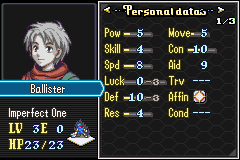
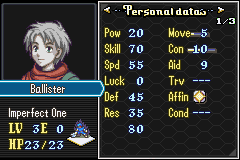
This here is Ballister. He wields a mix of magic and axes. One thing you’ll immediately notice is the lack of a separate Magic stat – splitting Strength and Magic often makes hybrid unit design easier, especially when there are multiple of them, but it isn’t necessary so long as you can still give an answer for why the unit in question would use each weapon type.
Now, before I go further, I should address the elephant in the room. Faces of a Stranger is set in a world where magic is, for the most part, both forbidden and forgotten. Ballister is one of only two actual magic-users in the game, with the other being one of the main protagonists, Silt, a traditional mage. However, in place of other magic types, Faces instead has two new weapon types that function in largely similar ways to magic design-wise: bombs, which hit Res but are locked to 2 range by default instead of 1-2, and knives, default 1-2 weapons which ignore enemy defenses entirely but have very low might. As you can imagine, bombs being 2-range-only imposes an inherent reason for bomb-wielding “hybrids”, such as the lance/bomb Soldier and the axe/bomb Brigand, to use their other weapon type any time they need to fight something on enemy phase. Knives, on the other hand, are primarily limited by their users’ poor durability, but also by the fact that ignoring enemy defenses outright really isn’t much different than hitting Res in the majority of matchups, and that low might is very low. There also isn’t really a “hybrid” knife user worth talking about, as the knife classes are either knife/bomb, knife/healing, or knife/sword, and the only playable instance of the last one joins late and underleveled (though, if used, he does end up having to lean on the high power of certain effective swords just as much as he leverages knives). But Ballister’s tomes are true, traditional tomes, with all their advantages. So, how does he set himself apart from Silt and the variety of other axe, knife, and bomb units?
You may have immediately noticed something about Ballister’s Power stat. It’s, uh, bad. Very bad. Ballister has extremely poor natural attack power. He’s not killing anything with basic weapons. In comparison, Silt around the time of Ballister’s recruitment is able to blow up nearly anything in his path with his Thunder tome, and even the party’s knife users are hitting harder than the cursed child. Of course, Silt has to be careful of how often he uses that tome, as they’re not exactly selling replacements in a setting like this, but the same goes for any tomes the player might want to give to Ballister, a unit who can’t match Silt’s damage. So, what does Ballister offer? Bulk. Specifically, mixed bulk. Ballister is one of the only units in Faces to have a Res growth above the single digits, and his base of 4, while it may not look impressive at first, is actually reasonably high by Faces standards. Silt also has good Res, having a traditional mage statline, but Ballister has him completely outclassed on Defense – 10 base at his join time is exceptionally high, outdone only by the armor knight Ferris. Ballister also has good enough speed at base to avoid being doubled, and his speed growth will outpace that of most enemy types to start doubling reasonably consistently with investment. This positions Ballister in a place where, although he may not do much damage, he has a unique ability to take on multiple enemies at once with a lightweight and accurate 1-2 tome equipped and without fear of bombs or Voltage Pikes. That’s his primary sales pitch with tomes. But what about the axes?
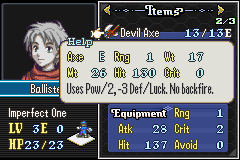
What about the axes, indeed? The Devil Axe that Ballister comes with is an extraordinarily powerful weapon, limited by its high weight and defensive penalties but more importantly by its low uses. The Devil Axe’s ridiculous might works as a solution to Ballister’s kill power problem for a while, OHKOing many enemy types throughout the next few maps, and while other units can certainly use it to good effect, its use of only half the user’s strength stat is a penalty that means more to them than it does to him, meaning they can often afford to use other axes and leave the Devil Axe for the boy. Of course, much like his tomes, Ballister only gets so many swings of this mighty axe, but by the time it runs out, it won’t be alone – while none are quite like the Devil Axe, axes across the board have the highest might of any weapon type, which is the exact thing you want when you suffer from poor strength but have sufficient combined speed and con to double. By the time the Devil Axe runs out, Ballister will be able to use other axes like the Steel Axe, Hammer, Swordreaver, and Killer Axe to cover his power deficit, and while he won’t hit the OHKOs stronger axe-users like Theria or Calibre can get, axes’ high power means a trained Ballister can still output respectable damage by doubling in the right matchups. Combine that with his unique enemy phase potential with tomes and his general high survivability into threatening enemy formations, and you have a unit with a very unique matchup spread defined heavily by equal use of both of his weapon types and the distinct tools they offer.
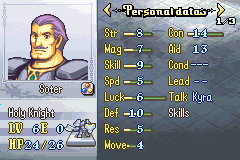
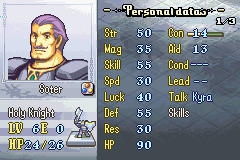
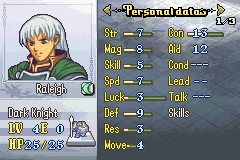
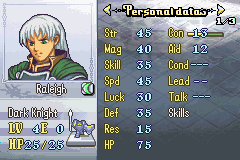
Now, I can’t do a writeup on hybrid units without mentioning some of the most iconic hybrids in recent history: the armors from Hag in White by Saint Rubenio. Specifically, I’ll be focusing on the first two, the axe/anima Soter and the lance/dark Raleigh. These spell-slinging stalwarts are some of the most popular 4-mov armor knights ever featured in a hack, and their hybrid nature is no small part of why – it’s a lot easier to stomach training a sluggish 4-mov statstick when they have the best enemy-phase weapon type there is, made even more relevant in a game where healing is so limited and bulk is at a premium. Their limited mobility also provides a natural tradeoff compared to both pure mages and pure physical combatants without having to skimp on combat. But from the lens of this discussion, there are still some issues to address here.
Let’s start with Soter. His Strength noticeably outpaces his Magic, and the high might of axes like his starting Steel Axe complements this well. Between that and the poor damage output of the basic Fire tome he starts with, the clear idea is that he focuses on axe combat for damage while his tomes are used as more of a sidearm to chip things at range and counter ranged enemies on enemy phase. However, in practice, this is a tenuous balance at best. While his damage output with axes may be higher on paper, he’s obviously too slow to double reliably and his strength isn’t high enough to reliably secure OHKOs, so the difference often isn’t meaningful, especially as enemy defense scales and he gets access to stronger tomes. But at least it is still a tradeoff that exists, and he will usually still carry an axe or two in his inventory for when the extra damage comes up.
Raleigh, on the other hand… frankly, you could show me an endgame Raleigh with base lance rank and I would not be surprised in the least. Raleigh’s magic actually starts out higher than their strength, with roughly even scaling, and lances in Hag are notoriously lacking in unique options to make them ever worth considering. And in addition to lances being an inferior challenger compared to Soter’s axes, Flux as a basic tome is also much stronger than Fire, so Raleigh doesn’t have to wait for Hurricane to show up before their magic offense gets rolling. Raleigh has basically no reason to click a physical weapon at all until they promote, and if they promote to General, that doesn’t really change – picking up a middling axe rank at that point is hardly going to unseat dark magic from its dominance. And yet, on the whole, Raleigh actually tends to get more use out of a physical secondary weapon type than Soter does, and it all comes down to what weapon type their other promotion option gets. As a Dark Knight, Raleigh can promote to Black Dragoon, shedding their armor in exchange for a horse and picking up access to the best weapon type in Hag: bows.
Now, compared to the melee triangle, bows have a much easier time competing with magic in general. Both attack from 2 range on player phase, and bows’ inherent advantage against fliers is an inherent matchup advantage magic often lacks – even the presence of anti-flier wind tomes is often inferior to bows against high-Res pegasi. Bows also offer the extended range of the longbow to hit foes from 3 range, something that, in most cases, magic either can’t do at all or can only do with extremely heavy tomes. Magic will still often be better into other matchups if the weapon might and attacking stats are comparable, but bows in Hag take this a step further with a weapon called the Cleave Bow. Requiring only D rank in the weapon type, the Cleave Bow augments the flier effectiveness with effectiveness against both cavalry and armor. Its raw stats don’t particularly suffer in exchange, and what’s more, this weapon is buyable en masse from a shop in chapter 11. Between Cleave Bow and Longbow, Raleigh’s bow rank puts in constant work after promotion, entirely because of the unique tools this weapon type offers to compete with magic’s inherent advantage.
Unfortunately, despite Hag being known for its high density of unusual hybrid classes, this pattern largely repeats. Hybrid units with physical ranks other than bows rarely make much use of them unless their magic stat is so poor as to make their magic largely useless instead. They succeed in unit differentiation from competing pure physical or magical attackers by means of their statlines, but struggle to actually justify all of their own weapon ranks existing simultaneously.
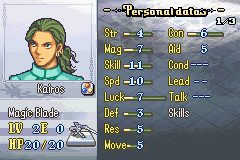
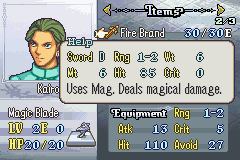
While on the subject of Hag, I also want to touch briefly on the subject of magic swords, and the specialist wielders thereof that often appear in hacks with split Strength and Magic stats. Magic swords, and magic sword specialists like Hag’s Kairos, have a lot in common with hybrid units on paper – you have a unit who primarily uses a physical weapon type in melee, but is also able to attack magically at 1-2. However, there is a quite significant difference in how they actually play. Compared to proper magic, magic swords are almost always limited in both availability and options. A magic sword specialist wielding their preferred weapon will often play more like a mage than a swordsman, but with fewer options in exchange for raw power, and their non-magic swords are often intended as a weaker option that exists to conserve uses moreso than as an equally-relevant weapon type. On top of that, the uses of those valuable weapons are still in demand by less magic-proficient swordsmen, as it remains the weapon type’s only option for 2 range. So, where a true hybrid leverages their wide arsenal for a unique matchup spread, magic swords are instead all about resource management defined by how narrow their arsenal is.
Now, I’ll briefly mention that Kairos in particular does have a promotion that turns him into a true hybrid, but once that promotion is taken, to no surprise with his statline, he basically just becomes a mage entirely.

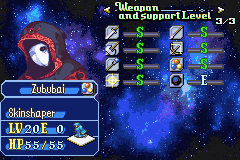
Cerulean Crescent by Rivian is a hack of many extremes, featuring some of the most unique and powerful units and weapons ever conceived. As such, it shouldn’t come as much surprise that its main contribution to this discussion is similarly-extreme: instead of simply having one or two physical weapon types and a magic type, the cryptic later-midgame prepromote Zububai can use all weapon types. What’s more than that: with the exception of the recently-invented dark magic, her weapon ranks are all immediately maxed-out. Now, flexibility alone isn’t enough to make a unit good, and that certainly still applies in a game as explosive as CC, but the ability to pick up absolutely any of the game’s arsenal of mighty S-rank weapons that aren’t in use by your other units is a degree of flexibility you rarely see, especially when those weapons look something like this:
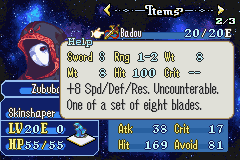
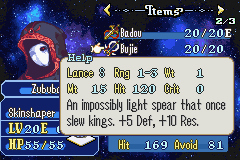
Of course, the S ranks aren’t the only things Zububai has that are worth using. Standout spells like life-draining Resire and siege tomes like Meteor keep her magic ranks busy with utility and range even when her strength outperforms in damage, while any of the massive selection of overpowered multi-effectives, super-high-crit weapons, and other similarly-absurd tools in the CC physical weapon list let her, bolstered by a significantly-heightened 3 power/30 hit weapon triangle, let her pick and choose physical kill tools for whichever targets she wants to come ready to delete. Together, Zububai has something worth using no matter which weapon type she turns to, and she can fit into any team composition by picking up whatever of these weapons you still need a user for.
Now, while her stats aren’t bad, they also aren’t especially standout for her join time, and she lacks any form of supporting personal skill or extra action effect common to other CC units. Pure combatants in CC by this point often want something extra, to either go truly over the top or contribute in ways beyond fighting, and while Zububai does also have staves, there are plenty of other staff-users, and having a high staff rank isn’t a very big deal when Warp and Rescue are both E rank. So, while she’s obviously a more extreme example of a “hybrid” unit, it’s a testament to the power of a uniquely-versatile weapon toolkit that Zububai manages to still make a solid case for deployment in such a powerful cast.
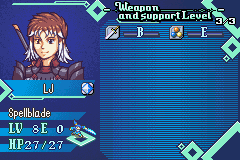



And finally, as you might expect from someone going through the effort to write over 5000 words about hybrid unit design, my own current work-in-progress hack makes a point of having quite a few hybrid units in its roster and class list. I’m not going to go into too much depth on any of them. Instead, I want to just take this moment to highlight some points about the identities I’ve given each weapon type, both physical and magical, so as to then show the logic of how each hybrid class leverages them.
-
Swords are exceptionally light-weight – outside of the heavy Blades, nearly all swords (even Steel) impose minimal-at-best speed penalties, and some like the Mageslayer even offer speed bonuses. They lack traditional ranged options, but have reasonably-available Levin Swords that scale off magic, and stronger but rarer magic swords at higher ranks. Notably, my Levin Sword is 2-range-only but has better offensive stats (especially in terms of might-to-weight) than lower-tier magic to give sword-and-magic hybrids a reason beyond the weapon triangle to still consider them. Swords also have more unique effectiveness tools, like the aforementioned Mageslayer, the Wyrmslayer, and the Rapier.
-
Lances thrive on accuracy and range versatility – in a move shamelessly copied from ArcherBias’s Faces of a Stranger, they have the highest baseline Hit of any physical weapon type, while swords fall in the middle. They struggle with weight the most relevantly of any weapon type, but have the most options for attacking at longer ranges out of the three melee categories – in addition to the standard Javelin, a weapon which gains a lot from lances’ boosted accuracy, lances also get the 2-3 range Saunion and a throwable effective with the 1-2 Heavy Spear.
-
Axes, as usual, are all about power. They are often heavier and less-reliable compared to swords and lances, but the weight is offset by significant Might stats, allowing them to pick up OHKOs without having to worry as much about speed. The Hammer boasts a brutal 14 might, threatening far more than just armors, and the Swordreaver is the first reaver weapon to become available to the player as the best way to crush speedy swordsmen.
-
Bows are… mostly what you’d expect. A bit stronger than vanilla, and with longbows more available, but otherwise the core idea is what it always is: strong, reliable damage at 2 range, with the drawback of no melee options leaving them unable to counter most foes on enemy phase. The perceived flaws of bows in vanilla are mostly due to poorly-statted users and/or juggernaut-dominated environments – the core concept of the weapon type is in fact quite effective when those external problems are addressed.
-
Anima is the most varied weapon type, designed in no small part around a main protagonist whose statline is marked by poor Magic and high Skill. Basic Fire and Elfire sport mostly-vanilla statlines with high reliability, but the strongest tools of the type – things like heavy 1-3 Thunder, brave anti-flier Airblade, 3-range armor-shredding Ionize, and of course the siege tome Bolting – all offer extremely-powerful but highly-situational advantage states that lean heavily on the user’s skill stat to make reliable, especially considering anima has no natural weapon triangle advantage state here. Anima is the most commonly-available magic type, but not all users can make equally-effective use of its full toolkit.
-
Dark tomes are either crushingly strong with severe drawbacks, or highly unusual, or both. Past the basic Flux tome, which is a bit stronger but noticeably less accurate than Fire, every dark tome has a gimmick – Rend has crushing might, but only works in melee; Death nearly always crits, but has 0 might and so is utterly ineffective on units with poor Magic or into enemies with good Res; Luna is the reverse, having 0 might but bypassing Res entirely, and is the only truly accurate dark tome; Omen is a deadly brave tome, but cuts the user’s defenses; Eclipse is siege-range and reliable by siege standards, but does fixed damage equal to half the target’s current HP. But across the board, the trend is the same: dark magic, when used correctly, hits hard, but at a price – usually in the form of crushing weight, shaky reliability, and/or vulnerability to enemy attacks.
-
And finally, light magic. Light magic in my current project actually has weapon triangle advantage against both other magic types, with dark then also beating anima. This plays into light’s primary identity: it is the ultimate defensive tool, with options like speed-boosting Flash, triangle-doubling Archetype, defense-boosting Guardian, combat-halting Subdue, and HP-draining Resire, all backed by 1-2 range, high reliability, and relatively low weight, but with the lowest might of any weapon type on average.
With well-defined and distinct identities for each weapon type, it becomes much easier to define roles and statlines for different hybrid combinations that keep both weapon types relevant. For example:
-
The armored axe/light Inquisitor has a physical weapon type all about offense and a magical weapon type all about defense. Axes demolish foes even with an armor knight’s low speed, while light complements an armor knight’s bulk with reliable 1-2 range and some resilience to the other, more common magic types. Notably, my hack is designed to be exceptionally fast-paced, there are multiple enemy types that are very hard to double but are designed to be conducive to physical OHKOs, and the Might difference between axes and light magic is very significant even before factoring in weapon triangle or effective damage, so there is a true, meaningful difference in kill power between the offensive and defensive weapon type here.
-
The sword/anima Spellblade, taking the place of the Myrmidon, is blisteringly fast and deadly under the light weight of swords, while anima tomes then fill in for swords’ lacking ranged arsenal and offer a generally-safer baseline. However, shaky Skill and low-end Con together with their speed reliance make higher-tier tomes harder for them to leverage into trickier matchups, especially when the playable one also has to work to build up their anima rank from E while her sword rank already starts high.
-
Axe/anima Oni Savages have a similar dichotomy to Inquisitor, but with a more offensive tilt. These slow bruisers will leverage axes to crush fragile speedsters in one hit, while switching to magic against slow, defensive foes, allowing them to cover both extremes while they struggle more into the more middling speed tiers.
-
Hunters, wielding bows and dark magic, are the most all-out glass cannon class there is, with bows offering a safer and more consistent option with longer maximum range, while dark magic makes their power even more explosive into the right matchups at the cost of tanking their normally-high speed and exacerbating their already-poor bulk.
-
On the flipside, Holy Riders, elite cavaliers wielding lances and light magic, exist to be the most difficult class in the game to kill, sporting solid speed and respectable defenses on both sides bolstered further by both of their weapon types. As both lances and light magic provide useful mixed-range and defensive tools, the Holy Rider draws on both equally to maximize their survivability depending on the exact enemy formation they face, but as the class has a lower offensive presence, they have to lean especially hard on what offensive tools they do have available.
The list goes on, but I think you get the point. Matchups, tradeoffs, use cases for both weapon types defined by those weapon types’ unique tools and structured identities. And if any of this catches your interest, keep an eye out for a public demo that I hope to be able to release around the time of this year’s FEE3!