How do you feel about colored growths?

Hello FEUniversers.

One facet of hack design that I’ve barely seen people talk about is the inclusion of colored growths in a project. Today, I wanted to ask the community what they think the use cases are for colored growths, and explain why I personally have never been a fan of them, feeling they are unnecessary at best and confusing at worst.

DISCLAIMER: I will be using pictures of some hacks as examples of what I dislike about colored growths. I like all of the hacks I use in this post, and the use of colored growths barely effects my opinions on a hack.

What I think colored growths are supposed to accomplish:
From my understanding, colored growths are supposed to provide a quick, easily digestible way to look at a unit’s growth rates without having to click into the separate growth menu/look at the exact numbers. Ideally, this would be functionally similar to an expanded minimug box, letting the player look at the stats and inventories of units without going to the menu.

Why I feel this does not work:
1. The bad colors
Some hacks use nonsensical corresponding colors. Take this example from The Drowned King:
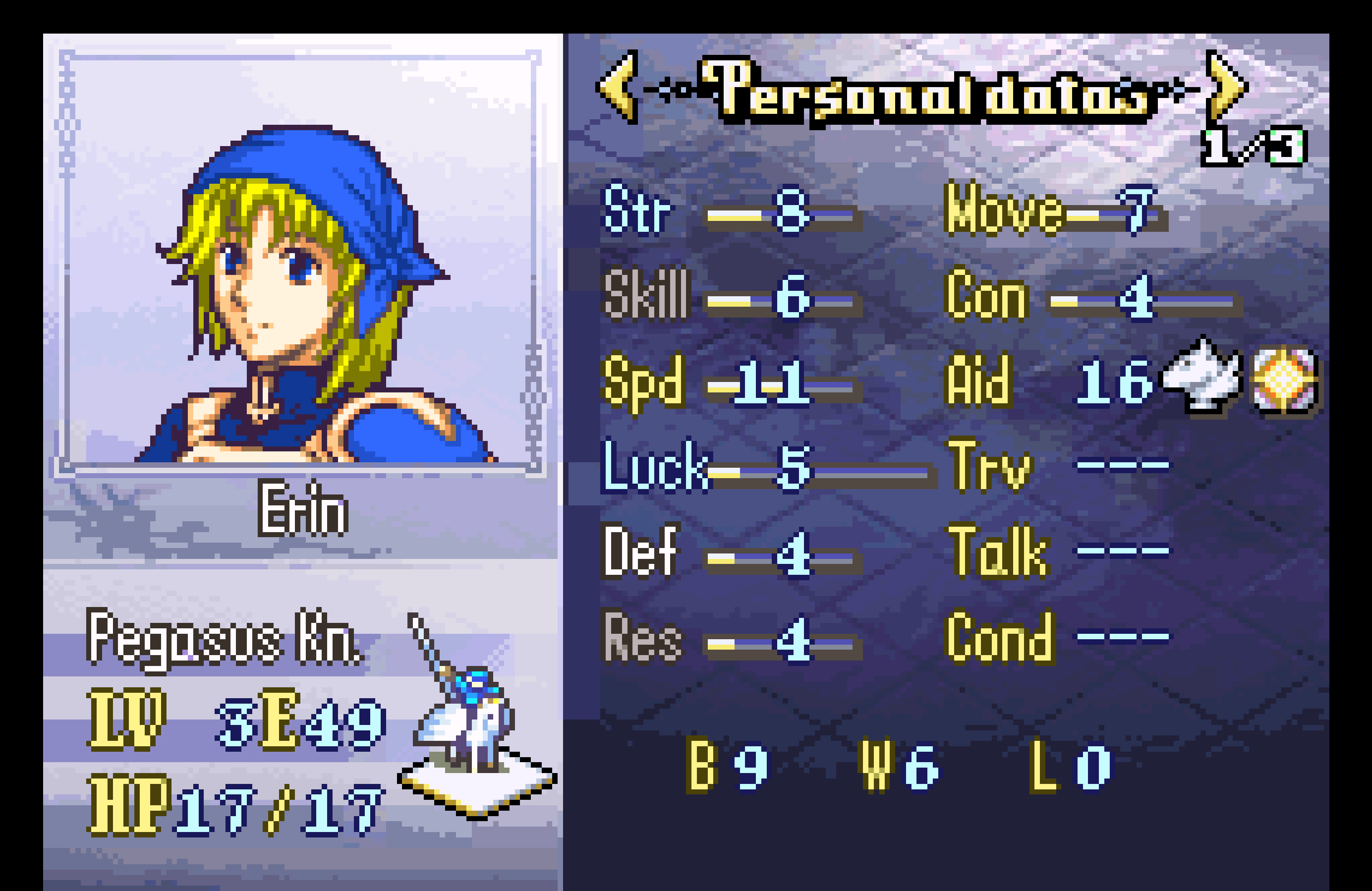
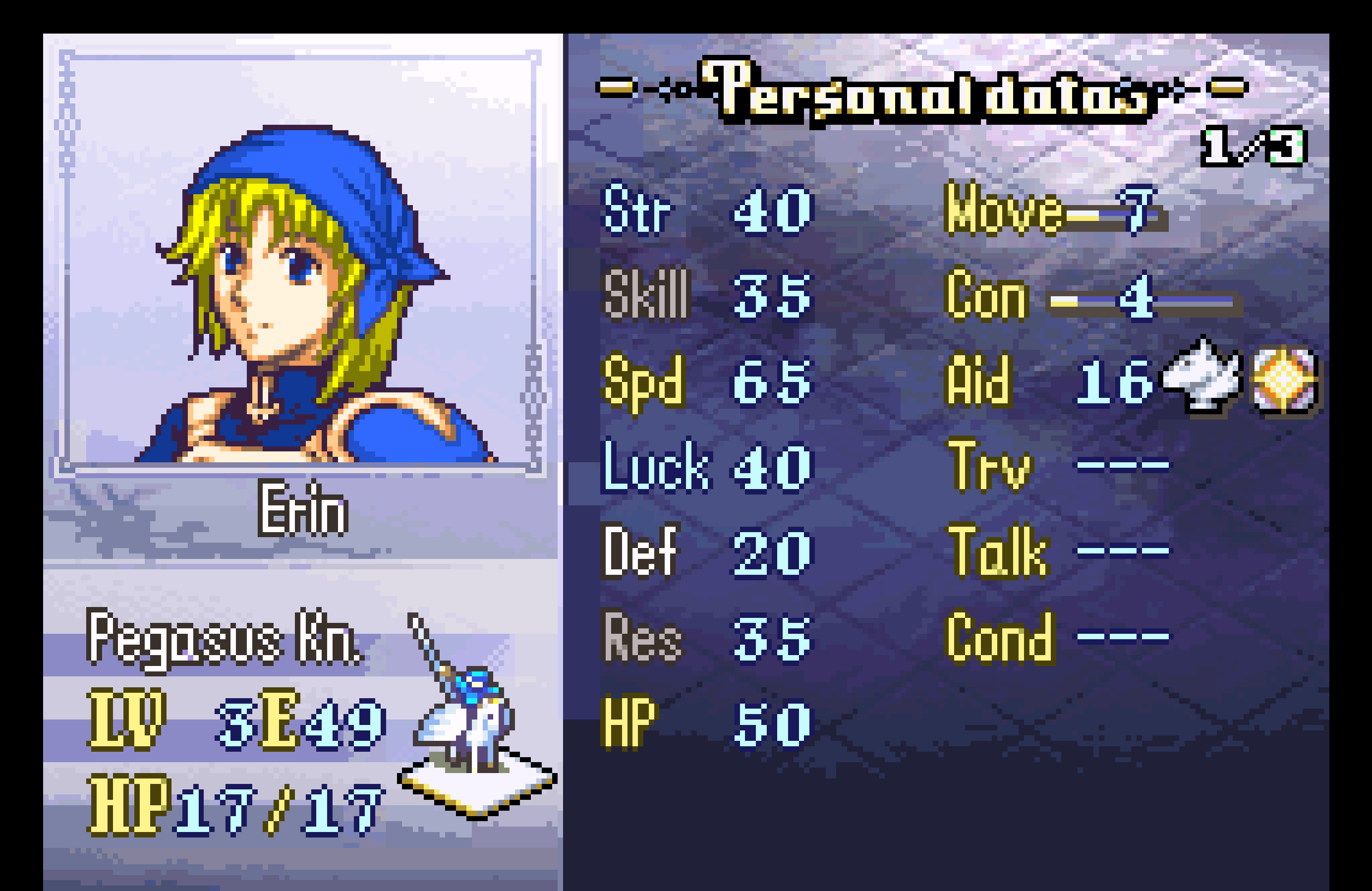
This might just be me, but the heiracrchy of colors here makes no sense. White is the lowest, then we’ve got grey, then… blue, then yellow? It would be almost impossible for me to intuit how good a growth was if I didn’t have access to the growth menu. Why is does grey indicate a higher growth than white? Why is yellow better than blue? If you swapped all of the colors around, it would make about as much sense to me.

2. The “good” colors
A more common color palette would be red → green indicating low → high growths, and that makes a lot more sense to me. However, sometimes the colors actively conflict with how we’re supposed to read a unit’s growths. For example, this is from A Bastion of Our Own:
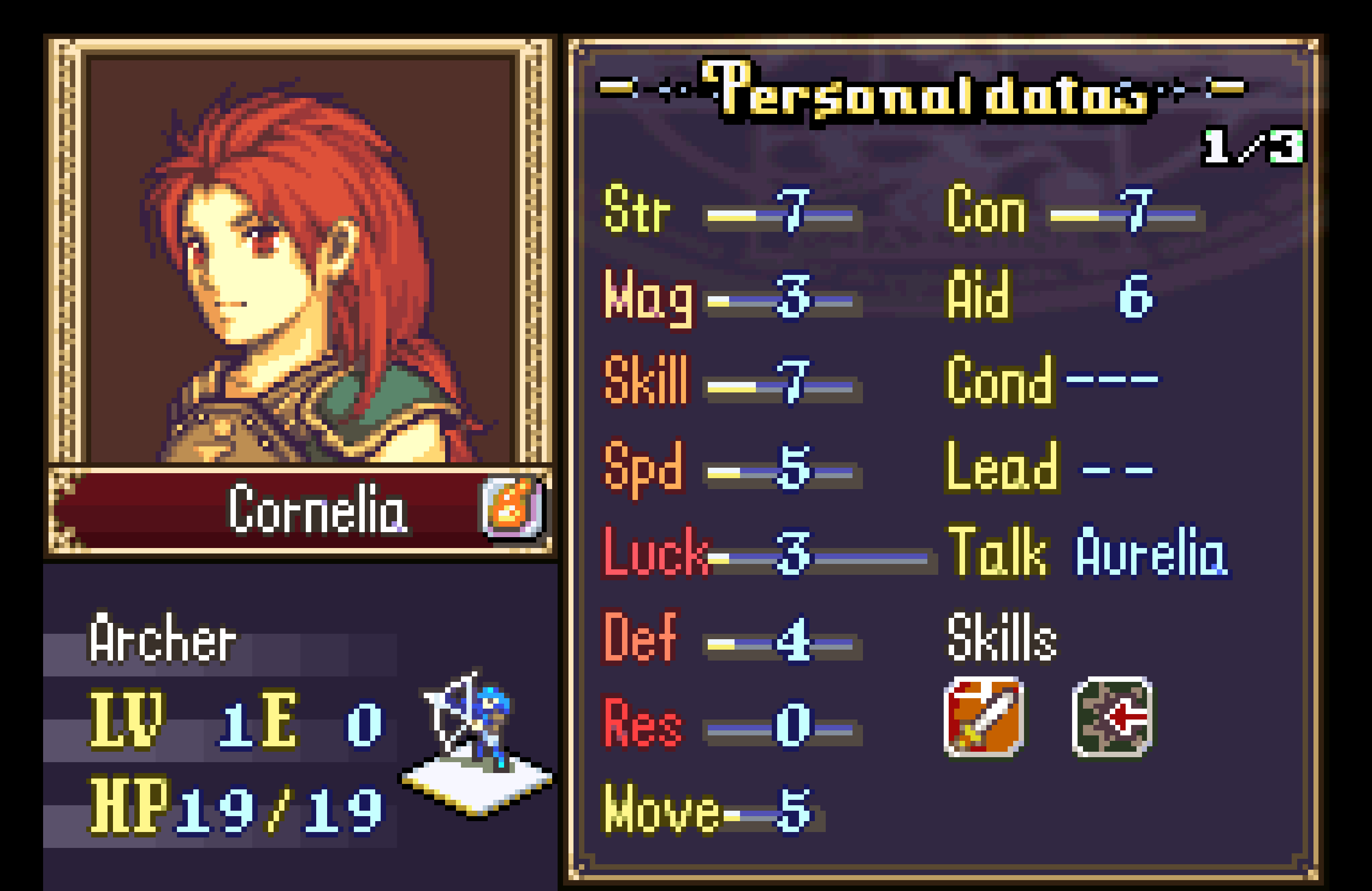
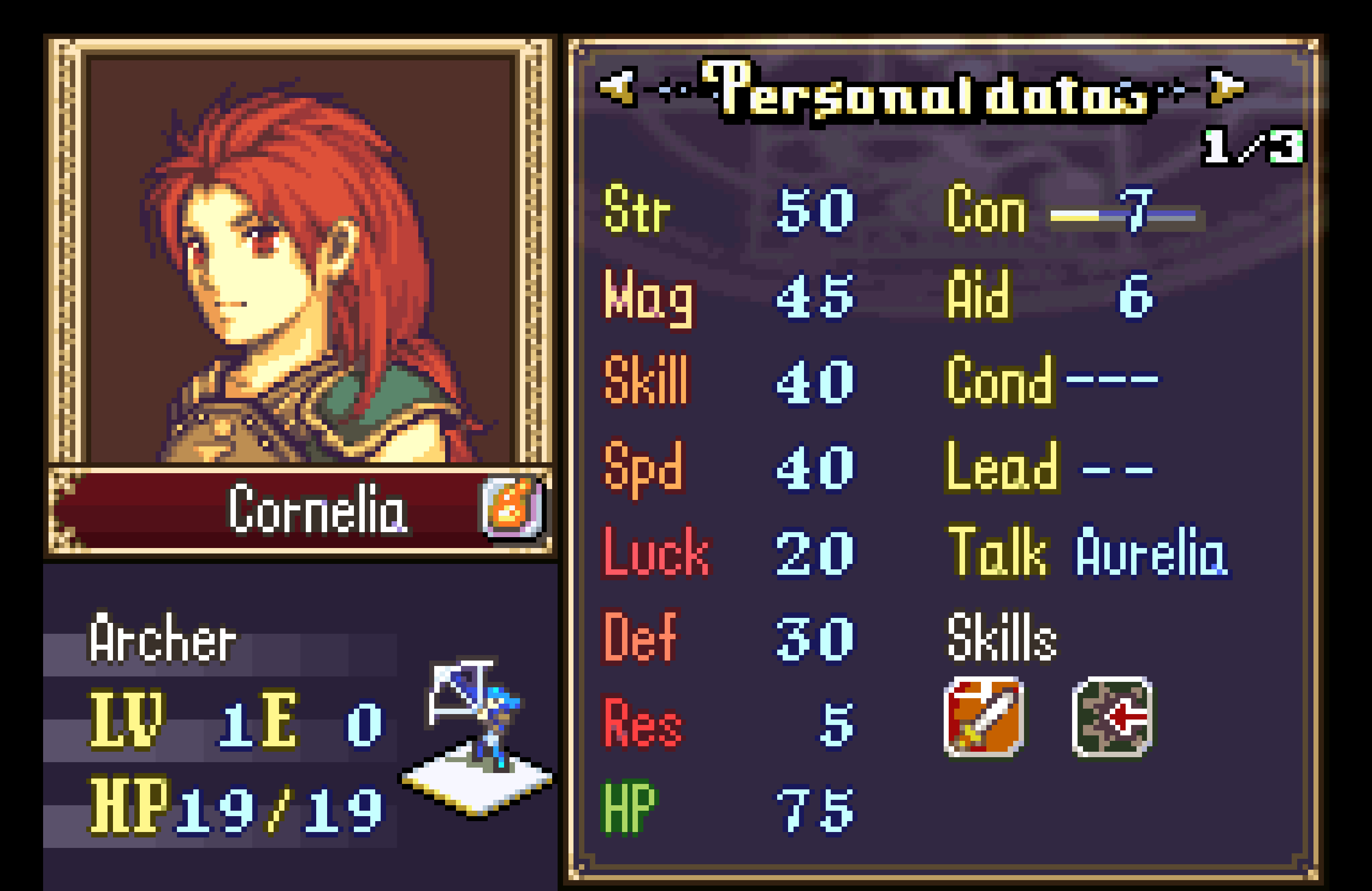
This is a unit you get on the first map. Compared to the rest of the cast her growths are average, but most of the growths are colored red or orange, which would indicate low growths. In comparison, look at Hope’s Trail…
…a game with considerably lower growths that makes it a lot easier to intuit how good growths are in comparison to the rest of the cast. Green is good, yellow/orange is middling, and red is bad. So why don’t I like colored growths here, either?

3. The bleeding into bases
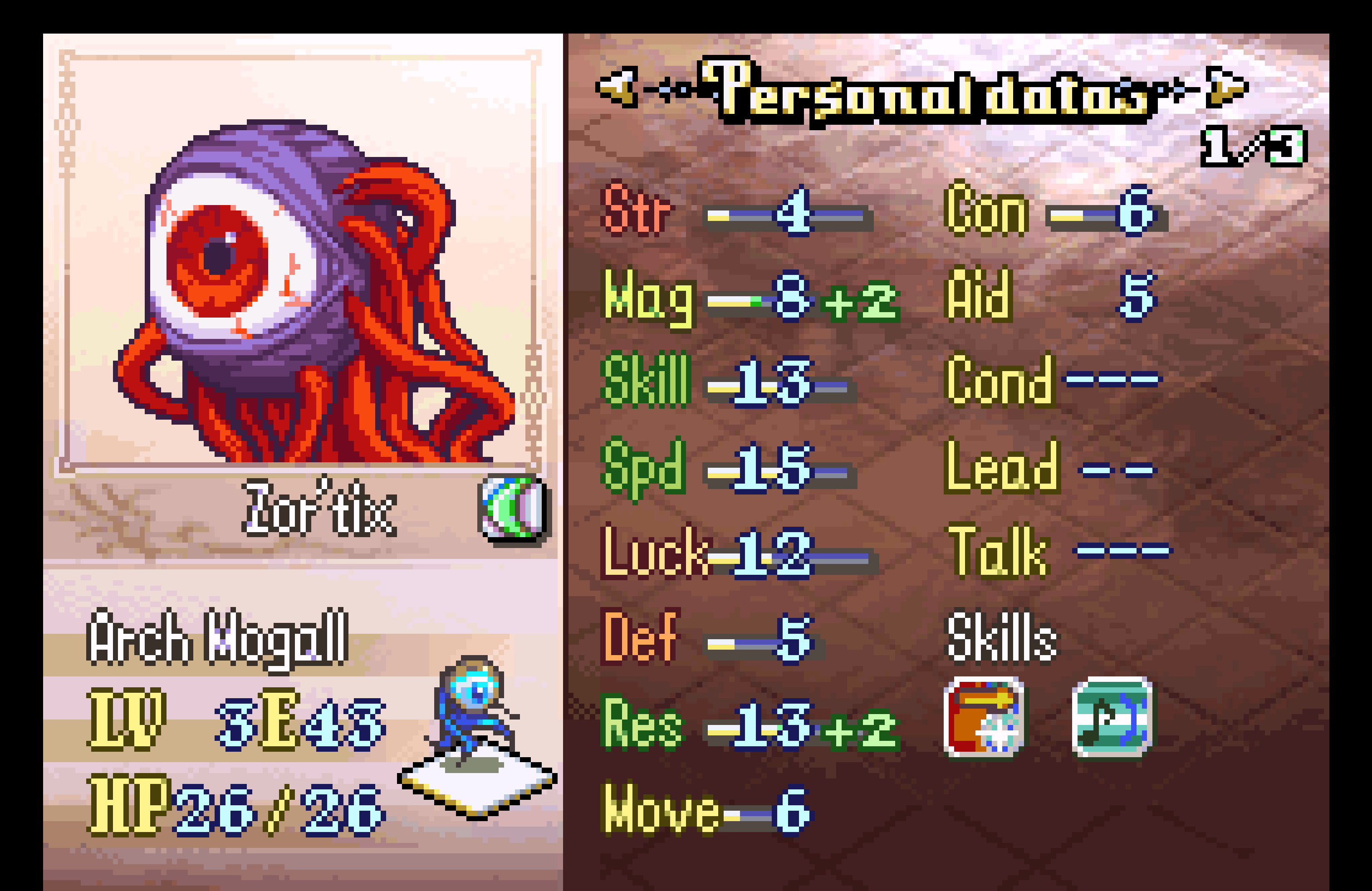
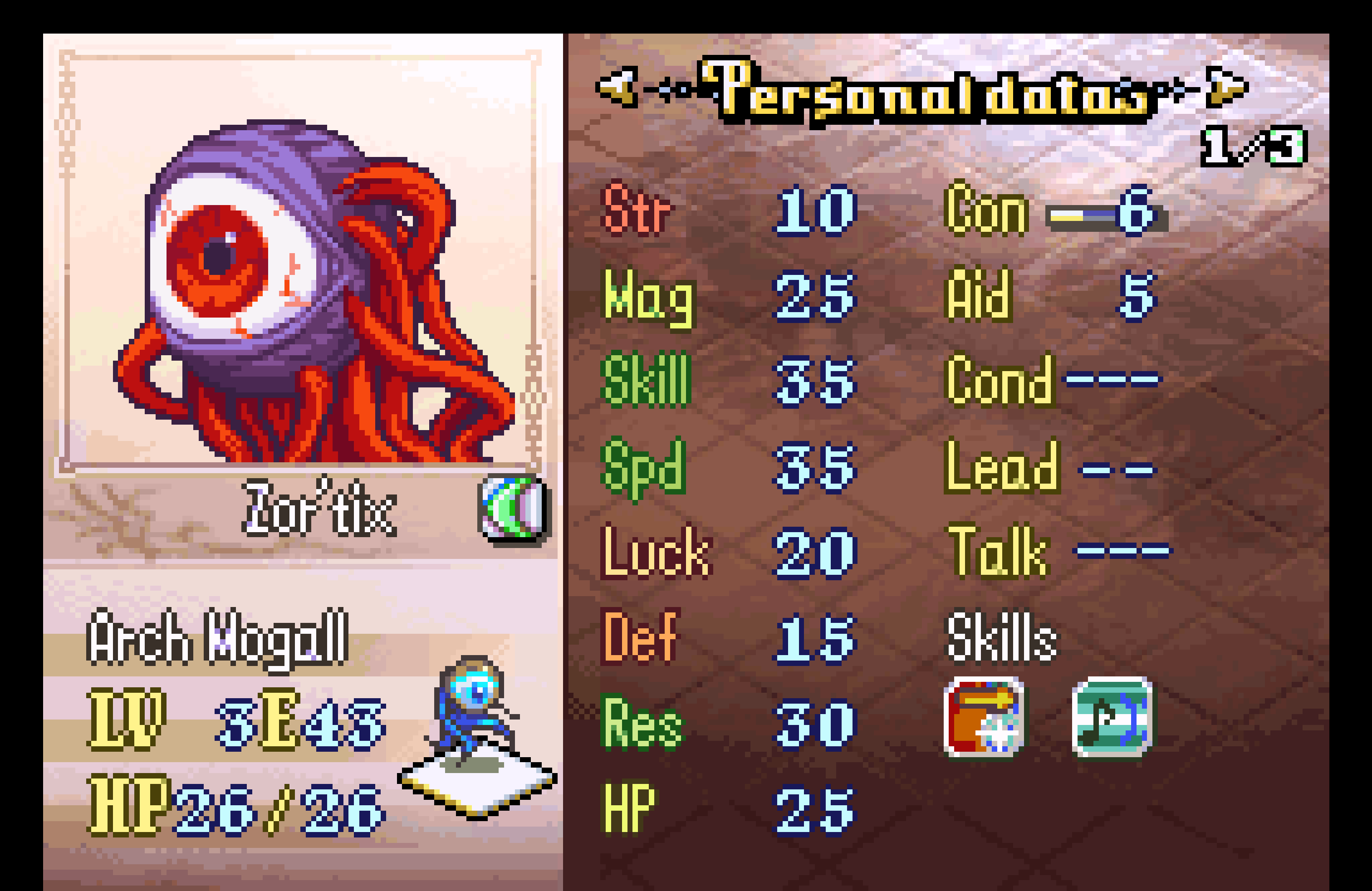
This is the main reason why I dislike colored growths. It clutters up the stat base screen. You’ll notice the colors are present in the base menu in all of my examples, and I just find it distracting a lot of the time. Sure, for units like Zor’tix it may be fine, but look at this other unit from Hope’s Trail:
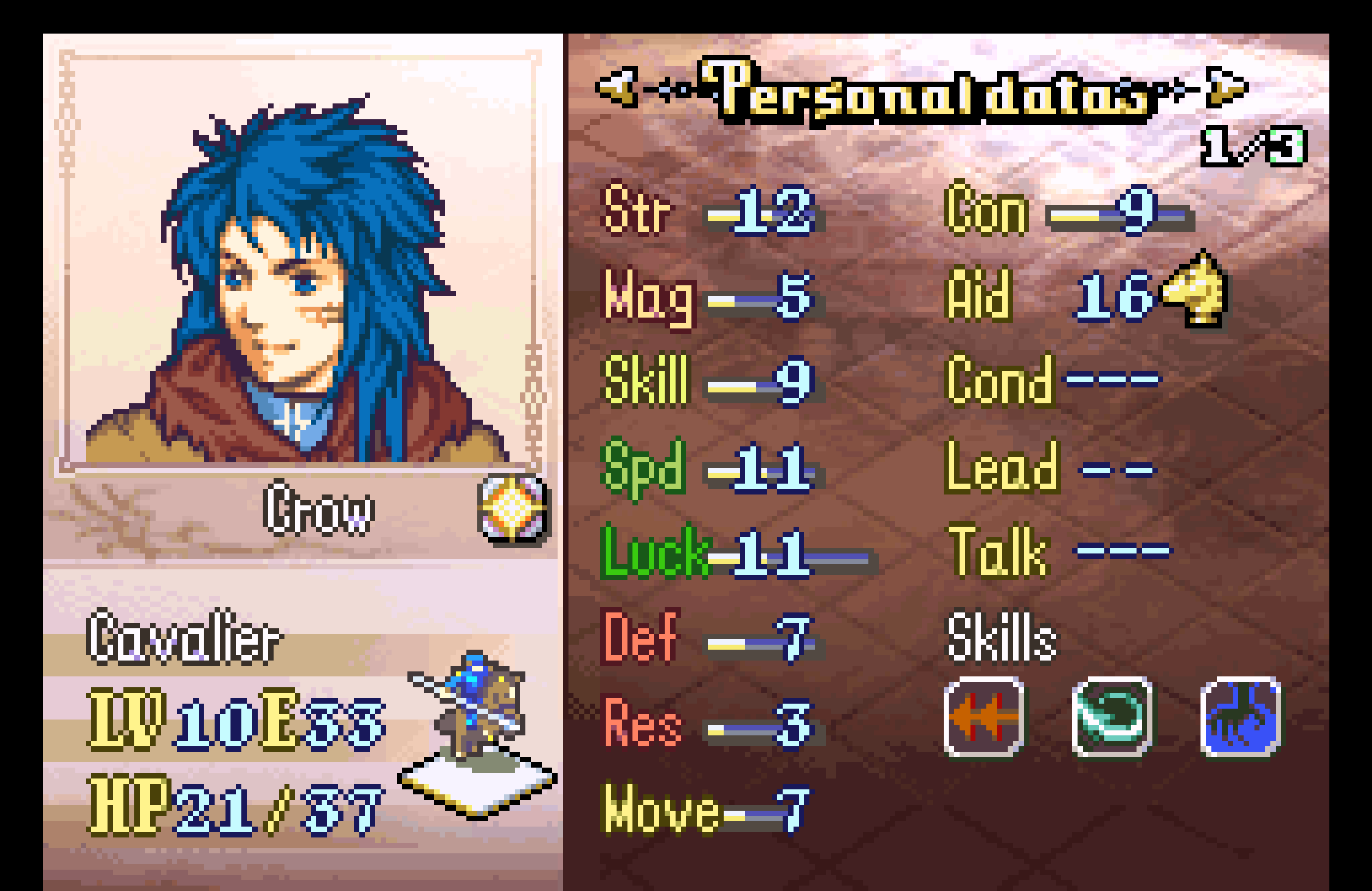
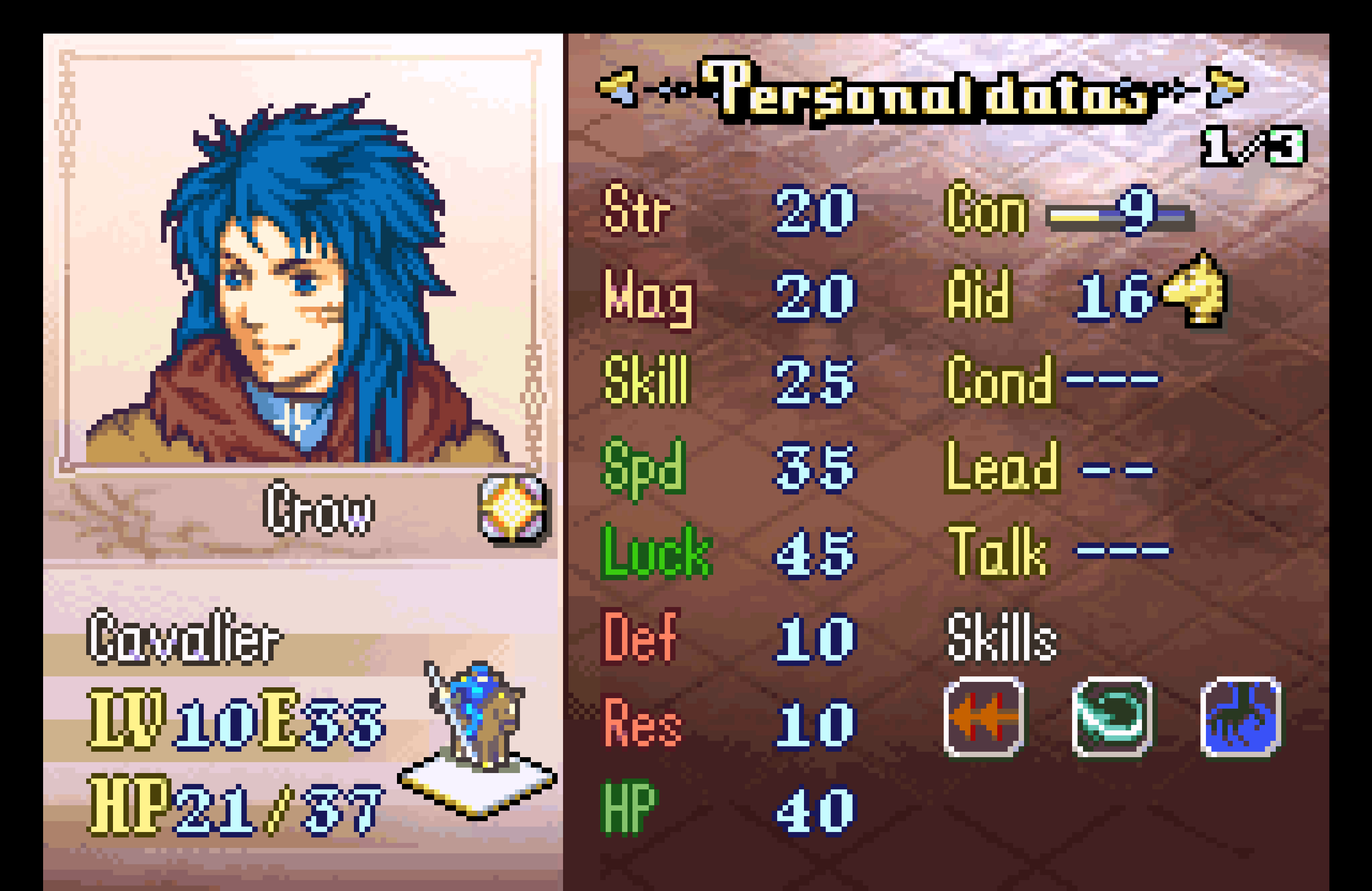
My first thought when looking at these bases is, “Why is speed green? It’s lower than strength.” This may not sound like a big deal, they are supposed to represent growths after all, not bases, but it takes my brain a second to realize this every single time I open the stat menu in hacks like these. Which just makes me ask, what’s the point of including colored growths in the first place if they’re going to make it harder to digest information?

With all that said, what are your thoughts on colored growths? I’m curious as to why people use them/think they’re helpful. As a final note, allow me to show you the one, singular use of colored growths that I like from Eligor’s Spear:
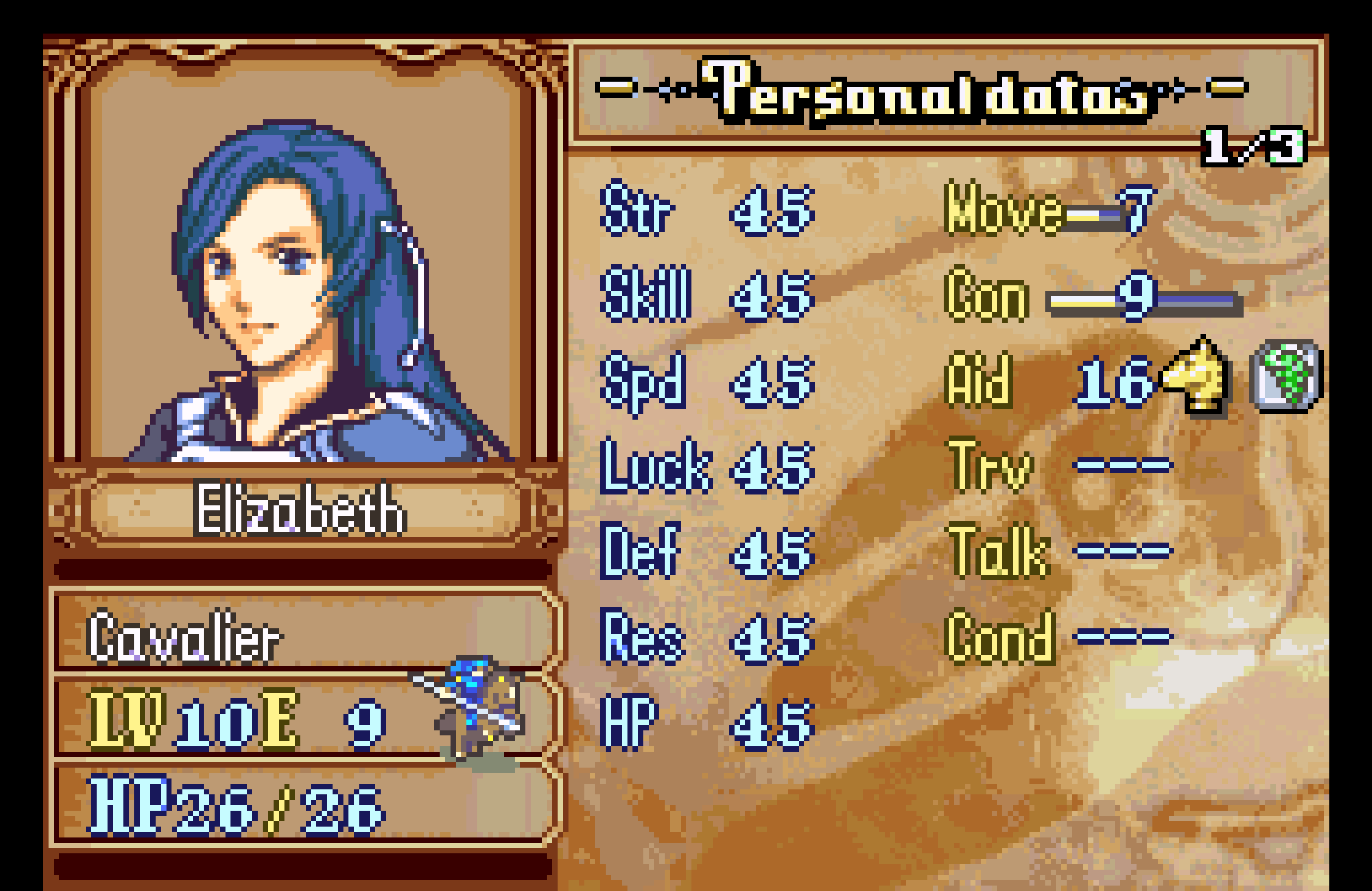
Peak Color Coding


Genuinely made me remember that a blue growth = around 45%. Thanks Elizabeth!

Plus if you only look at this unit you can forget colored growths are in this hack.

8 Likes

I feel Purple about them. Which probably means I should sleep.

9 Likes

There’s two versions of the patch that displays growth rates: a standalone version and the one included with the SkillSystem.

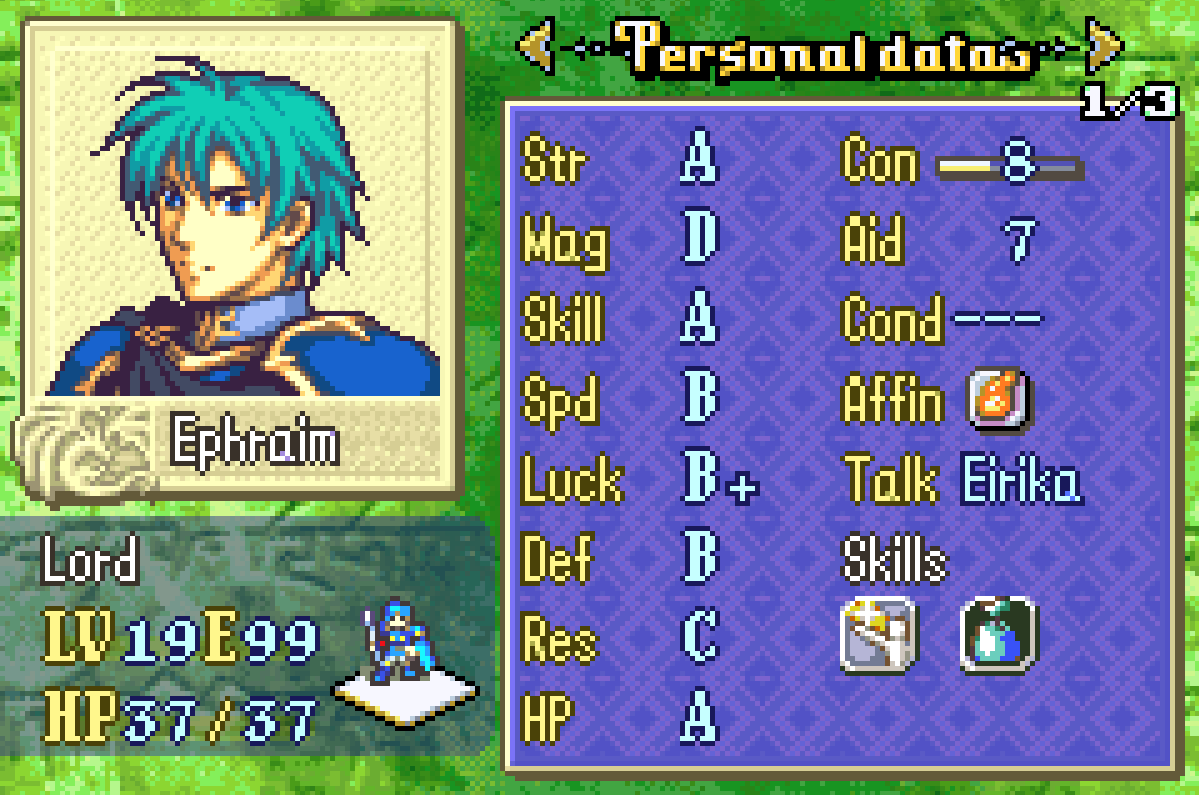
The standalone version uses blue, yellow, green, grey/black and white. I believe the reason why is that these are the exact same colors you can assign to unit actions like Attack, Visit, Wait, Talk, etc. This is the version used by hacks that do not feature skills - you can compare the screenshots you have provided and see for yourself.

The SkillSystem version uses different colors, and from what I understand, those can be changed (I’m not sure since I haven’t worked with SkillSystem). It uses a logic similar to HP in Pokemon: High - Green, Mid- Yellow, Low - Red.

I can’t speak for how much thought developers put into the actual color-coding, but generally speaking the gist of it is to give you an idea of how the unit can be expected to grow just by looking at their stats: Green in Luck means they’re very likely to level up Luck. You could just look at the actual numbers, but, ironically, it is designed to make information digestible or more readable just by a glance.

As for why the colors present growths and not bases: You could have a unit with high base Luck or Skill, for example, but due to said stat being high, they’ll have a low growth for it. It wouldn’t be particularly fun to max out a stat in a couple of levels and have it not grow for the rest of the game or until the unit is promoted, making the growth percentage allocated to that stat borderline wasted.

Regardless, the growths do not always follow base stats because you can deliberately design units to have low growths in stats they are already strong in and/or have high growths in their weaker stats.

There’s a case to be made that colors could/should indicate how much your units stats deviate from their averages/expected values at that level: let’s say your unit hasn’t been levelling Strength and therefore is falling below what is the average with the growth that they have. If they are like -4 below the average, this could be indicated with the red color. Similarly, blessed stats would be shown in green.

Of course, this does nothing to address the issue of clutter, and it could also send mixed signals: if you’re used to thinking that Green = high growth and Red = low growth, well, that’s not necessarily how it’d work anymore. Your unit can get blessed in their weaker stats and cursed in their higher stats.

As for your last screenshot:

The colors of the growths and the character coinciding is nice, but there’s another layer to this. Elizabeth as a character is insecure or uncertain, which is why she has those growths - they can go either way, or nowhere at all. The growths are uncertain as well. It’s about the integration of the character’s personality in to their growths. And using a Metis’ Tome will give her exactly 50% growths in all stats.

6 Likes

Personally, I don’t mind it much at all. As a GBA era fan, I’m used to Fire Emblem not being straight with its info and needing insider knowledge to understand it. I don’t necessarily think it’s “good” this way, but I’m used to it.

For ages, I had to manually calculate post-movement danger zones, learn wtf “attack speed” meant, pull up character stat pages to calculate enemy phase damage I’ll take if I end my turn on a certain tile, manually calculate effective damage and potential crit damage on enemy phase, and stuff like that.

Taking a moment to decrypt the colors on growth doesn’t bother me after all of that other stuff. Plus it’s optional info. I often ignore the colors and just look for the stat I wanna see. I’m also used to straight up not knowing what anyone’s growths even are, so on one hand this info is better than what we had before, while on the other hand I could just ignore it and see what my character gives me over time and adjust to it as I go like in every official title.

So, long story short, while the upside is not always necessary, I don’t see a downside other than “it can look funky and I value clean presentations”. So I can take it or leave it honestly :sweat_smile:

2 Likes

Growth colours clutter the UI and make it look inelegant in the name of uncovering partial hidden information; so I dislike them.

Growth colours are customized on a per-hack basis - as per your own screenshots, in A Bastion of Our Own, 50, 45, and 40 all have their own color; and in Hope’s Trail, 10, 15, 20, 25, 30, and 35 all are unique -

But these are growth values, representing a maximum change of 2 points by naïve average at the default truly capped level when starting from level 1. Each 5% does not make a difference, but here they’re colored like they are each significant.

The same applies to the colors chosen themselves - It’s really easy to pick colors where it doesn’t make sense why which is which or what the difference between them is, and also to pick colors where it is difficult to read the labels.

While, yes, a unit that has a 20% is very different than an 80%, but how much do the middle steps matter? Are 40, 50, and 60 distinct enough? How different is 5 from 10? I tend to not really care about growths in the first place because they’re random and generally completely out of my control.

My personal answers to that question do not match your answers to that question do not match the developer’s answers. That we have different opinions is good, but it makes divining information from the colors nearly fruitless. All seeing it tells you effectively is “this is higher than that”. That’s not much information, especially because I could also just… level the unit a few times. This becomes more true the more consistent the developer is about making units not have ‘ambiguous’ growths -

e.g. if the growth color changes every 20%, so a unit with 20 and 30 is the same, a unit with 40 and 55 are the same, but units with 75 and 80 are different. That kinda sucks!

But at the end of the day, I’m also just generally not interested in knowing a unit’s growths. It’s not important, there is typically nothing I can do to adjust it, and it mostly serves to spoil the surprise of units whose growths don’t match their bases or class archetype. These units are uncommon in the first place (name me a slow myrmidon), and they’re far funnier to encounter organically. It allows me to know if I can trust the developer to give me reasonable units, but… I should have faith that they will not troll me with a character that has e.g. 10%s across the board in the first place.

Growth colors, to me, while better than that, so rarely help. If I want to know the character’s growths, then I probably am interested in the actual numbers; if I just want to guess where a unit’s strengths are it’s more interesting and emotional to get levels.

I have the same opinion about how FE7x uses colors to represent the character’s bless/screw in that stat, but at least, intrinsically to that system, units are most likely to keep the “average” color, which is the aesthetic yellow it normally is.

Sorry, this got a bit rambly in a way I didn’t intend.

6 Likes

Hinata, Samuel, Shanam

2 Likes

This is a bit inaccurate, the purpose is to let you know if a unit is doing well/doing poorly so you know if you should probably drop them or not in favor of a new unit, and how consistently you can expect to see numbers like that. The averages are also generally used a metric to determine unit strength.

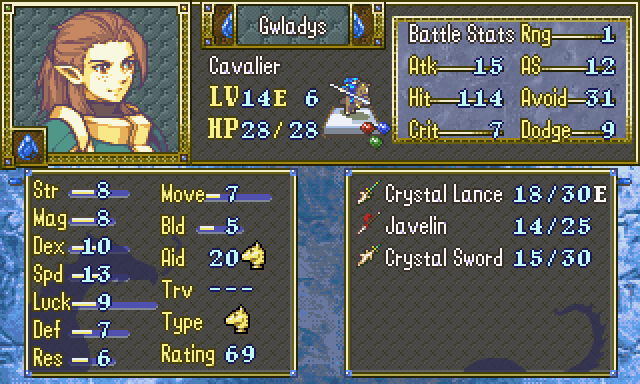
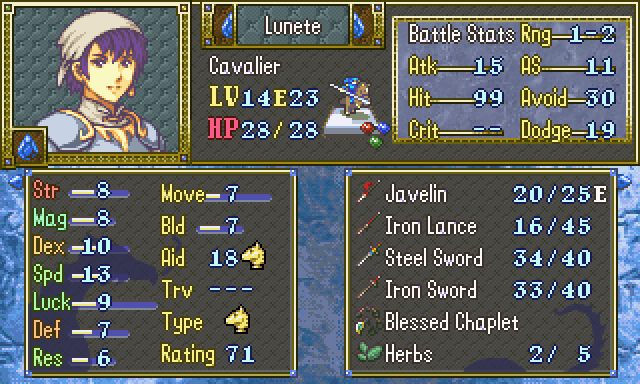
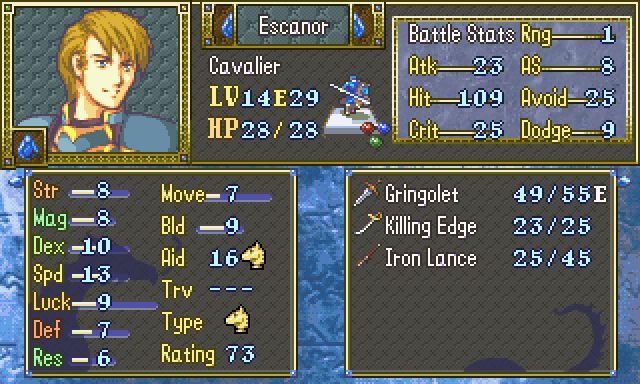
Personal examples


From here you can surmise that Gwladys is generally the Magic/Resist focused cavalier, while Escanor should have more Defense and Strength on average with much worse Magic/Res and Lunete much more Health and Strength, with less Speed and Luck. It’s not perfect, but it tries to give you information about what is normal and what isn’t based on a simple average.

The issue with that system (at least in my opinion) is if you early promote, you will be seen as below average because the system assumes the highest possible average aka promoting at level 20.

On the topic of specifically GBA colorations, I see no purpose in them given the system already allows you to see the growths, the colors are effectively a waste of time.

Given the system isn’t consistent, this leads to the opposite being true.

4 Likes

Yea honestly considering bases matter much more than growths, color-coding growths doesn’t achieve much. Esp when the colors use growths as a baseline instead of a unit’s bases.

A Jagen will have red-yellow stats across the board, even if their bases are solid enough to handle half the game with ease. A growth unit with horrendous bases will be green all-around even if their stats will only catch up after grinding them up to level 20.

2 Likes

Coloured growths only work when the game makes clear early on what it considers good and bad enough for coloured tiers.

The issue isn’t that it’s hard to figure out what the colors mean, rather that the color “tiers” give the wrong impression of how good a unit is.

Like, for example, a 50% is considered yellow. A 70% (very high for a non-HP stat) is considered green.

A Lv1 unit with a 6 Def base and a 50% growth will be at 11 Def at Lv11.
The same unit with a 70% (green) Def growth will be at 13 Def.

The difference is 1 extra Def every 5 levels.

If, for example, the 50% growth unit had a base of 10 Def, the “green” unit will only catch up to them after getting a total of 20 levels. By then the game will be mostly over. In this case, the yellow unit is clearly in the lead despite having the weaker color.

The fact that the colors are so skewed towards high stats does not help here.

Either a romhacker will have to lower the color thresholds, misleading a player used to a different growth standard, or they can keep them as default, which won’t work very well when every unit has an average of 40% in a non-HP stat.

5 Likes

Come to think of it does the game ever indicate whether the growths are the unit’s personal growths, current class growths, or both? A small tweak to the UI could reveal the numbers and make their relationship clear. And change their colour too.

Uh no. And the game uses their personal growths if they aren’t generics. If they are, then they use the class growths. I don’t remember how it was done but there was someplace there were you could state if an unit was unique or if it was a generic.

Complete fucking eyesore, legitimately worse than useless. It’s genuinely incomprehensible to me why they would ever be added, and if playing a game with them, I’ll remove them. They give misleading information – a yellow 40% is generally a great defence growth, a mediocre strength growth, and an appallingly low HP growth – and since they come with growth checking, you already have access to perfect information when you want it… which will be either Zero or One time depending on if you want to know them to begin with.

(Okay, I don’t mind ‘above 100%’ glowing green, every once in awhile.)

11 Likes

I think they’re pretty cool and can be very visually pleasing so long as the colors are actually analogous to values that are good/mediocre/whateverthefuck for the hack that’s using the colored growths.

Basically, if it’s just the default values and colors for them I don’t think they’re very useful, but when used as shorthand for what growths are actually considered to be quality wise for the hack, I think they’re pretty cool.

3 Likes

I’m kinda mixed on em tbh.
On one hand, if you want a general idea about a character before test driving them, they’re a good idea but it might just give you false hope. The intention is good overall, but I feel it’s easy to just toss a unit aside because “not enough green or yellow” despite the character themselves being intriguing.
If there was a way to have no colour difference when looking at stats by default and a toggle in the options (like you do for movement speed, animations, etc etc), someone who’d like to have that “mini spoiler” about expectations without actually checking growth rates could be an interesting way to please all audiences.
You don’t want to be spoiled? Leave the neutral-coloured numbers by default, don’t press Select and see where that journey takes you.
You wanna see it passively on a subsequent playthrough? Toggle it and see the colours!

Indeed, the most useful color grading would be literally 0, a meme amount that only exists to be above 0 and will not reasonably see a single growth without you getting lucky, anything between 10 and 100, and over 100.

And then for negative growths we give the poopoo brown color. :face_savoring_food:

Personally, I DESPISE colored growths. I much prefer having no color coding on them.

But also, I feel that having visible growths, like 99% of hacks do nowadays, will make players judge units too soon, without looking at their ACTUAL performance.

In my own hack, I am planning to use Dragz’s Growth Grades patch, which instead of showing the exact number of each growth, it displays lettered rank, based on a threshold in which the growth falls. These thresholds can be freely edited as well.

I think this gives the player JUST ENOUGH information, while also not giving EVERYTHING away. I think it’s okay for things in games to be a little ambiguous, and not spell everything out for the player. Maybe IntSys was onto something by never showing growths in mainline games.

For my hack, I am not gonna use the “+” ranks. I think I will have around a 10% variance between most ranks. (20-29, 30-39, Etc…)

2 Likes

Growth rates display in general was a mistake.

5 Likes