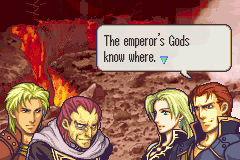
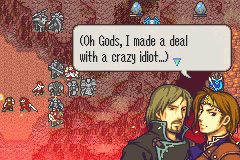
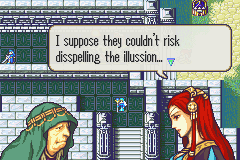
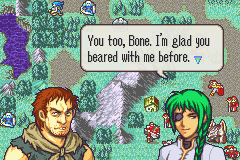
Finally I can give my full thoughts on this. Once again, your writing is good enough I would like to preserve it for future generations, so I’ve made an archive at Dark Stone Text Archive (Wasn’t entirely sure how to format the final chapters, so I lumped both route variations together. I can split them into separate pages if people prefer.)
A few questions for the archive:
- What are Tick and Morgan references to?
- Why are there vs quotes for Ruben in the data that are unused in gameplay?
Anyway.
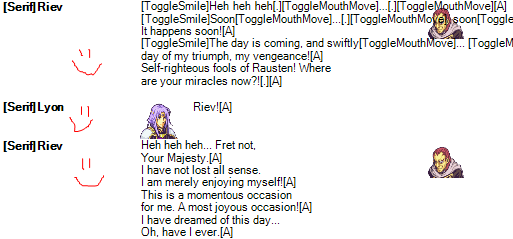
The thing that stuck out to me the most in this hack was the scene at the end of Ch23 where Lyon insists the Demon King isn’t real, just an alter ego he adopted. I immediately thought that sounded way more interesting than the canon plot, and while I understand why you didn’t want to diverge from canon to that degree, I do find myself wondering what that scenario would look like. I’ve long disliked FE’s overreliance on what I call “spooky demon men” – ontologically evil (usually non-human) villains whose motivations begin and end at “Because I’m evil” – and Fomortiis is probably the most blatant example of that in the series. I dislike them because they’re such superficial characters – there’s nothing to engage with when the answer to “Why are they doing this?” is always just “Because they’re evil.” They’re such convenient villains too – there’s no moral nuance to fighting them and any violence against them is automatically justified.
(This is why I liked that you used human villains for Hag – even when a human villain is as pathologically evil as Sandraudiga, the fact that they are human still gives them depth. They force you to acknowledge the human capacity for evil – they are mirrors rather than scapegoats.)
As a result I liked the Lyon route a lot more than the Fomortiis route. (Which to be honest felt a little tacked-on – I found it weird that all the characters were so calm and optimistic in the epilogue when their commander is in the background cackling about how he plans to kill them all.) I think this is pretty evident in the fact that, while the Fomortiis vs. Eirika/Ephraim dialogues are pretty generic, the new Lyon vs. Eirika dialogue you added is quite possibly the best writing in the hack and geuinely made me tear up reading it.
Lyon is interesting because he’s the most sympathetic of the GBA villains, but in execution I found the canon’s handling of him very disappointing, as he’s ultimately just flattened down to his obsession with the twins, with his actual motive little more than a footnote in the plot. So I’m glad you focused on that for this story. (Also, I really liked how you redid the scene where he takes Renais’ stone to incorporate the most interesting parts of both versions.)
Personally, I don’t consider Lyon’s actions justifiable under any framework; the fact that the disaster will only affect Grado leads to the obvious solution of just evacuating, especially given Vigarde has such good relations with the other nations. Even if that wasn’t possible, he’s still choosing to destroy five nations to save one, which just doesn’t math. I see the subtext here as it being a matter of pride – Lyon doesn’t want to ask the other nations for help because it would make him look weak. He cares more about preserving the idea of Grado than the people of Grado – and of course, it can’t be a coincidence that his plan also results in him gaining absolute power over the continent. I was disappointed that the characters never seem to acknowledge this – Duessel is the only one who directly criticizes Lyon’s actions, but his objection is also based purely around Grado’s image.
I also found it hard to swallow that Selena and Glen remained loyal after learning the truth about Vigarde. You made an attempt to justify it with Selena, but I still found it a pretty big stretch, and I don’t understand why Glen sticks around at all. He’s clearly not doing it to stay alive, because he’s explicitly suicidal and actively chooses death in both endings. So… why? He says in Ch23 “Perhaps I should just kill both [Valter and Lyon] and be done with it,” and… yeah? Why doesn’t he? Even if Lyon isn’t responsible for Cormag’s death, Glen makes it clear he’s still disgusted by the atrocities he witnessed at Caer Pelyn, yet he expresses this by… helping Lyon commit more atrocities? I get that you wanted to keep all the villains playable, but endgame Glen just seemed really incoherent to me.
I do think the generals’ behavior works as a criticism of monarchism and authoritarianism – when your form of government is a cult of personality that punishes questioning and critical thought, it doesn’t matter how benevolent any one dictator is, because that’s a system with no guardrails against anyone who’s less than a perfect saint. Even “good” people who rise to the top of such a system are self-selected for having more loyalty than sense. The number of scenes where the characters went “This is clearly wrong, but my superior ordered it so I’m gonna do it anyway,” were painful to watch but at the same time quite understandable.
(That said, I don’t understand why anyone sticks around in the Fomortiis route – not only should they have no loyalty to someone who isn’t Lyon, Fomortiis can’t shut up about how much he hates humans and plans to kill them to the last, so sticking around doesn’t even make sense from a self-preservation angle. I mean, I guess real-life fascist movements demonstrate some people really are that dumb, but realistically I think most of the army would desert at that point.)
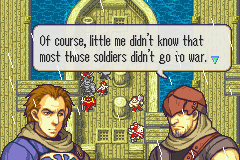
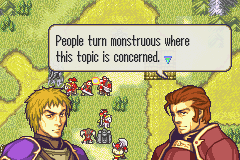
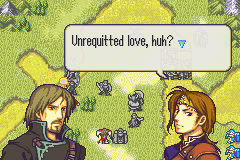
Otherwise, though, I really liked what you did with the side characters. It’s really neat how much you fleshed out and humanized characters who were only ever designed to show up for one map and then die. I particularly liked how sympathetically you portrayed the bandit characters – it never sat right with me the way that FE always uses them as one-dimensional punching bags, given that in real life the circumstances that lead to brigandry are often a lot more nuanced and involve failures at the societal level. Aias and Lieselott were also very relatable to me as an autistic person, and their paired ending was genuinely touching. I mentioned it earlier, but I liked what we saw of Orson too – the little things he does like remembering to bring Monica her favorite flower or always carrying sweets because Monica likes them demonstrate how much he truly loved her, and is a great contrast with Carlyle’s totally myopic love. (I loved how merciless you were to him, too. Get rekt Carlyle.)
I’m more ambivalent about Hayden. A big part of the appeal of AUs for me is seeing how things could have gone differently given the same initial conditions, so replacing a canon character with what is effectively an OC feels like cheating. (And after you said you didn’t make any lords go insane/evil this time around…) It was entertaining how much you leaned into his cartoonish villainy, though.
But overall, very enjoyable. (Though yeesh, FE8 map design has not aged well – I forgot how tedious all the “shuffle the entire army down a corridor in single file” maps were.) Though I don’t plan on actually playing Eckesachs since I hate FE6’s gameplay, I’m sufficiently curious to look through the story.