Hrolf (Fire Emblem Advance: Homecoming)
What is the value of a human life?
Some philosophers say all lives are priceless, that a human soul is worth more than any mortal wealth or possessions. In 2020, the United States’ Federal Emergency Management Agency valued the sum total of a person’s life at 7.5 million dollars[1]. In world history, human lives have often been bought and sold for far less, from bride-prices to chattel slavery to the grim calculus of war.
In Fire Emblem, the value of a unit’s life is… well, it varies. Player units, and their unique faces, tactical roles, and contribution to the story, are typically beloved and well cared for. Most players are willing to restart chapters over and over to ensure they all make it out alive. By contrast, generic units are puzzle pieces at best - just obstacles that need to be cut down to save the lives that matter. Sometimes, they’re not even given the privilege of posing a threat, and are just chaff placed only to die. Even green units, notionally the player’s allies and friends, get mocked and thrown away in the pursuit of fleeting tactical advantages.
Maybe there is no one answer that can satisfy all our needs. But to Hrolf, at least, it’s simple: the value of a human life is 400 Gold per chapter.
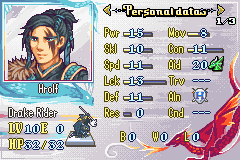
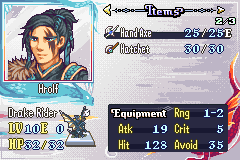
In Chapter 4 of local thread-maker Parrhesia’s latest campaign, Homecoming, you can recruit a wyvern-riding mercenary named Hrolf. While his access to flight isn’t unique - you’ve already gotten a Pegasus Knight by this point - his stats are a cut above most other units in your army, especially this early on in the game. His growth rates are competitive, too, so a well-trained Hrolf will stay useful all game long. He has mobility, strength, defense, and an incredibly cool mug - so what’s the catch?
Well, it’s like I said before. To Hrolf, the value of a human life is 400 Gold per chapter.
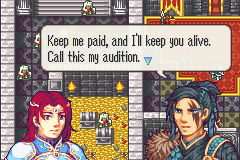
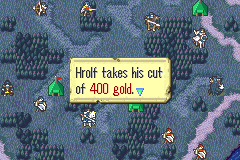
At the start of each chapter, if you have Hrolf deployed, he takes 400 Gold from your inventory. If you don’t have the cash, he leaves you permanently after the chapter’s end.
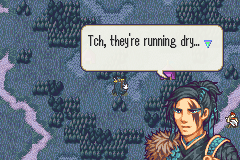
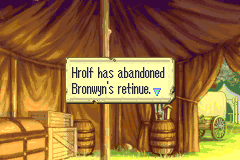
400 Gold on its own isn’t much - about the cost of a single iron weapon in the preparation screen shop. It adds up, though. There are about 20 chapters[2] between Hrolf’s recruitment and the end of the game, so if you deploy Hrolf at every possible chance over the entire campaign, he costs you a total of about 8,000 Gold.
Hrolf’s a strong unit, particularly for the price he demands, but he’s not without weaknesses. His Resistance is lacking, and archers can shoot him down as easily as other fliers. There are lots of maps, particularly indoor ones, where deploying might not be worth the money. If you do bench him, though, then he’s not gaining experience, and thus might have trouble keeping up on maps where you do deploy him. On every map, the choice of whether or not to pay Hrolf’s fee adds a whole new layer to Homecoming’s long-term strategy.
Later in Homecoming, you can hire another wyvern rider - a pre-promoted titan named Eskuldur - who instead asks for 10,000 gold up-front. She joins near the end of the campaign, though, and so has much less time to make herself worth the price. (Is she worth the price? That’s a question, and maybe an effortpost, for another time.)
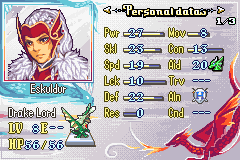
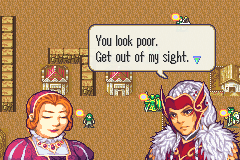
Whether or not you recruit Eskuldur is a one-and-done choice, though. You make your call when she first shows up, and just live with it for the rest of the game. Managing Hrolf’s cost, by contrast, is a fun little minigame that never goes away.
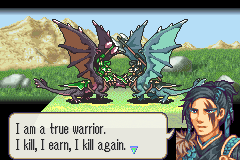
Due to the way Homecoming is structured, Hrolf doesn’t really have much narrative presence. That said, he still has a fair bit of implied backstory. Wyvern Riders in Homecoming hail from a country called Sjoersund. While you never visit Sjoersund during the main campaign, it has a role in the game’s wider political landscape - mostly as an ally of the antagonists. Hrolf has no loyalty to his homeland, though - only to money. He has a few lategame boss conversations with Sjoersund commanders that show his commitment to leaving his homeland behind.
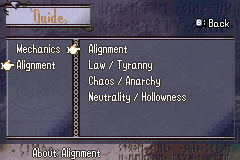
In place of affinity, Homecoming has a Dungeon & Dragons-like system where all characters[3] are aligned with Law, Neutrality, Chaos, or “evil” variations of the three. The latter - Tyrannous, Hollow, and Anarchic respectively - mostly show up on villains, with scarcely any player units having them. Hrolf’s amoral greed is conveyed even through his alignment of Hollow. This detail not only makes him stand out relative to the rest of the cast, but it also underlies characterization and completes the picture of Hrolf as a person in a way that only Homecoming could possibly do. The finishing touch is his quote if you deploy him for the final battle - the punchline has to be seen to be believed.
He also has a cool portrait. Can’t forget the cool portrait.
[1] https://www.fema.gov/sites/default/files/2020-08/fema_bca_toolkit_release-notes-july-2020.pdf
[2] To be specific, at maximum, you’ll be charged for 19 chapters worth of Hrolf usage. Stuff like the shopping map, and his drawback not mattering in Endgame, complicates this a bit.
[3] Except for the skeletons. Weirdly, despite being literally Hollow, they have no alignment at all.