lets make LOTS effortposts a trend lol, we need to match the hags
3 Likes
I promised a certain man I would write an effortpost about one of the units in his project after I finished AVT, so here we are. I should note that AVT was the first Fire Emblem romhack I’ve ever beaten, as I often get distracted by trying to juggle multiple romhacks and then never finishing any of them.
AVT is a really interesting game, numbers-wise. Very rarely do enemies threaten you because of their stats, since all stats but HP cap at 20 in this game. What you need to be cognizant of is enemy inventories, both from the perspective of a player who wants to capture some shiny new toys for their training projects and a player who wants to keep said training projects safe. Naturally, the existence of capture requires you to have units with high enough Con to capture bulkier enemies. Capture also cuts your Spd in half, since Capture is effectively the equivalent of Rescuing an enemy unit.
Now, there are many units in AVT that can reliably Capture, whether it’s Carmela with her AYE AYE! or Alva with her 7 mov and access to a crazy array of toys if you put some favouritism into her. Both of these units were characters I enjoyed playing with in my playthrough, but they’re not who we’re talking about today.
No, today we’re talking about the very laconic Armor Knight, Marzano.
For the uninitiated, Marzano is a really funny character. He joins you in Chapter 3, but only if you free him from a Chest that you unlock, which rewards you a Vulnerary. There is no sign-posting or talk events for this recruitment–he just thanks you for freeing him from the Chest and joins your squad near the end of the map. Since I was playing blind, I almost forgot I had left an unopened chest in Ch 3 before I cleared the map. Imagine my confusion when I obtained a Vulnerary, and then my mirth when after said Vulnerary I recruited Marzano!

If there was a word I’d use to describe Marzano, it’s reliable. 5 Mov Armor Knight aside, Marzano has everything he needs at base to perform to Endgame. First of all, he has B rank Lances at base in a game that has no shortage of great lances. He may not be the best recipient of those Lances at all times, but when you have weapons like the powerful Devil Spear or the Glass Spear (which cannot miss in a game where Hit is capped at 99), you can trade around those powerful lances to him whenever you need to do some decent damage or land a guranteed capture.
Ah yes, the real reason I enjoyed using this Paragon of an Armor Knight in AVT:Capture. In a game where Capture cuts your power and accuracy down when taking out an enemy, something drew me to using Marzano. I never went out of my way to show him favouritism or Rescue Drop him closer to the enemy so he could do Armor Knight things, but he continued to impress me with his reliable hit rates whenever I realized my Capture attempt would have risked a unit dying next turn otherwise.
12 Base Strength is only 8 away from capping in AVT, and all he’ll ever really need. Enemies in this game are not known for being extremely bulky. Naturally this leads to Marzano never being too far away from something he can contribute to fighting, be it to weaken or finish off someone threatening or as I mentioned before; participate in a capture.
You might be chuckling and shaking your head at that very prototypical Armor Knight Res base, and you’d have every right to in most circumstances. However, Roze took special care in crafting the variety of Anima tomes in the game to a point where I found that if I played well enough I could have Marzano be in range of a Mage on Enemy Phase and be fine, no Barrier staves needed. Marzano truly is that guy.
I should also point out that in a game where money is tight and mostly obtained by stealing Grey Gems or selling captured Loot, you really don’t need to worry about promoting Marzano. Promo gains as a whole in AVT are minimally to the point where if you are promoting it’s because you’re giving favouritism to a unit you love or you’re doing it for increased MOV or a new weapon type. Marzano has no need for either of those things, or even any stat boosters. Certainly he would have been an even bigger help in my play-through if I had the funds to promote him (I almost bought another Master Seal in Chapter 8, but opted for a Physic staff instead), but those things are hard to come by in this game and are only sold on one map. Save your funds, buy a strong Lance for Marzano instead.
I want to close this Effortpost by saying that in a sea of bittersweet or downright tragic Epilogue endings, Marzano actually gets a really happy and pleasant one.
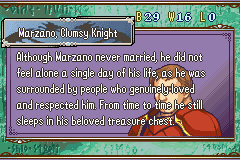
Would I say he was my favourite unit when I played the game? No, but he certainly left a memorable impression on me when I played; and that’s something I strive to do in my own projects.
This is all to say I want YOU to try using Marzano in your next AVT run if you haven’t already. He’s a lovely man and honestly a really cool unit that reminded me of how much you can do with a character that gets as little spotlight and dialogue as this guy.

6 Likes
Wyler (Shackled Power)
I usually don’t like trainees. More often than not, they are a liability to train and the payoff is just an above average combat unit, and by the time they pop off, I already have so many other strong trained units that the trainee isn’t remarkable. Shackled Power’s trainee Wyler is no different in many ways from the classic flunky trainee that just isn’t worth it, yet despite this he ended up being one of my favorite units in the game and I was very glad I took the effort to train him. So what makes him special? When I recruited him in ch9, glance he looks like a guy with bad bases and good but not good enough growths. He actually used to be worse than this; when I started my run he had only 2 base luck. Thankfully this was buffed to 8 making him more reliable early.


A fair point of comparison is Hute, an armor knight who joined back in the very first chapter. Hute’s bases and growths look quite similar to Wyler’s and his worse (but not terrible) skill and luck are easily fixable with cheap buyable secret books and goddess icons. So why would I use Wyler when I’ve got Hute and plenty of other solid trained units?
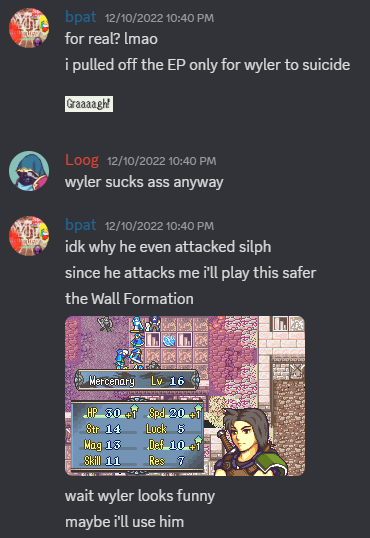
Turns out I used him because he “looks funny.” Now something important for Wyler is his join time. You recruit him partway through chapter 9, which is a long fog map notorious for having the hardest boss in the game. The boss is a paladin on a throne with high stats all around, equipped with a spear and brave sword, and to top it off he’s immune to effective damage. He actually has a battle conversation with Wyler, though Wyler has no business fighting him without rigging a kill.


Anyway it’s a massive pain to kill him reliably and it’s likely a several turn ordeal. This also means you have plenty of time to farm experience on Wyler! Unfortunately his combat here is quite bad; he dies in two hits, gets doubled when using anything heavier than an iron, and has iffy hitrates even with the slim lance he joins with. However, there is a silver lining: this generic lieutenant (bow/bomb promoted class), who I believe is the first promoted generic enemy in the game.


Obviously if this guy attacks Wyler he’s just gonna kill him. However, since he doesn’t have a melee weapon, it’s very easy to set up chip and kill exp for Wyler, which can give him over an entire levelup alone. Aside from this guy, there are a few generics that Wyler can safely attack without risking death like the sword cavaliers and guerillas (unpromoted lieutenants), so between all of these I got him to level 5 by the end of this map. By this point he still sucks and is still a total liability, but he at least isn’t risking getting doubled as much and has slightly better accuracy. But fortunately for Wyler, the next chapter is a defend map that cannot be ended early. This means it’s a perfect opportunity to train him, and Nello, the new paladin you get on this map, is pretty good at setting up kills for him. After this, the next few maps aren’t particularly great for him, but he at least grew out of being a liability and into a real contributor a lot faster than I expected him to. I promoted him at level 20 (he is a trainee after all), which he reached in chapter 16.

Now this is a real unit. Gone is the flunky who needed to be fed kills, replaced with a killing machine. Of course, I have several other similarly powerful combat units at this point, so what is it that makes him more than just another infantry combat unit? His class, halberdier, is one of three promoted mono-weapon classes that have +25 crit, the others being swordmaster and berserker. On top of this, he supports Prosel and Nello, the lord and the arguable best unit in the game respectively. An A+B support with these two results in a nice +12 crit. Late game Shackled Power enemies have enough bulk that it is often difficult for even your strongest units to defeat them in one round without effective weapons or critical hits. Also enemies in this game tend to have very low luck making crits more reliable than usual. Anyone can fish for crits with a killer weapon and/or supports and you even have access to a killer light tome for 1-2 ranged crits, but Wyler has a unique combination of properties that make him shine: high offense stats, 1-2 range, high crit rate, and bulk. While there are good units in the other two +25 crit classes, none of them can replicate both his bulk and crit rate. Unlike what you’d expect from a trainee soldier with good growths, by lategame an invested Wyler is by far the best unit in the game at 1-2 range enemy phase combat due to being able to reliably survive and crit often. Armed with the humble javelin, he can mow down hordes of both melee and ranged enemies on enemy phase without risking death.
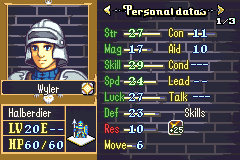

In case you’re thinking “wow this unit seems crazy,” he is still far from infallible. He is ultimately a lancelocked infantry unit which means his movement is poor, his weapon options are limited, and he is vulnerable to effective damage from the lanceslayer sword. Furthermore, despite all these green numbers, his resistance stat is notably terrible and his speed cap is low enough that he will not be able to double several enemy types by endgame, especially if his weapon weighs him down. In the end, he excels at his role, but he will never do anything outside of it. He won’t obsolete anyone else because all he wants to do is throw javelins and occasionally kill something with an effective weapon or killer lance on player phase. Players who leave his level 2 self on the bench will not miss him, and once they beat the game, they won’t think “man I really wish I used Wyler,” but for those who put in the time and effort to train him, he’s a very rewarding unit to use.


19 Likes
KEVIN LAST ROMISE IS THE SINGLE GREATEST UNIT OF ALL TIME
I may sound crazy but he soloed many maps in my last promise run
You may need to sacrifice the gaiden chapter to feed kevin more exp BUT he is really blessed
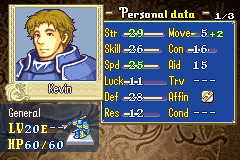
MY KEVIN HAD MAX OUT SPEED WITH ONLY 1 SPEED WING (He is an armor knight)
And he supports with rex and hes also pretty good
What am i saying is that kevin last promise os one of the best units of all time
Heres what peak kevin performance looks like
Kevin appears as an enemy in chapter 4 (or 5) of siegfried mode to recruit him just talk with siegfried
He easily can kill the boss of this map for the exp do to his high defence and also its an archer
Kevin makes a good first impression and will do pretty good on the rest of siegfried mode (maybe not letting you to go on the gaiden chapters but you dont have a convo anyway)
Anakin mode is where he shines the most
He is the first unit you gain back and acts like a mini oifey
You get the knight crest REALLY early so you can quickly promote kevin to turn him into a beast
He on some chapter recruits rex a pretty good unit to use as a support buff
Giving kevin the emblem lance and just throwing him at a wall is a really good tactic
This is my ted talk about kevin last promise the BEST unit in fire emblem
5 Likes
Hrolf (Fire Emblem Advance: Homecoming)
What is the value of a human life?
Some philosophers say all lives are priceless, that a human soul is worth more than any mortal wealth or possessions. In 2020, the United States’ Federal Emergency Management Agency valued the sum total of a person’s life at 7.5 million dollars[1]. In world history, human lives have often been bought and sold for far less, from bride-prices to chattel slavery to the grim calculus of war.
In Fire Emblem, the value of a unit’s life is… well, it varies. Player units, and their unique faces, tactical roles, and contribution to the story, are typically beloved and well cared for. Most players are willing to restart chapters over and over to ensure they all make it out alive. By contrast, generic units are puzzle pieces at best - just obstacles that need to be cut down to save the lives that matter. Sometimes, they’re not even given the privilege of posing a threat, and are just chaff placed only to die. Even green units, notionally the player’s allies and friends, get mocked and thrown away in the pursuit of fleeting tactical advantages.
Maybe there is no one answer that can satisfy all our needs. But to Hrolf, at least, it’s simple: the value of a human life is 400 Gold per chapter.
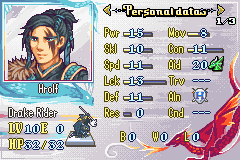
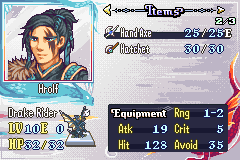
In Chapter 4 of local thread-maker Parrhesia’s latest campaign, Homecoming, you can recruit a wyvern-riding mercenary named Hrolf. While his access to flight isn’t unique - you’ve already gotten a Pegasus Knight by this point - his stats are a cut above most other units in your army, especially this early on in the game. His growth rates are competitive, too, so a well-trained Hrolf will stay useful all game long. He has mobility, strength, defense, and an incredibly cool mug - so what’s the catch?
Well, it’s like I said before. To Hrolf, the value of a human life is 400 Gold per chapter.

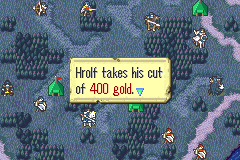
At the start of each chapter, if you have Hrolf deployed, he takes 400 Gold from your inventory. If you don’t have the cash, he leaves you permanently after the chapter’s end.
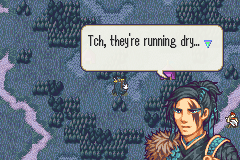
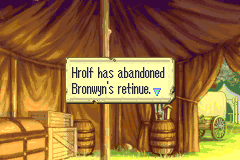
400 Gold on its own isn’t much - about the cost of a single iron weapon in the preparation screen shop. It adds up, though. There are about 20 chapters[2] between Hrolf’s recruitment and the end of the game, so if you deploy Hrolf at every possible chance over the entire campaign, he costs you a total of about 8,000 Gold.
Hrolf’s a strong unit, particularly for the price he demands, but he’s not without weaknesses. His Resistance is lacking, and archers can shoot him down as easily as other fliers. There are lots of maps, particularly indoor ones, where deploying might not be worth the money. If you do bench him, though, then he’s not gaining experience, and thus might have trouble keeping up on maps where you do deploy him. On every map, the choice of whether or not to pay Hrolf’s fee adds a whole new layer to Homecoming’s long-term strategy.
Later in Homecoming, you can hire another wyvern rider - a pre-promoted titan named Eskuldur - who instead asks for 10,000 gold up-front. She joins near the end of the campaign, though, and so has much less time to make herself worth the price. (Is she worth the price? That’s a question, and maybe an effortpost, for another time.)
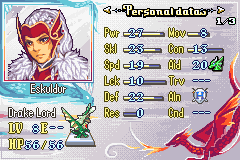
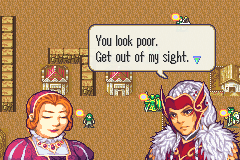
Whether or not you recruit Eskuldur is a one-and-done choice, though. You make your call when she first shows up, and just live with it for the rest of the game. Managing Hrolf’s cost, by contrast, is a fun little minigame that never goes away.
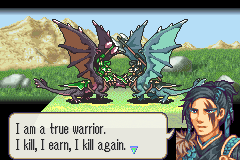
Due to the way Homecoming is structured, Hrolf doesn’t really have much narrative presence. That said, he still has a fair bit of implied backstory. Wyvern Riders in Homecoming hail from a country called Sjoersund. While you never visit Sjoersund during the main campaign, it has a role in the game’s wider political landscape - mostly as an ally of the antagonists. Hrolf has no loyalty to his homeland, though - only to money. He has a few lategame boss conversations with Sjoersund commanders that show his commitment to leaving his homeland behind.
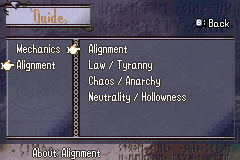
In place of affinity, Homecoming has a Dungeon & Dragons-like system where all characters[3] are aligned with Law, Neutrality, Chaos, or “evil” variations of the three. The latter - Tyrannous, Hollow, and Anarchic respectively - mostly show up on villains, with scarcely any player units having them. Hrolf’s amoral greed is conveyed even through his alignment of Hollow. This detail not only makes him stand out relative to the rest of the cast, but it also underlies characterization and completes the picture of Hrolf as a person in a way that only Homecoming could possibly do. The finishing touch is his quote if you deploy him for the final battle - the punchline has to be seen to be believed.
He also has a cool portrait. Can’t forget the cool portrait.
[1] https://www.fema.gov/sites/default/files/2020-08/fema_bca_toolkit_release-notes-july-2020.pdf
[2] To be specific, at maximum, you’ll be charged for 19 chapters worth of Hrolf usage. Stuff like the shopping map, and his drawback not mattering in Endgame, complicates this a bit.
[3] Except for the skeletons. Weirdly, despite being literally Hollow, they have no alignment at all.
15 Likes
Enrhyn (Fire Emblem Advance: Homecoming)
Ests kinda suck shit. I think they rock and will use them at every conceivable opportunity and then send screenshots of their green numbers to my friends to shill whatever hack they’re in, but objectively they’re a bit shit. Because of the opportunity cost of letting them steal experience and the time cost of getting them to catch up, yeah, but most of the time they never offer anything you don’t already have. Nino one-rounds everything a few chapters after she joins, but Pent one-rounds everything zero chapters after he joins and also has a cooler sprite.
The obvious solution I’ve been seeing a lot of hacks doing lately is to give ests some sorta niche other units can’t fill, whether through giving them a gonzo PRF or nutso stats in a setting where that actually matters. Most ests get both.
Enrhyn gets both, but unlike most situations, both factors actually matter.
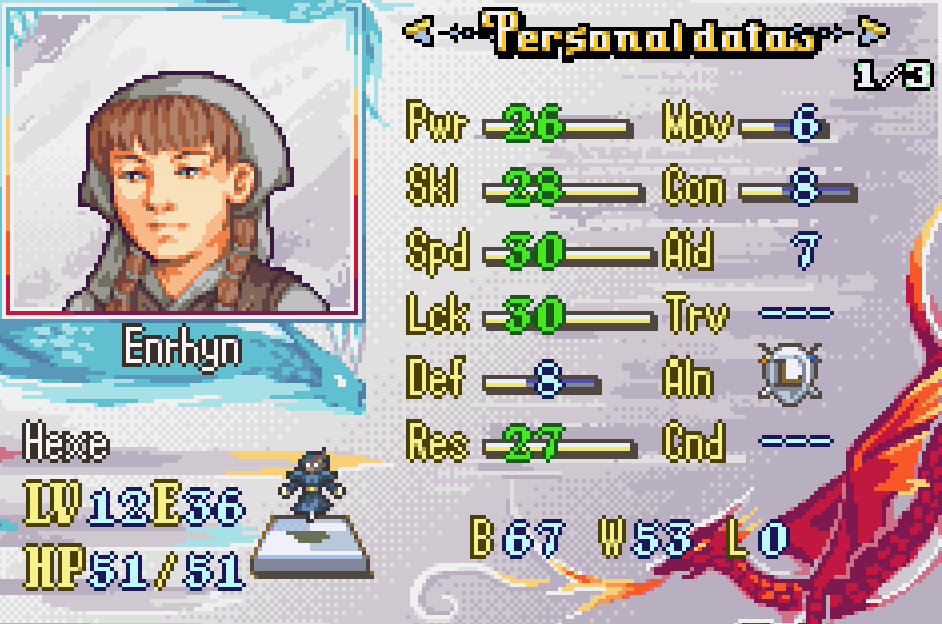
Without getting into anything spoilery, Enrhyn already has it pretty bad in her first appearance. She shows up at the start of lategame in an interlude where you can choose from 2 of 5 units to recruit. There’s some good units in that pile! There’s Eskuldur from the last post! Enrhyn looks like this!
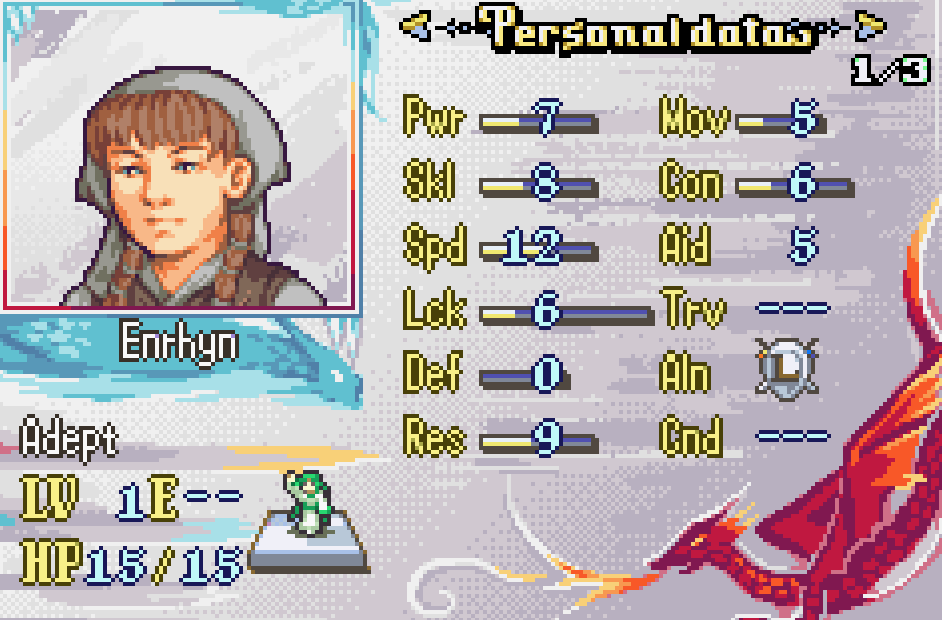
She’s very obviously off her ass on something!
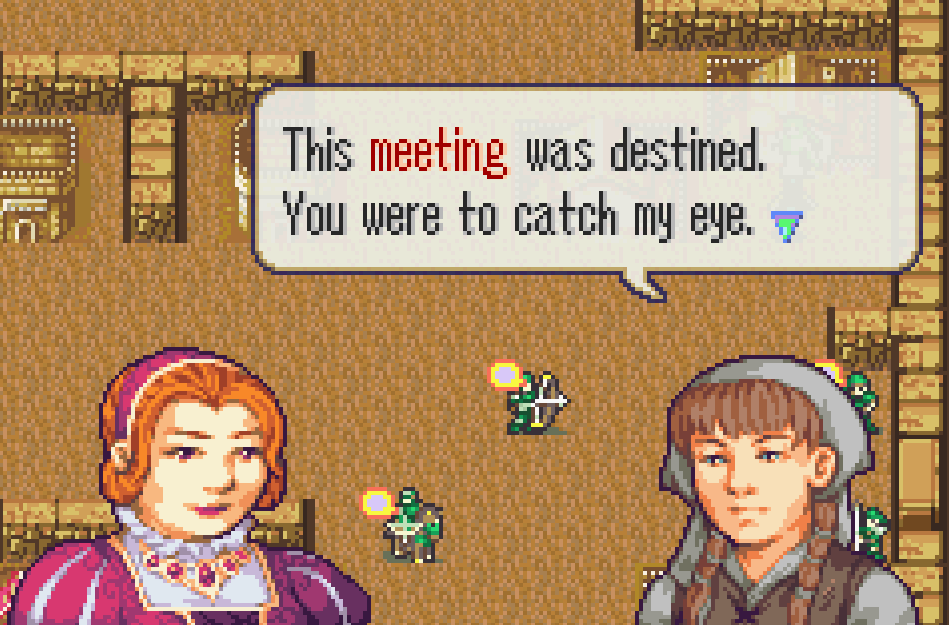
She’s even getting dissed in the tutorial box!
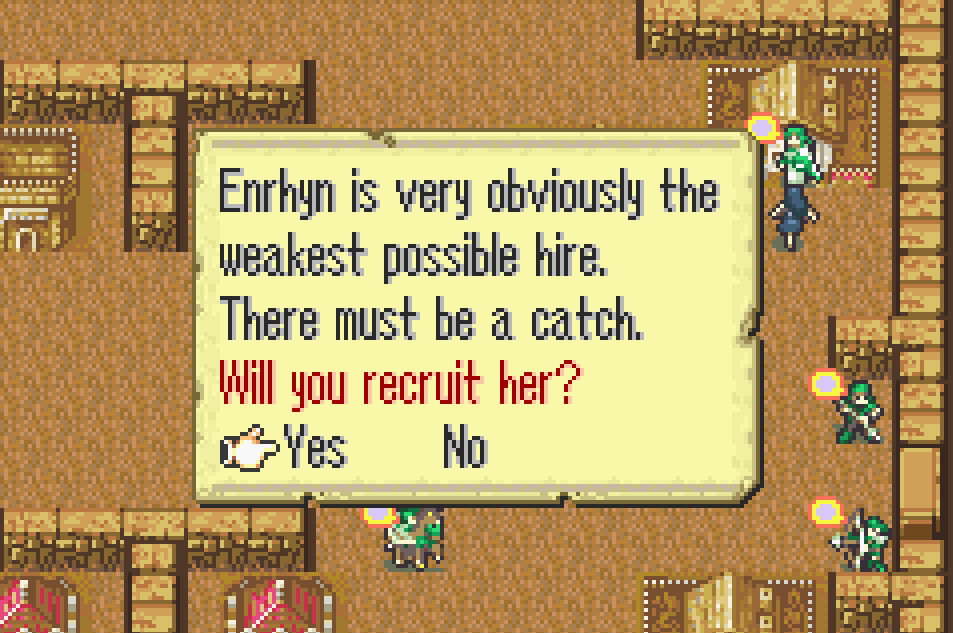
I honestly took this completely at face value and thought she was a fallback monk in case you needed another one for some reason. I brought her along because I thought it would be funny if her growths were massive, and they actually were. I definitely would have used her to endgame regardless because ests are fun, but she’s got two things going for her because of some Homecoming-specific quirks.
The First Thing: Her PRF really is that good.
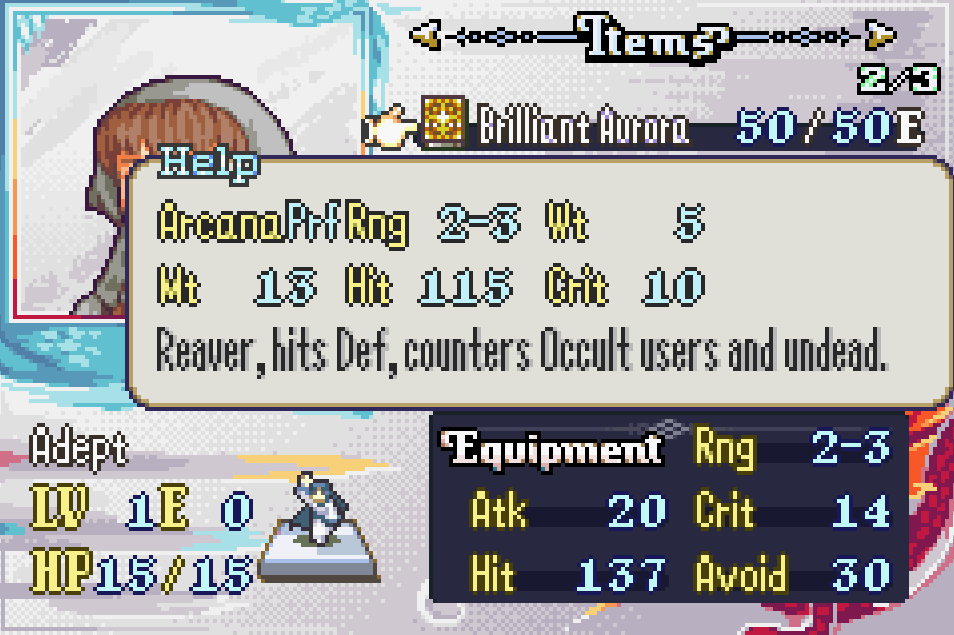
Every mage in Homecoming gets a PRF, and they’re all really good. However, most of them fall off, and a lot don’t really do anything new. Elionwy’s 85 crit tome does a lot of boss killing early on, but she has enough speed to kill low resistance enemies with normal tomes regardless, and her low magic combined with the low might of her PRF doesn’t do much to the exceptions. Trefor’s 1-3 high crit luna is incredible, but with his low speed, he’ll start running out of things to one-round with it. Enrhyn’s PRF instantly slaughters problem targets and never stops.
Enrhyn promotes into a Hexe, a mage with 6 movement who uses occult [dark] and arcana [anima] magic. Hexes are one of the most obnoxious enemy classes to fight, as most units have dogshit resistance except for mages and pegasi. Homecoming’s magic weapon triangle is a magic weapon line, where occult is effective against arcana and no light magic exists, so mages have a hard time pushing against the combined weapon triangle disadvantage and existent resistance stat. Hexes also have just enough bulk to get an incredibly powerful counterattack off most of the time, which is made extremely apparent when one of them has this hack’s version of Nosferatu, and may double slower units that have enough strength to take them out immediately. Ignoring the possibility that they may have a 1-3 range tome equipped, the only safe options for taking Hexes out are Warriors with expensive weapons, Paladins with expensive weapons, and Brilliant Aurora.
Brilliant Aurora has a bunch of secondary effects that seem like a parody of overtuned est PRFs at first, at least to me, but they end up being the best argument for bringing Enrhyn with you. Reaving occult magic is exclusively an upside, and the +50 avoid she gets from doing so makes her the best answer to it on enemy phase. The tome is also effective against occult users, even when they aren’t actually using occult, giving it 39 might against them while also targeting their weak defense stat. Brilliant Aurora is also effective against undead enemies, which make up a large chunk of the enemy forces during her first few available maps.
Just as an example, here’s a 23 strength paladin with a silver lance VS base Enrhyn.
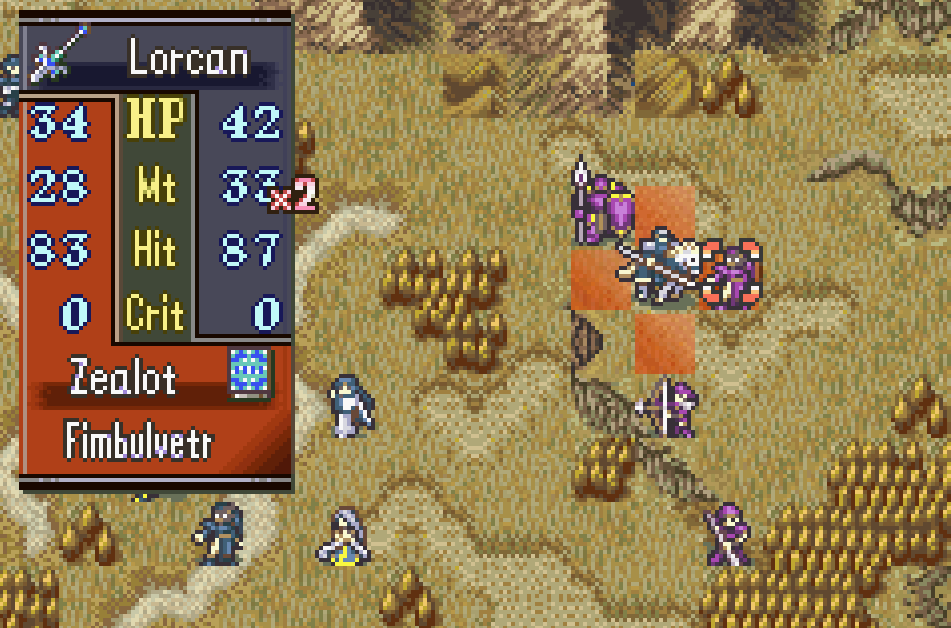
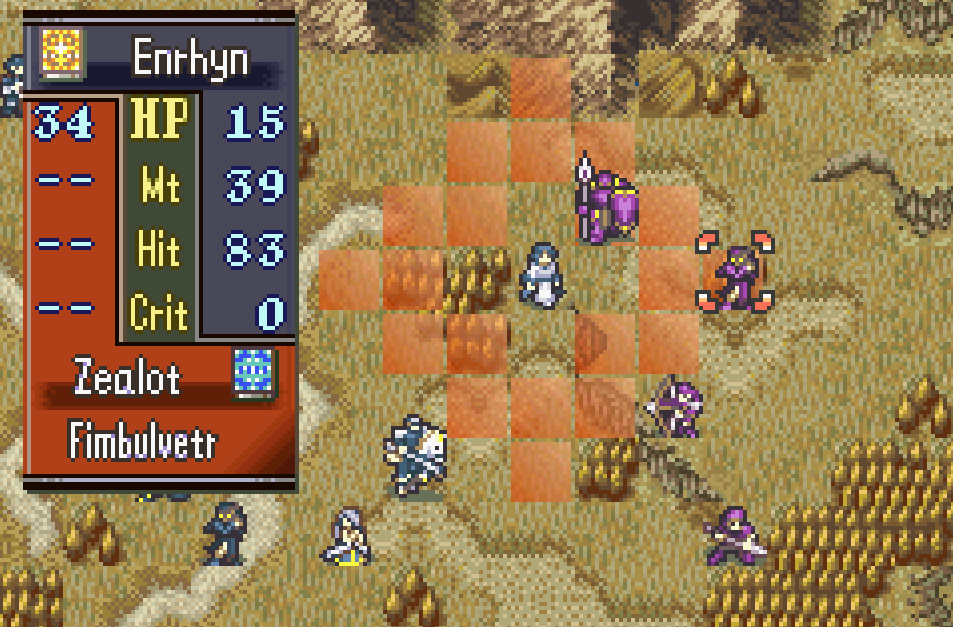
get fucked lorcan
Enrhyn would be great if all she did was kill Hexes and monsters. She does more, which leads into my next point.
The Second Thing: Her stats really are that good.
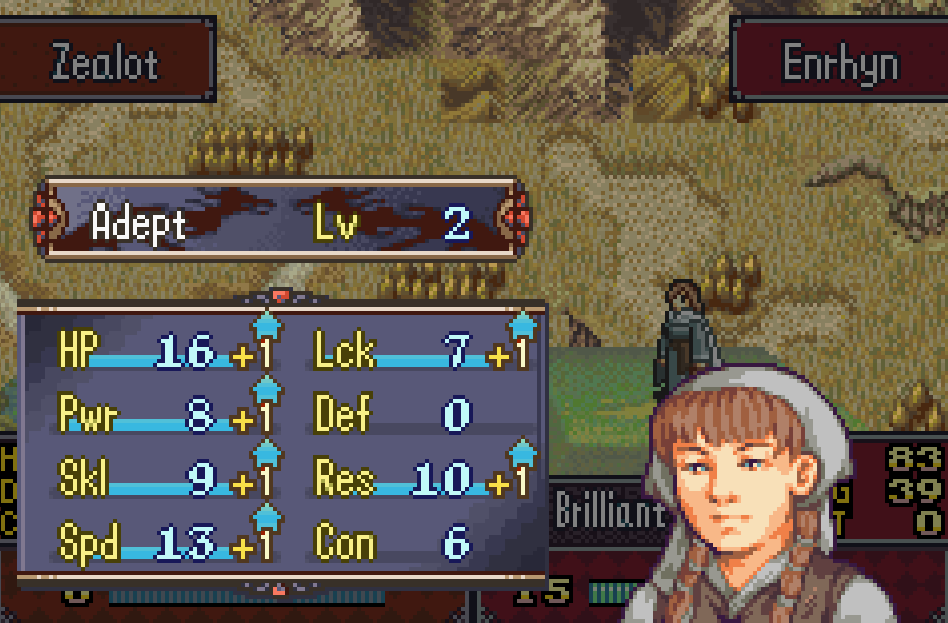
Enrhyn has a niche already, but it doesn’t take long for her to usurp every other mage’s niche. As I was saying earlier, most mages in Homecoming have iffy stats. The only non-prepromote mage with good magic and speed is Quistan, who sucks ass. The prepromotes have passable statlines that are rapidly eclipsed by your physical fighters, and while the healers have great offenses [albeit low skill], they don’t get PRFs. Enrhyn takes two chapters at most to reach promotion level, at which point she’ll probably have higher stats than most of your magical units, ‘probably’ becoming ‘definitely’ if you keep using her. This would be good regardless, but her growths become really noticeable when they turn her into one of the only units that can one-round consistently in the latter half of Act 3. Stat leads don’t matter in a setting where everyone has massive stats, but in Homecoming, she’s the only realistic option for killing endgame minibosses with Bolting.
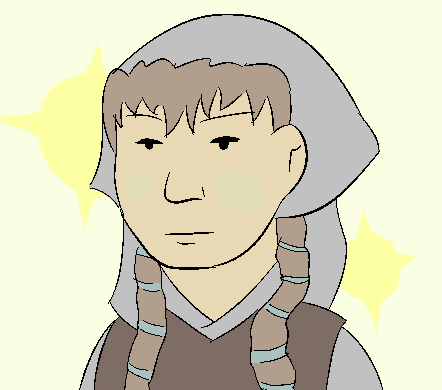
i also drew fanart of her because i got bored
25 Likes
For vanilla fans, there is Wil. For lovers of stats, there is Crowe. For lovers of protracted arguments about tiering, there is Sam. But for me, there is only
Marcello (Temple of Ardesia)
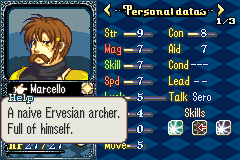
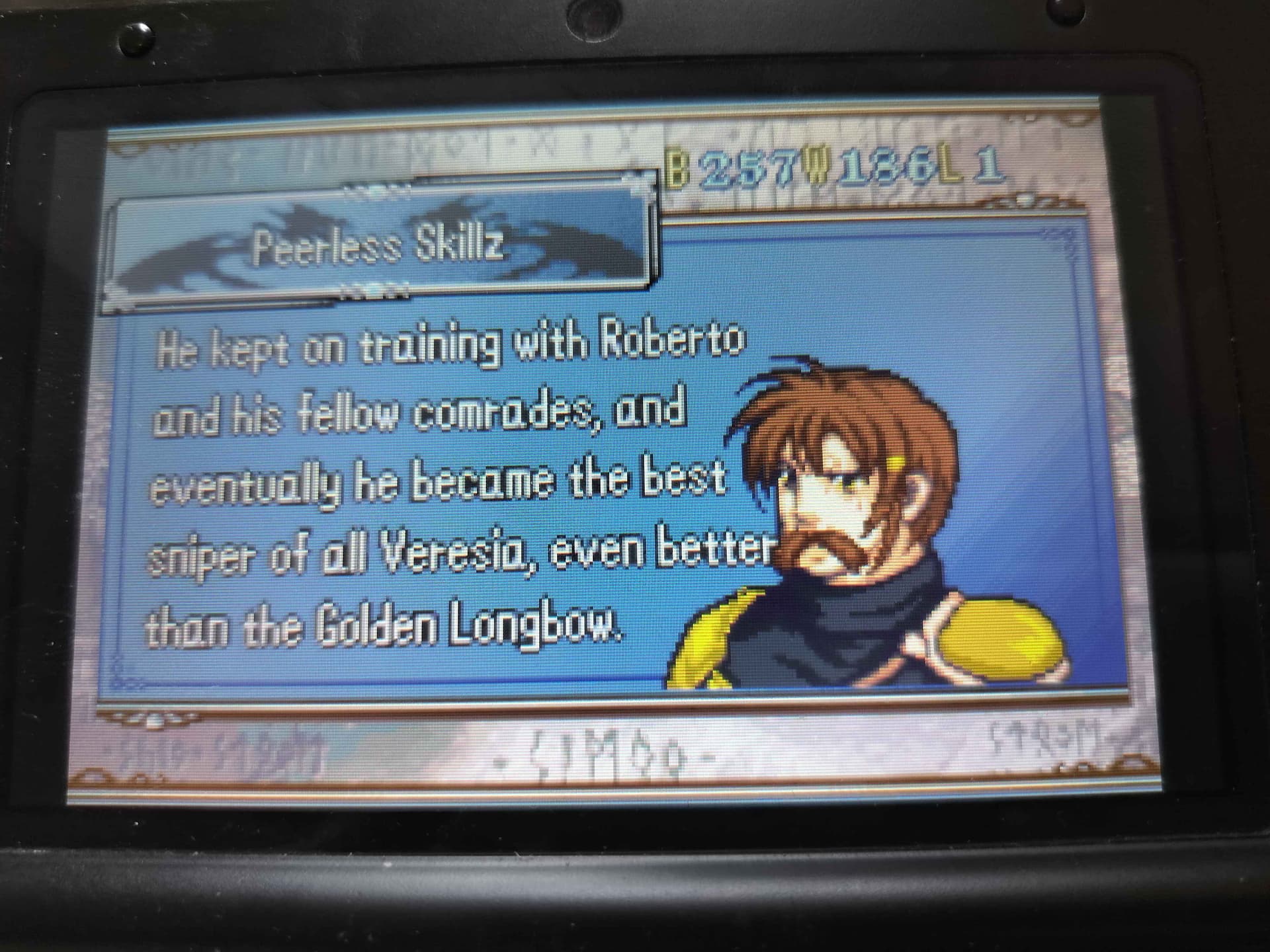
Marcello is a man with a funny mustache. He talks constantly about his “peerless skillz”, which include his hundred-arrows technique. He is, in fact, full of himself. But is he wrong? His stats seem to indicate one arrow, really. He has high Strength and a decent Strength growth, and reasonable Speed but a middling Speed growth. Wherefore, then, does he speak of a hundred arrows?
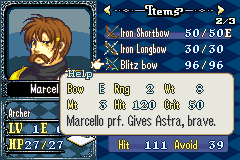
That’s right, this guy has an in-story super technique that’s represented immediately in gameplay by his prf. At first blush, this is already a pretty fun prf. It has low Mt, but it’s brave with 50 crit, and comes with a chance of Astra. However, what the game does not immediately inform you is that a chance of Astra in this case means 100%.
As a reminder, Astra hits 5 times in a row at 1/2 displayed damage. Combined with brave, this means that each Blitz Bow attack fired off deals a minimum of 5x displayed damage (with some damage loss due to rounding errors), before factoring in the 50% base crit rate. Combined with his mighty might, Marcello is a delete button, plain and simple.
Now, a delete button is not particularly interesting on its own, but how does this play out in game? The Blitz Bow has massive 96 uses. If you ration carefully and get lucky with crits, you can usually spend 2-4 uses on on-par enemies that are just out of range of your shortbow or longbow and get an otherwise undeserved kill. However, you can also choose to blow 10-20 shots on a single target in order to kill a boss that is otherwise far outside of Marcello’s ORKO paygrade. Temple of Ardesia is a long hack, and although Marcello is not playable in Part 2, nobody in the cast has perfect availability, and the fact that he’s in your starting team means his availability is as high as it gets. In other words, the decision to nuke with the Blitz Bow becomes a genuinely meaningful one across Ardesia’s massive 33 chapters (+19 gaidens, the majority of which follow chapters where Marcello is available).
This resource management minigame even extends to individual chapters, rather than across an entire run. Siege warfare eventually becomes a core component of lategame Ardesia chapters, and many maps have ballista that can create an advantage. Generally, you have a good number of units that can attempt to double enemy siegers if they’re holding a ballista or bulky siege tome. However, Ardesia has no shortage of status staves too, and these enemies are not guaranteed to be weighed down by their weapons. That’s where a likely unintended side-effect of Marcello’s Blitz Bow comes in handy: Blitz Bow’s Astra is applied to ballistae that Marcello rides. At the cost of additional shots from a given ballista, you can secure a kill on targets otherwise outside of ballista ORKO range, making him a unique siege tool that can either help chip existing siege targets, or, if your action economy is already overextended, spend your chapter-limited siege ammunition to absolutely nuke some guy right now.
Marcello’s gameplay intricacies extend into his friendships as well. He’s part of a trio of buds with Sero and Nazir, your thief and pirate that both have the ability to steal. While other games have triangle attacks, Marcello, Sero, and Nazir have a different unique dynamic. You see, most lategame Ardesia bosses come with Hoplon Guards, but are not innately immune to crits via skill. As such, one potent strategy for dealing with bosses is to first rip off the Hoplon Guard with one of Marcello’s two buds, and then unload into the boss’s face with the Blitz Bow. You can also choose to simply fire into the boss for 5x damage, but, again, this costs a lot of uses.
“Does Hammerne break this guy in half?” You can actually buy Hammernes at one point, they cost 21k a pop and there are better targets, like the S-rank wind tome that has Galeforce attached. I still repaired the Blitz Bow once, though, and with careful management, that’s all you should need.
Narratively, Marcello is one of the more well-defined and funny units in Ardesia. He is every bit the braggart in his character description, up to the point where he speaks in the third person because “Marcello is too strong to use only one person to speak. He needs two more.” He has incredibly random battle quotes where he will just challenge bosses he has no relation to whatsoever to showdowns to prove his skillz are superior. At one point, the lords invite everyone into Marcello’s house and then one of the steeds shits on his floor.
Truly, the perfect romhack archer.
Also he spells skillz like that in-universe.
20 Likes
Dogs. You know them, you probably love them, and most FE games have the common decency to not expose them to the horrors of war.
Luckily for us though, The Unbroken Thread is an FE game that is anything but common.
Flower the dog is a unit that joins in the earlygame of The Unbroken Thread. You might be wondering why I didn’t list a chapter number; that is because The Unbroken Thread is a living, breathing open world, where you have the freedom to go left OR right, choose your own path, and tell your own story. (Flower’s map is like, chapter 4-5 if you wanted to know)
While there are other mechanical differences with The Unbroken Thread I could bring up, mainly poise, it really doesn’t affect Flower that much, Flower has a hard time poise breaking and is very hard to poise break herself.
Let’s do something a little weird, and start with Flower’s endgame stats.
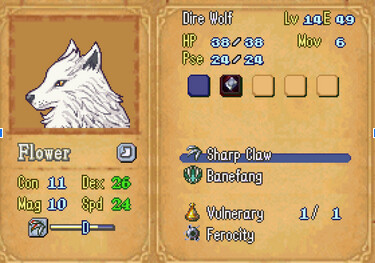
You might notice that this game’s stats are a little weird. Where’s strength and defense, you might ask? Simply put, they aren’t here, on allies or enemies. All damage comes from your weapons.
Now, this is both good and bad for Flower. As you can see, she has myrm-adjacent stats, meaning that her strength and def would’ve likely been garbage if they were included, to make up for the fact that she is nearly invincible due to her high avoid (which is augmented even more by tomebreaker once promoted) and incredibly deadly due to her high dex giving her pinpoint accuracy and decent crit. However, the downside is that Flower, being a dog, has only 2 total weapons that she can use for the entire game.
The sharp claw is a light, but strong weapon, and the Banefang (unlocked by completing Flower’s loyalty paralogue) is a mage effective weapon, which is absolutely massive in a game where damage-per-strike rarely exceeds 12, even in endgame. It also helps that the secondary weapon triangle (bows beat monsters, which beat tomes, which beat bows) makes Flower your only WTA mage breaker/killer for the entire game (no, the bird does not count).
Still though, the weapon sitution is unfortunate, and it has the effect of making Flower strong, but not overpowering. Tristan, for example, is a unit with a very similarly strong offensive stat spread to Flower, who ends up outpacing her in terms of damage and utility by virtue of being able to swap from silvers to killers to reavers to javelins.
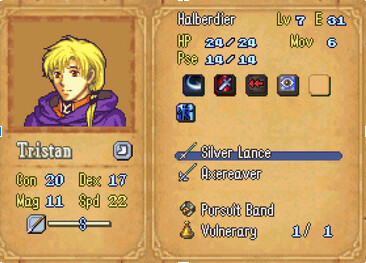
So, while Flower is a good addition to any party, and a powerhouse in theory, she is balanced out by the game favoring weapon diversity and utility over raw stats.
Anyway, I think it’s time to reveal that this effortpost isn’t about The Unbroken Thread
Flower (The Unbroken Thread 0%)
Let’s go ahead rewind the clock on that Tristan/Flower comparison back to their join maps
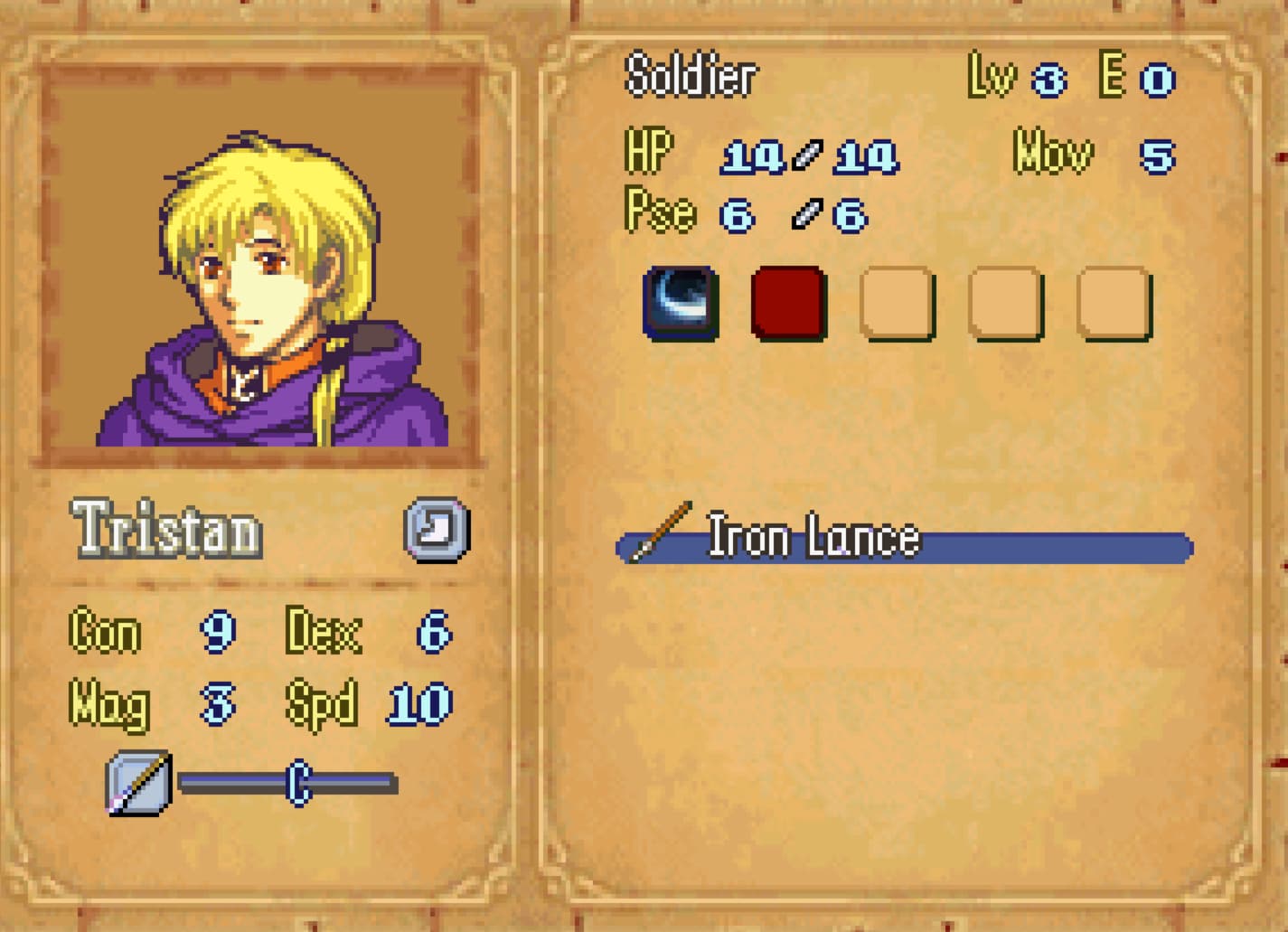
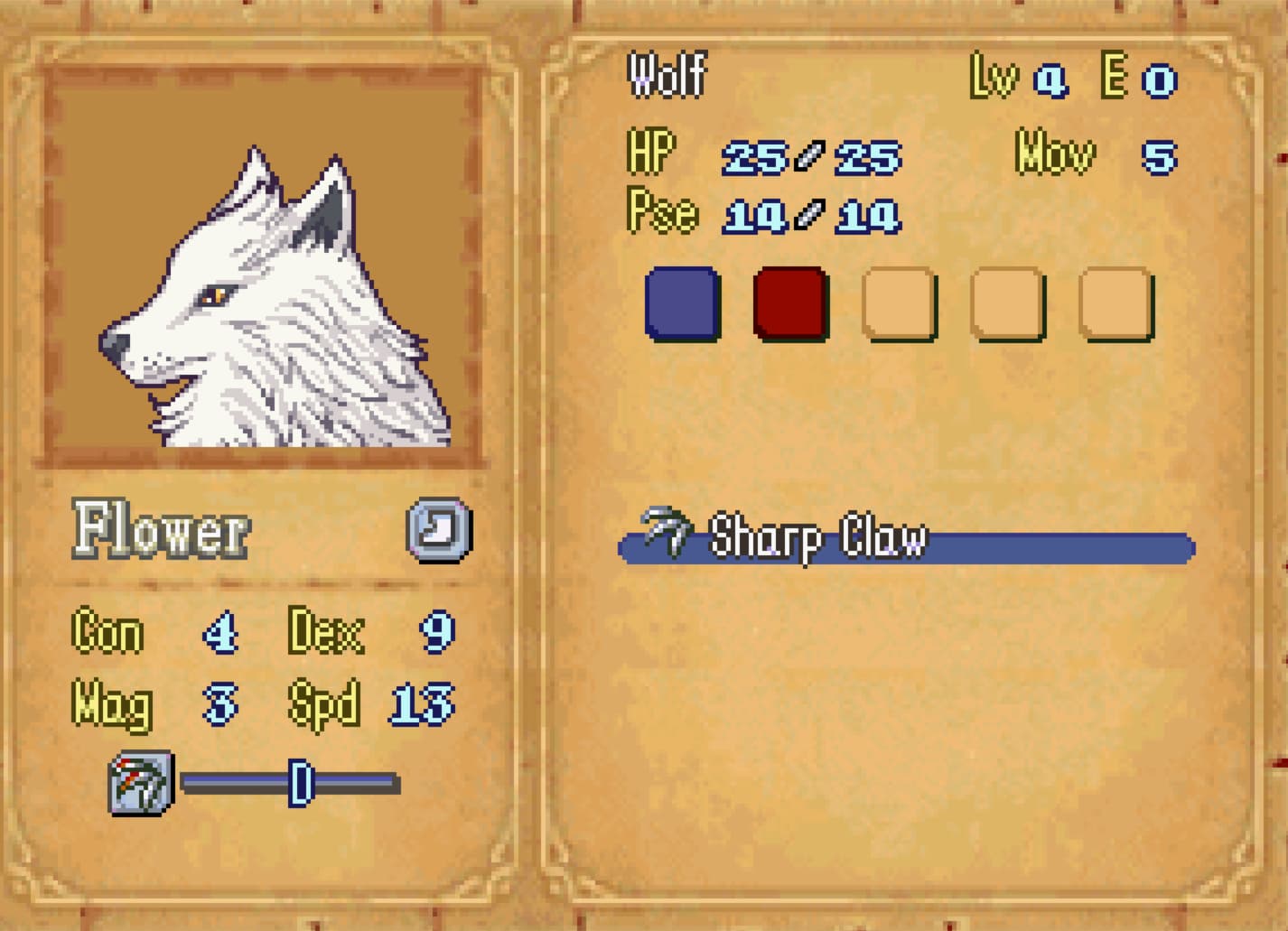
Con and Magic are both used for meeting weapon requirements (kinda like class certifications in three houses, or the weapon reqs from souls games, some weapons have a “you must have x con to use this” requirement). Flower really does not need either, since, guess what, she only has two weapons. However, con and mag being stats that no unit can level up deals a massive blow to every other unit in the game. Take away Tristan’s “lead” in con, and you are left with a unit that is way less bulky, way easily to stagger, slower, and less accurate than Flower.
And to make this comparison more ridiculous, Tristan is a great unit, most units in the game (even some that join significantly later by the way) do not have Flower’s mix of great speed and dex and good weapon access. In fact, let’s make a stupid comparison real quick
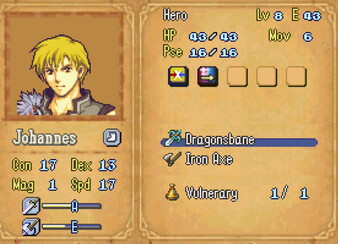
This is regular-growths Johannes at endgame, a hero that joins you at the end of the game and has excellent stats. His stats are so good, in fact, that in 0%, he racked up 100 kills in less than 10 maps. While his hp is admittedly much better, his speed and dex are not that much better than Flower’s, and they are actually worse when factoring in Flower’s promotion and Ferocity, a unique stat boosting accessory that only Flower can use (again, I ask, what bird?)
So anyway, Flower has base stats that are comparable in 0% to a endgame unit’s. What does this mean for the game? Well, it means that by the end of the game, Flower has 136 kills, more than every other unit in the game combined (except for Johannes, who had 100). Even on endgame maps, Flower doubles all but swordmasters and one rounds every mage in the game, including the final boss. Despite missing out on speed and hp levels, Flower still routinely dodges axe hits and can always be trusted to tank a few enemies at a time, something that your armor knight can’t even be trusted with. Flower is not only above par, but incredibly viable and interesting throughout all stages of the game, despite being an intentionally simple unit to use and understand. Flower is the tree branch you kill Ganon with in the first hour of playtime
And she’s a cute dog, which is pretty cool.
10 Likes
The Last Promise is a weird hack. Infamous for both its gameplay and writing, many aren’t particularly fond of it, and considering the problems it has, I think that is completely fair.
Unfortunately, I like this strange little game way too much. So I’ll give my thoughts on two units, starting with Althares.
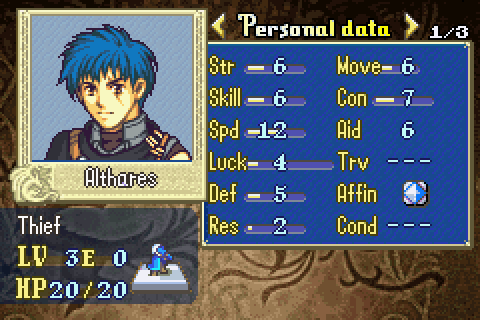
Althares’s join stats are actually kind of workable, even if he’s very much outclassed as a swordie by Shuuda, not to mention the lords. He has innate +15 crit, for some reason, which only really matters if you invest in his combat longterm. Unfortunately, being a swordlocked infantry only works in The Last Promise if you have the crazy stats and myriad of PRFs Kelik has access to, and Althares, while fast, has poor growths in both defensive stats, especially for TLP standards.
If that were all there was to him, he’d be a fine unit, but unremarkable. However, to make things even worse for him, chests and doors are a non-issue in this game with just how many keys you get access to, making his primary job as a thief generally redundant. Sure, there’s a good amount of stealables in Anakin mode, but there’s only really one that actually matters. So what can Althares do to stand out at all?
The Last Promise, being an old FE7 hack, suffers from the limitations of both the game it’s working with as well as the lack of advanced hacking tools at the time. Generally, this ends up causing unnecessary frustration with things such as inventory management (no convoy til Liuke). And yet, this inventory management makes the role of stealing elixirs to sell for Seraph Robes all the more fun to optimize. With no convoy access during Siegfried Mode, and the amount of items you end up receiving, units will end up discarding items all the time if you don’t plan ahead. These items will range from half-dead iron weapons to actual valuables. Althares floods your inventory even more mid-chapter with an absurd amount of stolen elixirs that you won’t be selling til you’re at the next preps screen. The reward for this inventory management, and properly managing funds through Althares’s thief utility, is buyable Seraph Robes in the final map of Siegfried Mode.
This is how it all comes together. Althares rewards the player for proper inventory management with the ability to make their investment projects even more capable for the rest of the game. There are units whose viability beyond a certain point hinges on these Seraph Robes, such as Cia, and Althares lets you invest in a notable amount more, should you only utilize him properly.
Althares wouldn’t be as exciting of a unit if he wasn’t limited by the lack of a convoy. Thanks to this clunky limitation, though, he ends up as one of the premier stars of Siegfried mode without being a combat standout. And thanks to him, you can help Shon, one of the game’s lords, scale better into the midgame, his worst section. Speaking of…
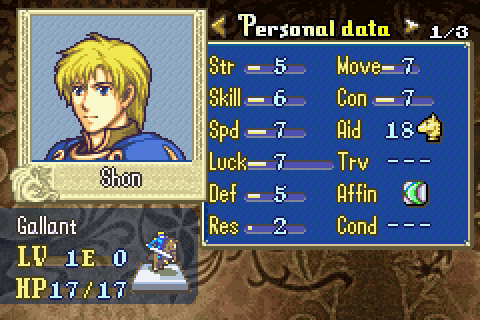
Shon, at base, is a complete wimp, fitting with his character. He doubles very little, hits like a wet noodle, and can barely take any hits with his atrocious 17 HP. His growths are also nothing standout for TLP, and his bulk in particular can often end up a major weakpoint. In the lategame, he gets an uber-powerful PRF that turns him into a playerphase monster, but that’s not a terribly interesting unit to use either.
Shon doesn’t exist in a vacuum, though. The earlygame of TLP is extremely axe-heavy, and the low-defense, low avoid enemies make for perfect candidates for Shon to mop up once they’re weakened. His availability is amazing, so training him seems appealing. Your reward for doing so isn’t an unkillable wall, nor a particularly impressive nuke until he gets Silvans (which isn’t around for long). The reward for training Shon is having a reliable, but not oppressive, secondary tank for Siegfried mode, despite his poor start.
Shon doesn’t have the growths or bases to outpace the competition on paper. What he does have, however, is the opportunity to outlevel them. For the first map, he has to solo else his sidequest is unattainable. The second map, if the sidequest is started, is also a Shon solo, though a short one. For the next few maps, he is one of if not the only good combat training project barring Siegfried, as Corben is the definition of mediocre. Because of this, him and Siegfried will be taking pretty much every kill, with Corben just there to weaken enemies for the duo. It’s not uncommon for Shon to close in on his level cap during Siegfried Mode. And while Shon’s father will be objectively better throughout the entire earlygame, and Kevin is also much bulkier, when I needed a third tank to cover chokepoints in Siegfried mode’s hardest maps, he’s the only one who could do the job. His poor midgame performance is offset by being a great secondary candidate for Seraph Robes, assuming the primary one is Inanna, so he can at least sponge a bit of damage on rejoin.
On a semi-related note, Shon’s availability is…strange. As I said at the start, Shon is a complete wimp when he joins, and this hardly changes throughout the game. At any moment where he has the chance to grow, to mature and stand up for himself and his allies in a way that matters, he doesn’t. Even in the final battle, the idea of confronting his father is too much for him, and he cannot be deployed at all. This isn’t the only map where his emotions get the better of him and stop him from deploying, too. Many criticize this as a failure of the game’s writing, ruining his chance at an actual arc. Personally, though, I really enjoyed that despite every opportunity to stand up and fight, Shon wasn’t up to the task in the end. His arc may not be satisfying, but I think it was an interesting (and likely unintended) subversion.
Neither Shon nor Althares are particularly well-designed units, necessarily. But, intentionally or no, they both enhance the experience in ways I greatly appreciate.
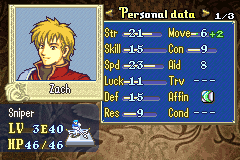
Also here’s Zach. I was going to make a joke about how neither of the above two hold a candle to him but honestly the idea that he might warrant his own post in the future despite being the definition of a mid archer terrifies me and completely destroyed any ideas I had for the bit.
9 Likes
Mr. Zach Ballista here hogging an entire mechanic to himself and nobody cares
3 Likes
“Please, Mr. Zach Ballista was my father. Call me Zachie B.”
Fire Emblem is a franchise with a very broad cast. Fire Emblem is also a franchise that has to write around the potential absence of characters given the permadeath mechanic, which means that this broad cast can often feel weightless in the grand scheme of things. This mixture of ingredients can often rear its head in an especially ugly form when a mainline game, hack, or other project spends one or multiple chapters dedicated towards gathering allies or recruiting characters… only for those allies to contribute nothing to the story for the rest of the game.
This means that writing memorable FE side characters often involves piecing together how to make someone feel meaningful despite being ultimately optional. But what exactly is the formula to creating a character who feels like they contribute something substantial to the story, and how does one make their scenes feel impactful on the greater scope of the narrative?
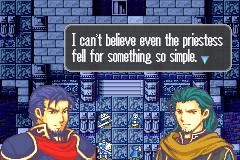
Well, let’s welcome in the belle of the ball of today’s post and dig into this a bit.
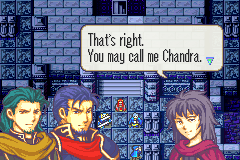
Chandra (Dark Lord and the Maiden of Light)—making characters that matter
Chandra is a one-off boss from the cult of Ahribaal that the main plot decides to devote an entire gaiden to, and her chapter is the player’s first introduction to the cutthroat culture of Ahribaal and how they operate. This setup all leads into Ahribaal’s later atrocities very cleanly, especially when just a chapter later Orion sees what they’ve done to his homeland with his own eyes and is utterly disgusted by it.
Chandra herself is sent on a suicide mission into the home of the titular Maiden of Light and her dragon priests, which is a fact she clearly resents. She knows that she is a sacrifice in a game greater than her and she is not happy about it, but what can she really do? And if the player lacks the compassion to see her as more than the story device she is, well… she is very much capable of serving her intended purpose in the main plot through this chapter alone. The cast kills her, the player gets their first taste of the Ahribaal medicine, and then everyone moves on to confront bigger and more heinous villains.
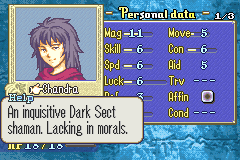
You can tell that she isn’t recruitable because her unit description is primarily negative about her, and that only happens with bosses.
But as any interactive narrative worth its salt would do, the game leverages Chandra as an avenue to provide options for the player to shape the story experience.
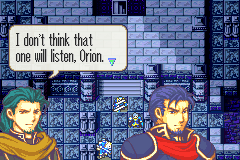
If the player notices that Orion feels bad for her during the opening event and acts on that sentiment, they’ll discover that…
…the tactician is correct and there is in fact no easy talk option between them to recruit her. Tough luck.
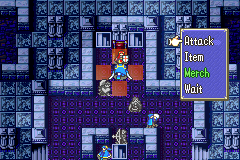
But there is a battle quote if they fight.
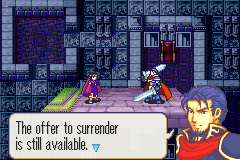
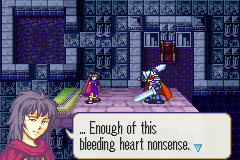
And if you obtain that quote as a skilled player should, Orion knocks her out and stops the others from killing her and Chandra properly joins the party.

I really love this recruitment. I love how it’s more than just a boring and straightforward “talk” marked by an obvious indicator bubble, and how it doesn’t show its full hand until after the chapter is over. I could go on about how amazing it felt to discover on my own that this random boss with a design that isn’t conventionally attractive by anime standards was actually spareable, and how much I adore how DLATMOL rejects attractiveness as a visual indicator of playability, but you can just read my effortpost about Alva if you want more about that.
Now, Chandra is not a character who significantly alters the plot trajectory of Dark Lord and the Maiden of Light. But having her along for the ride makes the game feel different than if she weren’t there: her presence and using her as a unit adds fresh layers to the story that pretty much no other character in the game could replicate with equal effectiveness.
Seeing the factions through her eyes sets the stage for later things to come: how she sees the gang sparing her as futile when she’s convinced the dragon priests would leap to execute her anyways, how her boss is a cult leader named Weaver who is more than happy to spend lives like currency, and how she makes a very peculiar observation about the Maiden of Light’s home that would probably earn her an immediate execution if Freesia was in the room.
Out of the player cast so far, all of these contributions could’ve only been provided by Chandra. Her perspective is unique from the rest of the party—sure, there technically is another Ahribaalite, but he hasn’t been home in a while and doesn’t have the same view of the Sect’s inner machinations as Chandra does. And she is acutely conscious of how the other cultures of Brauma perceive the Ahribaalites as scum and wants to piece apart how that came to be. So all the dialogues she gets past this point add layers to the story that others can’t, and in doing so she also makes the screentime dedicated to her prior feel more weighty in retrospect.
But how is she as a unit?
I benched her once, and it was by far the least fun DLATMOL run I’ve ever completed
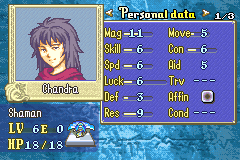
Let’s just say that most people who choose to field Chandra will likely be motivated by reasons outside of a pure gameplay vacuum. She joins alongside a much better unit (Freesia) and probably struggles to stand up to your other magic users from before. She basically only has two stats that are good… but she excels in both beyond compare.
And fortunately for her, her story setup as a defector from the enemy forces means it’s easy for a blind player to correctly intuit that she has a number of boss quotes later down the line… and that basically amounts to a golden ticket for long term deployment and investment in my book.
It is genuinely a lot of fun to find her a place in the party and etch out approaches to maps that make the most of her niche strengths. Her stellar magic means that she can always contribute with chip damage here and there even if her ORKOs aren’t super common, and after promotion she can heal more with a Heal staff than any of your stafflocked units could dream of. And come lategame, a particular item appears that benefits her a lot: the S-rank Dark tome that you get from visiting Ahribaal.
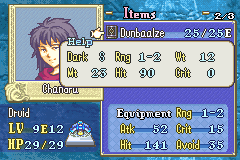
big number good. send tweet
Dunbaalze weighs her down a fair bit, but her speed is unreliable and it’s not like she wants to be taking hits anyways. It also has huge might, good accuracy, and 3X effectiveness against monsters—and monsters are generally some of the more dangerous enemies in the game, especially in lategame where enemies are all pretty scary, so being able to do enough damage to oneshot is often really convenient. And no one else in the game has magic quite like Chandra’s, so she’s the most likely candidate to hit oneshot thresholds for a wide breadth of enemies beyond just monsters too. It’s not the kind of thing that will break the game in two, but it really helps her feel like she has a distinct niche in a nice way.
Do you need Chandra oneshots to win the game? Of course not, just like the story technically doesn’t need Chandra’s recruitment to function. But her gameplay utility and the story flavor she provides mirror each other: they add enough to the experience that it makes her feel important even if she is not structurally essential per se.
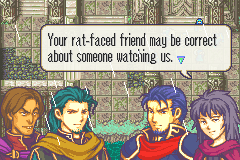
The events, supports, and interactions that she does get past her recruitment are excellent at utilizing her as a conduit, drawing out new sides of existing story beats in a form that feels like it is uniquely hers. Her presence expands upon Orion’s story in interesting ways, adding some warmly welcomed subtext to certain events in the main plot. Her familiarity with the Sect sheds light on a particular character who comes off very surface-level in every dialogue he gets… except in his interactions with her. She even gets some cute little moments of her own to shine, like when she detects an enemy ambush by realizing that their attackers are using the exact same illusion tactic on the party that she used in her recruit chapter and promptly dispels the illusions with ease.
There is one particular dialogue with her that I found very satisfying to encounter: a little scene that highlights how she is one of the very first characters who starts to catch onto a really important detail about the game’s lore. Of course, the protagonists manage to eventually sleuth it out too, and the main story makes it engaging for them to uncover the truth just as well… but it’s Chandra’s unique perspective that allows her to start putting the pieces together before they do, which also lays down a solid foundation of hints to properly prime the player for the eventual reveal. I won’t say where this dialogue is—and hell, it’s not too hard to find if you’re using her—but it’s been years since my first DLATMOL run and I still remember how thrilling it was to find it.
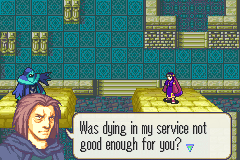
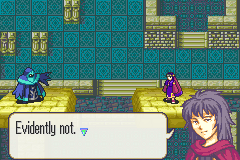
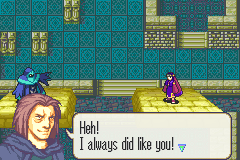
Get a load of this gal.
In general, I think DLATMOL is a game that rewards those who really try to dive into it, arguably moreso than a lot of projects. Some story-focused hacks like The Dark Amulet and its sequel prefer to present all of their coolest bits front and center, so that it’s impossible for a player to miss them. And I understand why a developer would want to do this! But with DLATMOL, a player could very easily just… completely miss out on so many of its coolest parts if they don’t care to search for them, and Chandra is no exception. The more you explore the game the more layers you’ll find to add to the narrative, and the story experience will be all the more engaging as a result.
I think there’s something very special about a story element that is technically optional but adds so much value to the narrative experience to the point where one might even argue that it should’ve been unmissable, and I think that DLATMOL is really good at making discoverable elements like these really rewarding and satisfying to look for. In that light, I almost kind of think that a part of what makes Chandra so cool and neat to me is that she’s missable at all despite how much she brings to the table. There’s almost an unspoken vibe of player agency here: you recruited this character, you invested in them and found them a niche despite having little pragmatic reason to do so, and you brought a new angle to your story experience as a result.
also, she is the only recruitable woman in the game who Darius apparently doesn’t find attractive enough to defect to your side for, and all that tells me is that Darius is a moron because HOW can you say no to a lady with more than four boss quotes
13 Likes
Baros (Drums of War)

Jagens are a tricky archetype to balance in Fire Emblem. That early-game prepromote tagging along with your scrub squad is essential for smoothing over the early-game training montage, setting up kills while also retaining the ability to selectively nuke a particularly dangerous enemy to keep your lord safe. Eventually, most Jagens fall by the wayside once promotions roll in, making way for the higher potential units that they’ve shepherded into the midgame.
Personally, I’m not usually a fan of using Jagens (or other prepromotes, for that matter) longer than I have to: I’m here to train a death squad from scratch, not be coddled by some old fart with the growth rates of a slightly uppity turnip.
In comes Drums of War’s Baros, a dutiful and patriotic magister who we’re introduced to as he’s lamenting the state of Rijesca’s rebelliousness to Captain Roxelana. After rounding up a levy of motley recruits to bring to bear in the Confederation’s grand campaign in Aulestra, we ride out to destroy the rebel cell festering in Leijia, and Baros joins our company in earnest. Surely, this seasoned commander of the Guard strikes fear into the hearts of his enemies with his devastating power, right?
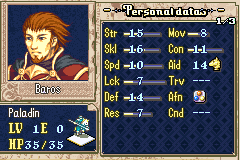
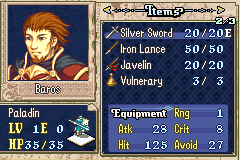
Eh…
Well, he’s got enough Strength and Skill to chip enemies reliably enough, and his defenses are good enough to tank a decent amount of punishment. But that 10 Speed is the real sticking point here: he’s not exactly looking like a combat carry past the first few maps, and often has to rely on his Silver Sword to one-shot mages when he fails to reach the doubling threshold. He’s certainly no slouch, but compared to our relatively seasoned recruits, he doesn’t make that great of a first impression. He’s clearly not going to be sticking around very long once we start promoting.
And as we sail into Aulestra and the company discovers how woefully out of their depth they are, so too do many players grow increasingly… disillusioned with Baros. You have early access to two other Cavaliers whose base stats are only a few good levels away from exceeding Baros, and already have the 8 movement that Jagen Paladins are usually prized for. In addition, the ransom system means that you’re easily finding units with bases who rival Baros in combat, such as Helje and Etienne. Heck, at a certain point, Roxelana begins to feel more like the early-game carry than Baros, with her impressive bulk and capacity to delete armor/cavalry units.
And as if the narrative reads my mind:

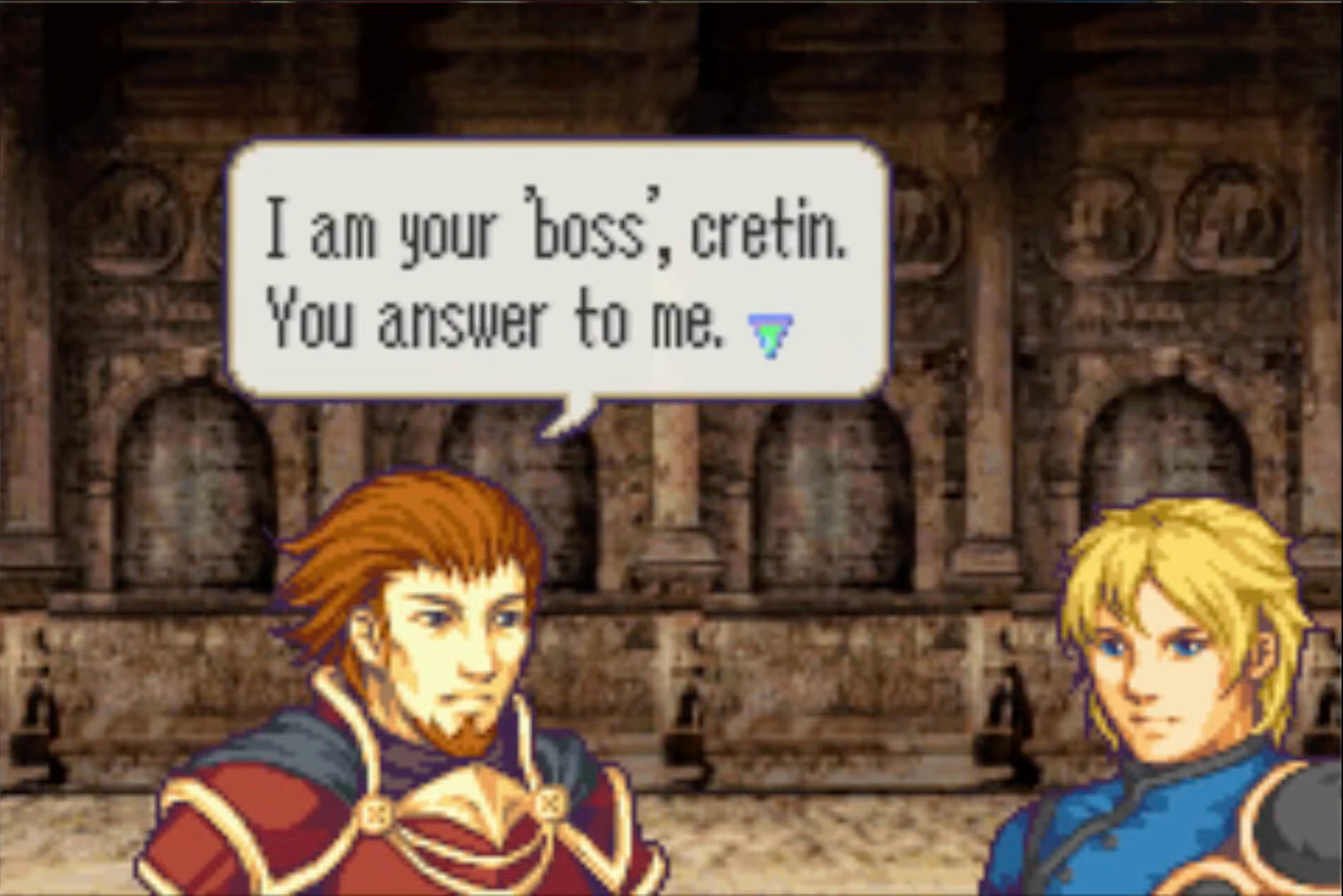
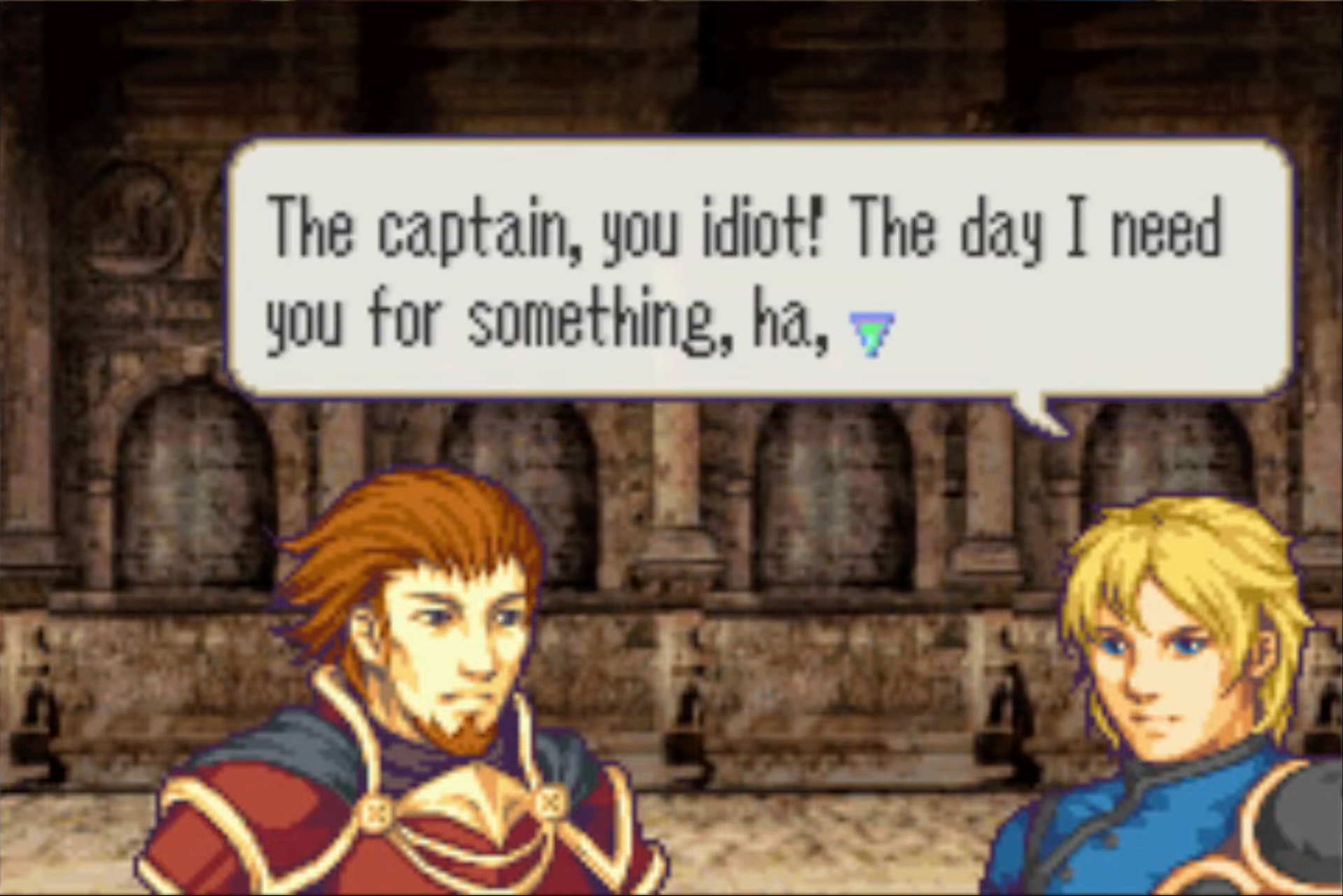
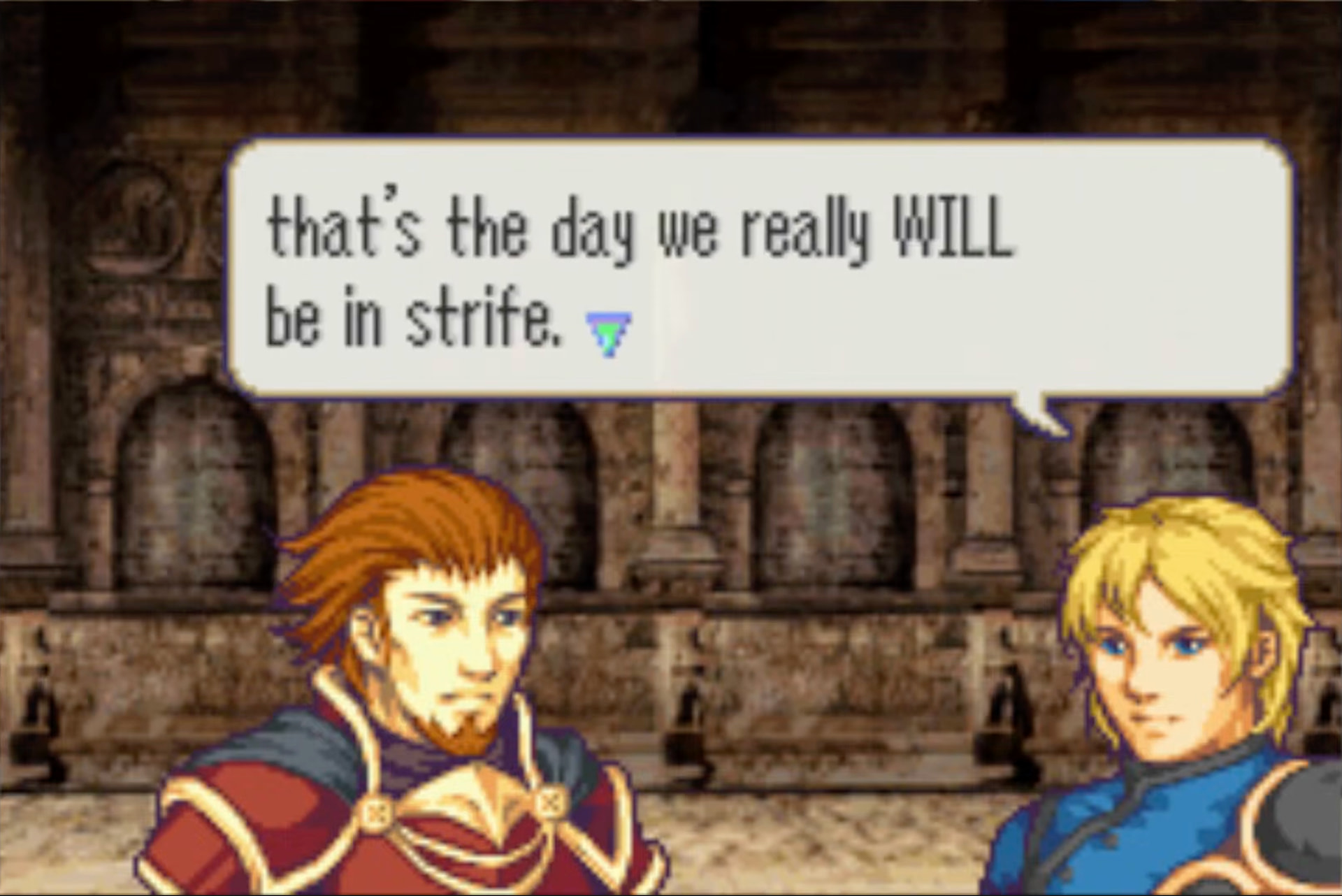
(You tell him, Radu!)
With faith in the Confederation and our Jagen floundering after a desperate last stand in chapter 4, Baros ends up leaving the party completely, riding off to look for imaginary Confederation reinforcements while Roxelana and her crew quietly slip away into the arms of the Exiles. And with that comes the end of Act 1.
Drums of War is quite a fast-paced level curve in comparison to other Fire Emblem games. Most units in the Prologue start at around level 5-7, and most of your army by the end of Chapter 5 is ready to promote, including Roxelana herself. And these aren’t early promotions either: Here’s a sample 20/1 Petras promoted right after Baros leaves the party:
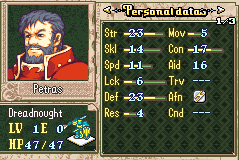
As you can see, the player isn’t exactly hurting for powerful units at this stage of the game. And I say all this because you don’t see Baros again until Chapter 8. Where he’s… not exactly happy about being left behind:
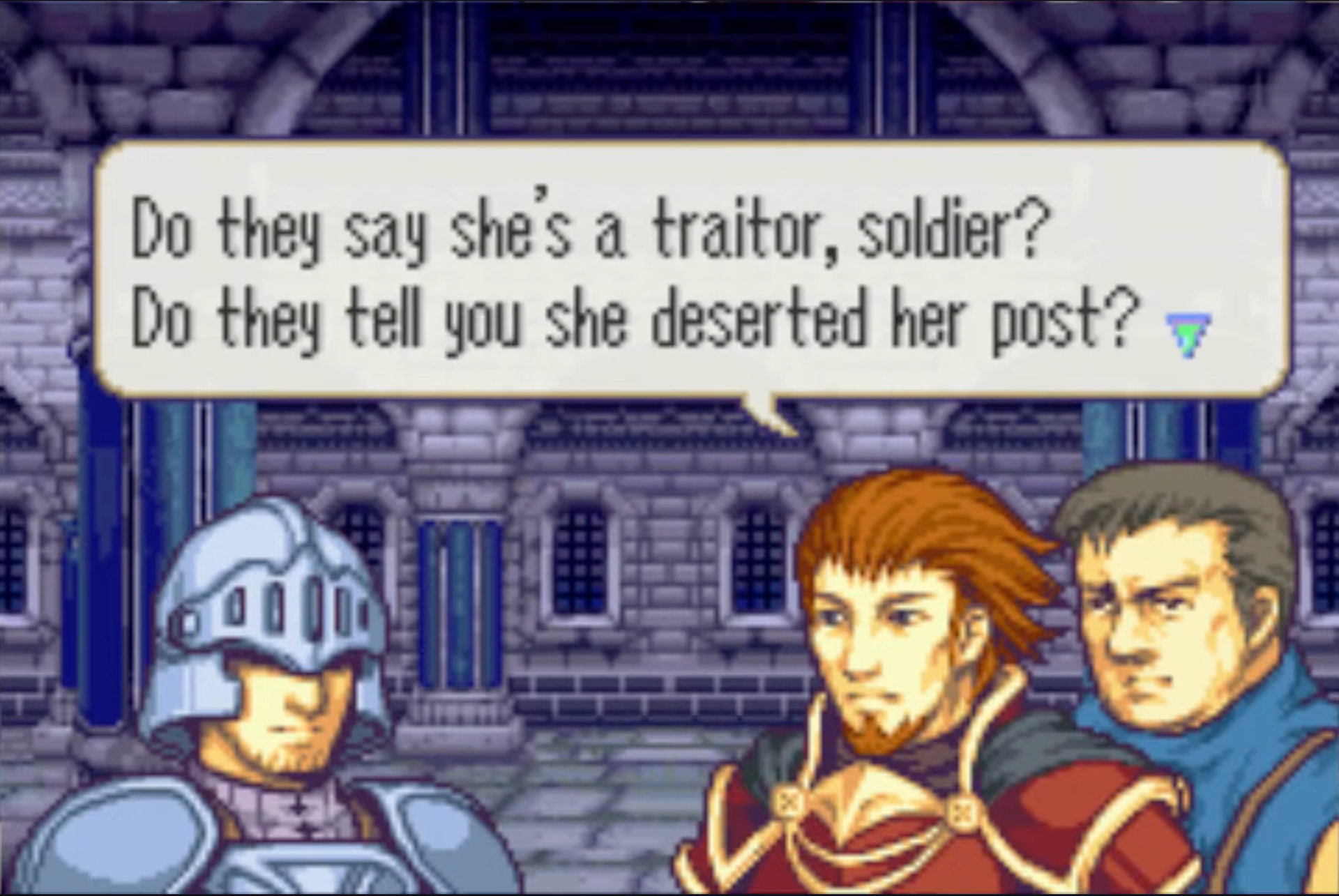
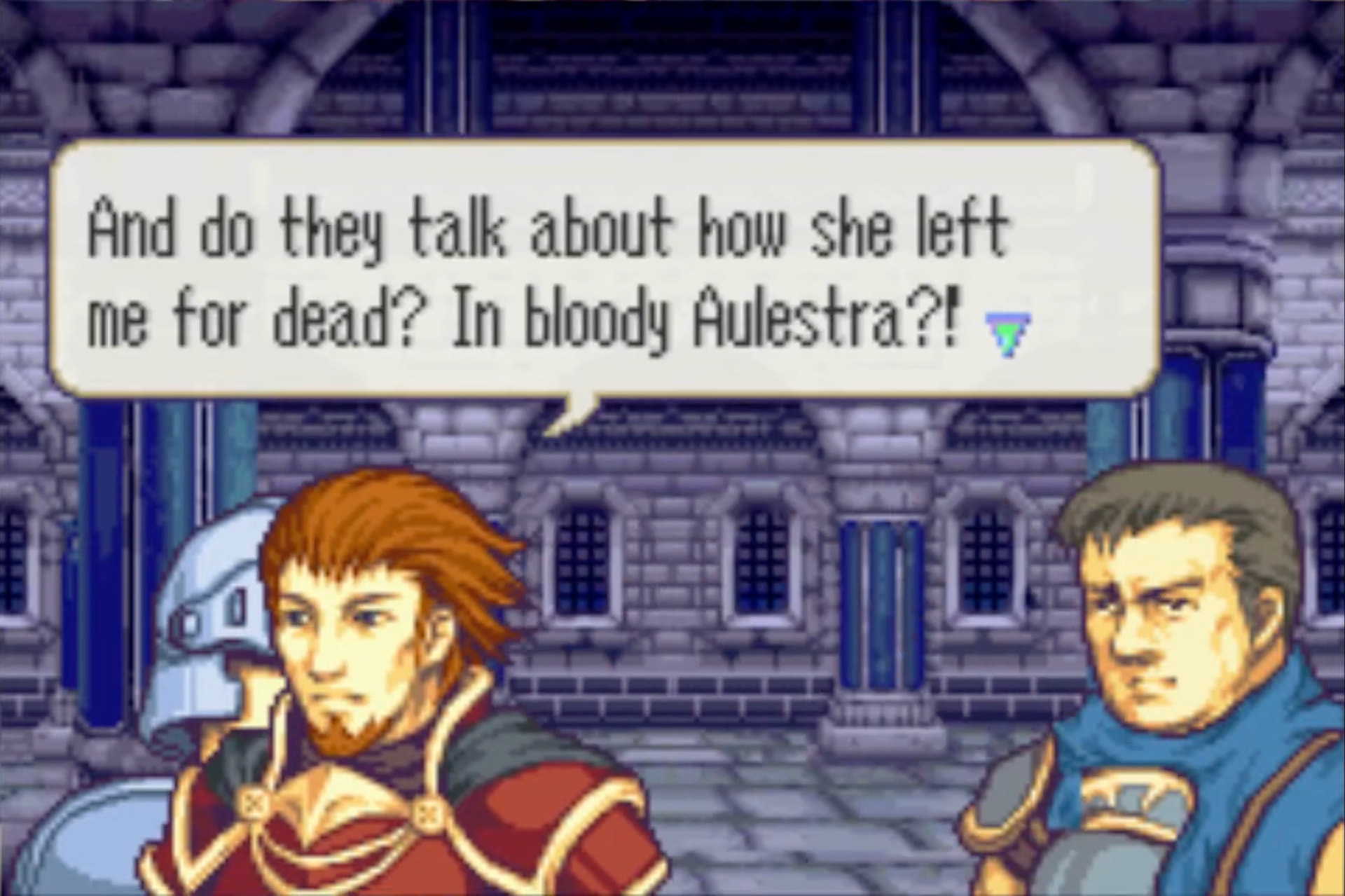
(Do you need a Snickers bar, man?)
He’s the main boss of the chapter, and he rejoins you once you beat him and have a heartfelt conversation about abandoning the Confederation. And after this great reunion is finally resolved, what do you receive?
A Paladin who’s fallen so far off the bench he might as well have stayed gone. His bases stay the exact same as before he left. Those impressive stat boosts you saw when he was on the throne? Apparently, that was a one-and-done type deal.
To add insult to injury, take a look at the ransom unit you have the option of recruiting in literally the previous cutscene:
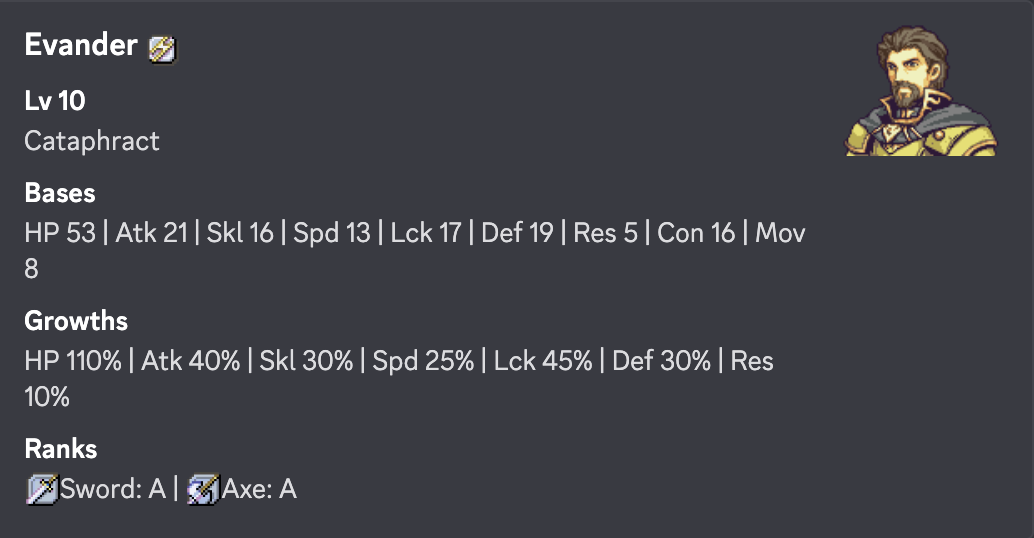
It’s not even close. Evander is leagues tankier, stronger, even faster than Baros. So by the time he’s welcomed back into the fold, most players won’t think twice as they bench him completely. I know I did on my first playthrough! And the second… and the third… and however many more times I’ve replayed Drums of War, leaving Baros behind past maybe the first couple of maps.
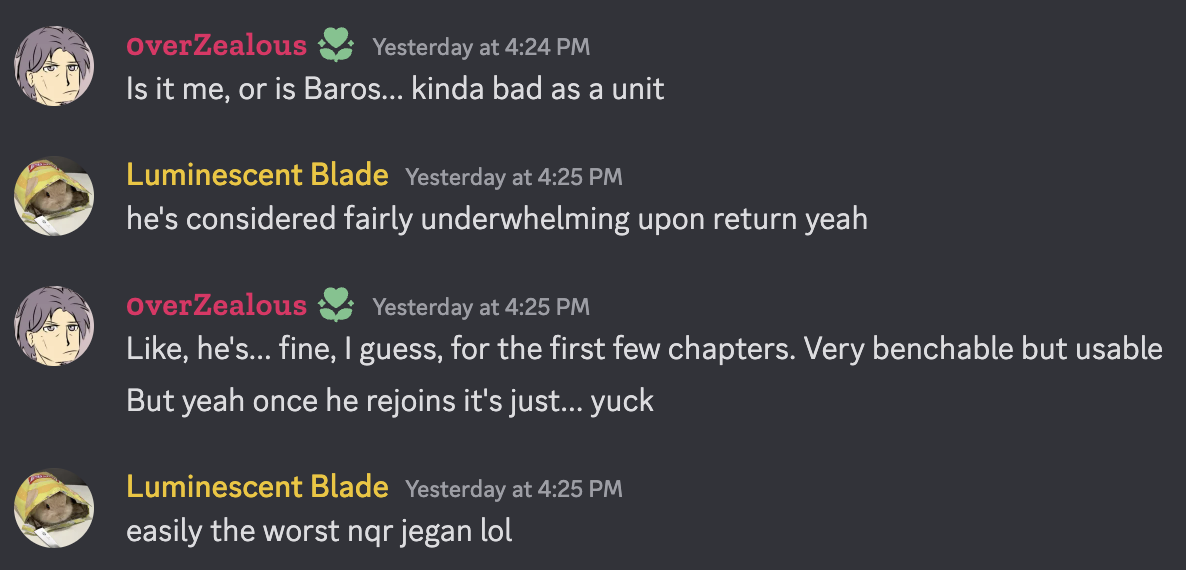
And then I had a funny idea.
Now, when I made this declaration, I was fully prepared to endure a lot of tedium in training him to a usable state. I expected he’d need a lot of favoritism to compete with the other Cavalry/Fliers on my squad, and that it would basically be a funny but ultimately impractical meme.
Boy, was I wrong.
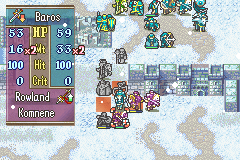
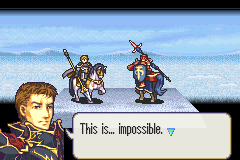
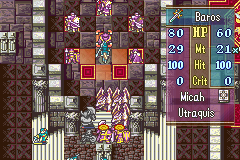
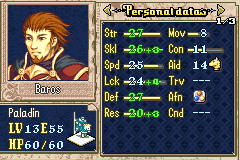
(And all he needed was some brilliance and a Speedwing…)
As it turns out, I’ve not given you the full story on the role that Baros plays. Because, despite his first impression as a pre-promote Paladin wielding a Silver weapon, Baros isn’t really a Jagen in this hack at all. In fact…
He’s actually the Shinon.
(I apologize sir, I was not familiar with your game.)
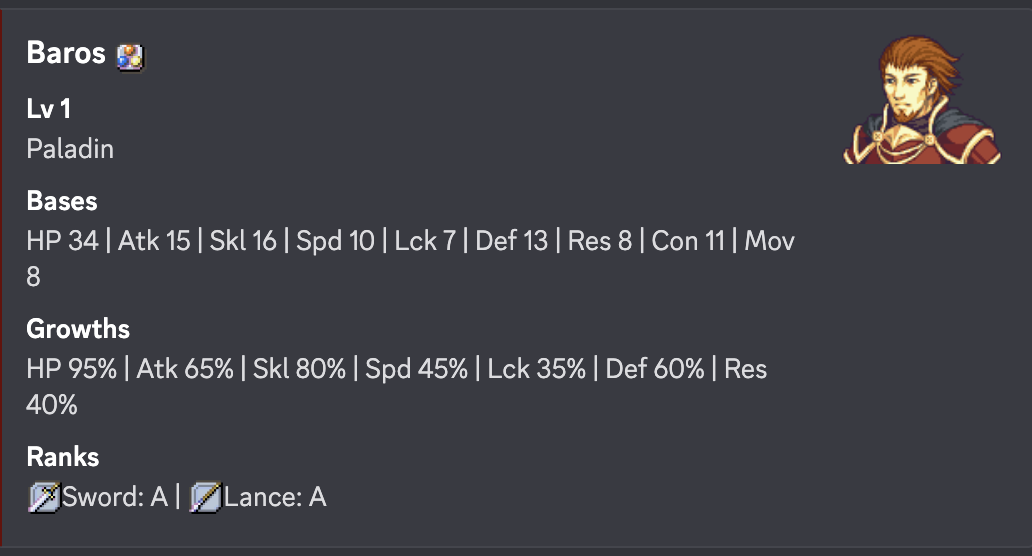
If we peel back the curtain and look at Baros’s growth rates, he’s absolutely cracked. 65% Strength and 80% Skill means an easy cap on his offensive reliability, while his 60% Defense (a ridiculous stat considering Petras, the premier tanky armor knight, has a 65% growth) and his 40% Res makes him an 8-move tank able to shrug off damage from both magic and physical attacks. Even his lacking Speed is still nearly a coinflip at 45%. He can easily turn into one of your best enemy-phasers by late game with a bit of investment, especially if you give him the Strange Brew to reset his level.
Additionally, Baros’s incredible weapon ranks give him another leg up over his competition. He can easily reach S-rank in both Lances and Swords, a feat that can be pretty challenging for many of your other units, considering Drums of War’s short length. In my own playthrough, despite using 4 lance users, none of them managed to achieve S rank before the end of the game aside from Baros, giving him near exclusive access to all three S-rank Lances (sorry Luthor, but that spear is mine)
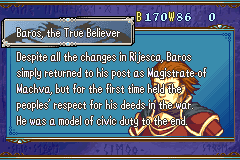
In a sense, you really have to be a true believer to stick with Baros. His incredible growths are hidden from the player, and the impression he gives when he rejoins you feels almost crafted to repel you from using him in favor of Evander or any other trained unit you have. Yet, if you stick by the Magistrate as I did, you’ll find yourself holding the same respect for his abilities as the people of Rijesca in the end.
22 Likes
Milo (Guard of Avelon)
When I started GoA earlier today, I did not expect to make this effortpost. Seeing his balanced statline and bold colour scheme, I immediately remarked on stream that he was giving Itsuke vibes, which nobody caught on because nobody remembers Itsuke from TLP and half the people in-stream thought I’d said ‘isekai’ anyway (I have a vaguely slurry voice to go with my drawling accent).
But with raw power like this, how could I resist?
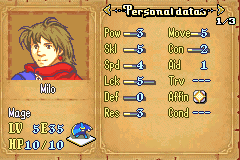
Okay, hold the raw power. Hold the power?!
And hold the speed. Hold the speed?!
And hold the spell list. Hold the spell list?! Hey, Jimmy, gimme a mage with nothin’!
Yes, Milo’s stats look bad, but don’t let that fool you. They are bad. Maybe he gets cool spells? Yeah, nah, Fire is the only spell he’ll get all game (maybe there was something different in the single on-map shop I never checked). Thunder is for being on the receiving end of. Is it really good in GoA? I think it has three might.
If I had another mage, you bet that guy walks onto the team. But there is no other character furnished with offensive magic under your control in GoA. Milo’s what you’ve got.
So as you’ve probably worked out from the fact that I’m writing about a guy who literally has lower bases than any unit I’ve ever made myself, GoA is a bit different. The circumstances are as follows. It’s five maps – and the first two are very short – where you only really scale from level 1 to about level 5-7. Units have shitty growths (I think?) and, compounding matters, this is the one time outside of LTC runs where fixed growths has actually made sense and been appropriate. This means that pretty much everyone’s first level is +HP and then their second one is a bonanza of all their other stuff. Level 3 is also tiny, level 4 is big again. I think Milo’s last level was actually empty. What a king.
Anyway, I bullied him initially and tried to funnel experience into other units instead, like Six.
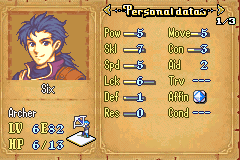
Six is an interesting case that illustrates how this levelling system works better than anyone else. You might look at Six and think this unit looks like outrageous dogshit, and that’s indeed how he turned out to be until hitting Level Three, Precisely. Getting there was like pulling teeth. Then he had 4 speed and went from doubling zero enemy fighters to doubling every enemy fighter, and, indeed, one-rounding them with basically 100% accuracy. There’s a lot of enemy fighters and they hit the hardest of any enemy type, so when he had that on top of chip he became a very valuable thing to have in the back pocket, and this effortpost was nearly about him instead.
But I wasn’t expecting to write it about Milo, even as I posted my final team to the Discord and realised, shit, I was gonna have to write about this freak instead. Is this a cope case? Was I won over by his charming personality? No. I don’t remember a single line he spoke. It doesn’t matter.
We’ve been over what he’s not. But we have to remember what I wrote about Vesper several months ago. Deficit discourse! Let’s not define him by his many, many failings. What can Milo do?
- He is pretty accurate.
- He can attack at 1-2 range.
- He will survive a physical hit from anything other than a steel axe fighter, and there’s only like three of those guys in the game.
- He hits Res.
Okay, but all of this describes, like, any mage. Perhaps. But let’s look at how replaceable these traits are:
-
Your archer and your paladin can hit reliably at range, your swordsmen can hit reliably in melee, but with the amount of enemies and your limited action economy (fairly small squad, full deploy, generally 2- or 3RKO standard) you need all hands on deck and knowing that he’s going to hit his shots is one hell of a safety net.
-
You get one hand-axe, which will never hit anything, and one javelin. You can buy other javelins, but still, they’re javelins, and accuracy’s a real concern. Besides that, you have an archer. Everyone has vanilla move, and some maps have a lot of forest around. Not only are enemies chunky and numerous, but finding the tiles to attack them from can be a real concern, and this really greases those wheels.
-
You don’t have to cover him in bubble-wrap. You can use him to lure enemies, and doink them back, almost no matter who they are. Remember what was said about the action economy. That’s one less hit you have to dole out on player phase.
-
This is the big one. Nobody one-rounds armour in GoA. They’re all but fucking minibosses. Your hammer guy almost-but-doesn’t one-shot and sure as hell doesn’t double. Your rapier does 3x2. So does your piercing dagger. And they hit hard in return. So when this guy can lay down 5x2 or 6x2 damage fairly trivially, and take a javelin (or, better still, not take a melee lance) in return, that eases the mathematics considerably.
So of all your limited roster, Milo winds up being the one who stands out the most. Mages in FE tend to feel disappointingly similar to your other guys, but Milo felt unique throughout, bringing his own little thing to the table, even if that wasn’t, like, ‘good stats’. I don’t think he one-rounded anyone in the whole game. He was unique not through addition, but through subtraction. There’s a lesson to be learned there. Nice visual design, too.

Anyway, play GoA. It took me like two and a half hours to beat, slightly inebriated for the final chapters.
12 Likes
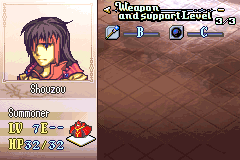
Shozhou (Dragon Herald)
So I beat Dragon Herald by Sigmaraven a few days ago, and highlighted a few standout unit designs in my Dragon Herald thread post, of which included Shozhou. I want to expand on what I wrote for him there – consider that blurb like, the sparknotes version of this. In addition to the gameplay-story integration elements of his design, I want to touch upon how well his gameplay elements itself balance with each other as well.
This will contain some spoilers for Dragon Herald. You have been warned.
The party is introduced to Shozhou as the figure behind the forces trying to capture You in chapter 7. He reveals he was, in fact, the previous herald 20 years ago who’s said to have “gone rogue” and killed a bunch of people at the summit. He reveals that the Verians have a method of sleeper-agenting their heralds, and after his survival, he’s been looking at ways to overcome their dragon-based magic, represented as light magic in-game. He tells You what happened and tells her to rethink what she’s sent to do, only to have her sleeper agent magic brainwashing activate to refuse that. Seeing that Shozhou summoned a whole army of skeletons to fight the protags, believing that killing her will free her from what happened to him 20 years ago.
The party defeats his skeleton summon army (tangentally: this is the hardest chapter for me in the game), and he does manage to break the brainwashing on You by breaking one of his own rare artifacts, and sends her off to do her thing her way. He later comes in to assist You—while You is free of brainwashing, the actual villains had some extra tricks up their sleeve, and shit still goes down. In chapter 8, Shozhou joins as a high level summoner with Luna in his base inventory. He leaves for a few chapters, then comes back to help You out with the original Herald’s trial in chapter 11, this time joining the party for good. He has his Luna there, as well as the tome he has as a boss in chapter 7, Nagalfar, which is his personal reaver dark tome, framed in story as something capable of beating the draconic powers that he managed to discover. He also shows up with 2 additional summons–they’re of higher power than his standard summons, but operates independently. While you do have the option of controlling them directly at the cost of some extra rewards at the end, you are given a Nosferatu tome the chapter prior, and can update his equipment in preps to take Nos + Physic, so it wasn’t too hard for me to keep them green.
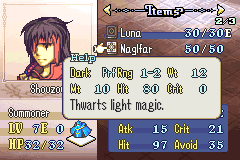
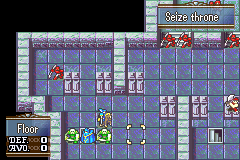
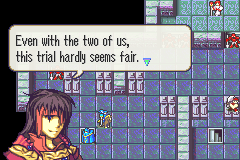
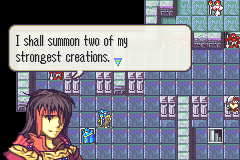
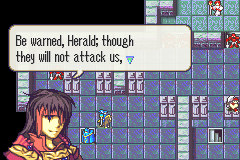
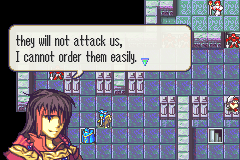
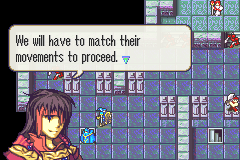
So that’s the background on Shozhou’s story presentation until he joins as a full-time player unit. Let’s break this down on how his kit ties into his back story and role.
As a prior Herald, Shozhou has been trained in Dragon temple styles of combat, which includes verian swordsmanship and light magic (You notably said she’s not good at magic innately so it’s only after her trial that she gains proper access to it with the First’s blessings). You’ll note that neither of them is what he uses currently–swords, granted, is less strictly tied to heraldhood, and more that shozhou just innately prefers using magic, but having no light despite many of the magic classes having 2 magic type access is a very intentional decision given he must know how to use it–to show his utter rejection of it. His staff rank is also higher than dark, and this too, is intentional–note that You is also a healer, and the healing aspects, Shozhou didn’t reject, as there is still kindness in his heart. He did, after all, save Mute, no matter what he says his motivations are, and in his solo ending, becomes a physician
This is further backed up by his boss quote during chapter 11, which you will very likely see given Nagalfar is helpful against the boss.
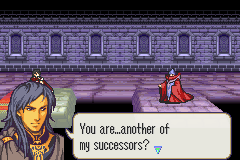
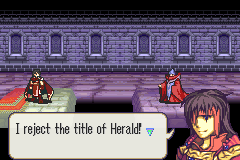
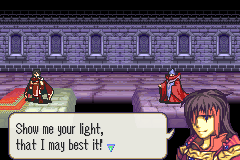
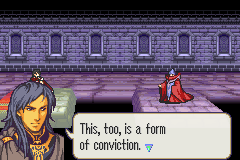
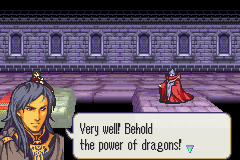
Shozhou’s character motivations is primarily wanting revenge on the country that turned him into a puppet to commit atrocities, so beyond Nagalfar, his personal, being a reaver tome to be good against light, his other starting weapon, Luna (which he even referenced in dialogue), is an anti-mage tome in general. Veria has a high concentration of magic users, so this further exemplifies his vengeance drive through his equipment. As the only summoner in the game and given his control over a summon army (with prep time), and with his battle quote in c11 in mind, it’s pretty heavily implied that he came up with this kind of summoning magic. One thing I also didn’t notice myself but I brought up the rest of this to sigmaraven, he told me

Blew my mind how much detail went into Shozhou’s unit design.
Anyway so how does this work out in gameplay? I enjoy units with role compression, and summoners as a whole, so Shozhou clicked with me instantly. He has competent combat, good staff rank, and of course, his summons. That in itself is instant deploy for me forever, but I do want to note his summons do change some of the way he changes how summoners are often used for me.
So his summons are quite solid, as in physically formed, and thus don’t cross terrain like default GBA summons. While this is technically a nerf to summon utility, summon utility itself is already quite strong, and this creates some interesting dynamics in using all of Shozhou’s kit. Because Shozhou’s summons don’t cross terrain, I want them to be up when I actually need them, whether it’s the right position to distract an enemy that would otherwise combine for a kill on a squishier unit or distracting siege. Shozhou’s own stats come into play here well–he has high, competent stats, but not immortal, and he does have a pretty high base level so there’s a limit to his snowballability, but he can equip nosferatu. Nos has enough weight on it to keep him from doubling a good chunk of enemies, so he’s not going to nos solo, but it does let him hit a reasonable bulk level to frontline into better position his summons, or even just to be an off-tank himself for a turn if needed. Normally, when I use summons, because they can get places easily, I tend to be spammier with them, and often neglect the rest of a summoner’s kit. With Shozhou, since his summons have higher positioning requirements, I have downtime for when I want his summons to actually be up, and he can contribute with combat and staffing in relatively more even proportions.
Terrain-interacting summons are not fully a strict summon power-down however, as they will benefit from terrain bonuses. In chapter 16, where the party has to take down two bosses, one of which is a very high power 3 range-having sniper boss on a cliff, who’s also surrounded by a bunch of homies and also a ballista guy. However, by leaving a summon in range of the ballista on top of a mountain to benefit from the hefty avo bonuses, Shozhou can practically indefinitely distract the ballista with it while also using the rest of his kit to help the advance. I was able to safely get the rest of my team to be able to jump all the mage and archer generic enemies to cover my wyvern safely into ganking the boss without having to go fully around.
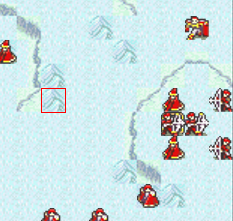
highlighting the tile in builder because it’ll show with the reinforcements up and because i forgot to take a real screenshot while I was playing. Most of the bottom sages do move, so they’ve already cleared out, but I did still have to gank most of the guys on the cliff in 1 go to ensure operational safety, and freeing up summon to do other things on subsequent turns of locking down ballista guy was very important to my strat here.
And to be specific: This isn’t saying terrain-limited summons are better in a design sense than terrain-ignoring summons, I also have some very fun and cool strats developed out from terrain-ignoring summons that would be unreplicable here, it’s just the differences–both limitations and perks here– creates interesting and different lines of play.
So in short, Shozhou’s unit design package is a masterclass in ludonarrative harmony and the summon change greatly impacts how often I use parts of his kit as a whole in a fun and interactive way.
He’s also like one of my favorite characters in the story too, so that’s a plus. Play Dragon Herald.
9 Likes
I had already put Do5 and the save files in my hard drive, but on second thought, I took them out so I could write a post about
Cothiva (Dream of Five: Definitive Edition)
Cothiva makes her first appearance in Ch 4, in Sorcha’s comedic interlude, and then joins the team in Ch 5. She has a Cometfall, which is particularly effective against cavalry and heavy infantry. This determines her role in the early game: she can defeat enemies in one hit.
ONE hit.
Safe and economical.
And on Route A, which I chose, there are quite a few enemy cavalry and heavy infantry units. I was impressed by Chapter 8x, where she effortlessly dealt with the armored units and reinforcing cavalry on the map. As a result, she gained experience rapidly, becoming the first unit to reach level 20 and be promoted (in Ch 13).
However, in Do5, too much experience is a curse. Because of the experience formula used, units that are too high-level will soon stop gaining much experience. So she started spending a lot of time on the bench. But whenever she got on the court, she was able to catch up. At that time, she no longer needed Cometfall, because as a Sibyl, she gained a +1 to Mov and the ability to use dark magic. Since her Mag, Skl, and Res growth rates are solid, she can use Luna to counter enemy mages and Wither to deal with physical-type enemies. Not to mention A-rank and S-rank light magic.
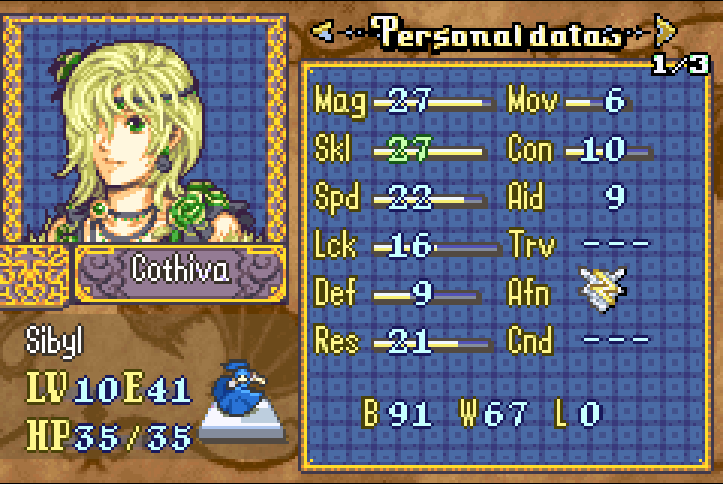
(As you can see, she didn’t fight in many maps.)
Teams at Do5 turn over pretty quickly. I replaced Chester with Marie, and then replaced Marie with Saskia. Cathale struggled to get on the field under pressure from the mage enemies on Route A, and when another opportunity arose, Jauger appeared with his prf. Crowe performed well, but in the final chapter, due to limited availability, he was replaced by Odette, who had A-rank support with her brother.I’ve been training Pegasus Knights for a long time, but the enemies’ brutal weapons are too dangerous…
Leaving Eudira aside, Amaryl who joins in Ch 23 is truly a formidable opponent for Cothiva. Her light and dark magic have both reached S-rank. I also gave her and Rena B-rank support.
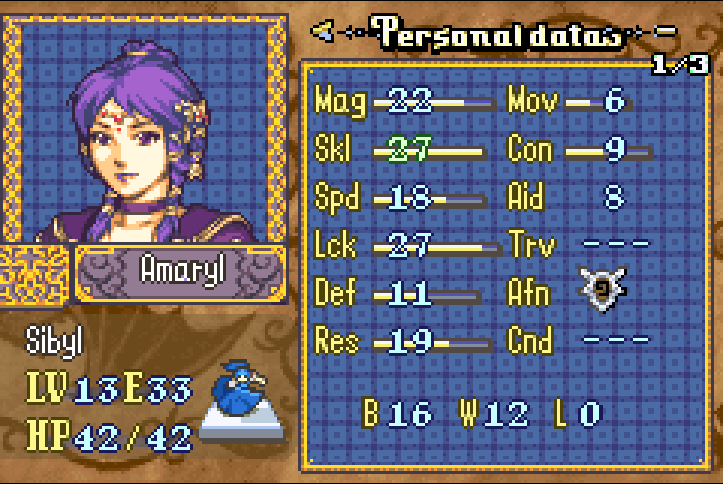
At the same time, Cothiva…
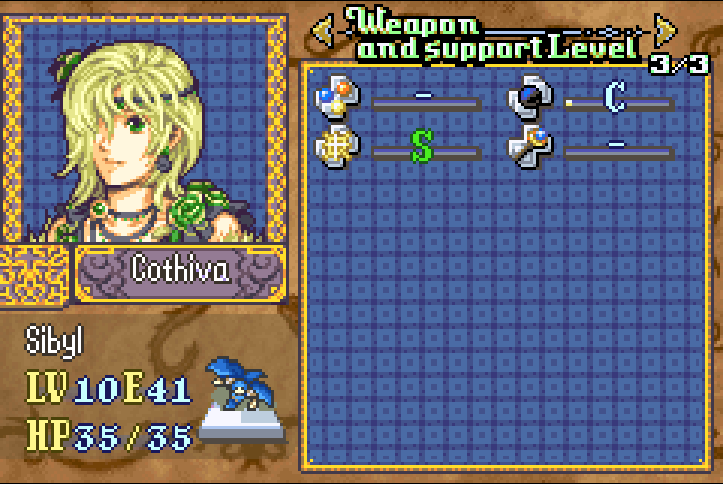
What’s more, compared to Amaryl, Cothiva really doesn’t have much of a presence in the story. I don’t recall any events involving her after she joined, and I’ve never used her to defeat a single boss. I don’t think she’ll trigger any special lines either… maybe, except for Sorcha?
Yet, on the final map, I still chose to deploy Cothiva instead of Amaryl. Because her HP is low (I forgot to use the item Bunny gave her), she cannot be a dragon slayer, but she continued to take down other enemies with steady precision, and that was enough.
Perhaps I’m just grateful that she was a huge help on Ch 8x, but yes, having a clear role in the early game can sometimes be very useful.
I also took my files of HC out for
Merry (Homecoming)
Fliers. A bit tricky to use, especially for early Pegs. Their base HP and Def are low. They are vulnerable to archers, who are common enemies. I hear they’re good at dealing with mages? But their base HP and Pwr are low and mages usually stay in the back.
But I still need to use them, because ignoring the terrain is really useful. And most Pegasus Knights are good at dodging attacks (except for axes and… arrows).
However, Merry is different. Her starting weapon type is sword and as you can see, her Pow ends up being quite high.
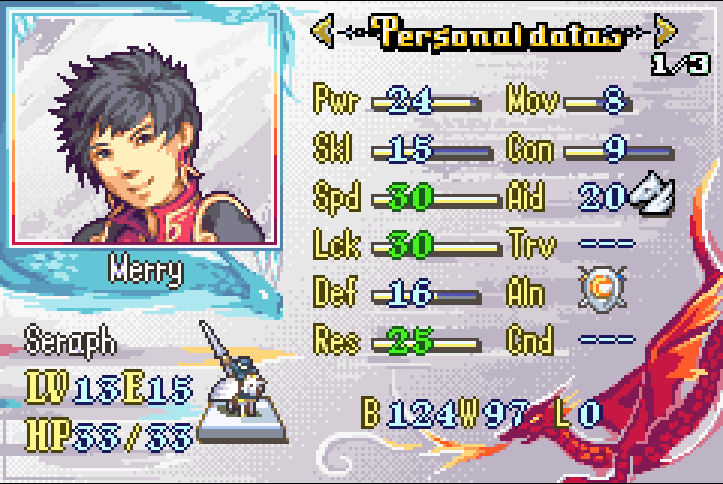
But that’s not why she became my favorite Pegasus Knight.
Do you see that green Res?
In HC, the damage dealt by magic swords is calculated using Res. But most units that use sword, their Res, well…
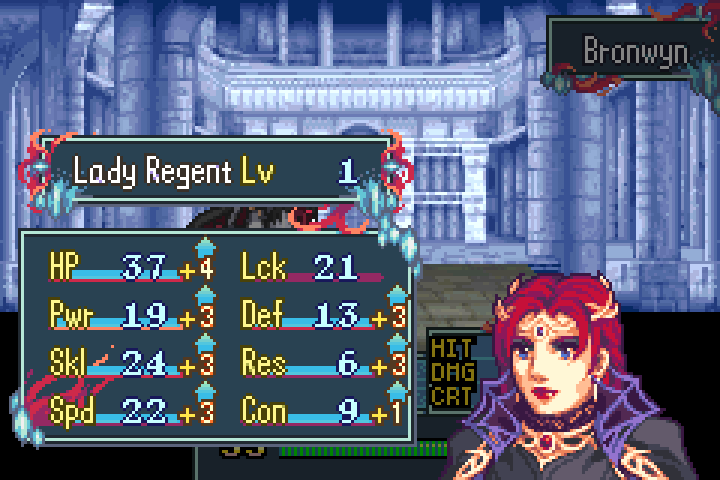
(Fortunately, Bronwyn’s res reached 12 at endgame (at Lv 20/16).)
As soon as I realized Merry had potential in Res, I bought her a Light Brand at the first Armoury that sold them.
And so she became the real mage in the team, with an 8 Mov!
In the chapter where numerous villages had to be visited, she served as both a flier and a mage. I particularly remember an enemy mage attacking her, causing almost no damage, and then being killed by her double counterattack.
That’s a bit too much, isn’t it?
(Btw an enemy Peg with Levin Kris also hit my Jasper badly. Mages in HC are unsteady sometimes.)
But remember, she is a flier, vulnerable to archers. Archers are strong in HC. And the player side doesn’t have available Zorya Shields or Hrethe Bracers or anything that can protect fliers, except for S-rank lance and axe. Peg can’t use the latter, and as for the former… it takes time to train to the required weapon rank…
This balances her out nicely, keeping players cautious. In the chapter where you need to get two door keys, I had Merry attack a mini boss, who I’d forgotten had a bow. When the enemy phase began and I realised the hit rate was over 50%, I was terrified and felt as though I was about to have to reset (in my case, reload  ).
).
RNG sided with Merry. She dodged the attack. And killed the enemy with Levin Kris.
A Valkyrie. A ture Valkyrie. Flying above the battlefield, reaping lives.
(Sorry Nerysse, but…)
Besides, Merry’s portrait is perfect. Just like her name. Love it.
7 Likes
Mumei (Holoemblem: The Search for Seiso)
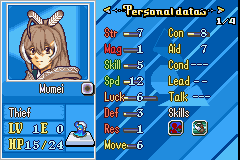

If I plainly uploaded these screenshots and told you this is a Ch1 join, you’d probably think this is your run-of-the-mill earlygame thief. You’d think she steals things, dodgetanks on occasion, gets chests and doors… and you’d be mostly right. Except Mumei is a primary combat unit with high one-rounding potential earlygame. And she tanks in the earlygame. And she solos entire armies midgame. And she solos enemies lategame. And if you play your cards right, she gets permanent 8 mov without boots. Wait what? That’s not in the job description!
Mumei’s usefulness is heavily backed by her raw necessity. Going through the earlygame (Prologue-Ch12, sometimes known as the Pekoland arc), Mumei is your only thief until Ch11. Earlygame Myrmidon to nuke/dodgetank? S4S doesn’t have one, so Mumei does that. Need a Mercenary to frontline? Doesn’t exist, so uh, that’s a Mumei job too, using a Barrier Blade (+10 DEF when equipped). Need to deal with 18 SPD 18 DEF ~40 HP Bracing Stance Halberdiers in Ch5/8/9/10? Mumei can keep them busy with a Lancereaver, or even one-round them with Society (PRF; 10-MT DEF-ignoring sword; mutually exclusive with Fauna’s Selection, an 8-MT 1-2 range DEF-ignoring bow) and help. In fact, it isn’t a stretch to say that Mumei becomes comparable if not more useful as a combat unit than Reine (the Jagen) after she gets a couple levels.
Mumei is essentially every early-game sword user bundled into one reliable unit, and she is extremely useful as a result. A good chunk of this comes from Holoemblem’s earlygame being difficult, and your choices for unit deployment being extremely constrained. Mumei is one of a handful of units that can double even the fastest earygame enemies. Given a Lancereaver, she can reliably survive and distract Halberdiers, while all of your other sword users tend to get doubled.
Even in the midgame and lategame, Mumei never falls off. Promoting to Assassin gives her a SKL/2% chance to instantly delete an enemy with Lethality while also getting bonus EXP. And Ch11 gives the player Peko’s Gambit, an S-rank regalia sword with 18 MT, +10 SKL/SPD and monster effectiveness. At this point in the game, a promoted Mumei is likely the only unit available with the Wlv to use it, giving her a monopoly. Peko’s Gambit allows Mumei to snowball even harder as it greatly improves her ability to dodgetank, the +10 SKL is functionally an additional +5% Lethality rate. Even when she doesn’t activate Lethality, Mumei still consistently hits 30+% crit rates in battle, and often one-rounds even without a crit. Monopolizing Peko’s Gambit makes Mumei indispensable, as from Ch13 onwards, monsters become the primary enemy units, and Mumei is one of your best units, if not the best, unit for fighting them. Peko’s Gambit durability also isn’t an issue as Hammerne is already available at this point, and more copies are handed out through the game; you will have way more Hammerne than stuff to use it on.
Mumei also has a huge incentive to train all the way up to Lv20, a feat that is very much achievable as her promotion gains are near-nonexistent and prepromotes are plentifully available for her to kill for EXP. The reward for training Mumei to Lv20 unpromoted is Indoor March, a skill that grants +2 movement whenever Mumei starts moving from an Indoors tile (such as Floor, Pillar etc.). This is already solid, but Mumei can also learn Outdoor March from her A-support with Fauna (who joins at the same time as Mumei, and is similarly indispensable in the earlygame due to having Lily’s Poise as a personal skill), which does the same thing but for Outdoors tiles (Plain, Forest etc.). With both, Mumei functionally has a pair of boots, which is very good to have on one of the best units in the game.
Mumei also learns Bargain at promoted Lv5. This is nice to have especially if she learns it early as money is tight earlygame, and Ch11 has a Secret Shop selling Brave Lances and Physic. If Mumeil learns it in time, you can be set for the entire run; the Silver Card is obtained in Ch13, and by then, you can simply overwrite Bargain with a more useful skill via a scroll.
It should be noted that with one exception (Zeta), all of Mumei’s competition sucks.
Pekora joins in Ch11 as a thief. However, her stats are mediocre-poor for that point in the game, and she cannot catch up to Mumei, who has just gone through the hardest part of the game. Pekora tends to be deployed as a passive leadership bot with her 2 leadership stars.
Zeta joins in Ch11 as a prepromoted Rogue with very good base stats. Zeta will consistently be one of your best units… while she is around. She leaves after Ch15 and doesn’t come back until Ch21x-A, and although Zeta is actually still very good lategame due to events that grant her massive amounts of STR (making it effortless for her to cap out at 40/40/40 STR/SKL/SPD), Mumei still needs to carry much of the midgame.
Chloe joins in Ch15 as a prepromoted Assassin, ostensibly to compensate for Zeta leaving. However, her bases suck and she lacks Lethality, making her very hard to justify deploying. Also needs to grind Wlv for Peko’s Gambit.
Okayu joins in Ch16 as a prepromoted Rogue. However, her stats also suck, and despite having the niche of being able to steal unequipped weapons with Steal+… the Steal+ scroll is found in Ch9 and has been abused for a good 7 maps by Polka, Choco or Suisei. Thus, Okayu’s niche is dead on arrival and her bad combat cannot save her. Can’t use Peko’s Gambit at base.
Ayame joins in Ch16x as a prepromoted Swordmaster. However, her stats suck with her durability in particular being poor. She also cannot use Peko’s Gambit at base, preventing these issue from being fixed.
In conclusion, Mumei’s usefulness is derived from a combination of her early join time, excellent performance and crucially, lack of alternatives. While most unit ratings have to consider alternatives to using a particular unit, Mumei has no alternatives. If you do not use Mumei, you die miserably in S4S’s earlygame, because there is just so much that Amelia and Reine cannot do. There is no opportunity cost in training Mumei, like a later training project would have, because it naturally comes as a consequence of the player… surviving the game. When other ROMhacks have early-joining units asking themselves if they are still worth using when they get statscrewed or midgame prepromotes show up, asking the same question in S4S yields but one answer: keep using Mumei, because all of the alternatives are just so much worse. Instead of giving the player choice, S4S delivers one simple message: “You will use Mumei, and you will like using Mumei”
9 Likes
I wanna talk about 3 units, one from each of the 3 hacks I’ve been most impressed by in terms of gameplay across my time on FEU. I chose these characters in large part because I feel they are great representatives for both ludonarrativity and just plainly being fun to play with.
Post #1: Katherin (The Sun God’s Wrath)

Have you ever wanted to use Mareeta, but if she joined at a reasonable time instead of like Ch12?
Katherin is a myrm that joins on turn 2 of Ch1, possessing essentially perfect availability. Her starting inventory is pretty nice. It has a Blutgang, a 7 mt magic sword that does 3x MT to ‘muscle units’, usually fighters and bandit-looking classes, a Light Brand(which, in this game, has the thracia +10 luck but very low(3) mt, so it’s mostly a 1-2 range dodgetanking tool), and a Wo Dao.
But, while her stats look eminently usable, and Astra is cool, she doesn’t seem particularly interesting or have a real unique niche in a vacuum, seeming like another fast myrm that murders axe users and loses to physical EP that she lacks WTA against. The amusing thing about her is that this IS actually correct unit evaluation. Katherin is not at the top of any SGW tierlist.
However, it’s correct unit evaluation for the wrong reasons. As of yet I’ve intentionally omitted several mechanics that make Katherin a lot better:
a) SGW was the most thracia game to not be thracia until bells of byelen and iron emblem gaiden and also AVT came out, so it has fatigue and PCC. Katherin has an absurd PCC of 5. That starting inventory Wo Dao is therefore a guaranteed kill button, although some enemies do have a skill that makes them take less crit damage. It’s also essentially her prf, because only sword saint blood units can use it (more on that later) and the next one that joins does so in Ch13.
b) Astra is 1x skill activation and doesn’t consume extra weapon uses. To be clear, proc skills are still bad, but Katherin gets pretty ridiculous skill, and Bolt Swords also give +5 skl like they do in Thracia, so eventually it does become something you can lean upon, and without killing your rare swords’ durability.
c) Both anima magic and magic swords in SGW are really, really, really broken. I’d venture to even say ‘completely gamewarping’. All lightning damage is effective vs dragons & wyverns, all fire damage is effective vs beasts & horses(yes, this is all cavs), and all wind damage is effective vs non-draconic fliers. Something I didn’t care to mention is that the amount of classes that can actually use magic swords are very limited. For a LONG time from here on, the only permanent units that can use magic swords at all are Astrea, the lord, and Katherin. That’s it. Magic swords effectively have myrmlock like the vanilla wo dao. And while Katherin has base D swords with some progress, Astrea has base E swords with 0 wexp. You get a flame sword fairly early on, like literal Ch2, and no permanent party member will realistically be able to use it when you get it, but Katherin will certainly be the first unit who can use it. It is 40 uses, 12 mt, bestows +5 mag as it does in thracia, and as previously mentioned, vs ANY cav units it is actually 36 mt. Katherin is a lot faster than Astrea too. Her magic is way worse, and her bulk is eventually a lot worse, but that doesn’t really matter for like the entire first half of the game. The flame sword is so good that Katherin is one of the best combat units until like Ch13-14 on 0% growths purely because it exists, and Astrea eventually getting the rank to use it doesn’t replace her either since you can pass it around vs groups of cav reinforcements(believe me SGW loves these).
d) Eventually she gets the Dragonbane thanks to her sword saint blood, which is technically not her prf but there’s like 2 units that could really ever care to use it and be worth using outside of 0% and while the other unit is way better than her and also probably wants it more since his raw combat is worse, she does murder all lategame dragons effortlessly and it’s 1-2 range phys high crit at the worst.
So, in summary, while Katherin is a unit who is ONLY combat, she is really good at it and being a swordlock is actually fine in this game because of all the effectiveness options on magic swords, which she is one of the few units that can use and which supply her with 1-2. Wants spirit dust/10. Her movement isn’t good though, which sucks, and her bulk is honestly not good enough to meaningfully EP eventually. She does get Lancecrusher as a skill through levelup at some point, but she is never going to be an extreme dodgetank because it’s hard for any unit to be into the lategame.
Katherin is also central to what was possibly my favorite story event in a FE game until the one I will be writing about in spoilers in my second entry for this thread. SGW’s story is really complicated and often maligned for it, though I find it charming, but basically, she is with Astrea’s mom’s mercenary group, Propater, with her twin sister, Nia, who she’s extremely close to, because they want revenge on a famous mercenary, Conway, who killed her father and whose group, the Assassins’ Guild, works with the big evil empire headed by the titular Sun God, Pyron. Phew. I almost asphyxiated there, but common enemies and all that.
The beautiful thing is that her sought revenge on Conway has only fairly little to do with the real event I’m talking about.
HUGE SGW spoilers, and this is a mouthful:
Katherin/Nia subplot
The first arc of SGW, Prologue through Ch5, is completely force deployed, and anyone dying is a game over. Katherin’s sister, Nia, isn’t met up with until Ch5 as a map NPC, since she’s in a different division of Propater. Ch5 involves hauling ass to the other division of the group since there are a bunch of monsters and dragons everywhere. When you clear the map by reaching the group and killing the rest of the dragons, the mercenary group is pieced in three.
Iskander, a sub commander of Propater, escapes with a lot of the elites, but basically everyone else is captured. Kuroth, a man who runs an independent army of slavers, gives most of the captives as bounty to the Red Army, one of Pyron’s armies, but he gives Nia specifically to Rody, the bloodthirsty dragon crown prince who primarily only works with Pyron because he hates humans. Katherin and Nia are VERY misanthropic, and Nia in particular is a callous interrogator, tracker, and assassin, so Kuroth figures that someone like Rody, who just loves killing and hating people, will find Nia’s company amusing.
And as it turns out, Kuroth’s absolutely right.
Rody is endgame boss material; he has insane stats and is basically invincible,
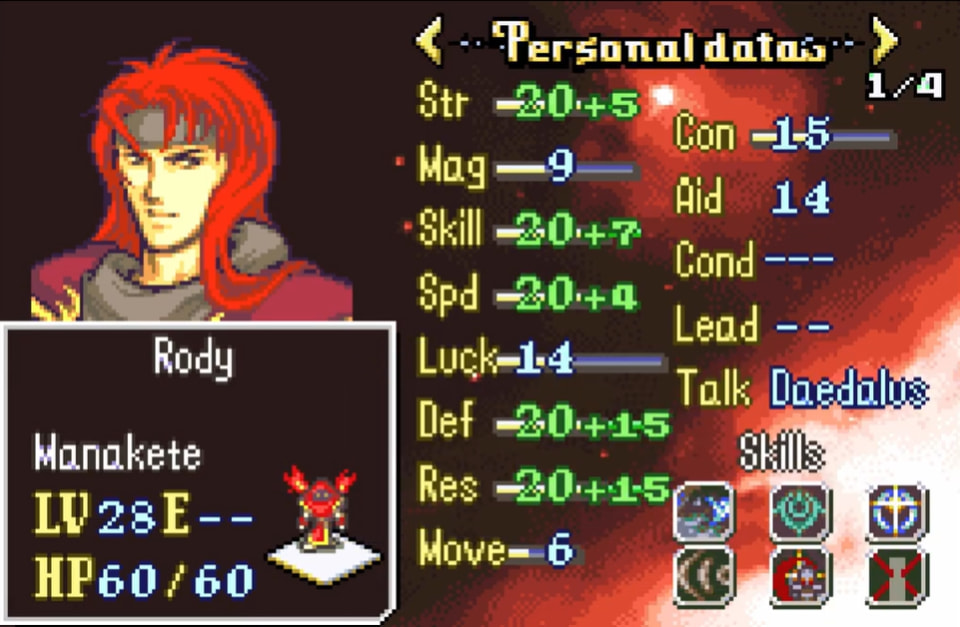
so, Astrea’s group, who shortly thereafter escapes from a prison camp, of course is always avoiding Rody’s dragon murder hobo menagerie like the plague. That means that for a majority of the plot, Nia is with Rody. And while Katherin fears for Nia passively throughout the game since she’s in the clutches of a man like that and thinks she’s probably dead, they’ve actually fallen for each other HARD. In Rody’s eyes, Nia’s the only person who really understands his cold hatred for humanity and she has a great appreciation for his brutality and straightforward, honest, if cruel nature. So he is very tender towards her and Nia becomes fanatically devoted to him. He promises to protect Nia from everything. I love bad romance.
I mentioned Katherin and Nia are sword saint descendants. The sword saint’s weapon is the Dragonbane, a 1-2 range physical sword with dragon effectiveness, and yeah, this does help Katherin tremendously in the lategame but it’s not really her Prf since some other obtainable units can use it, though most aren’t very good. Plotwise, it is kind of meant to be kept at the sword saint’s grave generally, because dragons don’t like when it is around. Rody loves Nia so much that she convinces him that they should go grab it for her so that she can kill dragon traitors in his army for him. Isn’t that so mushy??
All good things must end, so before the inevitable tearjerker can pop up where the party can and has to confront Rody but Nia stays by his side, she dies in a shocking cutscene where different enemy factions between Conway and his Assassins’ Guild, the Red Army etc assault Rody’s army to curtail his murder rampages. Infighting is very common between Pyronian allies, but they manage to decimate a lot of Rody’s core allies, and the commander of the Red Army kills Nia and allows Conway to take the Dragonbane. They’re unable to kill Rody (look at that statscreen) but the damage is done and he is absolutely despondent about what just happened for the rest of the game.
Later, Katherin gets revenge on Conway and she’s very confused as to why/how he had the Dragonbane.
So in the third from last chapter, (it’s the penultimate chapter in terms of real gameplay), Rody is the midboss. And he has a convo with Katherin:
\
Oh yes. I love double lion dragon king gotoh.
But everything about this story makes me very sad. Rody was raised to hate, only knew how to hate, until he found someone who understood him so deeply he learned how to love. Then it got stolen from him and he knows only emptiness.
I LOVE this subplot because while there are aspects of it that are probably too chuuni, it’s great at playing with your expectations and it’s really just something I wouldn’t expect to see in a FE game. I also like that it’s an interesting question from a reader POV as to whether they actually loved eachother in a pure sense or it’s some complicated stockholm syndrome relationship, since obviously there’s a massive power dynamic there.
Lastly, I think it’s just plain cool that even though it was not consciously inspired by Mareeta and the Galzus recruitment, it very much gives me those vibes, which is awesome for such a thracia-derivative game.
8 Likes
Post #2: Rohesia (Cerulean Crescent)

This wasn’t supposed to be myrmposting monday but maybe that’s how it will end up…I venture that this is because developers spoil myrms on purpose. Whether that makes them better than other units, it usually gives them plot/subplot relevance which I enjoy!
So, technically, these are not Rohesia’s bases. She gained 1 level. (+1 str, +2 skl/spd are the important stat changes) I’m too lazy to find a real picture of her bases but this is close enough. Wait a moment, you might have thought from reading…she gained +2 skl/spd from a single level?

Uh, yeah.
So you might also imagine: oh, this is probably just a Karel unit. She’s the sword saint, but she’s out of practice, so she gets insane growths to make up for it. I bet she joins after Ch20.
She joins on turn 1 of Ch5.
So you then might reason: well, her bulk is pretty whatever even though she is dodgy and her str sucks so she might actually struggle to kill without weighing herself down since her con isn’t great.

um…
Oh, yeah, and there’s a steel blade with 15 mt that you can get in ch1 and the next chapter also drops a steel blade. She, of course, has no issues with hitting enemies.
So, this is Rohesia, the ‘Headtaker’, the Sword Saint of the Cerulean Crescent, and probably the strongest swords(wo)man in the world in-setting. The fact that you get her in Ch5 and she will never spend a single turn in any chapter of the game not oneshotting something shows how demented CC’s balance curve is. But it’s also wonderful. She even utilizes some of the more interesting swords well, like the duan dao/chang dao that give a hit assassinate so she double crits fast enemies before they can move or ‘da stabba’, an armor/cav/flier effective sword that ensures her damage scales against tanky guys in the lategame. To be clear, this is not a catch. She isn’t a temporary unit or anything, you just get a kill button for the rest of the game in Ch5. In many FE games this would not be that good. For example, in FE4, Ayra might as well say ‘kill target unit’ but she sucks because of movement and no reliable 1-2. Rohesia does have decent movement in the context of CC but no seriously reliable 1-2 that kills, but it doesn’t matter because CC is extremely player phase focused. I think this presents an interesting discussion about how different units are in different contexts. On her face, Katherin, from the previous post I wrote, is not even that different from Rohesia. Really fast/skilled, basically will kill enemies on initiation every time, ostensibly mid if workable bulk. But she is so much worse in practice because CC was designed around you killing most of the enemies on the map on PP very quickly and SGW isn’t.
Depending on how you tier games, maybe Rohesia isn’t quite a top 5 unit in the game if you care very strictly about LTC because CC has extremely absurd movement and extra action options, but I think for a vast majority of people touching the game she’s easily top 5, especially on misery mode where kill thresholds are a little harder. Her EP is not even as bad as it looks from her bulk because you get these passive items called sanctuary (bestows pokemon multiscale) and tethia’s tear (an item that gives you +15 luck) and there’s eventually a luck statbooster shop too, and this is actually somewhat reliable as a dodgetank method for an already very fast unit, as outlined by Lumi’s article on Vermillion somewhere else in this thread since I’m sure she talks about this potent combo.
Why does Rohesia get insane growths? It would be clever to say that it’s a Karel reference like I intimated above. The reality is that Riv decided to just double her growths one day for some reason and it didn’t really interfere with the balance so he shrugged and kept it. Or at least that’s how I heard it.
Also, Riv loves old people. Don’t ask me why.
I love Rohesia as a character. She’s extremely no-nonsense and loves battle to a concerning degree, but is also dryly hilarious. Her dynamic with her idealist daughter Oriana and her more realistic but ambitious granddaughter Krynia is really enjoyable.
There is a story gimmick where, throughout the entire game, a lot of different enemy bosses are Rohesia’s past students, or maybe some others are veterans of the Crescent like her who are her old friends. This makes so much sense, because obviously, she’s world famous to the point where even Ellerie, the lord, had heard stories about her on the mainland. Sometimes it’s easy to ascertain who is a student to go grab a boss convo from, sometimes it’s less obvious, but either way, Rohesia can and will likely oneshot every single one of them, usually after the student and Rohesia herself accept in the convo that she’s probably gonna kill them. It’s genuinely funny but also really sobering, and this is how I would describe the entire mood of CC. It’s a hard tightrope to walk, but it’s executed really well.
Eventually, for the intro to the last act of the game, you are introduced to a character who shares the Sword Saint class, and it’s made very clear in the story some time later that she was Rohesia’s greatest pupil. She is routinely shown to be basically invincible in combat.
Big CC spoilers:
The last Rohesia event
So this is Cherise, the greatest swordmaster on the Mainland.
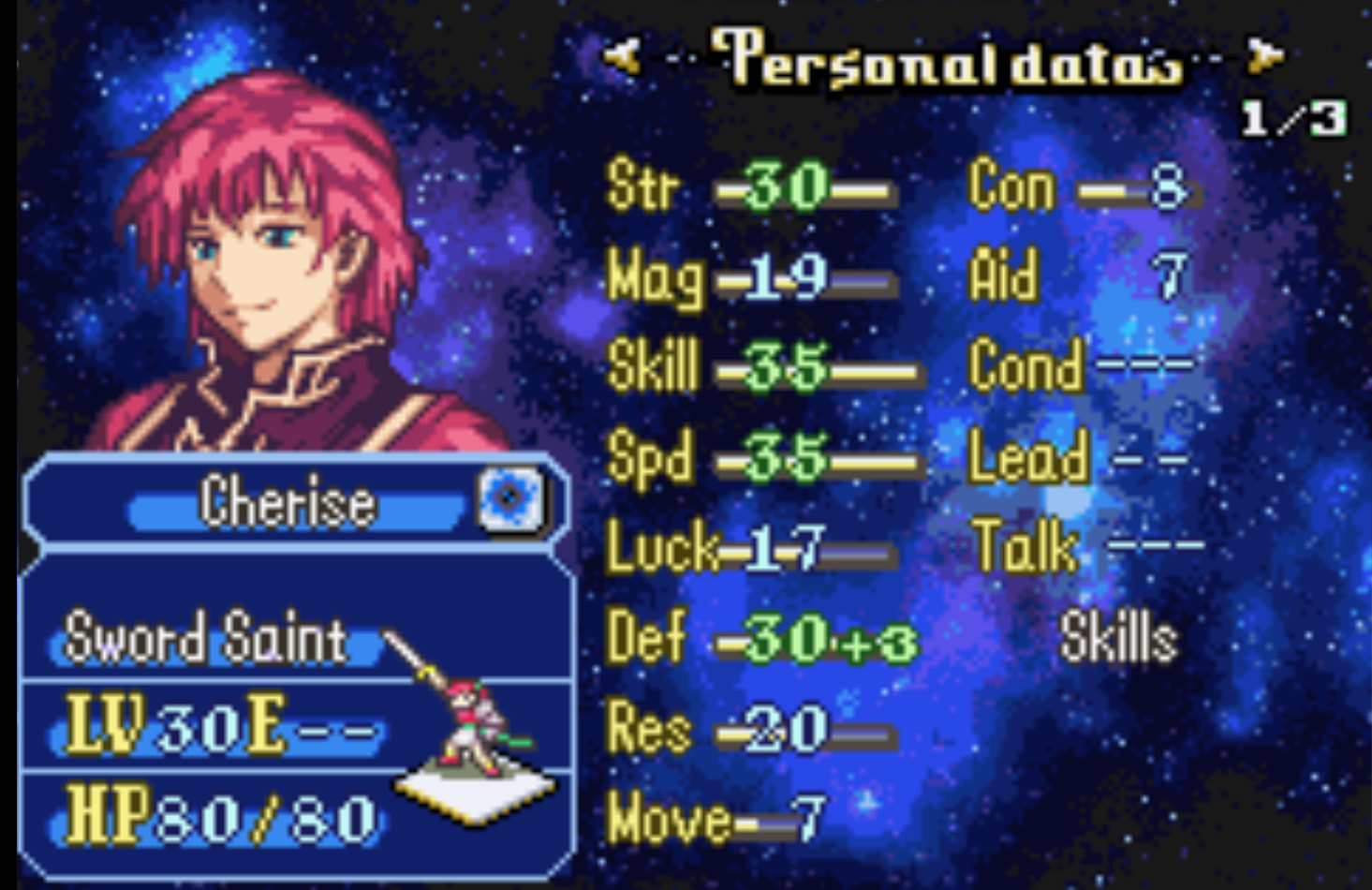
She obviously has way better stats than Rohesia and would roll her in a 1v1. It’s not shown in the picture, but she also has a Shield Projector, which is what’s giving +3 def. It’s also a hoplon guard.
But there’s a talk event that you can do instead of actually fighting her. And it’s glorious. I’ve recorded it here because it’s just better (re)experienced that way rather than looking at screenshots.
https://youtu.be/QNi-Hl0B02Q?si=OxTLXM4MjB3nbJ0-
Later, in the epilogue, during the last Yalunzar basecamp, Rohesia muses on the fact that she outlived all of her students, and wonders what the point of going to the Crescent was after all if she didn’t secure safety and prosperity for her family or the people she cared about.
This is my favorite event in a FE game, period. It’s awesome, climatic, and unexpected at once.
Rohesia is emblematic of everything that is good about CC’s design. Wonderful story integration that goes well with the fact that CC has several bosses on each map. Absolutely insane unit that seems completely unbalanced and also kinda not that good at the same time. And, above all, a willingness to do what’s awesome rather than what’s hinged, or reasonable, or seems like ‘good’ design.
13 Likes
Strong Units, Weak Units. That is only the selfish perception of Fire Emblem Fans. Truly skilled Dies’ers should try to win with their favorites.
-Karen, Gen 2 Elite Four Member, Amateur Video-Essayist, and Vileplume Enthusiast.
HeroicVileplume (Dies Emblem)
Alternative Title: A guide to using bad units in Dies
Part 1: A Truly Vile Unit
You may know Dies Emblem as a nightmarish slog where forumgoers must unit to deal with the most intentionally garbage map design ever conceived, and on occasion, it certainly is that. On other occassions, it is a wonderful look into FE hacking as a hobby: what goes into making projects, what is going on in the minds of people who make and play them, and what can go wrong with publishing your projects on the internet.

Hi, my name is HeroicVileplume. I made a hack once called Skill Issues, which is a Fates hack that makes all items have 0 hit, and thus I have been cursed eternally.

Yup, that’s me. 51 hit at base, and that’s not getting much better

Thankfully, that’s because my stats are pretty good! 20 Str and Dex are my unpromoted caps, which are both incredible, and I (at least currently) really don’t need exp since I’m an archer that won’t get countered. Once I do promote, my growths are really solid, 50% str and spd, and 100% dex will keep me relevant as a damage dealer for a long time.
Slight problem. Conventional wisdom suggests that I do still need to hit enemies to deal damage, and thus, gain experience. If I don’t do that, promotion is currently going to cost me 14k gold, and I have a cool 1000 currently. Well, it’s lucky then that I come with the best item in the game.

The reliable pin does nuke my damage, but it makes the damage that I can do consistent. Think of it as me having a proc skill (hitting) with often like a 30% proc chance.
Now, this is all still tragic, because in his infinite humor, Sigma stuck me with a balistae that weighs me down to 0 mov and speed, and also gave me a skill that specifically buffs two units: Gold (a completely fine archer with a cool scaling gimmick that joins early) and Archerbias. You don’t want to know when Archerbias joins. But this isn’t all bad, Gold users will appreciate the buff, and the balistae at least lets me get reliable exp on my join map, and it’ll provide a chunk of cash towards promotion. Or y’know, you could just sell the reliable pin to a unit that actually is good and call it a day.
Part 2: Training Arc
So, you’ve decided you want to use a bowlocked unit with 51 accuracy and 2 base speed. A wise choice, but one that is going to require a lot of favoritism to work out, so let’s go over your options.
Your first option, if you are a real Vileplume lover, is to give me the mercy scroll. Mercy scrolls are very rare, and allow you to bypass the very real and very punishing trauma mechanic, which will take your units right off the map and saddle them with a hefty stat penalty for next map if they accidentally kill a human enemy. This is, however, a terrible idea, and is equivalent to handcuffing yourself to a radiator for a bit. My combat is very unreliable by nature, and giving me a mercy scroll will all but force you to build your team around me doing a large amount of combat, and even I didn’t subject myself to that.
Looking at the preps screen, a few options stand out for helping me.

Gifting, Arena, and Friendly Spar are all mechanics unlocked before I join, and they are the friends of any bad unit. Gifting allows units to transfer money to each other, which is useful for buying arms scrolls and skills from the vending machine or buying weapons, armor, and items from the FE4 style pawn shop. Meanwhile, the arena is a not-so-fair fight, where a really strong enemy gets to smack you once without you being able to retaliate in exchange for some money. For a melee unit, this is a pretty bad deal, but an archer doesn’t need to care as much about losing 50%-90% of their hp pool from one attack. Finally, friendly spar puts you into a round of combat with Sigmaraven, where you trade blows to get some experience, and most importantly, paragon (which is obtained after combat if Sigma outlevels you). In general, Dies is pretty hard, and some units are quite bad, but there aren’t a lot of units you can’t fix by giving them a massive amount of cash and some experience from Sigma.
All of these come together to…still not make me very good, unfortunately. As a sniper, I’m fine, I have the strength to carry some pretty heavy bows, and I’m definitely going to cap at least Dex, but still, most units don’t have to deal with a tax on an item slot and 50% of their damage just to be a real unit. Quite sad. However, I might still have a few tricks up my sleeve…
Part 3: Dies is a Weird Game
Welcome to endgame! I’m looking a bit different since you’ve last seen me. Somehow my strength went down? I really have no idea how that happened unless Sigma buffed me in a later patch. As you can see, my stats are doing pretty decent, capped dex helps me quite a bit. I wonder what’s going on with that 15 use bow though…

Welcome to what turns Vileplume from a completely awful meme unit, to only a mostly terrible unit! There is an event after chapter 14 that allows me to choose from a list of TM moves to add to my inventory, and there are some genuinely great options. Magical Leaf is a bow that literally never misses, Bullet Seed hits 3 times per shot, Grass Knot increases damage based on weight, Giga Drain heals me for damage dealt, and Petal Blizzard is AOE! With the exception of bullet seed, all of these incredibly high might bows are also magic, meaning they automatically negate all armor of the target (which is really good). There’s also a neat thing with all of these weapons, they all automatically have 100 hit. I can’t add my dex to that, unfortunately, but 100 is still much better than the 71 hit I’d have otherwise, and this lets me easily kill most physical units (often several at once). Granted, I don’t have mercy, so I can’t be shooting down human enemies consistently, but anything helps.
Here is where I’d normally end this review, but Dies has a little treat if you deploy me in the final battle (cropped to avoid final map spoilers)


Honestly that one moment is worth all the suffering it took to bring this sorry unit to endgame.
So anyway, the verdict: Do I think you should try out HeroicVileplume for your run of Dies Emblem?
Not really. Feel free to use me if I look interesting, I sure had fun using me, but I think what I generally wanted to point out here is that despite Dies looking very intimidating, that difficulty is counterbalanced by even seemingly really bad units having unique things that they can do to fight back. And so, rather than saying to use me, use the bad units you enjoy, you can make them work, and your faith will be rewarded when they suddenly get a unique event that makes them much, much better than they were otherwise. Dies is fun.
Edit: You might be wondering what Vileplume is actually good for, since I didn’t actually cover it much in the main post. Generally, Vileplume is fairly decent at chipping fast, frail physical units, can kill fliers (though dies doesn’t have many of them), and will outrange and kill mages (most regular bows are 2-3, but with Vileplume’s strength, I can actually wield the heavier, longer range bows.)
10 Likes