you could have avoided all this heartache if you stared into the mirror and asked “Why are you straight?” before making your submission.
3 Likes
Hachimi Hachimi Hachimi Hachimi wo taberuyo
ashita ashita ashita… hayaku 

5 Likes

It feels inaccurate to describe Dies Emblem as anything but the FE equivalent of edging.
It is absolutely a project worth trying and a completely once in a lifetime experience, in that you will probably never feel highs as unique as Dies’s highs nor lows as unique as Dies’s lows in any other file on FEUniverse. It is the only project that I have ever seen that I would say has like 100 interesting units and maybe 10 interesting chapters if I’m being generous (and most of those chapters are dialogue-only interludes), and it is honestly a little baffling as to HOW that came about.
I cannot run Dies reliably on my Macbook. So once I got this game working on my local library computer by some godforsaken miracle, I absolutely no-lifed it to hell and back throughout last month while rain pattered against the windows outside. It was a cinematic experience that was equally soul-damaging as it was soul-healing, and Dies is by far the game with the greatest delta between the amount of fun and engagement I had with it vs. my desire to ever pick it up again.
You heard me. 100 interesting units. That’s more than *your* hack has.
As of writing this, I do not think that any other project on this site comes close to the same echelon of gameplay-story integration consistency that Dies manages to achieve, at least from the vacuum of the units’ kits and abilities. It’s a real accomplishment that one of the games with the most bloated casts ever also has so many distinctly fun-looking units.
I have to credit the majority of this to the setup. Knowing that the significant majority of skills in the game stem from either a person’s request to Sigma, their personality, or their projects makes me feel like I’m naturally learning new things about them through progressing through the game and grasping their abilities. Even without meeting or knowing anything about UltraxBlade or ever trying any of his projects, a player can infer from the game alone with relative ease that he’s a really skilled hacker/Builder user, he made a 3H inspired hack and basically commandeered Myson as his own OC (and all the world is better for it), and he also applies large mounds of incomprehensible spaghetti code to his projects till they’re bursting at the seams. The same goes for so many others in the game, and in that light this is a game of learning about your community at heart.
This means that everyone’s gameplay directly references and reflects their real-life attributes, or the attributes of their projects, in some way or another. Mechanical dissonance is rare (though not entirely extinct), and nothing feels tacked on or shoehorned in because most every skill feels like there is a fairly believable narrative justification behind it, even if it’s just “this is what I would want if I was isekai’d into FE”. And there are almost no lame/unfun units who feel like their skills were designed purely to fill certain map niches that weren’t covered already, or entirely based on the gameplay attributes that Sigma wanted to provide for a specific section of the game. It’s such an unspeakably sublime design compass for making units and it makes each unit so much more fun when you figure out how to apply their skills correctly.
I honestly think this is fairly close to the most optimal execution of puzzle emblem-tier FE gameplay for me when all the puzzle pieces are essentially just fragments of characters’ lore, and to know everyone’s abilities and how to use them properly to create a Rube Goldberg machine that just barely works well enough to clear the chapter more or less requires learning at least one or two new things about each unfortunate forumgoer that you’re dropping on the map. Because knowing these abilities means learning something or another about each person or their project, whether you like it or not.
Obviously, there’s a grain of salt to be taken about certain traits of people—going in you know to expect that some of it’s going to be flanderization for comedy purposes rather than what people are actually like. And there are a number of exceptions where Sigma clearly just… didn’t know enough about the person to implement them in the game in an interesting fashion (The preps function guys barely get a pass because I’m a psychopath who loves the FE4 castle mechanics) but I think the majority of the units in the game are particularly praiseworthy in this light.
Trauma
I cannot understate how utterly fantastic this is. I adore trauma to bits. I love how it draws out the boss-sparer molecules in my brain in a totally different way. I love how it made every kill feel more weighty. I love how it completely rewired how I approached the game and made me stop and think every time my cursor hovered on the “attack” button. I love how sometimes I had to weigh out whether eliminating a dangerous threat was worth turning my best unit’s emotional processes into soup for the rest of the chapter. I love how it made me actually take generic red units’ deaths into consideration more consciously.
The last bit is especially notable because usually my mindset towards murder in FE is primed towards “spare named characters when possible”. I rarely expect there to be any reward for sparing faceless red units. I think it’s often pretty unreasonable to expect stuff like conditional cutscenes for this kind of thing unless the scenario is explicitly set up for it, but I think trauma/mercy/etc does a good job at establishing a similar vibe with a much more realistic workload.
I think FE’s core gameplay loop makes it easy for some players to forget that your decision to kill a person is an event with tangible weight behind it in universe—especially when the ones being killed are faceless mooks who don’t matter narratively most of the time—and I am absolutely enamored with how the trauma system (and other things like how killing that guard in front of that one house changes the house dialogue) serves as a mechanical reminder of that fact. It encouraged me to apply a mindfulness that even goes beyond my usual habits, and I really loved how it altered the fundamental way that I interacted with the game.
It may be unsurprising to hear this from my mouth, but trauma is awesome.
“I like FE4’s gameplay” is one of the funniest things I’ve ever said, according to some
I like FE4 trading a lot. I already don’t tradechain items very often in FE, and I don’t think it’s very interesting or fun outside of specific tight scenarios. I like to tie together items and units in my head once it starts feeling like an item “belongs” to the unit and they’ve used it for long enough. In that light, one thing I liked about FE4 was how trading was a hassle. It was something I had to put effort into, and that helped the items feel more valuable and like they had more identity. So seeing it in Dies was a real treat, and I like how much prep stuff is available in Dies as a whole honestly. Am I a psychopath for saying that?
That said, I don’t think that Dies perfectly mimics the magic of FE4’s preps for me and falls short in some aspects. Aside from items lacking things like kill stars, after a while the game definitely becomes a lot more generous and lax on trading things around—and I think part of this is because after a certain point if you don’t trade things around to set up for certain circumstances you start getting your ass thrashed and can’t win at all. It definitely lost a bit of its shine in the later parts of the game for me, but I’m glad it was here at all because damn I love FE4 trading.
Here’s where I explain why this game is actually just On the Edge 2 by Alguien
I said earlier that the game only has maybe ~10 chapters that I’d call interesting and engaging if I’m being generous. This is because the vast majority of maps are extremely oppressive in a form that often dwarfs player skills and makes them feel a lot less impactful than they appear on paper, and frequently required absolute perfect turns and RNG rigging in order for me to barely scrape out victories. It felt like I was playing a game of War, except my deck was all Uno cards and I wasn’t allowed to use any face cards because the CPU had them in their hand at all times.
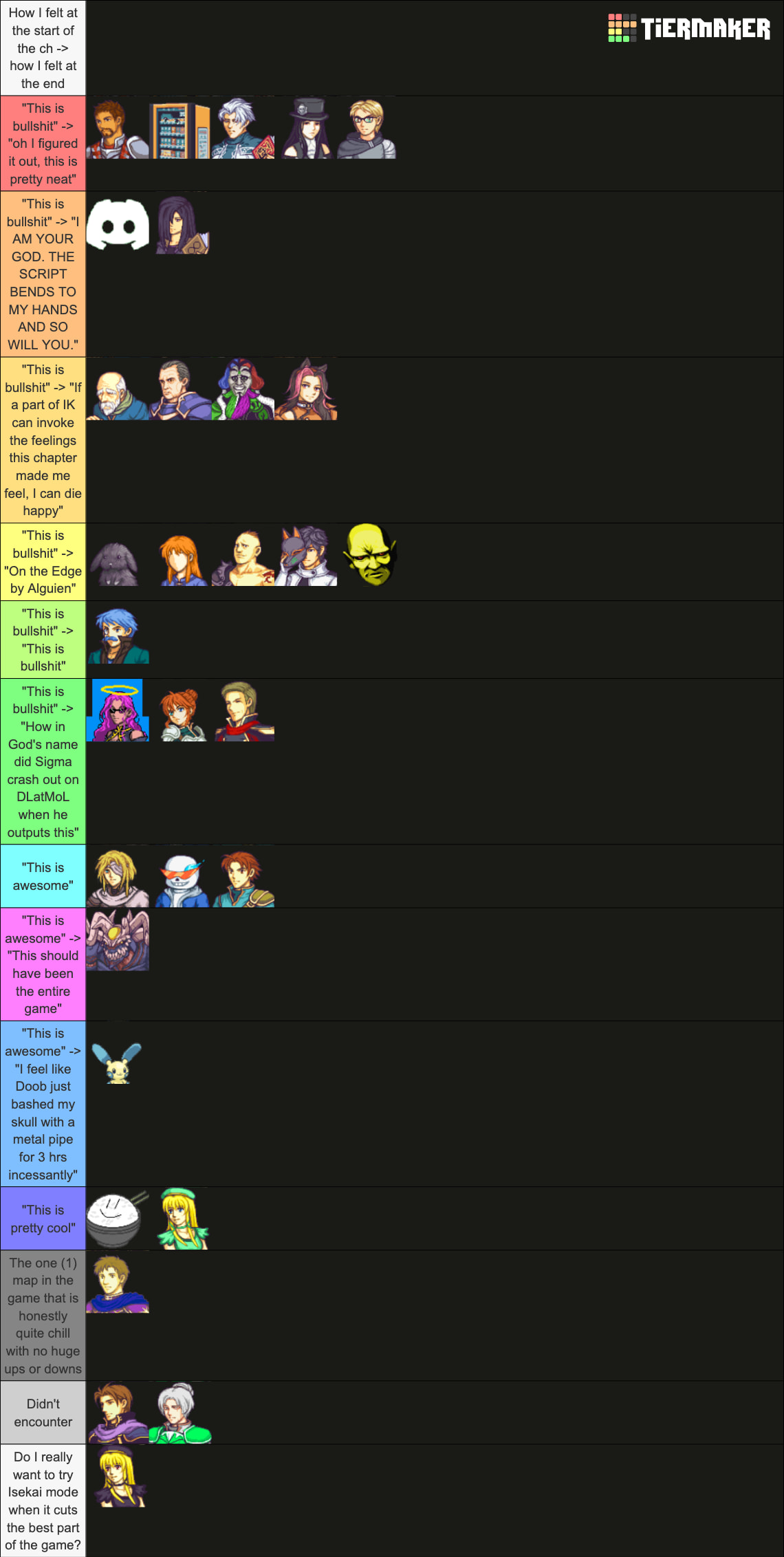
In practice, this means that 95% of the cool and fun skills with perfect interactive storytelling on paper often feel niche at best and useless at worst. I felt like much of my time with this game was driven by this overlying feeling of “okay surely SOON there’ll be a chance to use this cool skill in a way that makes them feel neat and strong” and the payoff only came maybe like, half the time. I always felt like I was on the back foot and kept getting excited because I wanted to see the gameplay-story integration unfold and the cool skills come into play… and as a result the game felt like it was so close to being fun more often than it was actually fun.
And as I mentioned before, when I DID manage to barely scrape together a duct-taped solution by leveraging my growing lexicon of the various forumgoers on FEU, it felt like a drug injected straight into my bloodstream. The chapter right after the Inferno is one of my favorites in the entire game because the process of figuring out how to complete it through reviewing what I knew about everyone, and then seeing it all come together and work out, was thrilling in an unmatched way.
But a fair chunk of the game felt like I was barely on the cusp of discovering that eureka moment… but every turn I was missing just one or two more face cards to win me the game. And in that light this is easily the most New Theory of Thracia-like game I’ve ever seen on this website.
Now, I have nothing against oppressing the player when the mood is right, because that’s honestly really engaging if the mood is properly set. But sometimes it felt like this constant oppression manifested itself in ways that either weren’t intended or pushed against the narrative. The Levin society map with Nereid/DT and the Polinym map come to mind in particular—having to reset time and time again because the latter was so punishing murdered the story’s pacing right before it marches to a climactic moment, and while I imagine the intent with the former was that fighting against a civilized community was demoralizing for most well-adjusted people, it felt less like my team was weak and more like the people of Ort were freakishly strong beyond anything we’d fought before.
Ultimately I do kind of wish that this game was a bit more accessible, especially when the coolest part of it is practically at the very end. Also, I am now even more lost on how losing a unit to a crit in DLATMOL’s lategame was traumatic or unmanagable for you at all when the tides of bullshit far worse in this game was apparently never traumatic or unmanagable enough to warrant nerfs to the maps while testing them.
Lose
This is hands down the best¹ chapter in the game. Thank you for proving all the nonbelievers wrong and making a single-unit boss map that is earnestly really cool and enthralling.
Bosses in general feeling powerful in distinct ways is a part of the game that I really loved (and I especially loved how Cheap Provocation often opened up different avenues to engage with them, which makes them feel even MORE distinct as they rightfully should, enough that it’s honestly potential effortpost worthy) and Lose is really the highlight of that.
¹second best
The Inferno (SPOILERS)
This is hands down the best chapter in the game. In essence, it serves as a peek at every single character person in the game and their footprint on the FEU sphere—a culmination of everything that you’ve been taught through naturally progressing and spending more time with the game because again, given how hard the game is you would NOT have gotten this far without inadvertently learning a thing or two about the people in this community. It’s so much fun and the apex of the experience by a mile.
But at the same time, it also feels different from the entire rest of the game in a way that I honestly would’ve liked to see more of, and I promise I’m not just saying this because I’m the centerpoint of it all. Rather, I think the emphasis on the various aspects of a creative community focused on projects and the exploration of the creative process are topics that would be fun to tackle further in the sphere of a metaproject about community members. Which is again especially prominent in Dies when everyone’s abilities are at least somewhat tied to their projects and creative outputs.
And while I will acknowledge that the project-centric ability design does add a subliminally Inferno-like layer to the rest of the game to some extent—hell I don’t think I would’ve enjoyed the Inferno as much as I did without that as the core gameplay foundation—from this angle, I was still left wanting a bit more out of the rest of the game’s script since most of it was about isekai shit and ticking off a bingo board and water and bandits rather than people’s projects.
Point being, I really loved it and would’ve liked it to be a greater slice of the whole game.
ᴬˡˢᵒ, ᴵ ˢᵗᵃʳᵗᵉᵈ ᴸᶦᵐᵇᵘˢ ᶜᵒᵐᵖᵃⁿʸ ᵃʳᵒᵘⁿᵈ ᵗʰᵉ ˢᵃᵐᵉ ᵗᶦᵐᵉ ᴵ ˢᵗᵃʳᵗᵉᵈ ᵗʰᵉ ᶦⁿᶠᵉʳⁿᵒ ᵃⁿᵈ ʸᵒᵘ ʰᵃᵛᵉ ᵖᵉʳᵐᵃⁿᵉⁿᵗˡʸ ʳᵉʷᶦʳᵉᵈ ᵐʸ ᵇʳᵃᶦⁿ ᵗᵒ ᵃˢˢᵒᶜᶦᵃᵗᵉ ᵗʰᵉ ⱽᶦʳᵍᶦˡ ᶜʰᵃʳᵃᶜᵗᵉʳ ʷᶦᵗʰ ᵀʸᵗʰᵉᴮᵘᵇ. ᵀʰᶦˢ ᶦˢ ᵐʸ ˡᶦᶠᵉ ⁿᵒʷ ᵃᵖᵖᵃʳᵉⁿᵗˡʸ.
The Inferno 2
Having thought about it, I do have some things that I might say about the end of the Inferno to try to push back at the statements made there. But in the good spirit of Dies I will kneel, bare my neck, and accept getting epically owned anyways—all I have to defend myself wrt not asking about that particular thing basically amounts to “touché”, and I will say that it did get me to pause and think back on myself more. In that light, I think you did succeed!
Outside the Circle (SPOILERS)
So there are definitely some instances where certain forum members get more focus than others. I certainly enjoyed segments dedicated to specific people, especially the Ultrax chapter for being such a delightful love letter to one of the most helpful members of the community.
But I also think that there are some elements that aren’t properly introduced in a form that’s comprehensible to an outsider. And while a lot of these elements still land as weird inside jokes or are serviceable as an introduction to the characters in question, I think there’s a few cases where the main story could’ve used a bit more priming for those not in the know—mainly regarding story-relevant segments that involve building up on characters who were already established, because I began to notice a small pattern of things popping up that didn’t feel like they were sufficiently introduced earlier. Specifically I’m thinking of 15-Cadbury and Bobby in the Inferno, both of which are elements that closely involve characters that already have been introduced by the story.²
I have genuinely no idea what’s going on with 15-Cadbury beyond it being a community circle that certain people are a part of, but the text almost presents it as a sort of Rye/Lesk cult. And I think just introducing this Rye faction earlier/having it discussed somewhere as a point of focus before the split, even if it’s just Rye and Lesk wondering wtf their society is up to or if they’re also stuck here after being saved on the Ysor map, would probably have been fine just so it doesn’t come out of complete nowhere. Could probably make some mention about Rye cosplay or harems here just to establish the bit earlier, so when it comes later it invokes a “wait they were serious?” feeling.
As for me playing the Inferno centerpoint, I did enjoy the bits about myself (and was a bit surprised as to the extent of the things you’d trawled in on me), but I’m not confident on whether the big payoffs/wham moments would still land for someone who’s never met me, because I’m not certain that the relevant attributes were properly introduced enough to hold weight for those who don’t know. In that light, I think prior scenes (or minimally just ch11) would’ve needed a little extra bump to prime people for the end of the Inferno. I def have ideas on how this could come about, but this is already long enough so—
Let's look at this under a finer lens
I would say that the main issues are that (1) the DLATMOL thing comes out of nowhere and might be hard to follow for those who don’t know it and (2) the story-centric mindset, while implied in some places, doesn’t really take center stage for how Bobby is characterized in the game. A fair bit of his screentime is focused more on trying to learn about everybody and puzzle things together, which is a few steps adjacent to this but doesn’t quite embody it enough to the point where I think blind readers would reliably recognize it.
I think some quick and easy things I would’ve done for this are
1: have a line referencing DLATMOL somewhere in ch11—nothing extreme or super prominent, just some small offhand exchange that mentions it.
“is that thread wish list why we’re waiting out here in the desert”
“of course. if there’s one thing I learned from DLATMOL it’s how to use the info I have, and I’d bet that someone we know will be here”
“but I thought that was the no javelins hack, what does that have to do with anything”
Both of these things are relevant later!
2: have at least one scene somewhere in ch11 that establishes me as a storyhead who purely sees gameplay as a vessel for the narrative. The latter is a little difficult in the scope of ch11 without warping a scene around it but maybe we can try to imply it anyways.
“Is that the person we’re looking for out in the distance?”
“I’m still confused as to why we need them”
“Well, Spense said that Bobby is a super lorehead, right? For all we know he could’ve wished to know the plot of the game in advance.”
“idk, he’s the type who likes piecing things together on his own.i mean he hates talk indicators”
“either way we’d better hurry. If he specced entirely into story I bet his gameplay isn’t great, and those LT users around him look like they’ll die to a stiff breeze too”
I regurgitated this in 3 minutes without thinking too hard but hopefully the general idea is conveyed. Gosh it feels weird to theorycraft writing myself. I’m never doing this shit again.
² Ultrax/Scraiza could use a mention earlier on maaaaaybe but I think their chapters are still fine enough at introducing what they and their projects are like without context, because they’re so closely focused around them. Also helps that these are their first introductions
So, uh, yeah. That’s Dies. Extremely awesome game unlike anything else in this fansphere that I’d rather not touch again if I can help it. Please try it if you think you have the willpower for it because it is absolutely worth trying.
Also I’m not doing Helltorture mode sorry. Also also, Sigma I can happily provide a copy of my more detailed notes if you agree to help me with a mild to moderate favor somewhere later down the line.
14 Likes
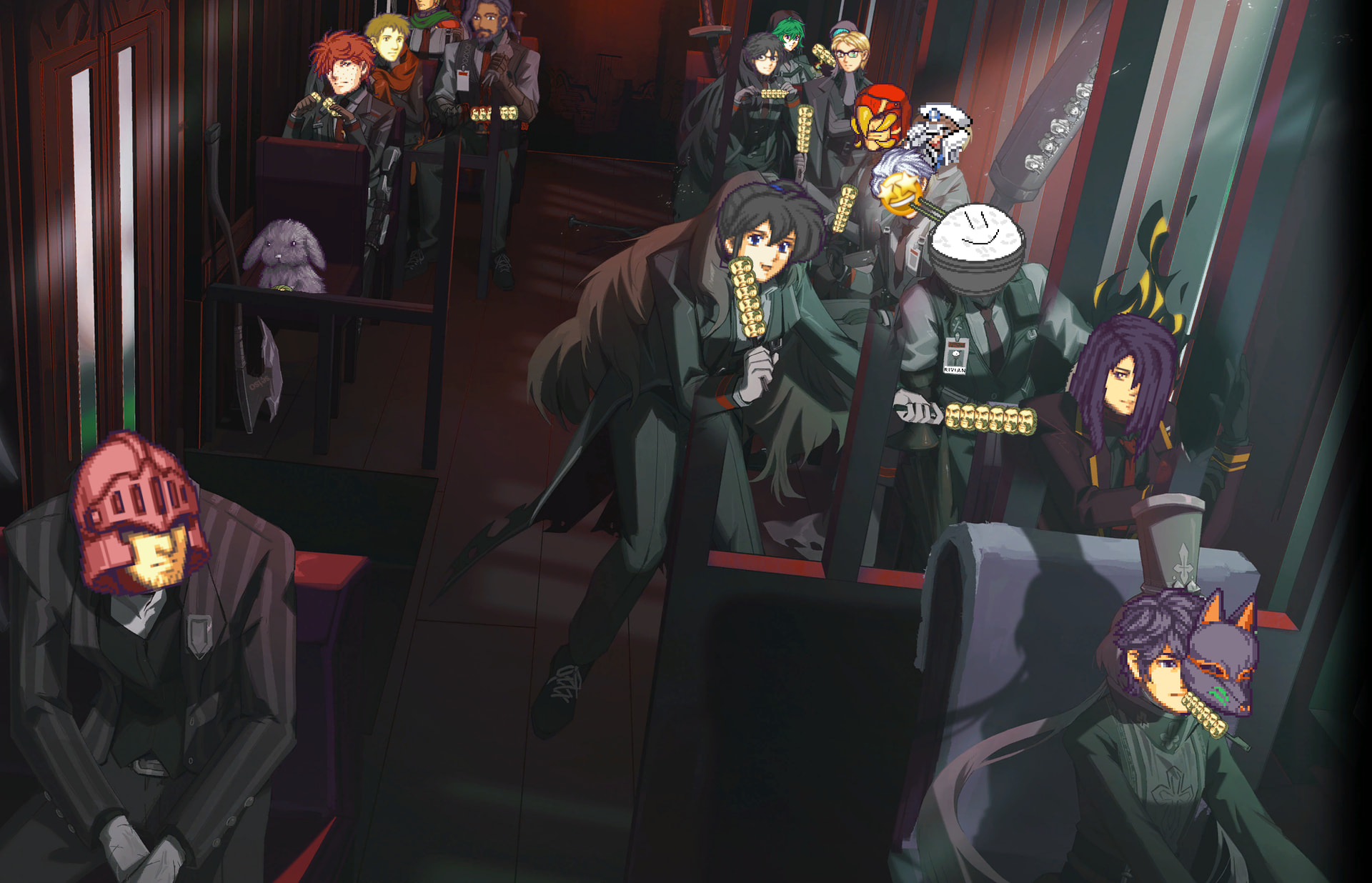
wait why is everyone in the bus eating do5head dangos
2 Likes
leftover snacks from the ch11 stakeout
4 Likes
wait who formed a Rye/Lesk cult and didn’t tell me
2 Likes
Limbus Mention
3 Likes
This is a shot in the dark, but were you using Camdar? And if so, did you have the brave sword and Canto+ rings on him?
If not, that might’ve been the source of the grueling difficulty you experienced in Ort? Being able to snipe two buff-providers each turn risklessly and from any range (teleport → attack → cantoport → get danced → teleport → attack → cantoport to a safe tile) makes the Ort maps much, much easier, at least in the build I played.
2 Likes
Lesk did we not tell you about the hubby’s fanclub
1 Like
bobby i appreciate (and largely agree with the criticisms included in) your in-depth review of dies but i think if i ever seriously worked on dies again my colon would just slip out of my body like a lubricated eel
4 Likes
whoopsie gravy
(Canto+ ring was basically glued to Yasako because I felt bad traumatizing people for like 80% of the game until Emmett got traumatized maybe 50 times in the same chapter)
you don't actually need a colon. my friend got his removed a few years ago and he's still fine so sit down and enjoy your do5head dango
More seriously, knowing you and Dies I wrote this less because I expected the game to change and more because I wanted to break down my thoughts on the game in a form that’s hopefully interesting for others to read. I do hope you got some enjoyment seeing me try to pick at what you’ve made because it’s one of a kind.
6 Likes
if i get to be on the bus does that mean i’m actually a good unit 
2 Likes
I know the hubby fanclub but when did I get promoted to object of adoration
I lost the thing that made me unique now I’m just me
3 Likes
Thats what makes you unique, Lesk
3 Likes
I’m uniquely washed
4 Likes
Some context: by that point in the game, Sigma had a lot of units left to add and only so many chapters left. He’d slotted a Cadbury-centric map as part of the ch15 split, and I half-jokingly pointed out that “a ton of guys in a big block” would be accurate to Milieu’s enemy placement and serve as a functional way to just drop in a ton of units. That suggestion evolved into the map we got, which ended up being a really cool way in gameplay to leverage the Milieu “everyone has galeforce” bit in conjunction with Dies recruitment mechanics and movement tech. But the “story justification” for a lot of the units that appear there is a bit weak — from a meta perspective, it contains every remaining LT user/LTcord member, beast/shifter unit, and Anna’s Secret Shop and Team Stoned Stoners member (that’s the “Rye and Lesk cult” section you noticed — it’s everyone else from their hacking circle) that wasn’t already planned for a future map. Cadbury himself is an LT user and a beast unit, hence why those groups are there, and then the A.S.S. squad is just also there because it’s a sizable interconnected group with known ties to existing party members that works well for the whole recruitment-chaining speed-clear gimmick (if Sigma had additional justification for tying them to Cadbury, I don’t know it.)
4 Likes
no that’s basically it i crammed them all i’d fuckin’ do it again
3 Likes
No, you wouldn’t, because that would require you making Dies again.
9 Likes
Sigma can you make Dies 2
2 Likes