FEBRUARY 2026 – Fits and Starts
Overall Progress Checklist
- C3 and C4 theoretically playable, but not tested
- Much of the cast plotted out
- Figured out how to set up base chapters, and set up 2x
- Got the ball rolling for dialogue in earnest, including in C7 for some reason
- Finally settled on antagonist’s name
If I’m honest, not quite as much as I was hoping for, but work came back and I’m still figuring out my rhythms. When I start being able to poke at it again after work, then that’s where the magic will happen.
REGROUPING
It’s nice to think of a reality where I just have to knock out two chapters a month for 18 months, spend a little more time tweaking and get to release by FEE3 2027. Unfortunately, progress is never so linear as that. I haven’t quite made the progress I’d have hoped for in the ROM itself, but I have had a lot of ideas for stuff that will go into it, and the cast is starting to stabilise. I’ve also hit a rich seam when it comes to the writing itself.
There’s also other factors. For one, work has started up again, and I’ve been struggling to get into a groove with that and spending my free time productively. My free time was also hit like a truck by a The Pitt marathon that basically spiked a weekend. Also, looking around a very incomplete, very clearly WIP ROM just… is not nearly as fun or satisfying as one that’s properly taken form. DoR hasn’t yet hit its stride. I’m anticipating that when I have chapters complete through to C6 it’s going to be smoother sailing, particularly as the first Act has been by a long distance the hardest to plan and undergone by far the most rewriting.
It’s also a little bit haunted and some weird shit has happened, but HC had the same phase and got through it, so. You know, it’s probably fine.
RESHUFFLING (or: why the fuck is Lindauer doubling this myrmidon?)
There was a flaw in my plan.
I had wanted to compress and deflate stats a little, but a range of 0-7 in most stats wasn’t giving the right amount of ranges for the damage numbers and player stats being thrown around. After a playtest of the first couple of chapters, it was clear that they were pretty much functional, but enemy stats needed to be pushed further. Introduction of the weapon types also needed to be slowed down, I think. In the earlygame, the weapon being held was just overshadowing the actual class holding it. There is a fair chance that almost all weapons wind up getting cut down by 2-3 might and condensed a little; the numbers are just somewhat unwieldy, particularly for earlygame.
Still, the first step was to stretch out the range of stats up to 10 (or 11 power), reestablishing some immediate difference in classes.
It was a blow, but I’m not too shaken up by it. These numbers came from ripping things up from the ground, and it’s natural that this will need some recalibration. I believe in the overall system, and there’s no reality where it’s truly untenable. It’s just going to take time and testing to get them in a place that makes me happy.
THE ROGUE’S GALLERY
DoR’s approach to its cast is somewhere between DoW and Do5. From DoW, I want to give the sense of a tight-knit early group, one that will generally retreat on death and can be relied upon to chip in with lines here and there; I think that was only sometimes effective in DoW, but it also does really help to have someone you can call on to be The Voice of the Army (most obvious example being Kolbane in Do5) where needed. It being a more tight-knit group of retreaters here, instead of just Everyone, will balance things a lot better in theory.
What I really want from a character perspective is to have every playable character really represent some section of …
uh…
… Navara.
Your Chapter 1 complement comes in two groups. First-up are the more respectable folks. Lindauer herself, her lictor Asger – bodyguard, mentor, potential love interest, guy I’m trying not to just give Garath’s voice – the rider Fyodor Harkov, of Voorstenet yeomanry, and wandering swordswoman Triss Coleman, who is here looking for someone. The second group of arrivals comprise of hardscrabble refugees from the ruined town of Isling, counting among them the reluctant leader (and potential love interest) Ulrike, fellow temple ward Tascha, the itinerant sin eater Fomirach, asylum-seeking noblewoman Jadzia, anxious nerd Clovis and a large dog. Those people, by and large, have a connection to Isling’s temple, and will be able to elaborate on what role religion and faith still play in the Confederation.
(This was originally going to be a more major theme, and for a long time in development Lindauer actually was a priestess, but ultimately I couldn’t find an elegant transition between circumstances that would have allowed the story to go where I wanted it to. So she’s an official, now.)
But they’ve all got to be a little more than just statblocks, and each has some kind of sidestory or very concrete connection to the world that will be shown through the sidestory maps, not just supports. Triss is looking for someone in Barossia, and it’s not a spoiler to say that person will be found. Ulrike was thrust into a position of leadership because she kept a cool head in the crisis, but is deeply uncomfortable with that and relieved to have Lindauer to foist it on. Other times, it’s more about who they are and who they represent. Fomirach is your only Rhiannite party member for a long stretch, and is here through disillusionment with his own people and his former life. Jadzia is a Rijescan in exile from the events there, and offers a window into what’s going on there that is separate from the propaganda you’re usually fed, along with her own biases. Clovis can speak for the Confederation’s wealthy citizens, Fyodor for its former nobility, while Asger is a voice rather closer to the ground. In later chapters, as the boss recruit game picks up and – it is not a spoiler to say – you enter Rijesca, you’ll get to see more Opinions, more of the kinds of people there. Szalai doesn’t really have an axe to grind with the Confederation, he just really fucking hates the rebels. Kulesza (third love interest!) is forever climbing a greasy pole. Prii is a harpy. And so on.


While there won’t be full-on relationship bars, repeatedly mistreating a character will be remembered, while some might only open up if talked to consistently. Just looking for small ways to reaffirm that a given playthrough is uniquely yours.
Future cast members will include the likes of Margrethe ‘Rethe’ Flick, by a distance the most of a true believer in the Cause that you have, a patriot in the way only a second-generation immigrant can be (speaking as one myself), the semi-repentant deserter, Lennart, another couple of descendants of DoW cast members (including one already established), and the now-obligatory skeleton.
(A moment of silence for Urban, Ansehelm, Gisel, ‘Big’ Magda and Tamiska, who did not make the transition from the last version of DoW2 even though I was quite fond of all of their lines. Better luck in the next life.)
CAST DESIGN: I Don’t Think He Knows About Second Cast Section, Pip
So that’s who they are as people. Here’s who they are as statblocks.
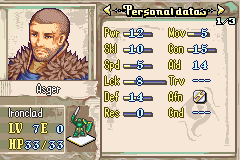
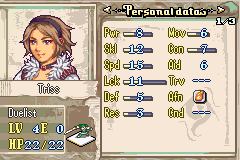
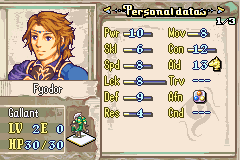
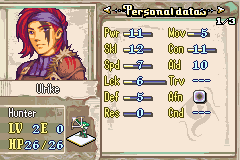
The re-shuffled character stats have allowed for enough difference between stats to allow for clear differentiation in statlines; Asger can take a lot more hits than anyone else, Triss can double everyone in the universe, Fyodor is pretty decent at everything, et cetera. Nothing too exceptional here, I’d say these units more or less resemble those in prior NQR campaigns.
Don’t get too excited. With the new focus on the economy, it’s going to be important to keep this lot shackled, so that the prospect of a new unit really is exciting, and that squads change up as the campaign moves on. See, there’s a bind in feedback. When you have a midgame prepromote show up, sometimes people will complain if this unit is competitive with the units you already have, as though that made their training pointless. But if you have a new prepromote show up with a great design and cool characterisation, it’s the worst feeling in the world when actually using them would basically be a strict downgrade over the troops you already have. Sometimes you thread the needle really well, and hear both kinds of complaints about the same unit (hi, Corentin).
Anyway, new units need to be worth the money, and the consolation for anyone who wants to stick with the old crew no matter what is that, hey, they get to pocket the cash. So while these units need to do a job in Act 1 and remain viable in endgame, I’m a little more free to hobble their growths to some extent. We’ll see how it pans out.
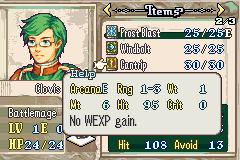
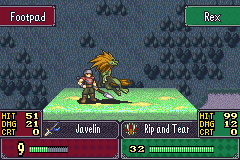
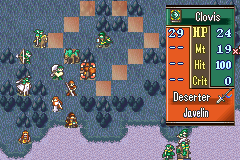
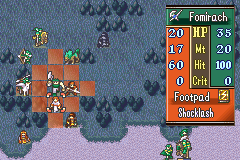
And of course, C1 exists in large part to showcase their talents, everyone able to jump on someone’s head going in. There’s still no need for SkillSys, but I anticipate more fun C-enabled effects on weapons (Bloodmoon Rise might well return…)
Miscellanea:
- Concoctions are back. I tried a Miracle Tonic only setup but it was a little forced, and rough with just one healer (without Physic) for the first few chapters. Right now instead of two Miracle Tonics it’s probably one Miracle Tonic and however many Concoctions… which feeds into the economy system, anyway. There’ll be fewer freebies. In Do5, I tended to give pretty much every new arrival a healing item, but here, well, most of your recruits after a certain point are from ransom anyway.
- I’m trying to ensure a gender balance on most classes, mostly for the sake of having different mapsprites and benefiting from extra visibility. Wanting most two-tiered classes to have an unpromoted representative in the cast helped flesh out the early cast. Like, hey, that gives 15 characters, plus lord and a couple of prepromotes and special cases, and that suddenly looks pretty healthy for a unit count by C7 Preps, meaning later units can then have more of a specialist vibe. Mix of weirder classes and more generally solid units.
- I liked how the compromise experience formula worked out in Homecoming, so that’s coming back.
I PROBABLY DON’T NEED TO HAVE ANOTHER SECTION BUT IT FEELS A LITTLE BARREN WITHOUT IT, MAYBE THIS IS NOT THE MOST FUTURE-PROOFED CONCEPT AND I SHOULD JUST ATTEMPT TO SHIP THESE UPDATES WITH WHAT I’VE GOT NO MATTER WHAT
A brief note on faction colours, since there’s had to be a minor shuffle here.
DoW’s weren’t really future-proofed, the casualty of allegiance palette freedom only being something I found awhile in; it wasn’t yet a patch, and was actually I think the first time I went into the .txt file of something to EA insert. I knew changing the main three palettes was possible – Christ, if GhebFE could do it, of all things… – but it took me awhile to settle, and when Act 2 was complete (albeit without C3 or C10) the player colour was actually purple, though this was more to shake things up than to actually reflect, for instance, Roxelana.
When it emerged, the big central idea, really, was to take inspiration from Starcraft 1’s first campaign. You start out in blue, representing the provincial militia of some backwater planet, allied with and ultimately abandoned by the (white… as player colour) Confederacy; along the way you ally with rebels, and your faction colour changes to red to reflect this, turning on the Confederacy as well as an assortment of zerg broods (usually favouring orange). Those rebels ultimately turn on you, though, and you revert to blue to fight their red terrans and kick the shit out of them in the final mission, the visuals supporting the story in a small way.
The parallels are unsubtle.
(Related note: playing around with faction colours is so routine and expected in RTS campaigns (let alone multiplayer!) that it’s startling to run into conservatism with the idea these days. Original C&C? White/red Nod, yellow GDI. AoE2? The campaigns have at this point seen the player in seven of the eight team colours (Grey tends to be the least favourite and is often given to ‘neutral’ factions, but even then it’s found some life as the signature Teutonic Order colour). WC2 was blue or white as humans and black or red as Orcs against enemies that ran the full gamut, with each colour explicitly assigned to a particular nation or clan. WC3 cycled through blue, purple and red, SC2’s Zerg campaign switched you from orange to purple at the midway point, the Total Wars let you play as any colour under the sun, Dawn of War has a modular painting system… all of these in games where you’re expected to read the situation on the fly and output 100+ APM, not with the comfort of a turn-based situation, and generally not with team colours that show up anywhere close to as clearly as GBAFE’s. Now, colourblind accessibility is a very real concern, and obviously the colours – whatever they are – need to be distinct from each other. It’s the sort of thing that demands a separate patch, and applying Contro’s Mirrored Enemy Sprites patch will do more for readability than fiddling around with values.)
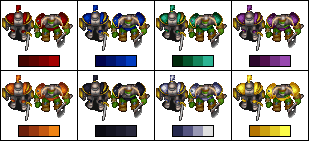
WC2 is the gold standard. Though note the absence of a true green, which would blend in with the vibrant DOS-era grasses (similarly, it’s difficult (though not impossible!) to make yellow work with GBAFE and its reliance on bright yellow for trim). Every colour was associated explicitly with a nation or clan, and the player colour would change at one stage in each of the vanilla campaigns to reflect a new front. And to at least some extent, these associations remain in WoW today!
The Exiles, then, had to be red to have that visual of the player’s allies turning red, playing on those traditional GBAFE associations (I did draw a line at the player’s faction colour changing mid-campaign). The Confed are shown as blue in battlesprites and portraits – often literally using the generic player palettes, at least for unpromoted Guardsmen – but that could never translate to the mapsprites, because the Company were already holding down teal. Purple wound up in the slot of the generic enemy colour – teal vs. purple popped nicely as a core match-up – while also being the Aulestri colour, with them being your enemies in the bulk of Act 1. Generic mercenaries were grey and brown – these led to some bland-ass palettes, motivating a shift to orange in HC onwards – and the Ecorcheurs, of course, were a distinct orange. Rhiannon were never fought as a primary adversary, so were free to be green. Clear battlesprites and portraits, but you could tell that the mapsprite integration was an afterthought.
These ideas were refined across Do5 and HC. Do5 had green as the Aukeman loyalist colour – influenced in part by Wyclif’s existing design and the generic green soldiers reflecting them in the 2012 version, but also by the visual of fighting against green units early on, again playing on the GBAFE associations. Then the different sides of the route split just mapped nicely and naturally onto purple and orange, and naturally set the scene for the Wardens to take over in Act 3 (with cyan/red firmly established as their colours from 2012) and Visharans taking a very classically imposing scheme in black/red for Act 4. Blue as Player 1 fit the classic vibe, was a secondary colour to the main Aukeman faction anyway, and was the main colour in Rena’s outfits. And given that you at some point faced greens and needed allies against those greens, that required white as an ally colour (when those allies weren’t loyalist Aukemans).
So moving onto Homecoming, where the Velians needed a classic black and red colour association – and I wanted black for the player and red for other Velians. Needed cool colours for Palnata but wanted to stay away from blue, so that led naturally to purple (with blue as a secondary colour on battlesprites and portraits). There was an issue for awhile where the black clashed with the purple, but Lumi helped out with her, uh, ‘actual knowledge of colour theory’ and tinted it slightly green. Sjoersund, the third and final nation even mentioned, get the third faction colour of green, setting them a little apart from the others. And that sets up generic ally white (which almost never appears anyway) and generic enemy orange.
And here was me worrying I wouldn’t have anything to talk about.
Anyway, for DoR, Lindauer’s portrait came back green, and I wanted green to be a nice, distinct player faction colour, helping the player stand apart. Aaaand green’s my favourite colour, and DoR’s the ‘get everything completely Right for me, leave it all on the table’ campaign, so it just made sense; besides, then I could continue to explore white as an ally colour, in its blue-tinted form (which I think of as ‘Lordaeron’ for how they conveyed white in WC3 without being able to go fully white, as they needed it for trim; I don’t feel WC3’s team colours are very good on the whole, but Lordaeron makes more sense to me as an adult). Without wanting to carry on blue, the Confederation kiiiind of just have to shift into purple at this point (the Aulestri legions won’t feature, freeing the space), coasting on their association as an enemy colour in DoW; this leaves room for orange to return as a generic enemy colour (hey, there’s the Ecorcheur associations here too, though the company is long dead and buried), but I want a deeper, redder shade this time, which is fine so long as it never coexists on the same chapter as red. Red winds up being the thorniest one; it has a soft association as the Rijescan national colour, by way of the Exiles. It can link the Exiles and the Rijescan armies in terms of mapsprite, but with different patterns in portraits and battlesprites; Exiles primary white and secondary red, Rijescans primary red and secondary teal (playing off the player colour of the Company), and that I think leaves the Exiles well-placed to be white while Rijesca is red when the factions are both on the same map. Would it shape up differently if I didn’t have DoW’s somewhat messy associations to build off? Yes. But this gives a sense of continuity that’s worthwhile.
That’s all. Watch Sinners.
Next time: base chapters, probably? And, with luck, Act 1 will truly take shape…