SEPTEMBER 2026 – THE FOG MINES
- Completed and tested C20, 21, 22
- C23 complete but not tested
- C24 map complete (it is the same map as C23)
- 22x conceived of
- Lumi’s second wave of testing has ploughed through most of the campaign
- XP formula created
- XP formula readjusted
- Many key coding developments added
- Radek no longer kind of sucks ass
Exciting developments! We’re posting a little early because I heard everyone’s been looking for new Fire Emblem release news, so if this is what the people want, NQR shall provide.
Garth Marenghi’s Occultplace
So there are workhorse weapons and then there are catch-all weapons. Workhorse weapons are fine and natural. It’s actually nice and good if a weapon for a particular type works pretty well at just Killing Guys. Clio in DoW has a funny situation where, despite rolling in with A swords and D lances, she very often wants the high accuracy and generally better WT situation of the slim lance and can compensate with raw power of her own, so sometimes doesn’t hit S swords (where she really wants the S-rank). It’s nice to just sort of have something in the inventory kit for ‘this is right for a lot of situations’. The issue, though, is when it’s a little too perfect. The classic, of course, is something like FE7 Hand Axes (it’d be moreso in FE8 if it had better wielders, though the likes of Gerik give you that). Well, we had that kind of a situation. Let me talk more about Occult Magic.
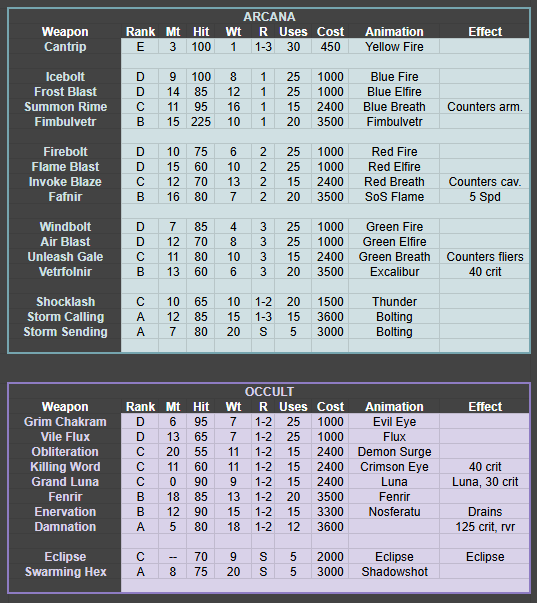
The magic situation as it stands. Things have changed quite a bit since the first draft of it all…
The gist of Occult vs. Arcana is simple. Arcana has all the answers, largely in more straightforward ways. You get one through three range… but almost always just one at a time, based off your element. 1-range Ice spells are accurate but heavy; 2-range Fire is powerful but inaccurate; 3-range Wind is light but weak (a generally poor tradeoff, but… they have 3-range). Each has a light and a heavy basic spell, an effective (I’m still tossing up alternatives for ice; mages don’t need help killing armour! But dragon alone is far too niche for this environment, so there’s a chance drake becomes an armour class) and an expert spell. Arcana has all the answers… but you only have five inventory slots. I like how it kind of leans into the slim sword / steel blade problem; fire is hard to harness, so you’re drawn towards getting it under control with bolts despite its higher raw power in theory.
Occult, by contrast, doesn’t have great straightforward options… in theory. Chakram used to be stronger, Flux used to be heavier, the bolt and blast of the type, except that being 1-2 range was obviously a significant buff compared to lighter equivalents; the malus was no cheap E-rank. Well, now I’m going to split the difference, because the issue is that Grim Chakram basically just hit all the right thresholds anyway. Matzi, Vistria, Auxerre… they all just wanted to Chakram-spam. When the draw of Occult is meant to be that you get big gimmick options. I had a Damnation tome right there… but Chakram pulled better numbers!
Well, this could not do, so I’ve taken an axe to Chakram, then made Flux lighter; Occult now strictly increases weight with rank. This hopefully creates an environment where the might tradeoff is more worthwhile more of the time. Damnation just didn’t have the might to keep up, so now it… has might, at all. Enervation’s stronger and slightly more accurate to compensate for weight. In general, the current vision is for Occult to scale up well to make up for relatively weak workhorse options. After all, if the goal is less chakram spam, they’ve got to use something in its stead.
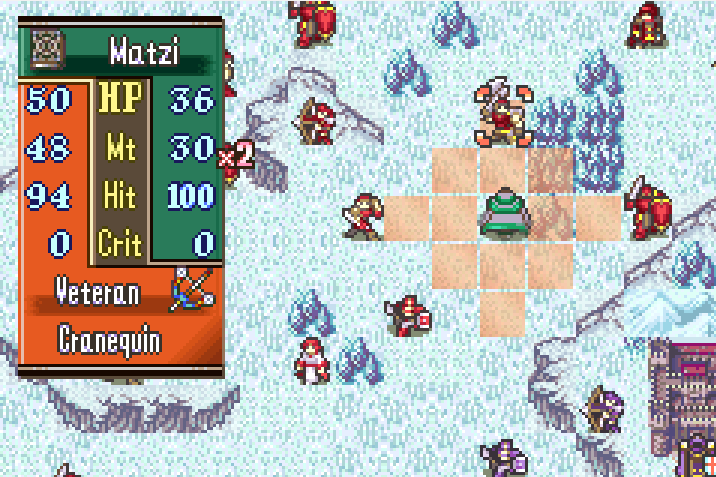
Let’s be ‘avin’ yer-- uh, nevermind
Except, uhm, that may not fix anything. Even with the new stats, Matzi’s getting the same results. If he doubles, he’s killing; if he doesn’t double, he’s usually not within OHKO range (though he can manage it situationally). Here’s the thing: your main occultist, at least in the earlygame, is looking like this by Chapter 18 (but again, due to XP / growth nerfs, this is probably more a lategame picture):
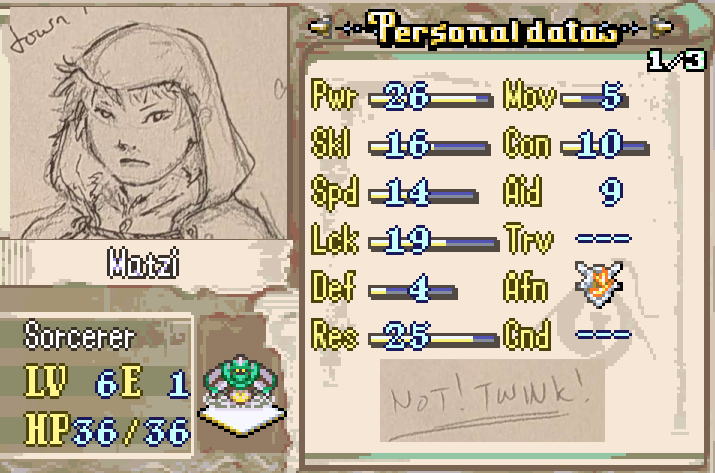
But also… is that really such a bad thing?
I mean, look at this guy. I talk about the deficit discourse a lot, and trying to avoid it. Try to focus on strengths, people! But also, uh, let’s not get carried away rebalancing the whole weapon tree around this guy. Particularly not around him being overtuned. Because, yes, Matzi is a good staff user and deals big, meaty offense, and 2HKOs basically everything. Because if he didn’t, you’re left with a five-move unit in a six-move world that gets his head kicked in by… by just about any physical attacker, really.
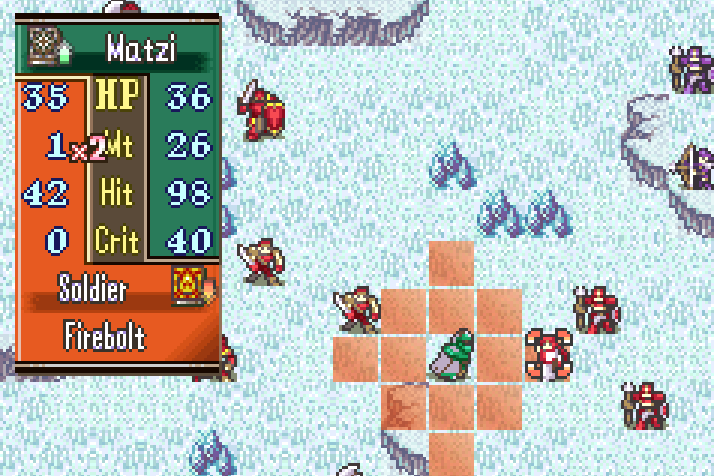
I’m just having fun with combat forecasts now, have you noticed? Anyway, in a game with terrible Res suffice to say Matzi’s anti-mage niche is legitimate.
Ultimately there comes a point where you have to pick your battles. Getting to a set of numbers I like a lot has been a slow progress and we’re still in the process of it. The primary design objective is not to create an environment where Matzi, Specifically, is heavily incentivised to use more expensive tomes. That’s quite a low priority, ultimately. And every change to Occult tomes affects other units, a lot of enemies, so on and so forth. So let’s go with small steps first, and we’ll see where they lead.
Revisiting Drums
As the sequel chugs along – and, indeed, eclipses DoW’s chapter count – I’ve been thinking more and more about Roxelana’s story. Specifically, about what I’d do differently now, and what I’d amend in a later release. Because I do want to give the old girl a fresh coat of paint, given that, unsurprisingly, I think it will get a revisit. And also it deserves it.
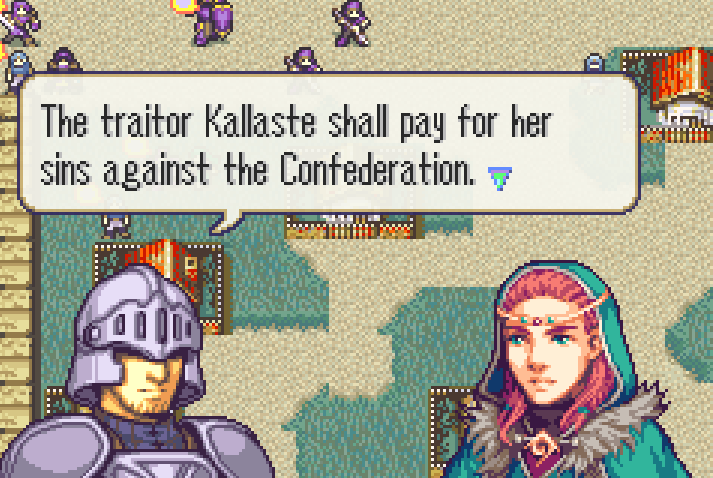
You can of course get a recap of Drums’ events at the start of Reckoning. The reliability of your sources may be in doubt.
Minor text fixes, of course, will find a way in. Inconsistencies. Events that don’t check if such-and-such is alive before firing. I think I’m going to try and establish more consistency with ranks, and, like, what is and is not the Federal Guard (Prologue makes it explicit that the Company is not, later chapters imply they are; the Guard are generally presented as a militia organisation somewhere beneath the coreland armies; ultimately having the main core army be the Guard and there be allied militia attached to that in a subservient role – which the Company was apart of – makes the most sense).
I’m also going to need to quickly patch over some minor things that are ultimately not still canon as of DoR. For instance, Goran and Thalassa settle in Rijesca in their ending, which made sense for DoW… but no, canonically that’s got to happen in DoR, because they need to produce a top-tier melee cavalry unit in time for Prologue.
And while I’m there, of course, it will be a good time to add Reverse Recruitment (which I made about 80% of… about 18 months ago), and hopefully also some more visual polish, which might extend to the battlesprite and maybe mapsprite palettes; the former are a little janky (I already fixed some of the shittiest-looking ones a couple years ago, but still) while the latter are a little more pale and desaturated than what ultimately became the house style, though I’m presently inclined to let those lie.
But I think I largely want to leave it as it is. The thing with Drums of War is it is very much the product of a particular time and place and mindset. Drums of War is the campaign I bolted together as a side project in a flurry of activity as my relationship collapsed, without really pausing to ask questions or think more than two steps ahead. The campaign outline started as twelve chapters and ended at twenty-two. There were very important pieces to the story that aren’t foreshadowed in Act 1 because I hadn’t thought of them back then.
And of course, some amount of jank goes with that package. Some of it gets to stay because I don’t want to untangle and re-code an entire event (I refuse to work with counters again, or deal with Micah’s bullshit summons in C15). Some of it needs to finally get beaten back into alignment (the C3 endless reinforcements working the way they do). And whatever I do will ultimately require a full replay. Which I’m not wholly relishing. But hey.
But also, if I was told to do it all over – if DoW was bulldozed and I was told to remake it from scratch – I wouldn’t do the same things. That might be for better, but here and there it would be for worse and, overall, it would be different. There is no cut of DoW that removes all bathwater and zero baby, particularly because bathwater / baby are a little in the eye of the beholder to begin with. DoW rushing through its main notes … makes it brisk in a way later campaigns wouldn’t be. Its maps are larger and longer than I tend to make nowadays … which gives it a grand sense of scale. Weapon numbers and enemy stats were initially planned out but there’s a lot of playing it by ear to fudge it into working throughout … but it works, so why reinvent the wheel and risk throwing the whole thing out of alignment? 2026 Me is a more experienced and confident designer than 2022 Me was. But while making DoW, 2022 Me knew what he was doing, and I’m still damn proud of what came out of it.
Beyond Velvet
So the initial Iron / Velvet split was borne of perceived necessity. I thought the setup for a menu of dialogue options was very complex and tedious, but this was only true if you wanted various bells and whistles, which I turned out not to need after the opening choice. So hey, Iron choices to be like a proper orthodox Confederation dignitary, Velvet to show discretion (or flagrantly lie). It was an elegant solution, and I’ve been using it less and less of late.
From the midgame onwards, more of your choices present themselves as multiple-choice, not just the broad strokes of orthodox vs. iconoclast. The big ones, of course, are the ‘dialogue boss fights’, negotiating with significant figures such as Ranestis Tarusanu, leader of the Exiles, who will wind up giving you more or less money depending on how well it goes. But it’s more minor ones, too. You get a more clear idea of what will be said, and thus, more importantly, how it might be received.
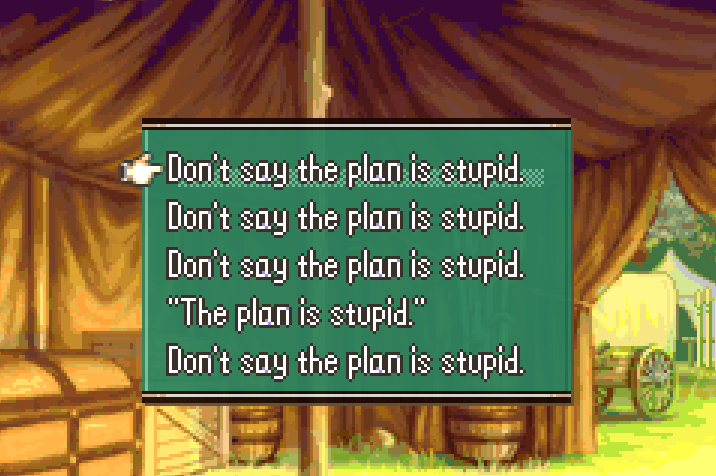
Sometimes the binary just isn’t enough.
… But hey. Necessity continues to breed invention.
The gradual phase-out of the binary options actually fits Lindauer’s character journey well. She starts out as a novice dignitary, a trained and talented diplomat but the Cause is still looming large over her, and she is still trying, by and large, to serve it loyally. Simply doing it right or bending the rules a bit is already a choice for her, to be done in broad strokes. As she sees more of the world, and more shades of grey – and reflects more on the experiences that have brought her to that moment – it actually makes all the sense in the world that her options expand from there.
So while I could, in the name of ‘consistency’, go back and remove Iron/Velvet choices altogether, replacing them with more specific binary options, I’m going to leave it the way it is. It tells a story – and through it, helps tell the greater story in microcosm – even if that’s not what was originally intended, and is all the better for that.
Speaking of binaries…
Trains That Run On Time
So I saw a guy online imply that DoW’s themes were centrist and that triggered an existential crisis.
The thing is, on the face of it, it’s not completely wrong? While the Confederation is clearly not a far-left analogue, the Exiles are clearly a far-right analogue. And, yes, it is a story about finding one’s own path, which is perhaps not so different from Finding The Enlightened Middle Path. Are the two sides the same? No, but they are both wrong for Rijesca, and it does (explicitly, in the text) come down to the pursuit of power moreso than any ideals either side holds.
So that had me reflecting more on the Confederation vs. Exiles dynamic, and that also had me reflecting on the well-worn dynamic that they themselves reflect. It actually had me thinking of another take online, which ran something like: ‘there was a trope of RPGs having overstretched empires struggling under the weight of trying to build up the world against agile revanchists who just wanted to subjugate the world, and if the real world has shown us anything it’s to vindicate the former group’. (The take was worded a lot better than this). And that was referring most explicitly to two RPG splits around the same time.
New Vegas, which I had played, and was not deliberately riffing off but was doubtless inspired by, has the NCR and Caesar’s Legion. It really is a matter of, ‘you know, the NCR are guilty of overreach, mismanagement and corruption, but your alternative is the faction that crucifies, murders and enslaves everything in its path’. The two sides are not presented as in any meaningful way equal. Though, perhaps, some writers thought otherwise. You actually do get two other options: the ‘fuck it, let’s just let a city-state of rampant capitalism take charge’ option where you side with the late and missed Rene Auberjonois, and then the fanfic option where you do that but you take over yourself, which is a faerie tale I have never had terribly much time for, cutting a Gordian knot in the interests of the greater power fantasy.
Skyrim, which I had not played (though, you know, was vaguely aware of) but since have, of course has the Empire vs. the Stormcloaks. This is probably the neater analogue, which is all the more annoying for being coincidental. And this is, insofar as the main story actually matters in Skyrim (which it does not. When you beat the main quest the credits don’t even roll lmao), a pure binary with no third option waiting in the wings. And again… very clear choice. Empire good? No! Empire bad. Empire imposing its own ideals of civilisation on proud locals. Except what the proud locals want is to shove Dunmer into ghettoes and so forth. Fuck the proud locals. There’s also not the power dynamic of NV; where the NCR are teetering on the edge with momentum all behind the Legion (but the NCR are, of course, defending a fragile frontier province in the wake of a barbarian horde; they will, ultimately, be fine no matter what happens to the Dam), the Empire was on track to achieve complete victory about five minutes after ‘Ah, you’re finally awake’ before, you know, dragons happen.
Here’s the RPG I was deliberately inspired by: Tyranny. Which I think kind of sucks complete ass as a game and has largely turgid prose and generally sophomoric writing, but, hey, it had some ideas! Chief among them: it, too, had a big empire holding a dubious border province, and the big empire had some of the same quasi-proto-Communist vibes and notions of equality, though while the Confederation I would like to think is more grounded, Tyranny’s tyranny is screaming We Are Lawful Evil in your face at all times. Say what you will about the Federal Guard, they are neither a human wave of rapacious death cultists nor are they wannabe Bronze Age SS. Not that grounded is necessarily better, but different vibes. Anyway, the third faction here is the rebels, and yes, they’re ultraconservatives who see nothing wrong with the power structure except that the nobles need to be back on top (though they’re probably more reasonable than the Exiles are presented; you see their virtues more often, and while there’s gender essentialism to the tune of ‘only women hold land, only men hold ships’, that beats what the Exiles have going on).
And my main historical inspiration was very plausibly the main historical inspiration behind all of the above, too: all roads do in fact lead to Rome. I mean, you have two very clearly Rome-inspired factions above, and the one that isn’t is very much rooted in antiquity generally. It was once put to me that the idea of a rebellion over citizenship was ‘anachronistic’. To which I can only say: Social War (91–87 BC) - Wikipedia. So, yes, the Confederation is very much a Republican Empire that takes pride in not having kings and scorns those who do, that takes pride in its citizenship while still being a very clearly vertical society, and that secures its power through its allies, allowing them some degree of autonomy in exchange for service. That’s obviously not all there is (there’s a lot of Roundhead in there too) but it’s not subtle.
So now I think about this in relation to A Literary Interpretation of A Centrist DoW. Because hell, I looked at the earlier tweet about vindicated NCR/Empire and think, yeah! And I went NCR and Empire when I played those games with barely a second thought (Skyrim does make it particularly easy for a dark elf. Like, mate, I just saw your ghetto). I’m also, at times somewhat unfashionably, a believer in incrementalism and lesser evils. So I think: is it different here? Why?
And to my mind the answer is: yes, it is, because the Cause is untenable. You’re coming at it from a Rijescan perspective, not just A Guy In The Space. You aren’t getting the liberties or rights of true citizens, but you’re bent under the responsibilities.
It’s also not a matter of the two sides being Just As Bad As Each Other. The Exiles are weaker than the Confederation; the expeditionary force crushes them at the Grunveldt, and then Roxelana finishes them off as the appetiser before Rowland’s main. And she kills off the Exiles root and branch, while she has to decapitate the Expedition, who have spent the time conquering the west… and, of course, the Exiles meaningfully cease to exist, while the Confederation still holds the Confederation, just with reduced borders. Tryphon makes a fairly good show of himself to the end; Wulfram does not. The Confederation is relatively cosmopolitan so long as people bend the knee; the Exiles are not. The Confederation can be endured and worked with, just not worked under; the Exiles must be eradicated.
Also… Roxelana tries compromise. She tries working with the system. That’s her central flaw! In Act 1, she digs in her heels and tries to do the proper thing before her hand is forced and she cuts loose, and it will come back to bite her again; she’s inflexible and tries to make the best of a bad hand rather than going for a mulligan. Act 2 in particular is a long sequence of her trying small mercies that vanish within the big picture. It’s nice that she saves a few towns on the road to Machva in C6, or spares some people here or there, but she’s still working for fundamental evil. In end-of-C8 she is told to her face that letting a few people get out and fill their pockets is just to salve her conscience. Sometimes there isn’t a status quo you can work with. And while Roxelana will need to be pushed, she ultimately does carve out a third path, not one that is ‘between’ two points but strikes out for what she believes in, what she stands for, and what she will spend the next twenty-three years striving, against all odds, to defend. Maybe learning some of the wrong lessons along the way.
So I think the story still pretty much holds true. As I interpret it, Roxelana scrapes against the limits of what someone can do within the system, and only when she breaks those limits can she meaningfully shape the world in a way that lives up to her ideals. The Confederation is guilty of empire, one of the ultimate human evils, but there is something in the Cause worth striving for that has become corrupted by the pursuit of power (throw Pyre into DoW’s many inspirations). Victory is not found by compromising within the lines, but through forging a new and better way. Of course… that is not always the most practical approach. Rena does have to compromise, but through deceit; she wears masks when they suit her, makes alliances with the undeserving, but there’s a reason she finds her way through to a solution where she gets what she wants.
Now of course in DoR the dynamics are different.
Ultimately, hearing takes that Can Be Justified helps think about a story, and helps clarify what one really might think of it, and is particularly useful coming into a sequel. My reaction to This Take Not Being Wrong, Necessarily, probably made me think about DoW’s themes more deliberately than I had since Do5, where dealing with the whole ‘can one well-intentioned military dictator really save the world’ – no, says Do5, and no, DoR will say, but DoW leaves it open, as this is basically where Roxelana finds herself. Just as HC then responds to Do5’s more scheming nature by having a storyline where purity even mixed in with naivete is critical to breaking a cycle of pain. Ultimately if there was only one kind of story with one kind of solution, the world would be a dull place. Weirdly enough, protagonists tend to be put in situations where their mentality and skillset can lead to a satisfying outcome (or, sometimes, where they’re deliberately mismatched; the obvious examples within FE being that Sigurd and Dorias are men out of time, and pay for it with their lives). Roxelana can’t solve Do5’s problems, Rena can’t solve HC’s, Bronwyn can’t solve DoW’s. That’s why they are where they are.
The Inherent Power of Romantic Love
So the romance options in Day of Reckoning have been multiplying, but I’ve yet to get particularly far into writing those actual arcs. I’ve finished most of the interlude talks with random people, and they do often call back to past events. For instance, you can sell Berisha on the idea of ‘The Cause’ in 11x and if you do so successfully, by giving her the version that gives her an unwavering direction, her morale later on in the game will be higher. No gameplay effect, but she’ll remember it and bring it up. Rarely, and never beyond the character themself, there is a mechanical benefit. Think of those as sidequests. But, really, if you don’t give a shit about so and so you probably aren’t regularly using them and will not have a need to ever talk to them.
Anyway, I feel I should at least go over the different romance options and how these happen. These are also happening through interludes. The support system is basically pure gameplay, and detached from dialogue; units tend to clump together in cultural groups or shared experiences, to encourage you to keep birds of a feather together. ‘Hey, Kulesza/Vistria/Jadzia all support because they’re noble Rijescan cavalry’ is easier to remember than ‘hey, Thalassa/Goran/Kirsten all support because Goran and Kirsten survived the same ambush, and Kirsten has a disarming manner of speech that lowers the guard of Thalassa, who is morosexual for Goran’. Affinity bonuses are out. You get the lot; 1 atk/def, 3 hit/avoid, 5 crit/cevade… so long as you’re adjacent. Supports grow from 3, but take effect from 1. And they are purely a gameplay concern that uses the characters as thematic shorthands. Lindauer can still sleep with Vistria even though her 6 move is never keeping up to Vistria’s horse.
To secure a love interest, you’ll largely have to keep talking with them throughout the campaign. It’s less about just mashing the flirt option wherever it’s there – indeed, sometimes flirting is the wrong option! – and more about building a rapport. Brush off Ulrike and hound her for a small breach of the Tenets and she’ll never open her heart to you. If you make it clear to Kulesza that you hold her ways of knowing and being in contempt, she’ll only dig her heels in further. Asger’s unhealthy holding patterns are great for banter and less great for a lasting relationship; keep dancing around the past and you’ll never get anywhere. And Clovis? Well, I settled on adding Clovis right after rewatching Master and Commander, so.

If you know, you know.
So here’s the cast, and you’ll recognise some of these names from the art above;
Asger is the guy you can depend on. Like the Magistrate, he’s a veteran of the Cyrek rebellion, and like the Magistrate, that casts a heavy shadow over him. While the Magistrate hides over it with a carefully-constructed veneer of loyal service to the Cause, Asger instead pushes past it, projecting the image of a tough, gruff, hard-nosed Guardsman. He’s quick to joke – the bawdier the better – and feels comfortable bantering with the Magistrate and toying with her airs. He also serves as her lictor, though his unpracticed tongue as a diplomat means he’s better-suited for bulldozing Lindauer’s lessers than negotiating with her superiors. To earn Asger’s hand, the Magistrate must find a way past their comfortable rhythm and acknowledge the horrors they’ve shared in and are, regrettably, complicit in.
Ulrike is a quiet, focussed huntress from the small town of Isling, which as the campaign commences in earnest has just been burned to the ground with most of its inhabitants captured or put to the sword. A laconic, serious woman, she nevertheless took on the mantle of leadership amongst the band of refugees, largely by default; after all, she presented them with a direction to go, and on her word, they moved. She finds it difficult to cope with Lindauer’s fancy airs and Covenant mannerisms, and will be irritated rather than charmed by shows of arrogant superiority. Still, her still waters run particularly deep, and if one lays claim to her heart, she’ll reward it with overwhelming strength of feeling, even if she might not find the words to that effect. To earn Ulrike’s hand, the Magistrate must find a balance; flirt with her, appreciate her, without making her feel like a toy, or that this is all a joke ultimately at her expense.
Clovis was in the wrong place at the wrong time. A wealthy scion of the artisan class, he is an educated man and a thinker whose mind is squandered on the petty business of war. Nevertheless, his burgeoning command of magic will become impressive with time and experience. The Magistrate will find him a rather gentle soul whose mind often wanders far away from the gruesome battlefield, and instead retreats to the perfect, orderly worlds constructed within his mind, where he can make sense of things and, perhaps, find new ways to think and to be that may just help in rebuilding the world. That is where his passion lies, most of all in his practical arithmetic. He hasn’t given a single thought to romance, throughout all this. He’ll sleepwalk into it. To earn Clovis’ hand, the Magistrate must not dismiss these passions, but tease them out, indulge them, and then show him new possibilities in turn.
Kulesza isn’t sure why she’s in this space because she is certainly not a romance option, what are you talking about, those rumours are baseless. The orphanned daughter of Margravine Carmilla czu Ilieva, Kulesza has been a tireless raider in the Rijescan highlands, harrying the Consort’s forces wherever she can and forever seeking to earn an exalted place among her order through displays of valour, as her mother did. War will make for strange bedfellows – well, not like that (unless… ?) – and so put her in the Magistrate’s path, a proud, stubborn and gallant woman fighting for what she believes to be a better future, a tireless avenger for her forebears, yet too sharp-eyed, open-minded and curious to silence treacherous thoughts. To earn Kulesza’s hand, the Magistrate must tread carefully; make her feel at ease with flattery, avoid patronising her or forcing her hand, and let her step up when she is ready.
Vistria is a similar story in terms of background, but her reaction was quite different. She’s another Rijescan of noble blood, but has felt no need to turn her back on her nation… at first. Still, when the Confederation come crashing through into the lowlands, she sees the writing on the wall and is willing to turn her coat with the wind. Despite her loose sense of allegiance, she is a warm, empathetic figure, who cares a great deal more for personal concerns and desires than the petty matter of who might sit the throne come the end of the war, and she’ll gently urge the Magistrate to stay focused on what she desires, and let that be her guide through the turmoil. To earn Vistria’s hand, the Magistrate must prove there is more to her than another power-seeker, and that she can be a guiding light for her in turn.
Ansett is an enigmatic tracker following the same path as the Cohort for most of the campaign, for reasons which are apparently coincidental but surely cannot be, after so many ‘chance’ meetings. He has an easy, charming manner and will be quick to flirt with the Magistrate, though the ephemeral nature of the meetings mean that any lasting feelings seem unlikely. Until, of course, he winds up on her side of the line… provided that comes to pass. He’s a man of deep, tortured and at this point ignored conscience, but there comes a point at which there can no longer be compromise. To earn Ansett’s hand, the Magistrate must return his playful affections – after all, he’s a man who knows when to fold a losing hand – before letting the situation engulf them both, and handling it in the most direct and human way possible.
I don’t plan to gate the player into a certain path before the (quite late) decisive moment, and there’s even an achievement attached to having all six paths open going into it, though the Magistrate will only ever follow through (for want of a better term) with one. Or, indeed, zero, if the faces don’t fit or the timing isn’t right. The only other romance currently confirmed to play out (besides an invisible backstory husband here or there) is Radek’s. Rest assured there’s plenty of Master and Commander in that, too.
Misc.
More miscellaneous changes happened. For instance, the MMB is in. And the new MMB gives more room for enemy names, and I’d been souring on the hemi-solution of narrowfonting enemy generic names, so now I can just… undo that. If ‘Invigilator’ fits then just about anything can fit. Causebound actually couldn’t fit, but the unit ID is now called Elite Guard, a label that’s been used in every NQR campaign so far and gives me a warm, fuzzy feeling.
And other grinds continue on. I know, by now, which monster classes have made it and which have not – hey, these become free spaces. Conveniently, I also know which lategame unique characters will need unique classes to go into those free spaces.
Ultimately a lot got done this month, even if it may not have been reflected in sheer chapter count. We’ve made a huge amount of progress and are cantering towards our goals. 2026 may not have an NQR release, but believe me; we are well on course for two next year. Be sure to catch our interview with Olivia in FEE3, along with all the other amazing projects showcased there.