JANUARY 2026
I typed 2025 at first. Fuck
Overall Progress Checklist
- All core items in the game (implemented with stats, sprites)
- All core classes in the game (implemented with stats, animations, sprites)
- Pretty much all of the non-CHAX code implemented
- Prologue and C1 mechanically complete (very limited polish, partial writing)
- Significant work on C2-3
- 12x map in complete state (iykyk, bydk)
- Very clear outline of first 15 chapters including gameplay concepts; more vague outline of rest of game. Set to be 28-30 chapters
- Much of the game’s music inserted
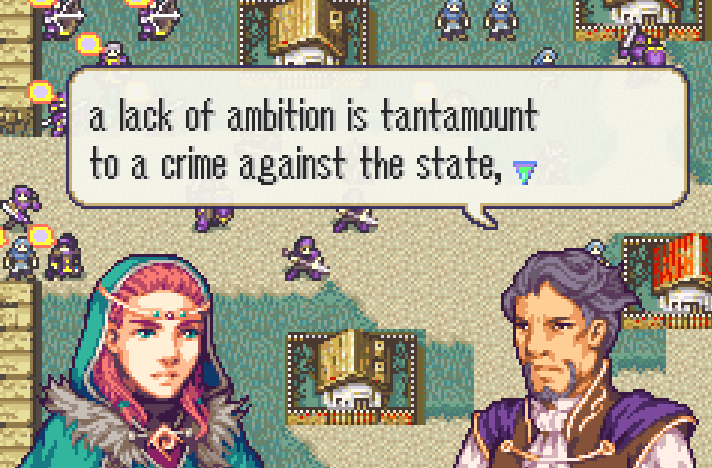
This conversation is the one where I most felt like: yeah, I’m back. Obviously several mugs are placeholders drawn from HC because I don’t want to deal with looking at Sepia Vigarde for half the game again.
So this was very much a month of securing the foundation, meaning there’s a lot to talk about. This time, I was very good about putting down the groundwork before continuing on. In part, this is down to the kind of first (gameplay) chapter I wanted to make. So expect another update where everything kind of interlinks. There’s going to be a lot of spreadsheets and dot-points.
THE OPENING POST
The Gaul, a fool in war, used barbarian tactics. After the first surprise, he was always beaten by the Greeks and Romans.
The Greek, a warrior, but also a politician, had tactics far superior to those of the Gauls and the Asiatics.
The Roman, a politician above all, with whom war was only a means, wanted perfect means. He had no illusions. He took into account human weakness and he discovered the legion.
– Charles-Jean-Jacques-Joseph Ardant du Picq, Battle Studies (1870)
The words you open your thread with are important. I don’t care much for the idea of a cold open into, hey, here’s a download link! Put something in the OP. Build some intrigue.
I won’t pretend I didn’t run into du Picq the same way everyone else did, through him being quoted and linked in ACOUP. But I did go through and read his whole, uh, sequence of notes, posthumously published as ‘Battle Studies’, and the above line immediately stood out to me. While the actual grasp of antiquity history is… loose, of course, certainly when it comes to the Greeks (I’ve read Ditch Guy’s PhD thesis, okay?), it clearly and concisely outlines a line of thinking.
And that’s one that, to anyone who has played DoW (though it’s also thematically relevant to Do5 and HC), should be pretty familiar. The Confederation draws inspiration – pretty clearly, I’d imagine – from the Roman Republic. The events of DoW are pretty much a dramatisation of the Social War (which I find it really funny to tell the couple of people who have accused the plotline of being ‘anachronistic’). And while the Confederation is clearly waning, as per… the events of DoW, and their hubris is leading them to defeat, their thought process is still summarised here.
So this sets the audience’s expectation up before they even boot up the ROM. This is going to be a story of a powerful state pursuing its own interests through warfare. Not a matter of honour or glory, no classes called ‘knight’. These factions are going to be bludgeoning each other into submission for the sake of realpolitik. The central conflict is not going to take a spoiler warning; the Confederation wants Rijesca back, and it’s going to try and seize it by force. Only, this time, you’re on the northern side of that border…
Look, I really just like the quote and need a place to stash it for the next couple years before I shadowdrop this thing.
ON CLASSES
I’ve been working on this framework on and off for months. HC’s class list was very limited, which was great in some ways, but felt a little stifling at times. As ever, mapsprites and animations partially dictated what I could do here.
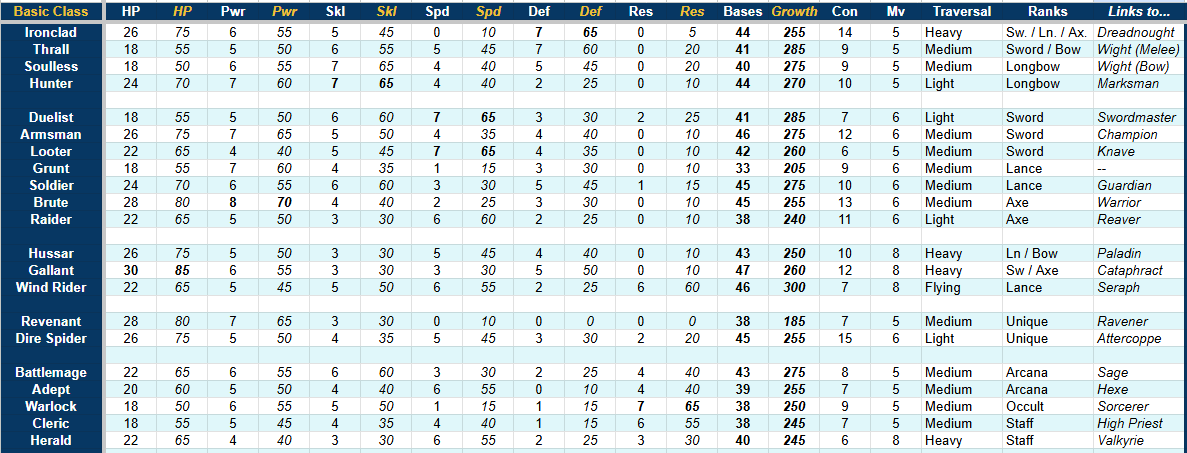
Miscellaneous thoughts:
- Welcome back, sword Mercenary, Soldier and Pirate.
- Ironclads were initially going to be sword/axe, but with the move to retain HC javelins and the addition of the Gallant class, they needed lances to stand out. I did consider lance/axe… but I’d already implemented the sword sprite. Ultimately, given the weapon rework, I think they can make good use out of the full melee suite.
- I considered a lancelocked defensively focused enemy-only T1 armour class, using the animation the armour in Do5 use. Ultimately this was rejected.
- Scouts from HC were going to return, but ultimately got squeezed out. They just didn’t really find a niche in this setup.
- I tried to avoid having any particularly sticky Spd/Def class, which tend to be the most annoying enemies to fight.
- Magic swords pulling from Resistance is going to return, which meant that classes with truly good resistance had to be swordless; mostly, this means Wind Riders. I did throw Duelists a little bone, though, mostly for the sake of enemies.
- I wanted to move from Archer → Sniper into Hunter → Marksman, a little less defence on enemies, but there’s also a separate Elite Archer promoted class (using Sniper animations) which does not get crit, allowing Marksmen… to get crit, and allowing the Hunter promotion to not feel like the ugly duckling on promotion, and allowing for more longbow units in general without reusing mapsprites.
- Grunts were a great success in HC and return. Looters being enemy-only means they can have 5 move for the purposes of pacing, and will just be item pinatas. Also no player Revenants, Dire Spiders, Clerics or Soulless.
- Terrain tiers are more streamlined now, less weirdness like ‘Warriors move a little better in hills and a little worse in forests’ which I’m not convinced anyone remembers anyway.
- Above all, I tried to iron out inconsistencies in base vs. growth stuff. Being fully consistent will drive you insane, especially when promoted stats are just unpromoted + promo gains, but… it’s close enough to keep me sane.
- Defenses are generally pretty high to give an even feeling, like having FE12 statspreads where armour have better speed than defence is just weird to me. But this is counteracted by largely high damage on weapons.
- I want stickier enemies than HC had, but with one-shotting still being viable. We’ll only see through gameplay if the balance is right, but early signs are good.
- DoR is going all in on LeoLink animations this time for whatever reason.
I’ll probably talk about this more later, but there’s a lot to get through today.
WEAPONS
This one took a lot of thought, and a lot of scribbling mad notes on paper until I finally found a system that worked for me. As ever, a really useful exercise remains kicking out what you envision as a core pillar. In this case, after a lot of flow-charts, the pillar was ‘an iron sword and an iron axe should have different stats’. With HC’s stronger weapon triangle making a comeback, you’ll still have big swings in practice, and with a larger focus on unique weaponry, I feel as though the different weapon types will feel more different than ever.
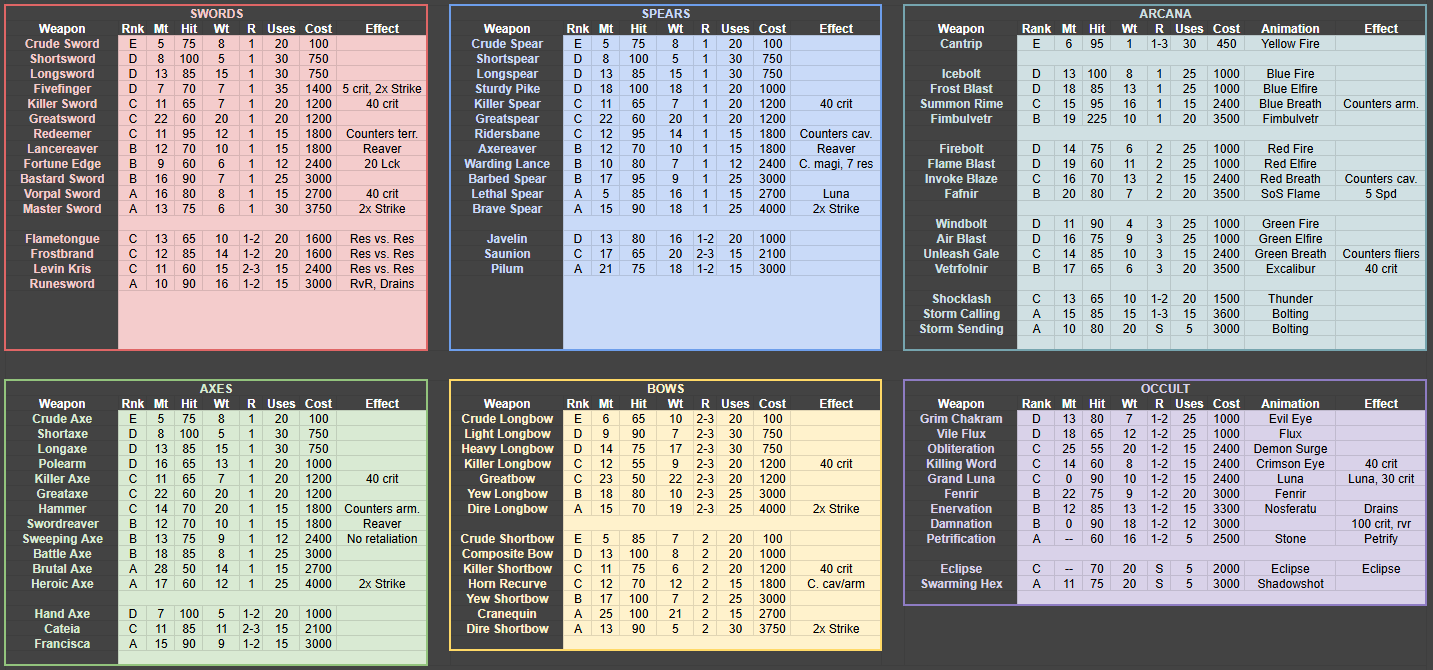
Putting together a coherent set of weapons and stats that didn’t have internal consistency motivated me to write down my internal logic as I went, so here are my stream-of-consciousness notes.
- in the money game, your E-weapons are terrible, but really cheap. a significant bonus for arcana is having a pretty okay E-weapon that they can use very well even if it lacks punch
- if you want consistency between figures, The Issue is that you’re never quite going to find consistency. +3 weight on slims doesn’t matter. +1 might on effectives becomes disproportionate. You can either live with this and the consequences (me previously, particularly in Do5), fudge the numbers (vanilla), or sweep the board.
- weapons as basically colours from MTG. every colour can sort of do everything, but not always as well or using the same keywords
- swords in part get rogue’s edge because swordmasters get avoid and they can lean into that some more
- minor D cycle: a slightly more expensive low-grade weapon that’s still leaning into what the weapon type’s good at. fivefinger can quad and fish for crits, pike hits hard but at destructive weight, cleaver has shaky hit and… i’m buffing it slightly to 16 might and 13 weight
- minor B cycles: edge, warding, sweeping all about damage mitigation. swords avoid, warding just blocks damage, axes simply skip it
- minor A cycle: maximising killing power in the most on-brand way possible. crits for swords, big might for axes, and what’s more reliable for spears than ignoring defence?
- each weapon gets an A weapon that leans into their strengths, as well as a brave weapon that riffs on their usual strength and takes it to extremes (so the sword can quad, the axe has immense damage potential, and the lance is reliable).
- ultimately looking at it they all needed a generically good silver equivalent, but these do deviate slightly. bastard/barbed/battle all linked by ‘b’, except that yew bows break that.
- ‘shortspear’ looks a lot better than ‘shortlance’
- ranged weapons all offer something the melee weapons don’t; pure power for lances, accuracy for axes (i mean, look at the respective animations), res hitting for swords.
- shortbows hit a little softer than longbows but have much better hit and weight. again, longbow archers probably only fish into shortbows when they have to, and there are no shortbow-only classes. but the options to punch up into cranequin (their A-weapon in the vorpal/lethal/brutal cycle) gives shortbow-users some texture
- more hit on shortbows is redundant, so they just pick up the bow D-weapon. again, it makes sense to me.
- horn recurve: worst of both worlds as far as ridersbane might and hammer hit goes, and can’t counter fliers. but they’re more versatile as a whole, obviously
- knocking composite bow down to 100 hit because 100 being the highest hit is pleasing to me.
- the class fantasy of arcana users is that they have all the answers… but you’re only equipping 4-5 of them at a time. an arcana guy with free supply would be cracked and involve a lot of micromanagement. And they do have a relationship of Ice getting more damage and worse weight, Fire getting better damage and worse hit, and Wind getting better weight and worse damage; it’s fine here that that creates better and worse relationships, because they’re still split by range. Ice gets the numbers fudged in its favour because… melee.
- dark was originally a bit more tiered but got chopped back down over time, though I’ve left the spaces clear in case I go back on that. again, a focus on weird esoteric shit in general and anti-magic in particular
- light isn’t a core type, but there also won’t be the mage Prfs of HC (though a couple of those Prfs are set to come back as one-offs)
- lumi would not forgive me if i removed the runesword
- Not included here: S-ranks are not going to be a clear set of 7-8. The idea will be more legendary weapons rather than boosting a particular set with similar bonuses (currently you pick up Kreshnikeve, Agovanje and maybe Lacplesis, but probably not the rest of the originals; Judita in particular would kind of be redundant, but tentatively you pick up Joyeuse)
- Happily, I’ve managed to put this all in order, avoiding the scuffed convoy ordering of prior campaigns and, indeed, vanilla
INTRODUCING [TACT] LINDAUER
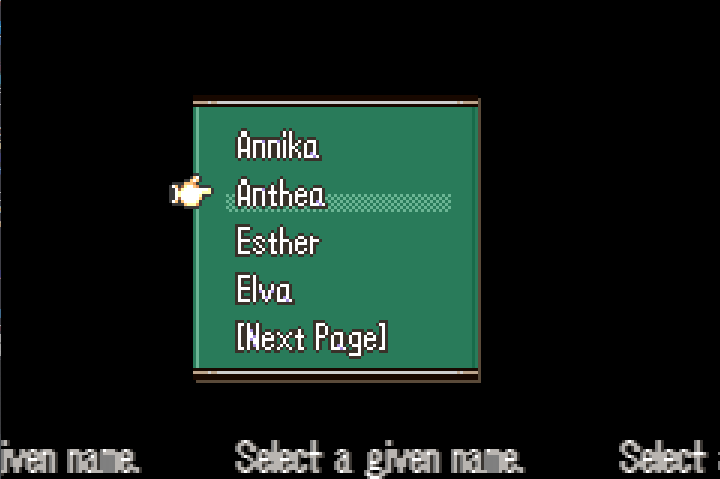
Last post, I said what I would do. Now I’ve started to actually implement. And things basically work as I’d hoped! I’ve mentioned the broad strokes already. You get a choice of twelve names and zero choice of one surname / face / class, and the person Lindauer is is largely set in stone. She’s always intelligent, articulate, measured… with an arrogant streak and an uptight manner. She will always be the woman plucked from obscurity to learn in Covenant, and that will always teach her the same set of lessons, shape her into broadly the same person. This is the person written of in the Stars. It’s just those moments that could have gone either way that it comes down to. Lindauer is always Lindauer… but Elva can be your Elva.
That aside: my favourite genre of RPG protagonist is the kind of person who is not a big power, but holds just enough to stand above the people she generally talks to. Great examples include:
- The Imperial Agent from vanilla SWTOR. You’re a cog in the secret police in a fascist state, and most questgivers you talk to are acutely aware you could have them disappeared at any moment… but you’re still beholden to Sith at any moment, and have to dance on eggshells and work around their whims.
- MMO stories are denigrated for good reason but a free trial of SWTOR genuinely gives you seven RPGs ranging from solid enough to genuinely strong, and Jedi Knight is also a class you can play.
- The Shaper from Geneforge. You wash up in an island backwater, where you’re regarded with reverence / fear / hate, in large part because you’re assumed to be extremely powerful… when in reality, you’re a shipwrecked apprentice who never received their training, and have to build up your power so you aren’t swallowed whole.
- And (sigh) the Fatebinder from (sigh.) Tyranny, a game that fails on all merits beyond ‘having really interesting ideas’. You theoretically hold supreme authority, but the Big Lads of the realm know the law is a farce and are not intimidated. Your superpower is also to gradually learn the law is a farce and to bludgeon people into submission by interpreting it as conveniently for yourself as you can, until you have the power to murder and subjugate your enemies.
- This isn’t even the first time I’ve taken inspiration from Tyranny, whose shitbag rebels who only wanted to overthrow the state to re-establish the old status quo were a direct inspiration for the Exiles.
- (Guess who make their inglorious return 23 years later?)
- This isn’t even the first time I’ve taken inspiration from Tyranny, whose shitbag rebels who only wanted to overthrow the state to re-establish the old status quo were a direct inspiration for the Exiles.
So as part of a general philosophy of leaving it all on the table in my final custom campaign as lead designer, this is the sort of figure Lindauer is. Initially merely Acting Magistrate, she holds a huge amount of power and authority in theory, but enforcing it is a different prospect. Her powerful and influential patron is dead, her retinue consists of one guy and some hangers-on, everyone is looking to her to resolve the turmoil… and she has an election to win!

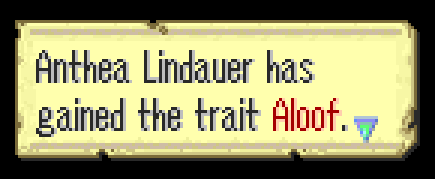
You get a set of three branching choices establishing significant flashpoints during her education. These activate global flags. I haven’t decided what those global flags do yet, but it’s not going to be ‘change your starting stats / gear / party’.
Now, there is one time where technology has let me down… but that’s probably going to save me effort in the long run, and we might have had a moment where necessity is the mother of invention. See, the special route menu thing (which I use for name selection above) has to be reinserted every time you fuck around with it. Okay, so I could presumably use text switching to lead to a different outcome… but that would also need constant reinsertion. Either way, the dialogue trees I’d envisioned just aren’t practical.
That’s fine.
Did any of you play the The Bard’s Tale reboot for the PS2, inexplicably starring Cary Elwes? I don’t know if that game’s actually any good – I suspect not – but it does stick with me for one reason or another. It’s referenced precisely once in DoW or Do5 in an R-text somewhere, I don’t even remember which. And it came to mind for one particular reason. See, as part of the streamlining into an ARPG, you didn’t get dialogue trees either… just, sometimes the game would prompt you to be either Nice or Snarky (it was 2003.), and Cary Elwes would raspily take it from there.
Introducing the Iron Fist // Velvet Glove system.
Lindauer is a theoretically powerful woman. She wields the Senate’s authority, she speaks with the Senate’s voice, she is First Among Equals in most interactions with her fellow citizens. Among her powers is… discretion. Sometimes, actually, it is best not to act as the distant unfeeling face of the Confederation.
Well, let’s see how simply allowing your minion to introduce you and giving these vigilantes a paper chit works out.
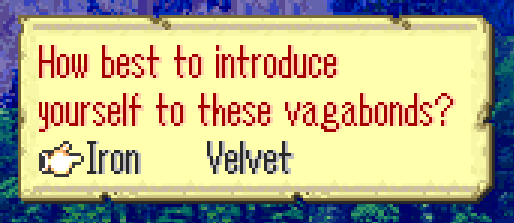
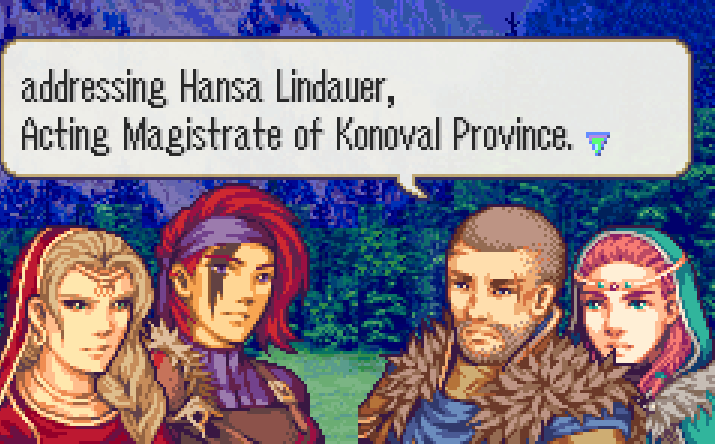
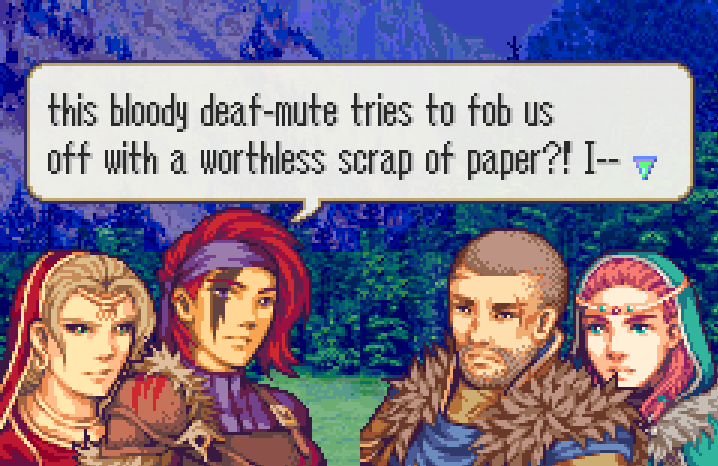
Okay, so Ulrike doesn’t take kindly to the high-handed approach, but she’s stuck with you all the same. There’s no mechanical difference here… though she might bring it up flintily down the line. Other times, though, bulldozing someone by wielding your rank as a sledgehammer is going to be more productive than trying to reason with them. Some people aren’t worth compromising with. Some people need you to pick your battles; it’s probably not going to be productive to tell the Exiles their Gods are fake and their ways of life are backward and savage, not when you’re looking to recruit their cavalry for the Cause (and their knowledge of mountain passes), but you do need to hold firm when they question your authority. And I’ve just now realised I forgot to extend Asger’s portrait…
Obviously the ultimate form of this is going to be The Ransom System. Execute or press-gang the deserter? And so on. Unlike DoW, this system does not come at you from the word ‘go’. Instead, it’s a slightly slower buildup before taking over as a core mechanic in the early midgame, or maybe a little earlier. Right now, it’s looking like Chapter 7. In the current blueprint, you get all your tier 1 units and a couple of others, before leaving your power base, entering Rijesca and having to live off the land, where almost all of your money will come from the meat market and pretty much all your recruits, too.
CHAPTER 1: The second chapter in the ROM
So C1 is playable from tip to tail. Let’s talk about that.
DoR, as you’ve seen, has a pretty heavily overhauled weapon system. There’s some things to get used to, and throwing the player directly into the deep end wouldn’t be fully appropriate. At the same time, it’s a custom campaign. You’re supposed to have played vanilla GBAFE already. And DoW, and statistically if you’ve played DoW you’ve probably played Do5. Hey, if you haven’t played Do5, go play Do5. If you haven’t played DoW, go play DoW. Either way, play HC.
Cerulean Crescent opens with a neat little tutorial these days showing your starting forces doing what they’re supposed to be doing, which is cute, but I don’t need to go to those extremes for these kinds of statblocks. I was inspired by Absolution, which has a first chapter where you’re basically guided into 100% reliable matchups and failing to hit them was 100% going to fuck you up. But… you have four guys, funnelled into a split of two guys per flank in a pretty short map. Finding the ‘correct’ solution is not exactly arduous.
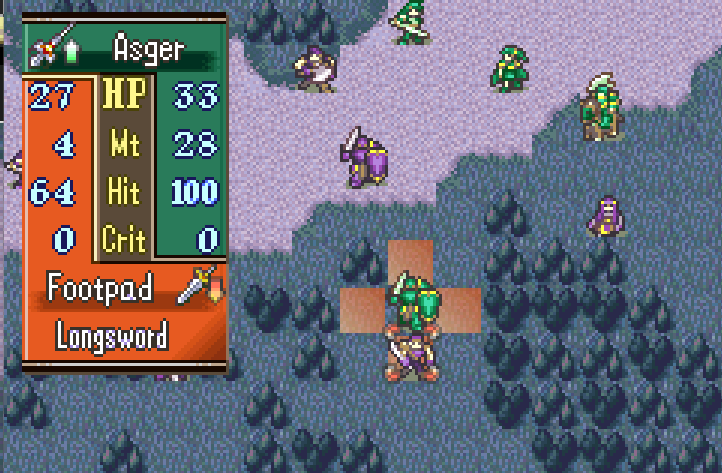
Wow it’s just like I deliberately made this matchup happen woooow
So I wanted a Chapter 1 that was sort of like that. Four guys against four guys in a fairly tidy matchup, setting up for an enemy phase where an enemy archer bounces off your ironclad and a myrmidon dies. Turn 2 is also pretty tight, and then on Turn 3, another squad of six guys rocks up, each with A Guy To Kill of their own. Then you converge and roll through the rest of the map. So, some amount of variables (through ‘the rest of the map’), but at the same time there’s also other, less optimal ways to force through a victory, and your guys aren’t about to be one-rounded for the most part, so you can weather a misplay. I wanted to make sure a loss of tempo wasn’t fatal, which was an issue with the DoW prologue.
It also sends a particular message. Hey, you can get one-rounds using your decent weapons. If you try and beat this map cheaping out with Crude weapons, you’ll eat shit and die! Use your tools!
Chapter 2, then, will take off the handrails and just let you push on (like C1 in DoW or HC), assuming you have a handle on things. You know Ulrike hard-counters enemy mages; you know Triss dices up low-defence units on player phase; you know you have a dog. We’ll know more about it all plays when I, uh… get there.
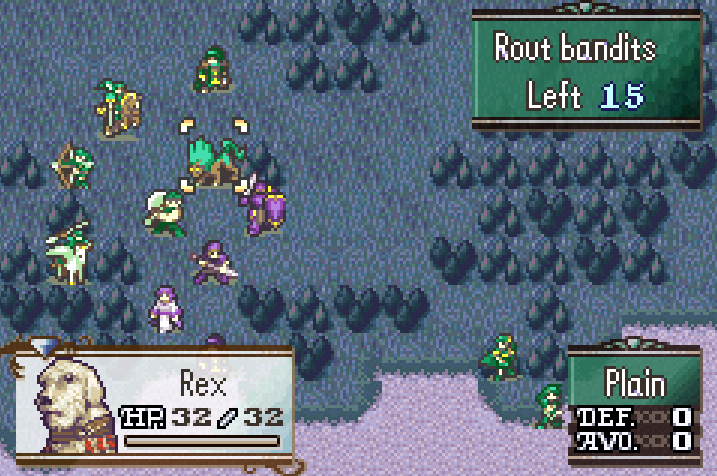
Really, I knew what snippet would create the most hype.
Next time: The Cast, Probably???