APRIL 2026 – Step Back, Move Forward
Overall Progress Checklist
- Chapters 6, 7, 8 played through to completion
- Chapter 9 should be ready to playtest on the weekend
- Wrote a lot more, including scenes up to 14x (though not nearly everything in between)
- First wave of battle palettes added
- Settled on Will magic mechanic implementation
With the foundations increasingly set, this is going to look more and more like ‘this chapter is done’ without many trimmings. Slightly early post this month because I’m going to be very busy over the next couple of days.
Reverse Ferret (Which Is Not Quite A Rodent)
Sometimes in life you encounter setbacks. Maybe it turns out that the 2011 version of Do5 Chapter 3 sucks too much ass fundamentally to be saved by making one-tile hallways into two-tiles. Maybe a conversation gets eaten because you’re writing it in-engine and you make the mistake of using Portrait 100 for anything, which has the unique effect of eating the entire conversation the moment you hit ‘Write to ROM’. Maybe your new computer really likes to crash Builder, which invariably freezes the rest of the computer and forces a hard shutdown in a way that cannot be healthy long-term and you can’t buy a new computer because that’s still really wasteful and, besides, the AI bubble has driven up costs to a ludicrous degree. Maybe you’re about to name two units who are associated with each other and in this order ‘Grond’ and ‘Prii’ and you’re happy with those names because one’s a Tolkien reference and the other, well, it just feels right for a harpy’s name, and then you accidentally say it aloud once and realise it just sounds like you’re trying to make a pun on ‘grand prix’ for some fucking reason when your only interaction with F1 is the Netflix series.
Okay, so, anyway. The whole Time Unit system is dead on arrival. Rest in peace. Here’s the thing: ultimately, the people who don’t care can still skip. If you’re going to read 0-1, it doesn’t matter if that’s out of three, five or ten. The intent had been to cut down on peoples’ burnout and improve pacing. I think it was a noble idea, but it doesn’t work for this particular medium and in this particular way for a couple reasons.
The thing is that there are different kinds of readers. Personally – as can probably be seen from my style of writing – I value verisimilitude, but not worldbuilding for its own sake. I don’t care if there’s a fully laid-out system for how food gets from farm to table, rooted in real-world economic structures of an analogous time period and culture. I view it all as being in service of the narrative, and just want to make sure the cracks aren’t visible. In my own work, sometimes I will go the extra length to establish systems that I have a grounding in and care about, but not the ones I don’t.
But some people really like worldbuilding, and view the production and presentation of a fully realised world as the point of speculative fiction. We pretty much got Lord of the Rings out of that philosophy, so I can’t exactly knock it. Sometimes these people ask me a question about the setting and the honest answer is ‘I don’t really know or care’, but it’s out of love.
So where does worldbuilding in an FE go? Supports, mostly. Real estate is crowded for scenes. My usual is a journal and then between 2-4 scenes before and 2-3 scenes after a map; usually at its most basic, something along the lines of:
- Journal: “We arrived at this place. Morale is low. We have this objective. I’m concerned about the revelation of last chapter”
- Scene 1-1: Arrival at such-and-such. Conversation about the surroundings foreshadowing [chapter gimmick]. Oh, no, our scouts have encountered the enemy!
- Scene 1-2: Conversation between enemy bosses expressing Thoughts about The Situation and, oh no, the player is attacking! To arms! Obviously the enemies feel they will win easily
- Scene 1-3: Erase background, fade from black, scan the field; mid-bosses and recruitable units say their lines
- (The battle itself plays out)
- Scene 2-1: Asger/Anghara/Garath/Roxelana says ‘boss I killed everyone’ and Lindauer/Bronwyn/Rena/still Roxelana says “I am a tactical genius.”
- Scene 2-2: Ransom opportunity as one of the captured bosses admits he would happily fight for the Cause given a chance
- Scene 2-3: Musing over the immediate implications of their victory and fretting over the greater situation
This is all assuming a relatively filler chapter, and where there’s room to develop further, characterisation and personal dynamics tend to take priority and be easiest to weave in anyway. What there’s not is a lot of time to say, ‘Hey, these are the intricate windmills that have given such and such a nation an industrial advantage’ etc. etc. etc. So worldbuilding gets shipped to supports and characters tend to represent some greater social group and supports tend to explore how they interact with the world. Examples from Do5: if you want to know the deal with Onduris on A-route you will find it out through Blixa’s supports; Wren talks about what life is like for Yscatra’s followers there; you can extrapolate Bellona’s lines to the circumstances of most Visharan knights-errant and Lizaveta’s to most Visharan nobles.
And, of course, I’m not planning to have supports. I’m planning to have towns and camps.
One of the troubles with the Time Unit system is it’s unpredictable which guys will drop which lore. I found myself increasingly thinking that there were character beats and interactions I wanted to be seen by most players, and they weren’t always predictable. Hell, I didn’t know Lindauer would pointedly not say something important about her hopes and dreams to the fucking harpy until it was already written. So I wanted to feel free to say more important things, though obviously nothing completely crucial. And I can now portray a more full picture of the world through characters’ circumstances, in a campaign where I’m trying to push even more the idea of these characters as microcosms of a greater societal group. And, ultimately, it just felt like an inconvenience to the people who wanted to engage with the world and the characters most, instead of a particularly interesting choice.
It still means that I’m going to ignore anyone who says there’s too many scenes but refuses to skip any of them, though.
Processing Disorder
The thing with The Hackrom is it’s always very uneven. Right now, what’s leapt ahead of everything else is progress on the script… in parts. I follow what’s inspiring me for the day to keep myself fresh. At time of writing (a fortnight before posting…) Chapters 1-6 are playable, but not fully polished. C7 is pretty close, C9 is pretty close, C8 is… a page of notes in my notebook, largely sketched out in a few minutes before trivia. Some stuff is missing. You get the picture.
Anyway, I’ll give an idea through what I did today, on the 7th (happy 17776 Day). Without ever really knuckling down to work on the hack, I…
- Put down a bunch of enemies on C7 – not quite all of them, because I got sidetracked when I…
- Saw that they were a new faction, which reminded me to make the faction palettes for them, also…
- Remembered that not all bosses to that point had correctly assigned music and I’d been meaning to fix that, so I went ahead and fixed that for pretty much every boss up to that point, then…
- Wrote most of C10 from scratch, which reminded me to…
- Fetch the name for a track in use, which meant looking up a playlist on OST, which meant I may as well fetch the names for every other track from that same game, also…
- Being struck with inspiration for how a later thing should play out and writing it down so hopefully I remember it in ten chapters, and…
- I’m probably forgetting some other shit.
The next day (that’s today, I’m adding to this) I started poking at C12. So I haven’t played C7, have not meaningfully touched C8, have set up a ton of complex events in C9, have almost written C10 (but nothing else), haven’t touched C11 outside of spawning three temporary units, but right now it just made sense to poke at C12. Including setting up more generic unit IDs, which means more palettes…
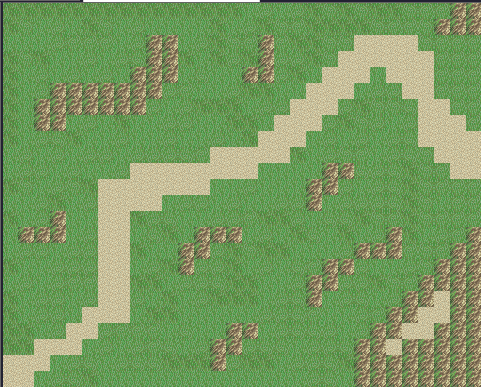
And when I do play C9, this is what it will look like.
It’s a chaotic process, is what I’m saying. I can focus on hammering out one chapter a time if that’s where my mind settles, but at this early stage where there’s just so much that needs work on… easiest to just let the hours flow as they’re productive. Hey, now I’m sitting down here on the 12th having done things like battle palettes (generic and otherwise) and gradually working on a final deep dive to fill out the music list, and C8’s still barely begun. Now I’m adding to this paragraph the following day and I wrote some of C14’s end scene last night.
You take my point.
Fight Smarter, Not Harder
With one mechanic already on the scrap-heap, it’s nice that another piece of the puzzle is moving into place. While this isn’t a mechanic per se, it’s an important part of what I’m looking for with map design. You spend much of the campaign fighting against seasoned soldiers, not just thugs, cultists, unwashed rabble or crack teams of assassins (twelve Level 7 steel lance soldiers at a time). Even the ‘bandit arc’ – we know that you don’t have to start with bandits, but it is convenient to find an excuse to beat down underlevelled trash and reserve the Big Enemy Army until your forces are more powerful in turn – is largely comprised of deserters. I’d like maps to feel a little more reactive, and enemies a little more clever.
Of course, some of you probably read ‘smarter’ in relation to ‘enemies’ and your pattern-recognition brains forced the subservient fleshbag it’s attached to to projectile vomit on your keyboard immediately. Of course, we’ve all tried to play FE4 with ‘clever’ enemies and watched them simply run past your Holsety user. But to my mind, ‘clever’ isn’t a matter of seeing 0% hit on a battle forecast and deciding to simply run past a guy. Rather, it’s a matter of tactics and positioning; that’s how it can be communicated within FE, anyway.
So it’s a matter of small things, conveyed through events, formations and AI settings. The real stupid thing, in my view, is when a guy on a throne just sort of sits and waits for death and all his stationary AI minions just let it happen. So I’m trying to give missions unique flavour in ways that express a plan, through, for instance;
- Frequently, reaching the boss room or final area will trigger every other enemy on the map to charge, just in case they’ve been left behind.
- Enemies on different flanks often have ‘Squad AI’ on the later stages of maps, to try and lead into a pincer attack.
- In Chapter 3, your defensive position starts the map, uh, ‘on fire’. Human enemies stand back while summoned zombies are left to suicidally charge you and try and keep you pinned down.
- In Chapter 7, the boss on a Seize map is an archer; if he leaves the gate, a stationary armoured midboss hustles up to cover the position.
- Chapter Eight.
- In Chapter 12, you need one door key, there are two bosses carrying them in the NW and NE corners, and when one goes down, the other will charge and force the issue.
Et cetera, et cetera. It’s just small things that are meant to add up to the sense that the enemy is not just waiting for death, but is trying to kill you, and, ideally, survive. It can’t be a truly reactive experience – and it shouldn’t be, that way lies FETO / FEH PvP – but adding a little push and pull to the later turns of the map to sustain interest is a consistent design goal.
On the other end of things, Lindauer also gets the chance to feel clever mechanically, not just like she’s smashing head-first through obstacles with brute force. After all, it’s the enemy that should have the brute force! So Chapter 4 sees you ambush an enemy column and sandwich them between your men and a Guard battle-line; 10 has you attack a lance of wind-riders in the rain, where their mobility is crippled; in 11, you requisition some ballisticians to shoot down enemy messengers as they try and make a break for it. I’ve always felt better about writing a chapter when there’s a real rationale for the chapter to play out as it does, and it can help add sauce to even something that becomes a straightforward, stock objective map (C15 in HC springs to mind).
The added spice also helps, given that DoR is aiming for a similar level of gimmickiness in most chapters to DoW. It’s not quite the same vibe, but after the two introductory chapters, there’s always meant to be some kind of hook to help it stand out. Break out of the fortress that’s on fire. Ambush the enemy column with your pick of 24 slots to place units. Race your powerful allies to the boss. Break statues. Of course, I do think sometimes you need The Big Seize Map every now and again, or a relatively straightforward outdoor slugfest, almost to contextualise everything else. Nevertheless, I’m pleased with how distinct the first twelve (of 28-30) chapters all feel.
Next Steps
So with Act 1 in the rear-view mirror and Act 2 careening towards the finish-line, it’s time to start thinking in earnest about Act 3. The way the process goes, I have the chapters I know I need to include, and now it’s about shuffling them around and figuring out what goes between them. I also need to develop personal dynamics in time for the Big Payoff to come… and I suspect that means I’m going to need to add a couple more chapters to Act 3 and subtract a couple from the final stretch. We’ll see. But I have a solid foundation to work from and, though I hoped to make four chapters this month (and probably could have, but burned out over the past couple of days), we’re making very good time. If I can sustain two chapters a month I’ll have everything done by March; realistically assume I can’t quite manage that, call it May; give five months to polish and that’s another FEE3 release on time.