MARCH 2026 – CALL ME GOD OF CROCODILES BECAUSE WE ARE SO BEK
If I was making this a Homecoming retrospective, I could headline it ‘March of the Black Queen’.
Overall Progress Checklist
- Chapters 3, 4, 5 played through to completion
- Chapter 6 ready for playtesting, theoretically ‘complete’
- Vast majority of Act 1 writing complete, some in Act 2
- Some rebalancing of equipment and class stats
- Stat R-descs, shop chatter, various other minor details complete
- Spelling of ‘armoury’ corrected in all menus
With that thought out of the way, you can probably infer this was a good month for The ROM. It’s better than you think, because I’ve started writing this on the 5th. What made the difference is simple: we hit The Moment, the one I was looking for in February’s updated that I was sure would come.
See, in February, it hadn’t really clicked yet, and the ROM was also acting weird… well, there wasn’t none of that this time, either. Did you know, if you try and force more than 50 traps into a map, it puts garbage data in your save’s convoy? But necessity breeds invention, and actually, I was forced to find a more graceful implementation for my map gimmick, one that actually works a lot better anyway.
That gimmick belonged to Chapter 3, and completing that today (at time of writing: again, the 5th) is when things really started to click for me. Sure, I had to redo the first turn because I forgot to clear the cutscene enemies outside (which included siege); sure, I had to fling overloaded enemies to the far reaches of the map; sure, I played the whole time with the enemy in white because I forgot to turn off a flag; sure, I needed to manually increase a generic enemy’s stats so he could use his siege tome, which I ultimately took off him anyway. That one scuffed run really clicked. I’m not going to pretend it was the peak of gaming or whatever, but the numbers felt right. The interactions worked nicely. The gimmick was fun, as soon as I made it start a turn later.
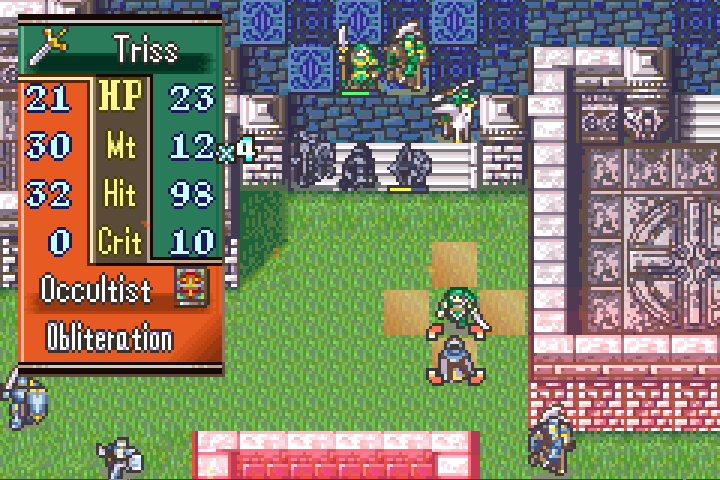
This is how every myrmidon vs. shaman interaction should go. Don’t worry, HC Hit Thresholds are returning, I just haven’t had Lumi implement them yet. Also FUCK I need to change one of these mapsprites. I’ll let you decide which I mean!
Even now, looking at it and thinking of it, I want to keep playing. Which means we’re officially past the ‘pulling teeth’ part of the process. Act 1’s writing is close to the finish line at time of writing (and will be closer still at time of posting), and overall there’s just far more of a sense of things taking shape. And I like the shape it’s taking!
Shifting Hollace
There’s been further changes in the Fiddling With Things category.
I’m finding myself gradually nerfing lethality and buffing durability. I still want one-shots to be plausible, but I found myself thinking in testing that failing to ORKO was disappointing… which is not what I’m looking for. Getting back the 2RKO Standard was a key objective and so far not really one that’s materialised.
I’m also returning to Infantry Swap. That hadn’t originally been the plan. In DoR, you’re stuck with a convoy unit, and the idea was that your extra mobility was just, your one Reposition from that convoy unit. But I’m hoping that Repo+Canto still makes that useful, while ensuring that a unit that can’t attack anything or get into defensive posture for EP can still contribute outside of item trades.
Between all these shifts, I think it’s going to necessitate another redesign of the prologue. Less tight and telegraphed by necessity, because the numbers just aren’t where they need to be for that anymore. That is, without finagling enemy stats in the prologue to be appropriately oneshottable… which I don’t want to do! Realistically, you’re going to look to a new enemy class whenever it first pops up and then imagine that those stats are going to be built on going forward, leaving aside how artificial it would feel to have Mysteriously Fragile / Slow Enemy Unit turning up at convenient places. But I’m really tired of toying with and poking at Chapter 1, so that’s a Later Problem.
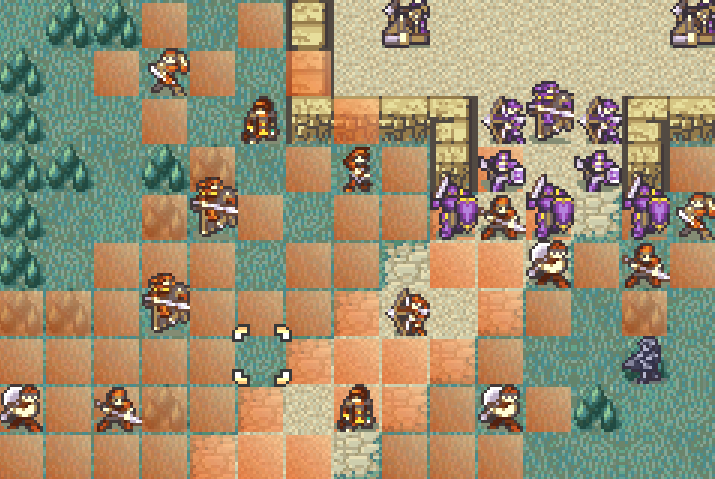
Perfectly ordinary attack forecasts. Not even a little cursed.
How are you playtesting this, Parrhesia? I am so glad you asked. Just sort of gunning through. Same lightly scuffed save file has zoomed its way through Act 1. It’s not exactly future-proofed, given that there’s a few minor unimportant things like, for instance, ‘the experience formula’ aren’t yet implemented. Whatever. What’s most important for now is checking that the chapters function properly and that they’re 80, 90% where they need to be. Besides, what good would it have done to have polished Chapter 2 to a razor sheen when I then decided two maps later that every class needs +2 HP? What about when such and such a unit winds up needing a buff down the track? It’s an art, at this point, not a science.
Please, call me [Tact]. Frau Lindauer was my mother
So now that we’ve hammered down our main character’s design (see Lumi’s post above), we’re starting to really pin down what our main character, like… is.
This is not going to surprise anyone, but the protagonist’s personality is a real driver of the feeling of each campaign, and I don’t think I’m flattering myself to suggest that the three so far have been very different personalities.
- Roxelana’s sins were sloth and arrogance, which combined to get her in over her head more than once. But she was a stalwart soldier who felt a real duty to her men and did right by them as best she could, an intelligent woman who had put it all together in her head and was in the right place at the right time to act. The worst thing she ever did was – mitigated by circumstance – try to attack and kill an innocent.
- Though starting in a similar position on paper, Rena is far younger (21 instead of 33), and far more of a ruthless schemer. She was capable of far greater deceit than Roxelana – honest to a fault, and to her cost – could ever manage, and her worst act was to perpetuate a lie (though this unravelled her in time). She was able to see the big picture more.
- Bronwyn was trusting, to a fault. Being sheltered from the world meant she was able to see the world in shades of grey rather than giving into nationalism (and becoming anyone’s pawn), but she also put faith in people who didn’t deserve it, to her repeated cost. But trust is itself a good thing, and her open nature was also what allowed her to break the cycle and triumph.
I could go on, and I’m tempted to, but you take my point. They were tailored to drive the story I wanted to tell in each case (and the way they developed influenced changes made later in each story, as I got a better sense of who they were). Lindauer’s destination has always been known; key points have always been known. But now I’m getting a stronger sense for who she is.
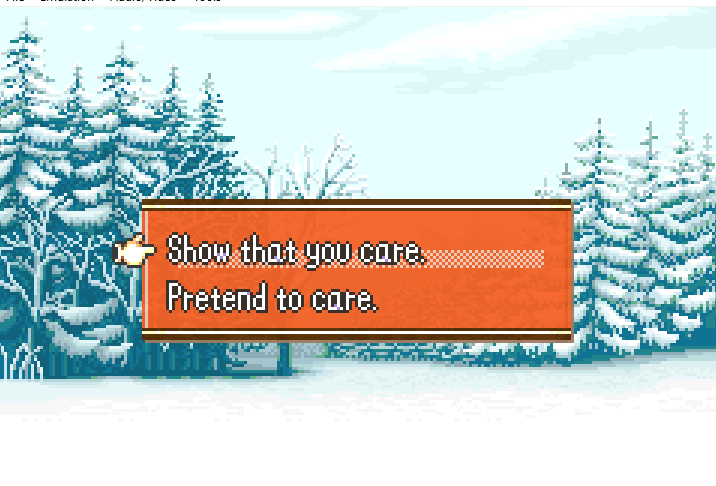
I actually debated whether or not this was TOO unkind an option to give Lindauer (the context isn’t particularly flattering), but then decided it was funny. We’re still largely keeping to Iron/Velvet, but incorporating a little more flexibility in meaningful moments (and this moment which doesn’t actually change anything).
It’s a curious situation for Lindauer specifically because the ideas for What Would Happen In The Sequel, initially, didn’t really revolve around her. The story hook from my perspective is that I wanted to push the setting to breaking point, after the barely stable position attained post-DoW. In particular, DoR, thematically, seems mostly interested in an exploration of power; what people will do to attain it, what people do with it once it’s there, how they hand it off. So Lindauer becoming an increasingly cold-blooded careerist makes sense to help her fit in. She seeks power and does what she needs to do to attain it within the confines of the Confederation, achieving remarkable social mobility by hook or by crook. She is an outsider within that society, and for all its pretense of egalitarianism is seen as just some hayseed from the sticks, promoted to a station she hasn’t earned as one of the favourites of her now-dead mentor. And she needs to get her foot in the door.
At the same time… she does need a heart. There’s a place for villainous protagonists, but I do tend to keep a relatively optimistic tone in endings, at least, and would like to see the world in a better position for having had 28-30 chapters of Lindauer rampaging across it. So her position lends itself to a journey of: well, she knows she wants power, but she gets an increasingly sophisticated understanding of how she wants to use it, such that by the time she’s ready to make a decisive impact it’s with a view to creating a better world. And she will. Might not stop any apocalypses or kill any demons or be any closer to finding the ‘Fire Emblem’ of the setting (which is probably somewhere north of Xuanhe, not in this backwater), but she’ll make a difference to enough people.
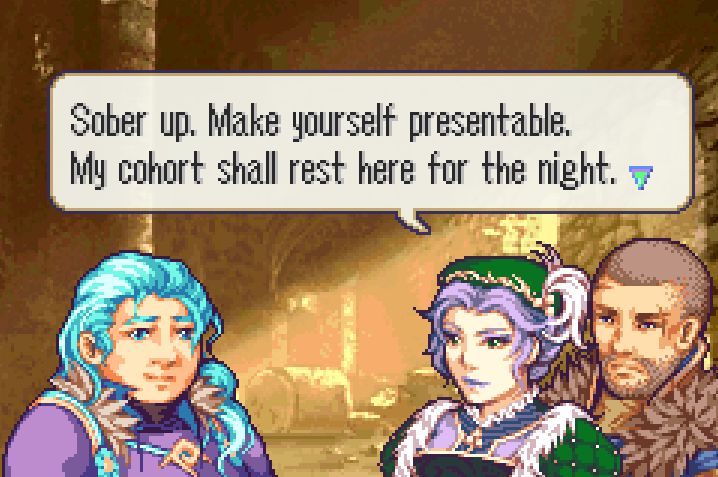
You always have to have a rationale for a Jagen’s stats, I feel. Old? Coasting and washed-up? Well-trained but inexperienced? But I haven’t really explored ‘high-functioning alcoholic’, yet.
So that’s the aim, but we’ll see how it shakes out. I don’t really buy into the whole idea that ‘oh the characters tell me what to do!!’, like, these things are all in service of the story, but sometimes you do find something developing organically and then decide to let it come to the foreground. Sometimes it’s something small (Roxelana taking and sustaining an immediate dislike to Saszkia, Rena’s fastidiousness, Bronwyn being pedantic and this being a hereditary trait), sometimes… less so. We’ll see what comes out of Lindauer with further prodding and testing.
Name? Job? Bye.
Providing another avenue for her development is one of DoR’s Big Things, the interlude chapters. Not that they’re by any means unique; in fact it feels like most custom campaigns have some sort of base mechanic (like Hag’s) or interludes (like CotA’s), and all of DoW, Do5 and HC have had at least one. Battle Preparations is vanilla FE7, for Christ’s sake.
I went through a few ideas for what I wanted with DoR. Initially, I really wanted base conversations. Works for Tellius! And supposedly there is a menu implementation, though it’s a lot more finicky to work with Builder. I started planning things out, and then came to the realisation that they didn’t really suit my purposes. Two main reasons for this:
- Timing. Tellius base happens, then preps. So you can have scenes in a point of safety, then those optional talks, then you’re on the battlefield and setting up the chapter. In GBAFE, there’s not that extra stage.
- Pacing. You’re probably just reading all the base conversations you can. That’s a massive increase in the amount of Words to take in before gameplay, and by definition these ones aren’t wholly necessary for driving anything forward… but people are probably still going through them anyway. Is it ultimately just self-indulgent?
So I discarded this idea, with the added advantage that I didn’t have to figure it out (by asking Lumi to figure it out). I liked Hag’s implementation of bases, for Hag, but it didn’t quite work for what I wanted to see (besides, Hag Bases™ are a specific enough concept that… they’re really just Hag Bases™ at this point).
Ultimately I came back to interludes, but ~with a twist~. Of course, a classic custom campaign interlude gives you a selection of units and lets you conscript one or two (as seen in Do5 and HC), but that mechanic would distract from the ransom system for the most part, which is already your main vehicle of player expression through roster-building. So that’s not here. What is here is the opportunity to check in with your crew, see how they’re reacting to the current situation, maybe advance a few personal dynamics.
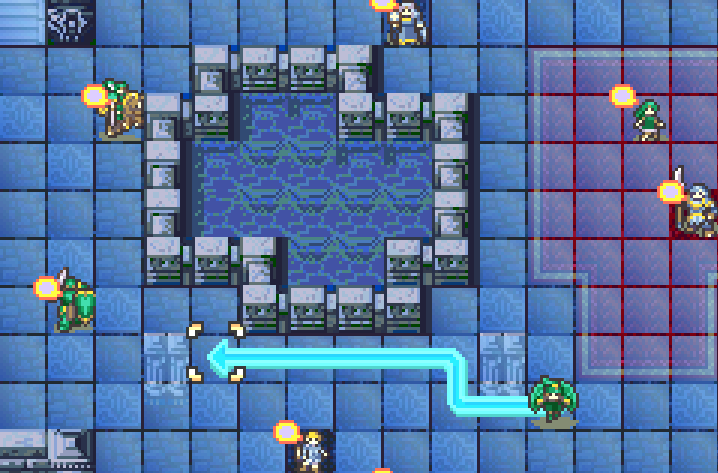
Of course, this is far from novel. It’s quite routine in, for example, an RPG, to have some sort of ‘home base’ you keep coming back to, where you can chat up your companions. They’re in just about every Bioware RPG from Neverwinter Nights on, for a start, if not earlier. I’m in two minds about these. I feel they do create pacing issues. I’ll use Dragon Age Inquisition for my example, but it’s far from alone; often you get your base and your opportunity to talk to your companions, but that winds up being… here, have 18 dialogue trees to exhaust, with them all helldumping their backstories onto you, their thoughts on the current situation… worthwhile in isolation, but taken on aggregate? You wound up getting lost in it. And, sure, they’d update eventually… so what does that mean, keep going back to check every time anything happens? I’ll do that for Sandra in Pyre, but nobody else… or, well, if I do, I’m checking boxes, not paying attention. My Trevelyan sleepwalked her way into fucking Josephine, but I can’t really say I remember at all who she was or what she was like, besides ‘polished’ and ‘available’. And this is all one thing in an RPG where talking to people is the main draw of the game, but in an FE, it’s really meant to be more of a garnish.
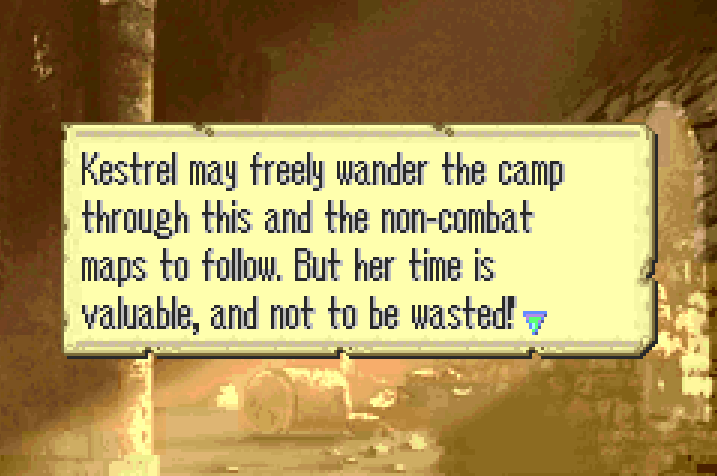
So the implementation is as follows:
- Every 2-3 chapters, you get a non-combat chapter with fairly short before/after scenes, generally the option of shopping, convoy access from a tent, and three Time Units.
- These TUs can be spent talking to any of the 9-10 other player units hanging around the map. Conversations are purely for flavour, but might affect later conversations down the track (for instance, if you were initially rude to Ulrike and follow on with that by harassing her about her dog’s name in 2x, she’ll give you the cold shoulder in 5x).
- There’s also generally neutral units who can be talked to to get a feeling for the lay of the land.
- Instead of one base camp, it’s set in wherever the player is. Random abandoned outpost for 2x, Rech Township for 5x… an actual base camp for 8x, and so on.
So three scenes in some level of detail, and if you don’t really care about picking the brains of your little minions, you don’t have to. And for the ones you do, hey, you get to express yourself through choice, prioritising the blorbos you most want to inhale. To which you will reasonably say: well, people will savestate to see them all anyway. To which I will say: that’s fine, but they can’t then blame me for pacing issues, and the absence of rewards takes any gamification out of it.
Curiously, menu bases might actually come back separately… though not really willingly, on my part. If they do, it would be very much stripped-down and stapled on in the aftermath, purely as a way to redeem support conversations. I don’t really want to do support conversations at all, but the base system as implemented hasn’t really left room for them otherwise and… unfortunately, Full Supports is just a really good marketing keyphrase. Homecoming’s reception has been extremely strong, but its link click downloads haven’t quite been doing the business as I’d hoped. Putting in the OP that most of the cast had just a handful of lines may have been a little too bold. If I can have there be on-map setup and then the conversations take place off the battlefield, that works out well. We’ll see what’s possible in a couple of years. If I run out of steam, that’s the first thing I’d want to sacrifice.
Misc
I’m becoming increasingly enamoured of breakable walls in indoor maps. Honestly, I think you’d see them more often if they weren’t really annoying to set up.
The early front-runner for ‘most Marmite character’ is Prii, a termagant you have the option to acquire in Chapter 8x. The second-favourite is… Traxhar, the mauler you have the option to recruit instead of Prii in Chapter 8x.
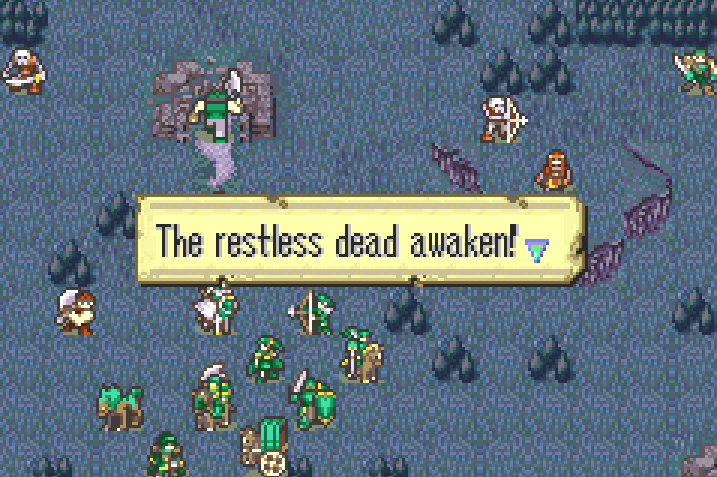
The recurring RPG mechanic where you rob a tomb and get loot at the cost of awakening enemy undead is cool. It’s past time it came to the GBAFE format.
Time for a transparent plug. Hey, did you know that there’s a bunch of custom campaigns on Backloggd (DoW and Do5 among them)? Well, there are. What’s Backloggd? It’s Letterboxd but for games. If you want to leave a review out in the wild, there is a place one can leave reviews.
Next Time: Act 1 Complete? Probably?