mm, this got away from me again, sorry.
Then the death has no narrative meaning or weight because it was spoiled, thus doing it was not pointful. As a writer, if you tell me that There’s A Monster At The End Of This Book*, and then there is, in fact, A Monster at the end of the book, congratulations, even a child can tell you that wasn’t interesting as a pay-off.
I have made this exact complaint multiple times in reference to one story whose author perpetually revealed this spoiler yet also called their game very serious; but last time I complained about how choosing to do this ruins the story, I got brigaded, so it goes un-named.
As a good contrasting example, look at Shadows of Valentia, where Lukas berates Alm into giving the other villagers a chance to prove their combat ability being important for them to learn how to fight. To at least let them get the last blow. This carries all the same notes without that problem.
For those who don’t know of this excellent children’s book;
the MONSTER at the end of this Book, starring LOVABLE, FURRY OLD GROVER (who, on this cover has his hand raised and is saying "Hello, everybodeee!" with a soft grin.)
(boilerplate title page, ie. copyright information, that it’s written by Jon Stone and illustrated by Mike Smollin, "This educational book was created in cooperation with Children’s Television Workshop, producers of SESAME STREET etc)
Grover: This is a very dull page. What is on the next page?
The rest of the book is 2 page spreads, w/ BIG MULTICOLOR TEXT, pink text, and normal text.
1-2:
Grover: WHAT DID THAT SAY?
Grover: On the first page, what did that say? Did that say there will be a Monster at the end of this book???
Grover: IT DID? Oh, I am so scared of Monsters!!!
(Grover stands aloof with hands raised in front of him.)
3-4:
Grover: SHHH Listen, I have an idea. If you doo not turn any pages, we will never get to the end of this book.
Grover: And that is good, because there is a Monster at the end of this book.
Grover: So please do not turn the page. (Yellow bubble, small text)
(Grover is presumably lying on the floor, holding a hand up to his face with one finger raised.)
5-6:
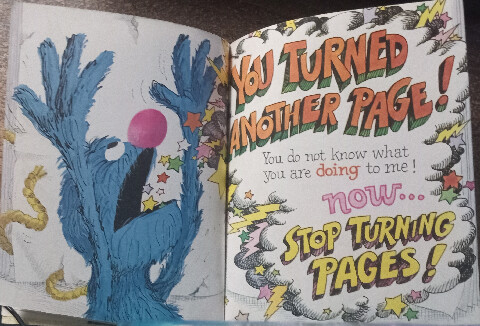
Grover: YOU TURNED THE PAGE!
(The entirety of the other page is dedicated to his over-exaggerated reaction.)
7-8:
Grover: Maybe you do not understand. You see, turning pages will bring us to the end of the book, and there is a Monster at the end of this book…
(Grover stands with his arms crossed in front of himself, holding rope that is binding around the pages in the background with all sorts of knots.)
Grover: … but this will stop you from turning pages. See? I am tying the pages together soo you cannot …
9-10, which I cannot describe adequately:
11-12:
Grover: There! I, Grover, am nailing this page to the next one so that you will not be able to turn it, and we will not get any closer to the Monster at the end of this book.
(Scattered around are various woodworking tools, particularly two saws, multiple rulers, brackets, and a box full of wooden planks. Grover is hammering nails into haphazardly placed boards against the ‘page’ background of the page, accompanied by a variety of sound effects: BONK BAM BING! KLONK BING BONK.
13-14:
(Grover has a hand up in the air and his other covering his face. The background pages are now torn, and there’s dust clouds all around.)
Grover: ALL RIGHT! ALL RIGHT! ALL RIGHT!
Grover: Do you know that every time you turn another page… you not only get us closer to the MONSTER at the end of this book, but you make a terrible mess!
(“A terrible mess” is in bubble letters blue text, not pink semi-bold like Monster is and has been.)
15-16:
Grover: This will stop you from turning pages. A heavy, thick, solid, strong brick wall. I would just like to see you TRY to turn this page.
(Below, there is, indeed, a brick wall, as well as a toolbox, water bucket, bin of mortar with a hoe at the bottom of it; on the other side Grover is holding a trowel and laying another brick on top of the wall - below is a brush and glue can as well as a rake, and a number of loose bricks.)
17-18:
(The turned page is significantly torn, the bricks ripping through it. The wall is now just a disheveled pile of bricks, with the bin, glue, hoe, rake all looking damaged and sticking out of this pile - as is Grover’s hand!
Grover: Do you know that you are very strong?
(Unlike other bubbles, this text is small where the bubble is very large, leaving a lot of white space.)
19-20:
Grover: The next page is the -end- of this book, and there is a MONSTER at the end of this book.
Grover: Oh, I am so SCARED!
(Grover stands in the middle, hands brought together in front of him.)
Grover: PLEASE do not turn the page.
Grover: PLEASE
Grover: PLEASE
Grover: PLEASE
21-22:
Grover: Well, look at that! This is the end of the book, and the only one here is …
ME
(This ‘me’ is complete with hearts and two little arrows, and is in a rounded font. Many of the other pieces of huge text have been in slightly pointy ones!)
Grover: I, lovable, furry old Grover, am the Monster at the end of this book.
Grover: And you were so SCARED!
(Behind Grover, who has his arms crossed daintily, almost hugging his shoulders, lies in big bold yellow, ‘THE END’, with the D cut off.
Grover: I told you and told you there was nothing to be afraid of.
23:
(Grover has his hands raised, covering his head and face somewhat.)
(Grover, thinking, in small font, “Oh, I am so embarrassed…”)
If spread 21-22 had instead been of some actual abomination disgusting creature, the whole book would be completely uninteresting and unmemorable. It would be boring: There is a scary monster and we are scared of it once we see it?
Horror stories use a very distinct methodology of making things feel scary, describing the oppression, terror, fear that is felt - and it is those descriptions of emotions that give these stories value. This doesn’t just apply to emotional parts of works, but it’s the same.
This has been done multiple times in the past and it’s actually incredibly boring and torturous because it doesn’t do anything except make you sit there while the AI is going at it for longer time for no direct reason.