It’s been 3 days and nobody has written a lengthy recommendation for the Hag in White. Frankly I’m disappointed. Time to fill that gap here. Now, then:
Tiresias (Hag in White)
When I play Fire Emblem, staff utility is an extended game of chicken. In games with reclassing and mixed offense like Fates and Engage, it’s a rush to get my staffers out of healing roles and into Malig Knight/Mage Knight as fast as humanly possible. And even in games where reclassing doesn’t exist or offensive magic and healing comes as a set, I find ways to minimize staff usage as much as I can.
My dislike of staffers comes from a few different places:
- It’s very difficult to differentiate staff units. The only stats that matter for staff utility are magic, staff rank, and movement, and sometimes those differences aren’t meaningful. Even a middling-magic staffer can coast off the high might of Mend, and high staff rank isn’t as impressive as it looks if status/positioning staves have poor availability.
- Staves are usually boring. They heal, higher rank staves heal more. The staves with powerful effects like the aforementioned status/positioning staves are often so restricted in availability that the player can almost never take advantage of having units with a high staff rank. Torch and Unlock are practical jokes on the hacker by taking up two precious item slots. Barrier is the most interesting one in the roster in my opinion, and I wish staff design leaned into that niche more.
- Combat is more satisfying than staffing. Combat will almost always give more exp per action than staffing, letting healers get outpaced in efficient play (and even non-efficient play!). For something more subjective, the feeling of training up a combat unit to the point of hitting one-round thresholds will always be better to me than ranking up in staves to heal an ally better.
It’s not impossible for me to like staff units - two of my favorite hack units are Wren Do5 and Avan TMGC - but my enjoyment of them is completely divorced from their staff utility. I had kind of resigned myself to that being the high water mark for staff units in hacks since coding new staff effects is difficult and few hackers want to experiment with hybrid staff classes.
Then Hag came around and smacked me across the face. “Oh, you find staffers boring and use them as little as possible in favor of offensive magic? Here’s Apate. Have fun!”
There’s a lot to say about Hag’s central conceit of one staff user, but this effortpost isn’t about Apate. This effortpost is about when it breaks that conceit.


Everyone, meet Tiresias. He shows up on turn 1 of Chapter 16 with stats like this. This is when the vast majority of your army should be promoted or right at level 20, by the way. His abysmal bases and ranks alongside Paragon and Discipline firmly place him as Hag’s Est.
And of course, there’s the elephant in the weapon ranks.
It cannot be overstated how much Tiresias’s presence greases your action economy. In earlier chapters if a unit got injured they’d have to rely on Apate for a bailout or chug a vulnerary. But Apate can’t be everywhere at once and vulneraries are weak and expensive, leading to many turns where I had to take a strong combat unit out of the action to heal themselves or cower in the backline queuing up for Apate’s service. Tiresias, at base, offers a free heal that’s stronger than a vulnerary (6 Mag + 7 mt from the Makeshift Rod) and doesn’t consume the target’s action. Technically this is what all staff units do, but it wasn’t until Tiresias (and Apate, obviously) that made me aware of just how much momentum they provide even when using basic heals.
A lot of Hag’s maps involve a split army, and the side without Apate is always going to be noticeably much sluggish than the one who can take advantage of her healing. Having Tiresias around to cover Apate’s blind spots, even if he is unilaterally worse than her, is so immensely useful and his presence in the roster is basically uncontested even for those that dislike raising Ests.
So that’s that, then. My feeling at seeing Tiresias and using him throughout the mid-lategame of Hag made me finally appreciate the importance of staff utility and how healing can be just as hype as combat in the right contexts. We can all go home now.
…
…
Oh, you thought I was done?
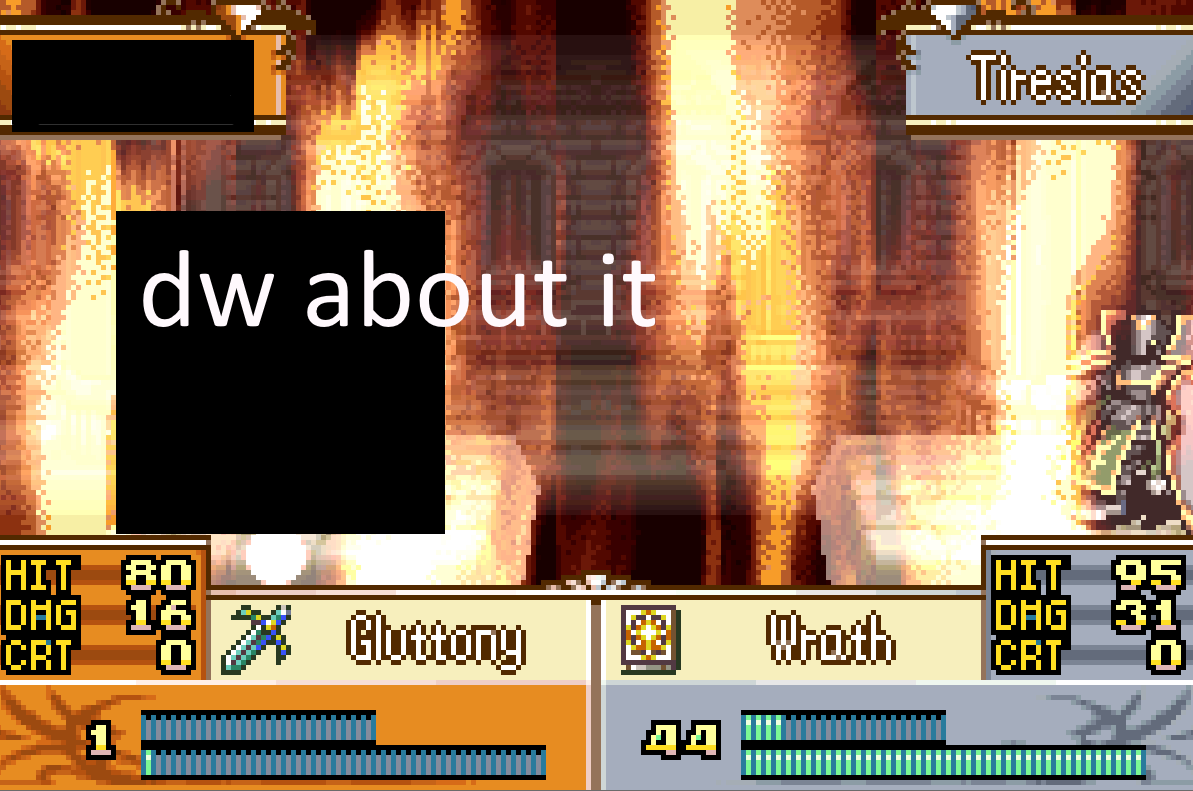
I’M JUST GETTING STARTED.
So, as much as I just praised the way Tiresias’s staff access provides him exclusive utility and how his presence is a godsend for the hack’s action economy, I also think it’s the least interesting thing about him.
Tiresias has a very unique stat spread. As an Est with Paragon, most of his oomph comes from his growths, which are unimpressive at a glance. 50% Magic and 45% Speed are high, but it will take a long time to grow out of his poor bases. 15% Resistance is outright horrendous, especially in a campaign like Hag’s where enemy magic users are extremely common. 35% Strength and 30% Defense are, while low in absolute terms, very high for what’s supposed to be a magical unit. His 0% Skill growth speaks for itself.
These odd growths interact with his class set in interesting ways. He can promote to either Bishop or General: Bishop grants +1 movement, crit boost, and a lot of Light and Staff exp; General grants Reposition, Canto+, Lance and Axe access, and enormous bonuses to physical stats. There are so many benefits and drawbacks to each choice with different ways to patch up their weaknesses and optimize their strengths.
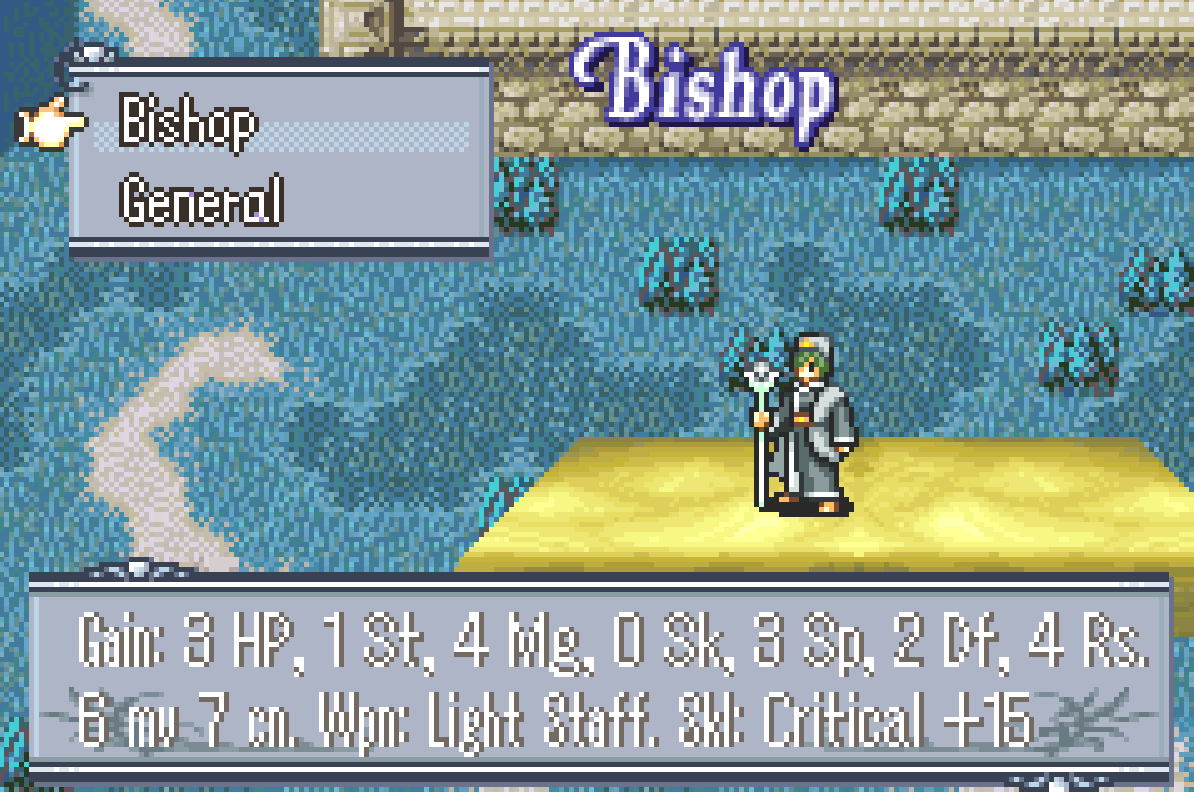
Let’s start with Bishop. Bishop is the more traditional of the two choices, doubling down on Tiresias’s staff utility. He gains a huge boost to magic, allowing him to heal more even with the Makeshift Rod or Heal, and the extra point of movement lets him maneuver adjacent to allies to heal them more easily.
The main weakness of Bishop is its lack of offense. 4 magic on promo, while amazing on paper, isn’t quite enough to make up for the low might of Light tomes. +15 crit, similarly, isn’t accomplishing much with 0 skill.
However, there are ways to patch up this weakness in offense. High-ranked Light magic has innate crit and Tiresias’s Dark affinity gives 2.5 crit per level, so he can crit stack with support partners while lacking any skill.
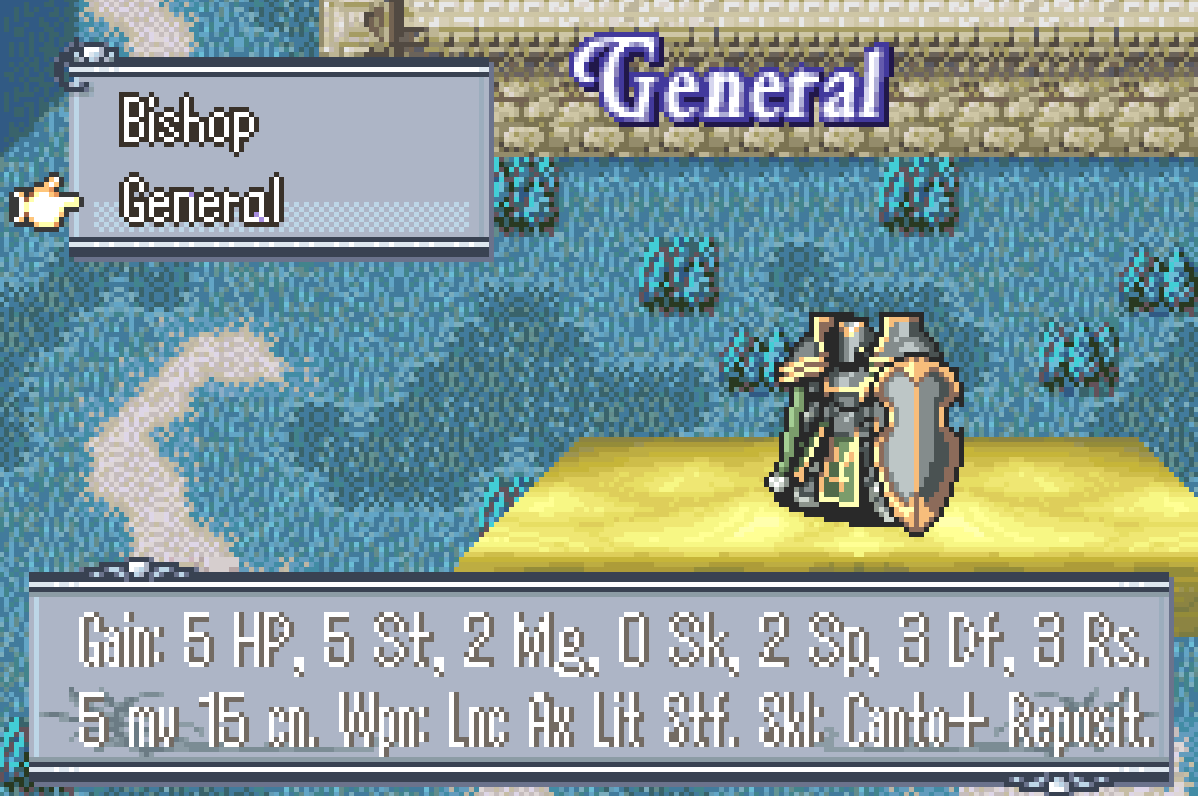
Then there’s General. General is monstrous. The boosts to physical stats turn him into a reliable frontliner and gaining access to new weapon types lets him cast off the shackles of Light magic. Canto+ and Reposition open up another dimension of movement for him while keeping the low movement identity of the class.
Despite all these shiny new toys, General has weaknesses that Bishop lacks. 5 movement hurts, especially when he has to get adjacent to an ally to heal them, and less magic and staff rank on promo means he’ll be worse at it than if he took Bishop. The addition of new weapon types also means that Tiresias no longer has the crutch of Light’s sky-high hit rates.
But just like there are ways to fix Bishop’s lacking offense, you can fix General’s horrid hit rates. Tiresias comes with a pre-built A support with a unit named Wulfric. Both of their affinities provide hit, so Tiresias can gain +15 hit just by being within 3 spaces of Wulfric. Wulfric is also an excellent unit in his own right who excels at being on the front lines, which synergizes even better with this choice of promotion for Tiresias.
Hm. A pre-built support, huh?
I’m going to close this writeup with praising Tiresias’s characterization, as I find it just as exceptional as his gameplay.
Even though Tiresias is recruited at the start of Chapter 16, he’s been present in the story for a good while by that point, albeit in a background role. He first appears in a cutscene in Chapter 5 and several aspects of his character become apparent almost immediately.

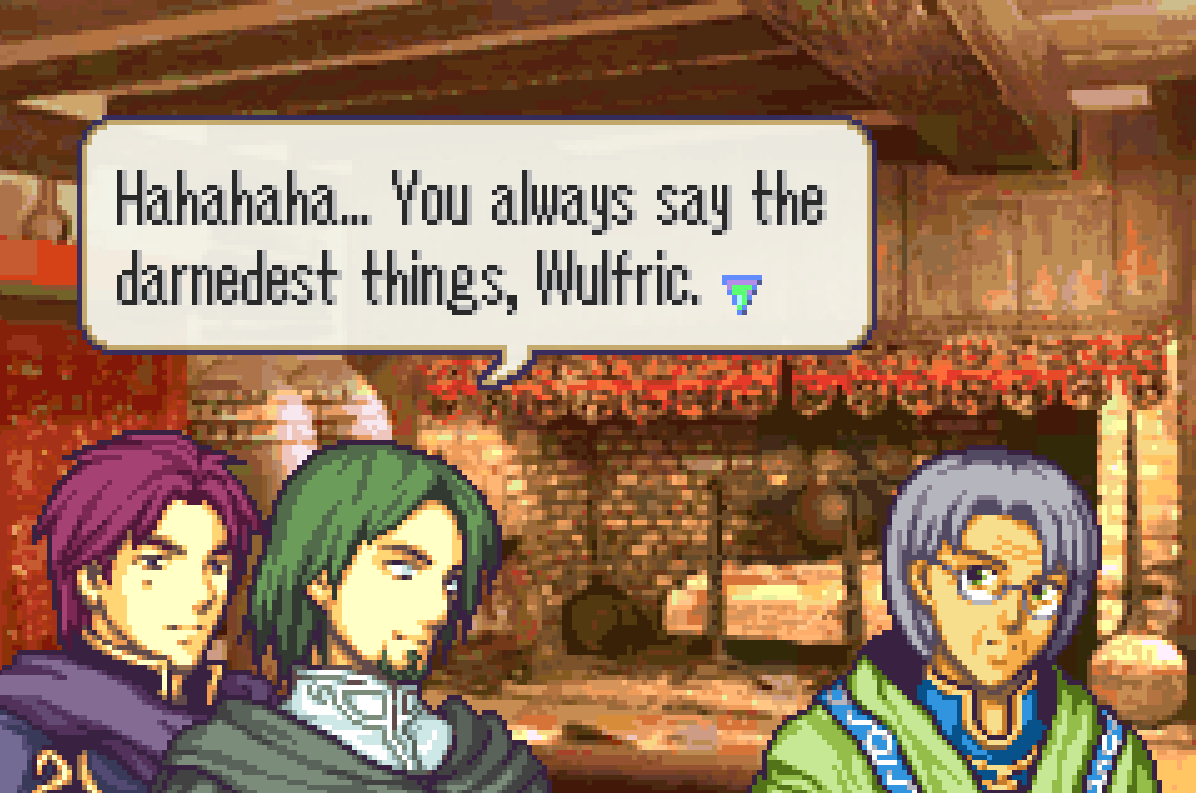


First of all, he’s blind! Disabled characters are a rarity in Fire Emblem, and including visible disabilities in hacks is especially difficult due to unique asset requirements. Tiresias can luckily share the standard Bishop animations, but his blindness is excellently shown in his portrait’s lack of pupils (and 0 skill as a unit! I love ludonarrative consonance). His blindness is handled deftly within the narrative as well: in this one introductory cutscene he’s shown to rely on Wulfric to help him navigate his surroundings via touch, a routine Wulfric seems intimately familiar with.
Second of all, he’s gay! Yeah there’s no beating around the bush that Tiresias and Wulfric are in a romantic relationship with each other. They’ve been together for some time now by the start of Hag’s story (represented by their pre-built A support) and consistently characterized as extremely devoted to each other. Rubenio lampshades this a bit with Tiresias’s line in the convo, but I believe it coming from Wulfric.
I’m not going to harp on this too much, but having gay disabled representation in hacks is extremely meaningful to me. I adore Tiresias and Wulfric dearly and every interaction between them is so wonderfully written. I did cry when writing this, you all should know.
Even outside of his blindness and relationship with Wulfric, Tiresias is an extremely strong character. Wulfric is recruited into the player’s army in Chapter 7 while Tiresias hangs back at the base camp. He’ll have something new to say every chapter, sometimes reminiscing with Wulfric, sometimes furthering his research into Light magic, and sometimes enthusiastically discussing the finer details of weaponry with the blacksmith Hestia.
Underlying each of these interactions is a deep sense of tranquility, curiosity, and zest for life. The world of Hag is deeply melancholy: Tartaros is oppressed by a corrupt theocracy, Glamorgan is ruled by scheming margraves, and the little guys are just trying to get through each day one at a time. Nothing about the world is romantic to its inhabitants. Even the more outwardly chipper members of the army have a wrinkle to their happiness: Vasiliki fakes her optimism, Kairos masks his crisis of faith, Delilah delights in cruelty, and Alonso and Polonius retreat into a larger-than-life character. But sincere optimism pours out of Tiresias’s mouth in every conversation, and that optimism stands out like a shining beacon.
Hence why Tiresias choosing to join the army at the lowest point in the story is such an effective choice. I won’t spoil the details here, but up until this point Tiresias had wanted to join the fight but acquiesced to everyone else’s requests that he stay safe at camp. Him finally choosing to take a stand marks a tonal turning point in Hag, and I think it works wonders.
I’ve spoken long enough about Hag without a call to action. If you haven’t played it yet, play it. No matter what your taste in hacks is, if you like hacks you’re going to like Hag. Thank you so much for reading.