There is a concept that shows up every now and again, particularly in pedagogy, called the ‘deficit discourse’. This is when a discussion around a certain topic centres solely on negatives, which despite the best of intentions can entrench a narrative that views such and such a group or demographic as being solely defined by the (usually very real!) issues that beset them. At worst, this can foster a ‘white saviour’ narrative (or wealthy, or in some way privileged) or enable a learned helplessness in the community in question.
For instance, there’s opposition within the Aboriginal Australian community (by no means unanimous, I should stress, and probably not even a majority - but I had Aboriginal convenors in university who were influential to my own thinking in the matter) to the long-running ‘Close the Gap’ initiative, which has been policy since at least the Kevin Rudd years. This has focused on the genuinely appalling gaps in health outcomes between indigenous Australians and other groups, and so aims to ‘close the gap’ in these metrics (such as life expectancy). While the gap is very much real and closing it should be a national priority – nobody is suggesting ignoring the disparity! – the national conversation around Indigenous people, by now a small minority in their own land, is excessively centred around this deficit in outcomes and leaves little room for narratives of Aboriginal excellence or culture. Well-intentioned chardonnay socialists are prone to writing off Aboriginal Australians as an already-lost cause, rather than as people facing systemic injustice (while of course, those without even good intentions simply feel they have their suspicions confirmed time and again by the media). An unfortunate consequence of this has been the recent referendum for a Voice in Australia, which in the interests of brevity I will summarise as a complete shitshow. An American example might be the ‘No Child Left Behind’ policy, infamous for its negative impact on the children it was theoretically supposed to benefit most.
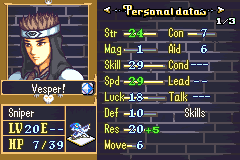
With all this in mind: Vesper from Shackled Power is not a very good unit.
She was a late addition to the campaign, added because there were only two unpromoted bow units and one joined relatively late. With one of them being Strength-focused archer Lou and the other being the Speed-focused nomad Lilim, Vesper slides uneasily into the position of being the, uh, Resistance-focused one. She has a marginal skill lead, but Lou has more than enough to hit everything. And this isn’t some situation where classes are completely irrelevant; SP has class-specific promotion items, and it takes a while for the second Orion’s Bolt to arrive, let alone the third (if it even exists, I don’t recall). She makes up for these deficits by having inferior promotion gains to either of the other two, and inferior caps compared to the other Sniper.
This extends to her story relevance. Lou is one of a trio of town militia who get sporadic acknowledgement through the game, and the final map quotes even have a minor conditional for if they’re all deployed. Lilim is a significant secondary character and your main link to a relevant city-state, and a significant antagonist that comes with it; her character arc is a key part of the midgame, with significant mandatory plot scenes devoted to its setup and payoff. Vesper shows up in a yellow house.
Nevertheless.
There are plenty of things Vesper can do.
There was an issue in Shackled Power’s original cast, and Vesper does help solve it. If you aren’t using Lou, hell, someone’s got to lug these bows around. Shackled Power has a reputation for a deployment crunch, but I’d say this is more of an issue when late-midgame prepromotes start coming in; early on, there’s plenty of room to just have Vesper around on the fringes.
And she can do a job, too. Vesper’s bases are more than respectable, outside the clear weak point of atrocious defence. She hard-counters two enemy types: fliers (she’s strong enough to swat pegasi, she’s easily fast enough to double wyverns) and magi (her speed and resistance are high, even without factoring the longbow in). SP has plenty of both of these enemies, ones which pack a punch, and almost no ‘mixed tank’ units to fire and forget. She even starts near a couple of magi she can trivially kill, and on a map with a large contingent of fliers that includes the boss.
And that can be all, but if you take a shine to her? She joins with lowish bases, but
a low level to go with it; sure, that sounds bad, but it means she levels quickly even if you’re making no real effort to train her. Given some love, and a bit – okay, a lot of luck (I can’t imagine the average Vesper caps strength and speed at 18/17; mine only had one Energy Ring and Talisman!) – Vesper’s more than capable of hanging with the team for the long-term. Even if she doesn’t truly pop off, her strong points remain in place and remain valuable, as lategame has a lot of place for fly-swatting; unpromoted enemies pack a punch if left unattended but can be brought down even by B-listers like a neglected Vesper. And, while SP merely has vanilla longbows, they’re still immensely useful in a lot of positions.
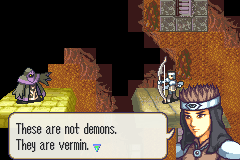
Further, while she may not have the continued plot relevance of Lou or Lilim, this doesn’t stop her from having a memorable recruitment and a clearly defined personality. You probably hear about her before you see her; someone in a red village asks you to check out the graveyard, and because it’s the daytime, the gravekeepers are probably asleep, so gives you a Restore staff to wake them up. It’s a cute joke that, fortunately, doesn’t need to be played out mechanically; you need only visit her house in the graveyard. Vesper, the gravekeeper, grumbles about how this fighting is costing her valuable sleep and says she’ll help you drive off the filth.
That’s pretty much it for her forced lines, but the game doesn’t forget about her, either. Being a gravekeeper, Vesper believes the dead should stay in the ground, where they belong; the next few chapters do have you squaring off against undead a couple of times. She has boss quotes with the early undead bosses you face where she outlines her beliefs. It isn’t just a straightforward matter of hating walking corpses on principle; she resents having to defile the corpses by sticking arrows in them, and reserves her hatred for the source of their reanimation.
And of course, she has supports.
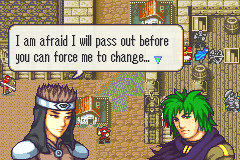
She’s portrayed as… well, it’s clear enough that she isn’t exactly used to talking to people. Furthermore, used to the literal graveyard shift, she’s ill-tempered due to the hours she’s now forced to keep. She’s suspicious of people (doesn’t trust Orville as a turncoat, doesn’t trust nobility to respect people like Lou…) and overall very standoffish, but does display a playful side, which makes her, well, more interesting to listen to, and leaves some room for interpretation (is she genuinely blind to Cyrus’ flirtation, or just ignoring it to fuck with him while keeping him around for his utility?). She’s a pretty straightforward character in a cast with a few genuine standouts, but you want someone like Vesper to be pretty ‘straightforward’, with a few consistent elements. She doesn’t have time or space for the emotional arcs of the main cast, and SP knows better than to pretend she will.
In any tier list, Vesper is probably circling the drain, but she’s still worth a dozen Sophias; hell, she’s comfortably better than all nine capital-A Archers from FE5-10. When you make your campaign, someone will inevitably be propping up the tier list for you, too. But that doesn’t mean you should give up on them. Give them something to be good at. Give them a solid, consistent character to refer back to. Give them a connection to the greater story. Make sure, ultimately, that someone could come back years later and write an effortpost about them.